HighEfficiency Appliances 2026 Guide & Data
Compare appliance purchase, installation, label energy, local utility rates, capacity, service, repair, and residual value with a transparent low/base/high lifecycle worksheet.
Quick Checks
- 1Compare exact model numbers and label kWh, not marketing families.
- 2Reprice standardized label energy with your marginal utility rate and realistic use.
- 3Treat capacity, installation, repair access, and service as part of efficiency.
The Short Answer
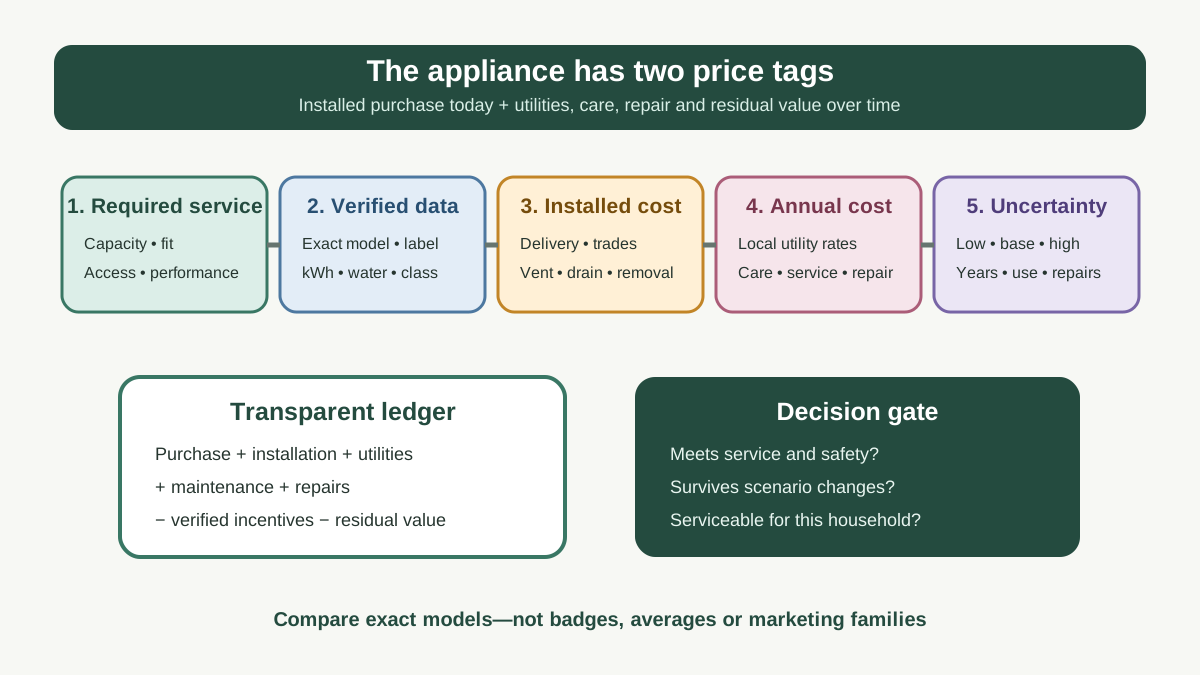
Short Answer: Buy the appliance that delivers the required service at the lowest credible life-cycle cost—not automatically the cheapest model or the one with the biggest efficiency claim. Compare exact model numbers, capacity, the yellow EnergyGuide estimate where applicable, ENERGY STAR certification, your electricity and water prices, installation, expected use, maintenance, repair access, and residual value. Run low, base, and high scenarios because operating cost and product life are uncertain.
An efficient model can be a sound upgrade, but efficiency does not rescue a poor fit, unsafe installation, unwanted feature, weak service network, or capacity that forces extra cycles. Preserve your assumptions so the decision can be audited later.
The Appliance Life-Cycle Ledger
Create one row per exact model:
| Input | Model A | Model B | Model C |
|---|---|---|---|
| Exact model number | |||
| Usable capacity / required service | |||
| Purchase and delivery | |||
| Installation and modifications | |||
| EnergyGuide kWh/year | |||
| Water per cycle or annual water | |||
| Local electricity and water/sewer rates | |||
| Expected cycles or operating pattern | |||
| Annual filters, cleaning, consumables | |||
| Repair allowance and service access | |||
| Low/base/high ownership period | |||
| Residual or disposal value | |||
| Total low/base/high cost |
Keep comfort and performance requirements beside the ledger: noise, cycle time, loading height, door swing, controls, venting, drainage, temperature stability, available power, and accessibility. The cheapest column is not the winner if it cannot do the job.
EnergyGuide and ENERGY STAR Answer Different Questions
The FTC describes EnergyGuide as the yellow label that shows how much energy an appliance uses and how it compares with similar models. Its estimated operating cost uses standardized assumptions and an average energy price. The FTC explicitly notes that your cost depends on local price and how you use the appliance.
Use the label to capture:
- exact model or product family covered;
- estimated annual electricity use in kWh;
- the comparison range and product class;
- capacity or configuration;
- the assumed energy price and estimated annual cost;
- additional fuel information when applicable.
ENERGY STAR is a voluntary efficiency certification administered by the U.S. EPA. Products earn it by meeting the applicable specification and certification requirements. The mark helps screen models, while the model-specific label data helps quantify a comparison. Neither is a durability warranty or a guarantee of savings in your home.
Do not compare products from unlike classes using the position of the arrow alone. A large refrigerator and a smaller refrigerator, a compact dishwasher and standard dishwasher, or a vented and heat-pump dryer may deliver different service. Normalize only after confirming that each candidate meets the same capacity and functional requirement.
Reprice the Label With Your Utility Rates
Start with annual kWh, not the printed annual dollars:
Annual electricity cost = label kWh/year × marginal electricity price
If Model A lists 410 kWh/year and the relevant electricity price is $0.19/kWh:
410 × $0.19 = $77.90/year
If Model B lists 315 kWh/year:
315 × $0.19 = $59.85/year
The annual difference is $18.05 under those inputs. A $250 purchase premium would not be recovered quickly by electricity alone. That does not make Model B wrong; it means the decision may depend on water, capacity, noise, features, service, expected ownership, incentives, or a different local rate.
Use the marginal rate that changes when consumption changes. A bill's total divided by kWh may include fixed customer charges that do not disappear when an appliance saves energy. For time-of-use pricing, estimate the share of operation in each period. Refrigerators operate across all periods, while a dishwasher or laundry cycle may be scheduled.
For gas, propane, or another fuel, keep units consistent. Do not compare a gas annual-cost figure with electric kWh without carrying fuel price, efficiency, and fixed-charge implications explicitly.
Add Water and Water-Heating Cost
Dishwashers and clothes washers affect both water and the energy used to heat water. If model data provides gallons per cycle:
Annual water = gallons/cycle × cycles/year
Then price water and sewer using the local marginal rates. If the bill uses blocks, use the block likely affected by the change. Water-heating energy depends on inlet temperature, selected cycle, heater type, hot-water share, and efficiency; keep it as a separate transparent estimate.
Example worksheet, using illustrative inputs:
- difference: 3.0 gallons/cycle;
- use: 220 cycles/year;
- annual difference: 660 gallons;
- combined marginal water/sewer price: $0.015/gallon;
- water/sewer difference: $9.90/year.
Do not copy that rate. Local rates vary widely and often include fixed charges. The example only shows the arithmetic.
ENERGY STAR's current dishwasher guidance emphasizes capacity and notes that compact models can use more energy over time if their smaller capacity requires more loads. This is a good example of why per-cycle efficiency and household service must be evaluated together.
Installed Cost Is More Than the Register Price
Record every cost required to place the appliance into safe, compliant service:
- delivery, stairs, elevator booking, and removal of doors or railings;
- old-unit haul-away and refrigerant handling where relevant;
- required electrical circuit, receptacle, disconnect, gas connection, vent, drain, pan, or shutoff;
- cabinet, counter, floor, door-swing, or ventilation changes;
- stacking kit, pedestal, bracket, anti-tip device, or hoses specified for the model;
- permit or qualified trade work where required;
- first filters, drain accessories, or conversion parts;
- repair of damage discovered after the old unit is removed.
Measure the route and final opening. Width alone is insufficient: record height, depth, hinge clearance, handles, ventilation clearances, hose bends, service access, and door swing. Confirm that water valves close, the drain is usable, the vent is clean and compatible, and the electrical nameplate matches the supply.
Do not budget an unsafe shortcut. Extension cords, plug adapters, improvised dryer ducts, defeated anti-tip hardware, unsupported countertops, and unapproved gas or electrical changes are not efficiency measures.
Match Capacity to Actual Use
Larger capacity may reduce cycle count for a large household, or it may add purchase cost and energy for space never used. Define the required service with evidence:
- refrigerator: measured storage needs, door openings, freezer mix, ice use, and installation temperature;
- dishwasher: place settings per typical day, cookware shape, cycle frequency, and ability to run full loads;
- washer: dry laundry weight or representative loads, bulky items, accessibility, and available hot/cold supply;
- dryer: washer extraction performance, matching drum capacity, vent condition, and moisture-sensing behavior;
- cooking: cookware compatibility, circuit capacity, ventilation, controls, and actual cooking pattern.
Capacity and configuration influence the applicable efficiency standard and comparison group. ENERGY STAR's refrigerator criteria, for example, distinguish product configurations and features. Compare a top-freezer model with another model that truly meets the household's requirement, not with an oversized feature-heavy product merely because both are refrigerators.
Category Worksheet: Refrigerators and Freezers
Refrigeration runs continuously, making label kWh important, but real operation also reflects ambient temperature, clearances, seals, controls, defrost, loading, and door opening.
Before replacing:
- Photograph model/serial and EnergyGuide data.
- Measure cabinet and ventilation clearances.
- Confirm internal temperatures with a suitable thermometer.
- Clean accessible condenser areas as instructed.
- Inspect gaskets, doors, frost pattern, fans, and unusual noise safely.
- Price the diagnosis, food-risk plan, delivery, installation, and responsible disposal.
ENERGY STAR's current criteria compare measured energy with federal minimum standards by configuration. Certification does not mean every larger or feature-rich certified model uses fewer kWh than every smaller standard model. Use the exact Product Finder entry and label.
If the existing unit has a fault, start with diagnosis rather than a generic age cutoff. Use the refrigerator repair-versus-replace worksheet and the not-cooling diagnostic.
Category Worksheet: Dishwashers
Record annual kWh, water per cycle, capacity, cycle options, drying method, filter type, rack fit, noise, leak protection, and service access. ENERGY STAR notes that soil sensors can adjust a cycle and that standard and compact capacity differ. A compact machine may be right for the opening, but two frequent loads can erase a per-cycle advantage.
Run the purchase decision with realistic cycles per year. Include household water and sewer rates and the effect of pre-rinsing. ENERGY STAR advises scraping rather than rinsing and running full loads. Do not assume a premium cycle or heated dry is represented by your normal-use estimate if you plan to use it every time.
Verify drain-loop, supply, electrical, cabinet, floor, and leak-protection requirements. Compare a repair quote with the dishwasher repair-versus-replace worksheet.
Category Worksheet: Clothes Washers
For a washer, compare annual energy, integrated water information where available, usable capacity, cycle length, spin extraction, detergent requirements, vibration, door and lid access, and service. A washer that removes more water can reduce dryer work, but quantify the combined laundry pair rather than assigning a generic percentage.
Document representative weekly loads: everyday, towels, bedding, delicates, and bulky items. Check whether the chosen model can be installed level on the actual floor and whether hoses, standpipe, valves, drain flow, and required clearances are sound. Front-load ownership also requires gasket, dispenser, door, and cleaning practices appropriate to the manual.
If the current machine leaks, smells, or will not drain, diagnose the failure before treating inefficiency as the cause. Use the washing-machine repair-versus-replace worksheet.
Category Worksheet: Clothes Dryers
Compare the washer and dryer as one moisture-removal system. Record annual energy, fuel, moisture sensing, capacity, venting or condensate requirements, cycle time, ambient-space effects, sound, and maintenance.
A vented dryer needs a short, smooth, code-compliant exhaust path maintained free of lint and obstruction. A heat-pump dryer changes the boundary: it may be ventless and can use less electricity, but cycle time, condensate drainage, filter/heat-exchanger care, room temperature, capacity, and service availability matter. Price any electrical or drain work.
Use the model-specific heat-pump versus vented dryer guide rather than copying a universal savings percentage.
Smart Features Need a Service Case
ENERGY STAR describes useful connected features such as door-open alerts, scheduling around electricity rates, and dryer sensing. Decide whether each feature solves a real problem.
For every connected model, ask:
- Does core operation work without an account or internet connection?
- What data leaves the home and for what purpose?
- How long are security and app updates supported?
- Can schedules be set locally?
- Does a utility demand-response program change control, compensation, or privacy?
- What happens if the cloud service ends?
- Is standby energy included in the applicable label procedure?
Do not purchase an appliance solely because an app implies efficiency. Scheduling can move cost under time-varying rates, but it does not necessarily reduce kWh. A door alert can prevent waste if it is acted upon. Keep benefit claims tied to the household's actual use.
Repairability, Service, and Reliability
Public efficiency labels do not predict the cost of every future repair. Build a practical service check:
- local authorized and independent service availability;
- warranty term, exclusions, labour, travel, and diagnostic charges;
- parts diagrams and likely lead times;
- ability to clean filters, coils, pumps, traps, and gaskets;
- access without removing cabinets or stacked equipment;
- whether a single failed connected control disables basic operation;
- evidence from the current model family, not anecdotes about a different generation.
Use low/base/high repair allowances rather than declaring one technology universally more reliable. Keep an emergency allowance for food loss, laundromat use, dishes, temporary equipment, or expedited service where relevant.
Check the exact model and serial against CPSC recall information at purchase and periodically afterward. Registering the product can help manufacturers reach owners, but retain your own model, serial, receipt, installation, and service records.
Build Low, Base, and High Scenarios
Use the same equation for every candidate:
Life-cycle cost = installed purchase + utilities + maintenance + repairs − incentives − residual value
Avoid false precision. Vary the assumptions that can reverse the decision:
| Assumption | Low case | Base case | High case |
|---|---|---|---|
| Ownership years | 5 | 8 | 12 |
| Electricity price | current lower tier | expected marginal | stress case |
| Cycles / operating load | low use | measured normal | high use |
| Repair allowance | routine only | one plausible repair | major-service stress |
| Installation | direct fit | minor work | electrical/cabinet work |
| Residual value | higher | modest | zero / disposal cost |
Do not inflate future energy prices merely to justify a premium. Show the crossover price or use level instead.
Separate Replacement Cost From Upgrade Cost
When an old appliance has failed, the decision is not “spend the full price of the efficient model or spend nothing.” A basic replacement is already required. Compare the incremental installed premium for the higher-efficiency candidate with its incremental operating and service differences.
Suppose a compliant base replacement costs $950 installed and a higher-efficiency candidate costs $1,180 installed. The upgrade premium is $230, not $1,180. If the existing appliance is still serviceable, however, the full near-term replacement cost and the remaining value of the old unit belong in the decision. Keep these cases separate.
Use this replacement bridge:
| Question | Evidence |
|---|---|
| Is replacement mandatory now? | diagnosis, safety notice, failed part, lease/renovation requirement |
| Cost to restore current unit | written diagnosis, parts, labour, warranty |
| Cost of basic adequate replacement | exact model, delivery, installation, removal |
| Cost of efficient adequate replacement | exact model, same installed boundary |
| Incremental premium | efficient total minus basic total |
| Incremental annual difference | utilities, maintenance, consumables, service |
| Non-financial difference | noise, capacity, accessibility, resilience, time |
This prevents a common error: comparing an efficient product's complete installed price with only the repair part for the existing product, or comparing a repair invoice with an uninstalled shelf price.
Check the Household System Around the Appliance
An appliance can shift energy or moisture elsewhere. Include these interactions when they are material:
- washer extraction changes dryer work;
- dishwasher and washer cycles draw from the water heater;
- vented dryers exhaust conditioned indoor air and require replacement air;
- heat-pump dryers and water heaters exchange heat with the surrounding room;
- refrigerators release condenser heat into the kitchen or enclosure;
- cooking choices affect ventilation and space-conditioning loads;
- time scheduling can shift cost or peak demand without changing total energy.
Do not assign a generic system credit. Measure or model the interaction and show it as a separate line so it can be removed during sensitivity testing. If a heat-pump appliance cools a small utility room, confirm the manufacturer's ambient-temperature and clearance requirements and consider the building's heating season. If a vented appliance has a damaged exhaust path, repair that safety and performance defect before using old bills as the baseline.
Keep an Evidence Packet
Save the label, Product Finder record, quote, model and serial, installation instructions, receipt, rebate terms, commissioning result, and first month of operating observations. Photograph clearances, hoses, ducts, drains, brackets, shutoffs, and the electrical nameplate without opening energized equipment.
After 30 and 90 days, compare actual cycle patterns, utility intervals where useful, noise, temperature, moisture, cleaning burden, and error history with the purchase assumptions. A short post-purchase review improves future decisions and creates a defensible warranty record if performance is not as represented.
Break-even premium
If Model B saves an estimated $42/year in combined electricity and water and has the same non-utility costs, an extra $300 installed premium has a simple undiscounted break-even of:
$300 ÷ $42/year = 7.1 years
Then stress test it. At $25/year, break-even is 12 years. At $65/year, it is 4.6 years. Add differences in maintenance, repair, and residual value before making the final call. This simple calculation is not a warranty of lifespan or savings.
For large costs or long periods, a net-present-value calculation can discount future cash flows. State the discount rate and keep a simple undiscounted view beside it so readers can see what drives the answer.
Incentives and Claims Verification
Treat rebates as zero until the exact model, purchaser, address, installation date, contractor, documentation, and funding status are confirmed. ENERGY STAR's Product Finder and rebate tools can help locate possibilities; the program administrator controls eligibility.
Capture:
- program name and official URL;
- qualifying model list or efficiency requirement;
- purchase and installation window;
- pre-approval requirement;
- required invoice, serial, recycling, or contractor documents;
- tax treatment and funding limits;
- application deadline and expected payment timing.
Do not let a salesperson's estimate replace written terms. Keep screenshots or PDFs dated to the decision and confirm again before purchase.
A Store and Quote Checklist
Bring a one-page specification, not just a budget:
- exact opening and delivery-route measurements;
- required capacity and configuration;
- available electrical, water, drain, vent, and gas connections;
- three comparable exact model numbers;
- EnergyGuide and Product Finder records;
- written installed price and exclusions;
- return policy for fit problems;
- warranty and local service contacts;
- required accessories and consumables;
- recall check;
- low/base/high life-cycle ledger.
Photograph labels and nameplates. Marketing names can cover several models with different capacity, energy, voltage, or features. Make the invoice name the exact unit.
Frequently Asked Questions
Is ENERGY STAR always worth paying more for?
Not automatically. ENERGY STAR certification is a valuable efficiency screen, but the acceptable premium depends on exact model energy, your rates and use, installation, capacity, service, incentives, and ownership period.
Is the EnergyGuide annual cost my expected bill?
No. The FTC explains that it is an estimate based on typical use and an average energy price. Recalculate annual kWh with your applicable rate and realistic usage.
Should I always buy an inverter appliance?
No. Variable-speed control can offer performance benefits in appropriate products, but the word “inverter” alone does not establish annual kWh, durability, fit, or value. Compare the exact label and service package.
Does a larger appliance save energy by running fewer cycles?
Sometimes, but not as a universal rule. Match capacity to representative loads and compare annual label data plus actual cycle frequency. An oversized product can add unused volume and cost.
How should I compare gas and electric appliances?
Define the same service, carry fuel and electricity in consistent annual costs, include fixed-charge changes only when they truly change, and include venting, electrical, indoor-air, installation, and maintenance differences.
Should I replace a working appliance to save energy?
Calculate the incremental annual utility reduction, installed replacement cost, remaining service value, repair condition, and disposal. A working appliance with modest use may not justify immediate replacement on energy alone.
How do I include uncertainty about lifespan?
Run multiple ownership periods and repair cases. Avoid selecting one assumed lifespan that conveniently produces the desired answer.
What to Read Next
Apply the ledger to a refrigerator repair-versus-replace decision, compare heat-pump and vented dryers, price a dishwasher diagnosis and replacement, or work through the washing-machine repair-versus-replace worksheet.
Sources and Verification
Label interpretation and operating-cost limits use the FTC EnergyGuide explanation. Current certification and model data should be checked through the ENERGY STAR Product Finder and its explanation of how products earn the label. Category guidance comes from the official ENERGY STAR pages for dishwashers, clothes washers, and clothes dryers. Recall status must be verified by exact model and serial through CPSC. Exact labels, manuals, utility rates, installation conditions, warranties, and program rules control a household decision.
About the Editorial Team EnergyBS reviews public program rules, product specifications, utility rates, and reader-facing cost assumptions. Treat savings figures as estimates until you verify local prices, permits, rebates, and contractor quotes.
Sources and Verification
Editorial Review
EnergyBS Editorial Team
EnergyBS publishes practical homeowner guides. Important program, product, and cost claims should be checked against the linked source and local project documents before you commit to work.
Related Guides
View All ArticlesRefrigerator Repair vs. Replace 2026 Tool (Guide & Data)
A diagnosisfirst refrigerator repairversusreplace worksheet that compares the full installed decision, EnergyGuide operating cost, foodloss risk, warranties, fit, serviceability, and responsible disposal.
Heat Pump Dryer vs Vented Dryer 2026 Tool (Guide & Data)
A householdspecific comparison of heatpump, vented electric, and gas dryers using model energy data, laundry volume, utility rates, cycle time, drainage, room conditions, vent cost, maintenance, and clothing care.
Dishwasher Repair or Replace? A Cost, Energy, and
A diagnosisfirst dishwasher repairversusreplace worksheet covering fixed repair scope, age and condition, model energy and water, installed replacement cost, racks and cycle fit, drying, noise, leak protection, warranty, and disposal.