ICF Walls: The practical Thermal Envelope 2026 Tool
Insulating Concrete Forms (ICF) create a wall that is R25, airtight, and tornadoproof. Why wood framing is obsolete for highperformance homes.
Beyond the Stick-Frame: The Rise of Monolithic Envelopes
Short Answer: Insulating Concrete Forms (ICF) create a wall that is R-25, airtight, and tornado-proof. Why wood framing is obsolete for high-performance homes.
Most houses are built with 2x4 or 2x6 softwood "sticks" and filled with fiberglass fluff. This is 19th-century technology attempting to solve 21st-century energy problems. It leaks air through thousands of staple holes, it burns readily, it rots when damp, and it offers minimal protection against extreme weather.
Insulating Concrete Forms (ICF) represent a major change in building science. Instead of assembling a wall from hundreds of small parts, ICF creates a monolithic concrete structure that is simultaneously your structure, your insulation, and your air barrier.
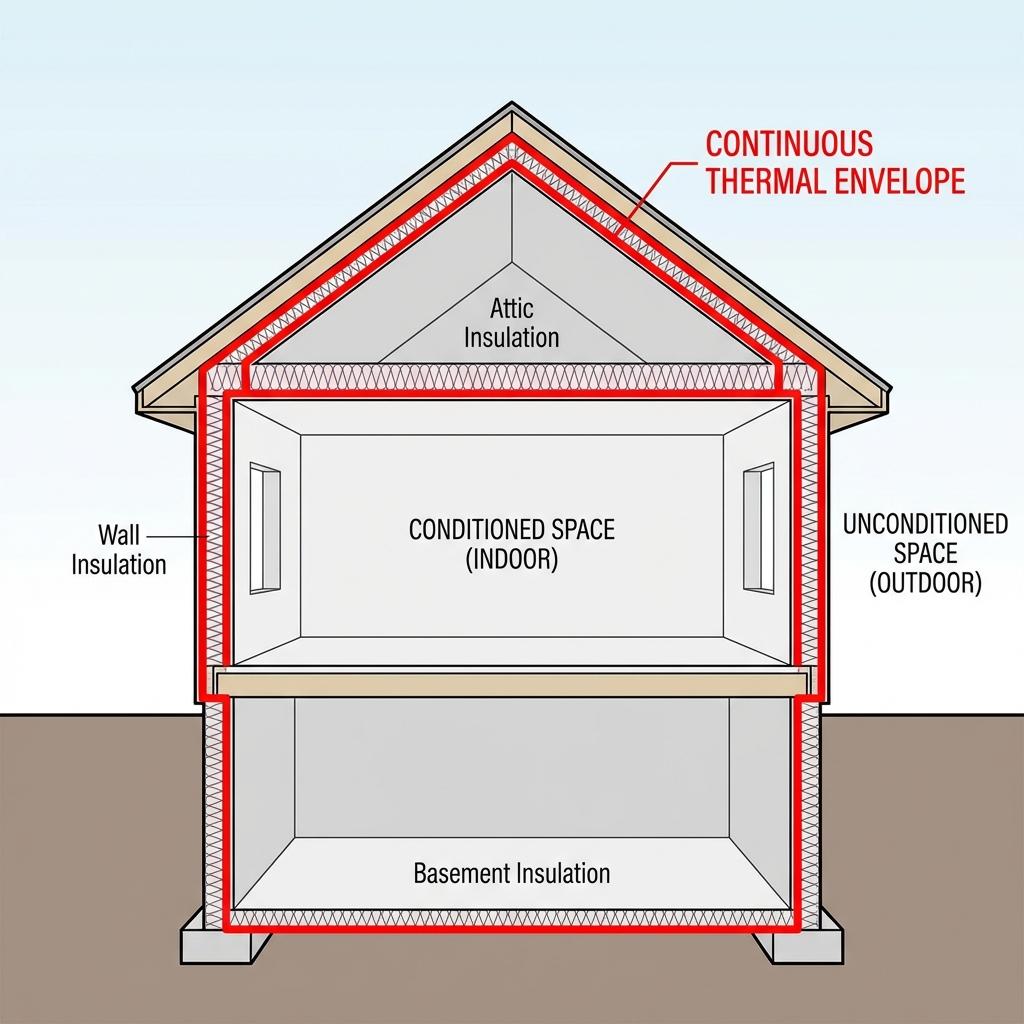
Visual Analysis: The Composite Strength
The cutaway above reveals the triple-threat engineering of an ICF block:
- Dual-Insulation Layers: EPS (Expanded Polystyrene) foam on the interior and exterior provides continuous insulation with zero thermal bridging.
- The Concrete Core: A 6-inch to 12-inch structural core that serves as the "thermal battery" of the home.
- The Rebar Lattice: Horizontal and vertical steel reinforcement that gives the wall its tensile strength, allowing it to withstand 250 mph winds.
Part 1: The Physics of Thermal Damping
In building science, we distinguish between Static R-Value and Dynamic Thermal Performance. ICF wins on both.
1. The Death of Thermal Bridging
In a wood-frame wall, every stud is a "bridge" for heat to escape (R-6 wood vs R-20 fluff). Because ICF uses continuous foam panels on both sides, there is no thermal bridge. The "Effective R-Value" of an ICF wall is typically 50% higher than a wood wall with the same nominal rating.
2. The Thermal Mass "Cushion"
Concrete's high specific heat capacity allows it to absorb and release thermal energy slowly. This creates Diurnal Damping:
- Daytime: As the sun hits the wall, the exterior foam slows the heat down. The concrete core absorbs the remaining energy without changing temperature.
- Nighttime: As the air cools, the concrete releases that stored heat back to the outside (and inside), stabilizing the indoor climate.
- The HVAC Result: Because the temperature inside an ICF home stays so stable, HVAC systems can be sized 30-40% smaller, operating at peak efficiency rather than cycling on and off.
Part 2: Engineering for "The 500-Year Life"
ICF isn't just about energy; it's about extreme durability.
1. The Sound of Silence (STC 50-55)
A standard wood-frame townhouse wall has a Sound Transmission Class (STC) of about 33—you can hear your neighbor's TV. An ICF wall naturally achieves an STC of 50 to 55. It is essentially an "Acoustic Tomb," making it ideal for homes near highways or airports.
2. Disaster Resilience
- Fire Rating: Concrete doesn't burn. ICF walls have a proven 4-hour fire rating, compared to 20-30 minutes for a standard wood wall.
- Impact Resistance: During EF5 tornado testing, wood walls are shredded by 100 mph 2x4 "missiles." ICF walls typically sustain only minor scuffing to the exterior foam.
Part 3: Technical Challenges: Bucking and Waterproofing
Building with ICF requires specialized knowledge. It's not just "pouring concrete into foam."
1. Window Bucking
Since the wall is foam, you can't just nail a window to it. We use Bucks—frames made of pressure-treated lumber or specialized plastic—that are inserted into the ICF blocks before the concrete pour. These create the structural "rough opening" for your windows.
2. The Hydrostatic Challenge
Concrete is porous. If you build an ICF basement, you must apply a Vapor-Permeable Waterproofing Membrane to the exterior foam. In 2026, we prefer peel-and-stick bituminous membranes that bridge the gaps between blocks, ensuring that the "Concrete Core" remains dry for the life of the structure.
Part 4: The 2026 Economics
"Is it worth the extra money?"
The Premium: As of 2026, building with ICF typically costs 5% to 8% more than high-quality 2x6 framing. The ROI:
- Energy Savings: 30% to 50% lower monthly bills.
- Insurance: Many carriers offer 15% discounts for "Masonry 1" construction.
- Resale: ICF homes are increasingly valued as "Fortress Homes" in climate-vulnerable markets.
The Verdict: Don't Build with Sticks
If you are building a custom home today, using wood for exterior walls is like buying a brand new car with a wooden chassis. It works, but it's fundamentally fragile. For a home that lasts 500 years and costs pennies to heat, ICF is the only logical choice.
About the Editorial Team EnergyBS reviews public program rules, product specifications, utility rates, and reader-facing cost assumptions. Treat savings figures as estimates until you verify local prices, permits, rebates, and contractor quotes.
Common Questions
What should I check first before using this construction advice?
Start with the numbers that apply to your home: climate, utility rate, equipment age, contractor quote, and local program rules. Insulating Concrete Forms (ICF) create a wall that is R25, airtight, and tornadoproof. Why wood framing is obsolete for highperformance homes.
How should I verify rebates, tax credits, rates, or savings before spending money?
Treat program amounts, utility rates, and tax rules as date-sensitive. Check the named government, utility, or manufacturer source before you sign a contract, and keep screenshots or PDFs of eligibility rules for your records.
What is the next useful step after reading this?
Compare this with Heat Pump Sizing Guide so you can check the cost, rebate, installation, or operating-risk angle before making a decision.
What to Read Next
Heat Pump Sizing GuideUse this next to compare the cost, incentive, installation, or operating-risk angle before you make a home energy decision.Sources and Verification
Editorial Review
EnergyBS Editorial Team
EnergyBS publishes practical homeowner guides. Important program, product, and cost claims should be checked against the linked source and local project documents before you commit to work.
Related Guides
View All ArticlesHeat Pump Sizing Guide
A homeownerfocused guide to Manual J loads, Manual S equipment selection, coldweather capacity, balance points, duct constraints, and the documents a defensible heatpump quote should include.
Ductless MiniSplit Head Placement 2026 Tool
A homeowner planning method for locating ductless indoor units by room load, air throw, doors, sensors, noise, condensate, line routes, service access, and wholehome comfort—not wall convenience alone.
Heat Pump Dryer vs Vented Dryer 2026 Tool (Guide & Data)
A householdspecific comparison of heatpump, vented electric, and gas dryers using model energy data, laundry volume, utility rates, cycle time, drainage, room conditions, vent cost, maintenance, and clothing care.