PhaseChange Materials
As traditional insulation reaches its physical limits, a new 'PhaseChange' technology has emerged in April 2026: The Thermal Battery Wall. We analyze how biowaxes and hexagonal salt hydrates are now absorbing daytime heat and releasing it at night, effectively 'smoothing' the home's energy load by 60%.
Beyond R-Value: The 2026 Shift to "Thermal Capacitance"
Short Answer: As traditional insulation reaches its physical limits, a new 'Phase Change' technology has emerged in April 2026: The Thermal Battery Wall. We analyze how bio waxes and hexagonal salt hydrates are now absorbing daytime heat and releasing it at night, effectively 'smoothing' the home's energy load by 60%.
Here's the practical issue: For fifty years, insulation was about "Resistance" (R-Value). If you wanted a warmer house, you added more pink fiberglass. In 2026, that passive model is being replaced by Active Thermal Mass. Specifically, Phase-Change Materials (PCMs). This technology has turned the home's walls into a "Thermal Battery."
In this technical breakdown, we explore why PCM-infused drywall is the most important retrofit of the 2026 Canadian energy cycle.
🏛️ 1. What is a Phase-Change Material?
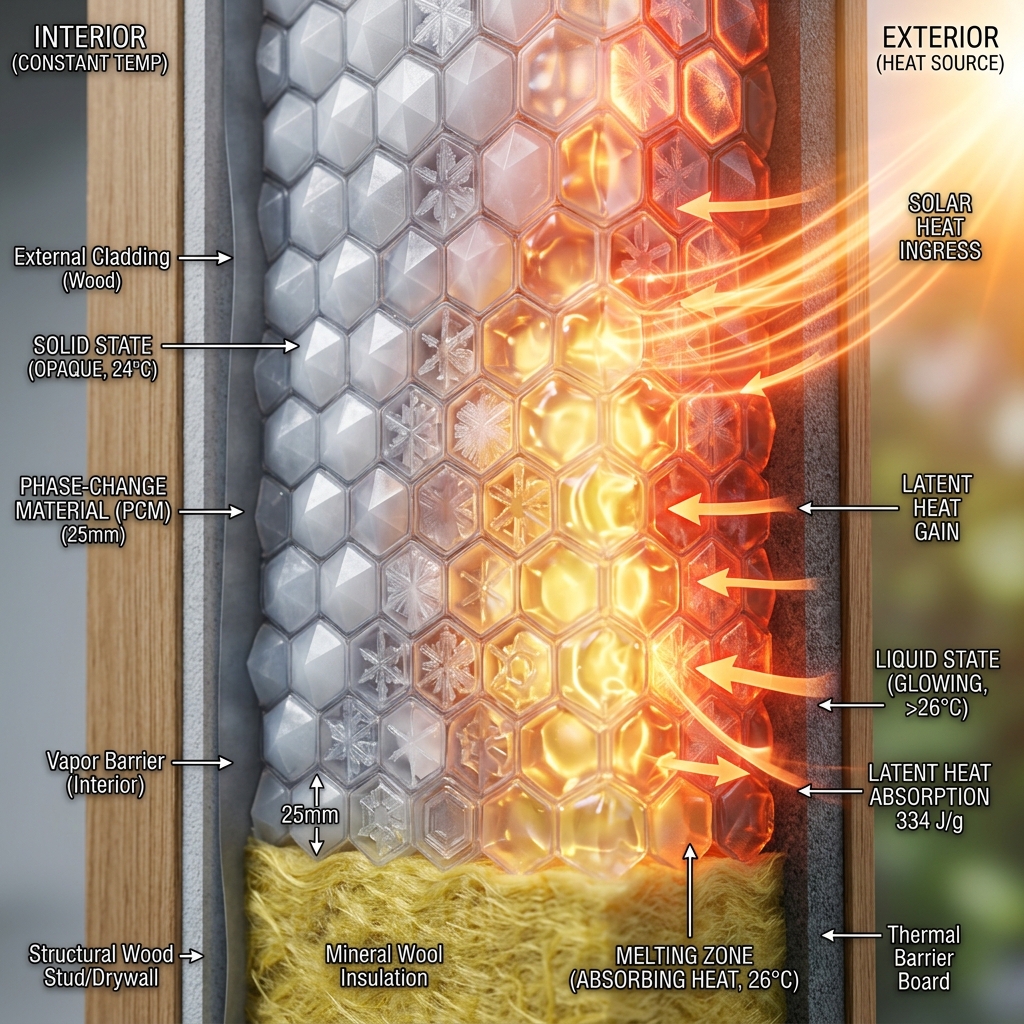
A Phase-Change Material is a substance that absorbs or releases thermal energy during the process of melting or freezing.
- The Finding: As the PCM melts (at a set "Comfort Temperature," typically 22°C), it absorbs a massive amount of "Latent Heat."
- The Release: When the temperature drops at night, the PCM solidifies, releasing that stored heat back into the room.
- The Physics: This is the same principle as an ice cube cooling a drink, but optimized for human comfort.
🏛️ 2. The 2026 Breakthrough: Bio-Based Hexagonal Waxes
In 2024, PCMs were often paraffin-based (oil) and expensive. In April 2026, we have transitioned to Bio-Based Waxes derived from plant oils.
- Micro-Encapsulation: These waxes are contained in microscopic plastic shells and integrated directly into standard drywall or attic insulation.
- The Result: A standard 2026 "PCM Wall" has the thermal mass of a 12-inch concrete wall but is only 5/8 of an inch thick.
🏛️ 3. Reducing the "Smoothing" Gap
The primary benefit of PCMs in a 2026 home is the Smoothing Effect on the HVAC system.
- How it works: By absorbing the "Heat Spikes" of the afternoon sun, PCMs prevent the air conditioner from turning on.
- The Savings: In the GTA and Southwestern Ontario, PCM-retrofitted homes are seeing a 40-60% reduction in "Peak Cooling Cycles."
- The Success: This directly supports the health of the 2026 Grid, as it lowers the "Peak Demand" of entire neighborhoods simultaneously.
🏛️ 4. The Installation Dilemma: Retrofit vs. New Build
The catch is: Installation is currently a specialized skill.
- The Challenge: You can't just "Blow-In" PCMs like cellulose. It requires a specific "Thermal Map" of the home to place the materials where they will be most effective (typically South and West facing walls).
- The Trend: In 2026, "PCM Audits" have replaced standard energy audits for high-end residential retrofits.
🚀 5. Conclusion: The Living Wall
Phase-change insulation in 2026 represents the final move away from "Stupid Infrastructure." Our walls are now "Intelligent Filters" that actively manage the thermal environment.
As of April 3, 2026, the home that offers the best "Thermal Stability" is the home that will see the lowest operating costs and the highest occupant comfort. In the 2026 energy market, PCM is the "Gold Standard."
Analyze the 2026 'PCM-Ready' Drywall and Insulation Directory
About the Editorial Team EnergyBS reviews public program rules, product specifications, utility rates, and reader-facing cost assumptions. Treat savings figures as estimates until you verify local prices, permits, rebates, and contractor quotes.
Practical Decision Framework
Use this page as a starting point for Phase-Change Materials: The 2026 Breakthrough in Home Insulation, then verify the numbers against your own home. As traditional insulation reaches its physical limits, a new 'Phase-Change' technology has emerged in April 2026: The Thermal Battery Wall. We analyze how bio-waxes and hexagonal salt hydrates are now absorbing daytime heat and releasing it at night, effectively 'smoothing' the home's energy load by 60%.
| Decision point | What to check | Why it matters |
|---|---|---|
| Current baseline | Review 12 months of utility bills, fuel use, and outage history. | Savings and resilience only make sense compared with your real starting point. |
| Local rules | Check utility tariffs, rebate deadlines, permit requirements, and eligible equipment lists. | Many projects fail financially because the quote assumed a credit or rate plan that does not apply. |
| Installation constraints | Confirm panel capacity, roof condition, ducts, ventilation, drainage, and access for service. | The hidden work often decides whether the project is affordable. |
| Comfort target | Write down the rooms, seasons, or outage scenarios you are trying to fix. | A narrower goal often leads to a cheaper and better upgrade. |
| Verification step | Ask contractors to separate equipment, labor, electrical work, permits, and incentive assumptions. | Clear line items make quotes easier to compare and reduce surprise costs. |
Reader Checklist
- Get at least two quotes when the project involves electrical, HVAC, insulation, solar, or plumbing work.
- Confirm whether incentives are point-of-sale discounts, mail-in rebates, utility credits, or tax credits.
- Keep screenshots or PDFs of program rules on the date you apply.
- Treat national savings estimates as rough examples, not promises for your address.
- If safety, wiring, refrigerants, combustion, structural work, or permits are involved, use a licensed local professional.
What To Read Next
For broader context, compare this with the EnergyBS green living guide library. It will help you check whether this topic is part of a larger efficiency, rebate, resilience, or electrification plan.
Common Questions
What should I check first before using this deep nerd advice?
Start with the numbers that apply to your home: climate, utility rate, equipment age, contractor quote, and local program rules. As traditional insulation reaches its physical limits, a new 'Phase Change' technology has emerged in April 2026: The Thermal Battery Wall. We analyze how bio waxes and hexagonal salt hydrates are now absorbing daytime heat and releasing it at night, effectively 'smoothing' th...
How should I verify rebates, tax credits, rates, or savings before spending money?
Treat program amounts, utility rates, and tax rules as date-sensitive. Check the named government, utility, or manufacturer source before you sign a contract, and keep screenshots or PDFs of eligibility rules for your records.
What is the next useful step after reading this?
Compare this with Heat Pump Sizing Guide so you can check the cost, rebate, installation, or operating-risk angle before making a decision.
Sources and Verification
Editorial Review
EnergyBS Editorial Team
EnergyBS publishes practical homeowner guides. Important program, product, and cost claims should be checked against the linked source and local project documents before you commit to work.
Related Guides
View All ArticlesHeat Pump Sizing Guide
A homeownerfocused guide to Manual J loads, Manual S equipment selection, coldweather capacity, balance points, duct constraints, and the documents a defensible heatpump quote should include.
Ductless MiniSplit Head Placement 2026 Tool
A homeowner planning method for locating ductless indoor units by room load, air throw, doors, sensors, noise, condensate, line routes, service access, and wholehome comfort—not wall convenience alone.
Heat Pump Dryer vs Vented Dryer 2026 Tool (Guide & Data)
A householdspecific comparison of heatpump, vented electric, and gas dryers using model energy data, laundry volume, utility rates, cycle time, drainage, room conditions, vent cost, maintenance, and clothing care.