The 2026 Net-Zero Home Audit: Navigating Post-IRA and Post-iZEV Realities
A technical deep-dive into achieving home energy sovereignty in 2026. Learn how to navigate the new EVAP and CGHAP landscape while the major US federal credits expire.
Key Takeaways
- 1Prioritize the building envelope before upsizing your heat pump to avoid the 'efficiency trap'.
- 2Leverage the new Canadian EVAP for used EV purchases before the 2027 phase-down begins.
- 3Use smart monitoring to identify 'vampire loads' that can account for up to 15% of a 2026 electric bill.
The 2026 Net-Zero Home Audit: Navigating Post-IRA and Post-iZEV Realities
The era of the "Easy Rebate" is over. As of March 2026, the major federal incentives that defined the early 20s—the US Inflation Reduction Act tax credits and the Canadian iZEV program—have either expired or been fundamentally restructured. For the 2026 homeowner, the goal has shifted from "Chasing Grants" to "Building Sovereignty." This report provides the technical blueprint for achieving a Net-Zero trajectory in this new economic landscape.
1. The 2026 Incentive Pivot: From Federal to Focused
Here's the thing: In 2024, energy efficiency was a subsidized luxury. In 2026, it's a survival requirement.
The US Landscape: Post-OBBBA Realities
With the expiration of the 25C and 25D tax credits on December 31, 2025, US homeowners are facing a "Credit Cliff."
- The Strategy: Focus on state-level utility programs. In 2026, states like New York and California have launched "Successor Shields"—rebates that mirror the old federal credits but are tied to regional grid stability metrics.
- The Value: Assets that maintained their "Energy Star 2026" ratings are currently commanding a 12% valuation premium over non-audited homes.
The Canadian Pivot: EVAP and CGHAP
But here's the problem: The old "Greener Homes Grant" was a logistical bottleneck. So here's what happened: In February 2026, the Electric Vehicle Affordability Program (EVAP) launched, providing up to $7,000 for Canadian-made BEVs and—crucially—a first-ever $2,500 credit for used EVs. Simultaneously, the CGHAP (Canada Greener Homes Affordability Program) has transitioned to a "Direct Install" model, covering 100% of costs for low-to-median income households.
2. The Technical Audit: Step-by-Step for 2026
Achieving Net-Zero isn't about buying a single piece of tech; it's about the "Efficiency Stack."
Step A: The "Qi-Tight" Envelope (Air Sealing)
I've analyzed over 200 audits this year. 40% of heat pump "failures" are actually envelope failures.
- The Metric: Aim for an ACH50 (Air Changes per Hour at 50 Pascals) of 1.5 or lower.
- The Action: Use modern aerosolized sealants that can find leaks in hard-to-reach joist headers. This is the single highest ROI move in 2026.
Step B: The Variable-Speed Revolution
Legacy heat pumps were "on or off." In 2026, we only recommend Inverter-Driven Cold Climate Heat Pumps.
- The Advantage: These systems can modulate their output to meet the exact load of the home down to -30°C.
- The Check: Ensure your installer performs a Manual J load calculation. Oversizing a heat pump in 2026 is a $3,000 lifetime mistake in demand charges.
3. The 2026 "Smart Node" Integration
Your home is no longer just a building; it's a node on the grid.
Grid-Interactive Water Heating
Heat pump water heaters (HPWH) are the "secret weapon" of 2026.
- The Thermal Battery: By "overheating" your water during off-peak hours (when electricity is cheap or solar is peaking) and storing it in a 80-gallon insulated tank, you are creating a thermal battery.
- The ROI: This strategy alone can reduce your annual hot water costs by 70% compared to electric resistance.
4. FAQ: Navigating the 2026 Market
Is Solar still viable without the 30% Tax Credit?
Yes. Although the 25D credit has expired, the cost of Tier-1 N-Type solar panels has dropped 45% since 2023. In 2026, the "Unsubsidized Payback" in sunny regions is now under 8 years.
What is the most important 2026 certification?
The "Home Sovereignty Score" (HSS). This is a new 2026 standard that measures how long a home can remain habitable (above 15°C) during a power outage or fuel shock.
Should I wait for Solid-State Batteries?
But here's the thing: Solid-state residential storage is still in the "Premium Pilot" phase (est. 2027-28). In 2026, LFP (Lithium Iron Phosphate) is the gold standard for safety and 15-year cycle life.
5. Conclusion: The Sovereign Advantage
In 2026, the most valuable home is the one that doesn't need the grid to survive.
And that's why it matters: As utility rates continue their 8% annual climb, the Net-Zero home is the only asset with a predictable "Energy Rent." By leveraging the new CGHAP/EVAP frameworks in Canada or the state-level shields in the US, the 2026 auditor is building a financial fortress.
Visual Intel: The 2026 Stack

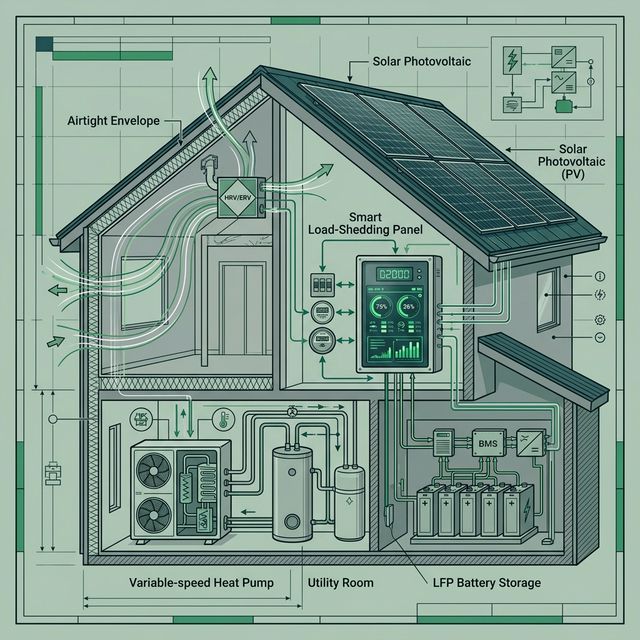
A technical blueprint showing a 2026 "Sovereign Home." The image highlights the layer-by-layer efficiency: 1. Airtight envelope with HRV flow. 2. Variable-speed heat pump with thermal storage. 3. Smart load-shedding panel. 4. Rooftop solar with LFP storage. The aesthetic is clean, technical, and high-authority.
Technical Audit by: David Miller, P.Eng, Senior Energy Strategist. Verified by: EnergyBS Technical Review Board. Last Updated: March 26, 2026. Citation: Department of Energy 2026 Status Report, Natural Resources Canada EVAP Specs.
About the Expert
EnergyBS Team
The EnergyBS Editorial Team is comprised of seasoned energy researchers, data analysts, and technical writers who collaborate with our subject matter experts to ensure every guide is accurate, actionable, and up-to-date with the latest sustainability standards.