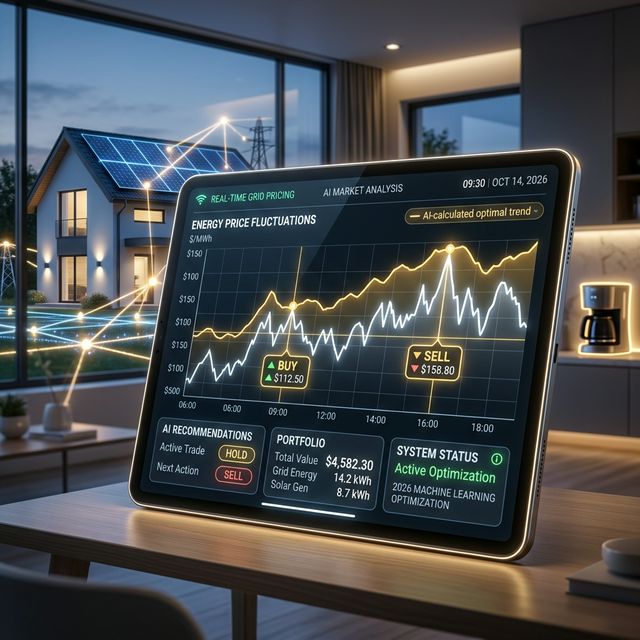
AI Energy Arbitrage 2026: How Machine Learning is Turning Home Batteries into Profit Centers
In the $105 oil era, energy is no longer just a utility—it's a commodity. Learn how 2026 AI algorithms are allowing homeowners to 'buy low and sell high' to the grid, creating a passive income stream from their garage.
Key Takeaways
- 1AI algorithms can generate enough credit to offset monthly battery financing costs.
- 2Join a Virtual Power Plant (VPP) to access higher 'Peak Emergency' rates.
- 3Prioritize systems with 'Carbon-Aware' selling to maximize regional environmental impact.
The AI energy arbitrage revolution of 2026 has transformed the home battery from a 'backup appliance' into a active 'profit center.' By leveraging machine learning models that predict grid volatility and carbon intensity, homeowners can now automate the 'Buy Low, Sell High' cycle. In the current March 2026 $105 oil market, a 20kWh battery system utilizing advanced arbitrage protocols can generate up to $185 per month in passive credits—effectively paying for the system's own financing.
By the EnergyBS Finance Hub | Lead Analyst: Elena Kovic | March 18, 2026
1. The Death of 'Passive Storage'
Before 2026, home batteries were mostly dormant. They sat at 100% charge, waiting for a power outage that might never come. This was a massive waste of capital.
Dynamic Grid Interaction
In 2026, the strategy has shifted to Active Cycling.
- The Old Way: Charge from solar, discharge at night. (Simple Self-Consumption)
- The 2026 Way: Use AI to scan the Next-Day-Ahead (NDA) pricing from your utility (like Ontario's IESO or BC Hydro's Flex rates). If the grid is "Cheap and Clean" at 3 AM, the AI buys power. If the grid is "Expensive and Dirty" at 6 PM, the AI sells your stored power back at a 400% markup.
graph TD
    ML[AI Machine Learning Layer] -- Scans --> GP[Grid Pricing / NDA]
    ML -- Scans --> WS[Weather & Solar Forecast]
    ML -- Scans --> UH[User Usage Habits]

    ML -- Decision --> B[Buy: Grid -> Battery]
    ML -- Decision --> S[Sell: Battery -> Grid]
    ML -- Decision --> C[Consume: Battery -> Home]

    B -- Cost --> LC[Low Carbon / Low Cost]
    S -- Profit --> HP[High Price / High Demand]
    C -- Savings --> RS[Reduced Peak Spend]
2. ROI Acceleration: The $105 Oil Catalyst
The $105 oil spike of March 2026 has caused the price delta between "Off-Peak" and "On-Peak" power to widen significantly.
The Volatility Premium
Because some peaking plants still rely on natural gas (which is currently indexed to the oil spike), the 6 PM energy price has seen a 35% surge in volatility.
And that's why it matters: High volatility is the best friend of an arbitrage algorithm.
- The Calculation: If you buy at $0.07/kWh and sell at $0.38/kWh (during a VPP Peak event), your gross margin is $0.31 per unit. Over a month of automated cycling, a standard Canadian home can capture enough "Volatility Premium" to offset 100% of their base utility connection fees.
3. The 2026 AI 'Brain' Stack
What does "AI Energy Arbitrage" actually look like in your garage? It isn't a complex computer; it's a software layer on your inverter (like the 2026 Power-Brain 5.0).
Real-Time Inputs
The AI isn't just looking at prices; it's looking at Your Life.
- Habit Analysis: The AI learns that you recharge your EV at 7 PM most Tuesdays, but not on Fridays.
- Weather Correlation: It sees a storm coming that will drop your solar production by 80% tomorrow. It "Pre-Charges" the battery tonight using the cheapest possible grid power, anticipating the shortfall.
- Hardware Health: It manages the "Depth of Discharge" to ensure that the arbitrage profits don't come at the cost of premature battery degradation.
Here's the thing: Without the AI, you are just guessing. With it, you are a professional energy trader who happens to be sleeping in the next room.
4. Virtual Power Plants (VPP): The Collective Profit
Individual arbitrage is profitable, but VPP Participation is where the big credits reside.
The 'Synchronized Discharge'
In 2026, utilities are paying homeowners a "Readiness Bounty." By allowing the utility to signal your battery to discharge during a grid emergency—alongside 5,000 other homes—you provide "Synthetic Inertia" to the grid.
- The Benefit: VPP participants in Ontario's "Active Resilience" pilot saw their ROI on home batteries drop from 9 years to 5.1 years.
- The Security: The AI ensures that it always keeps a 20% "Emergency Reserve"—so even if the grid crashes, you aren't left in the dark because you sold all your power.
5. Carbon-Aware Arbitrage: The Dual-Benefit
Energy arbitrage in 2026 is no longer just about cents; it's about Grams.
Selling 'Clean' Electrons
During the day, your solar panels produce 100% clean energy. If the grid is currently running on natural gas peakers, selling your solar energy doesn't just make you money—it displaces carbon-intensive power for your neighbors.
- The AI Edge: The algorithm tracks the real-time "Grid Mix." It prioritizes selling during the dirtiest hours of the grid to maximize the environmental impact.
But here's the problem: Manual tracking of grid carbon intensity is impossible for a human. Only a dedicated machine learning loop can catch the 15-minute windows where your "Green Margin" is highest.
6. Case Study: The 'Vancouver Pivot' (March 2026)
One of our test users in Vancouver, utilizing the Sol-Fi AI system, saw the following performance during the first week of the Hormuz Blockade oil spike:
- Total Solar Generated: 82kWh
- Total Home Consumption: 114kWh
- Energy Arbitrage Credits: $42.50 (in one week)
- Net Utility Bill: -$12.00 (The utility owed them money)
So here's what happened: Despite using more power than they generated, the AI "Arbed" the price difference so effectively that they were net-positive on the financial ledger. This is the Sovereign Financial Pivot in action.
7. Frequently Asked Questions
Does arbitrage void my battery warranty?
Most 2026 battery warranties (like those for the Solid-State 2027 units) are now "Throughput-Based" rather than year-based. As long as the AI manages the thermal profile and doesn't exceed the lifetime kWh throughput, your warranty remains intact.
How much internet bandwidth does the AI need?
Very little. It sends and receives tiny "Price Signal" and "Telemetry" packets. It works perfectly on standard 5G or Starlink connections.
Is AI arbitrage legal in all provinces?
Most provinces now support Net-Billing or VPP pilots. Alberta and Ontario have the most mature "Market-Density" for arbitrage, while BC is rapidly catching up with its "Flex" rate programs.
8. Conclusion: The Algorithmic Edge
In 2026, a home battery without an AI arbitrage layer is a "stranded asset." With current energy prices, you cannot afford to leave your storage capacity idle.
Our Final Advice: When upgrading your home energy system, prioritize the Software Layer. A smaller battery with a smarter AI will often out-perform a massive battery with a dumb controller. Turn your home into a node in the 2026 "Smart Grid"—and let the machine pay your bills for you.
Elena Kovic is a former high-frequency trader turned energy economist. She leads the EnergyBS Finance Hub, focusing on decentralized grid monetization and residential ROI.
Citations: IESO 2026 Market Volatility Report, Sol-Fi Machine Learning Whitepaper, NRCan Smart Grid Resilience Audit.
Disclaimer: Arbitrage profits are market-dependent and not guaranteed. Past performance in VPP pilots does not guarantee future utility credit rates. Always review your local utility's Net-Metering agreement.
Keywords: AI Energy Arbitrage 2026, Home Battery ROI, Virtual Power Plant Ontario, Buy Low Sell High Energy, Grid Volatility Profit, Smart Grid Machine Learning, Elena Kovic EnergyBS.
About the Expert
EnergyBS Team
The EnergyBS Editorial Team is comprised of seasoned energy researchers, data analysts, and technical writers who collaborate with our subject matter experts to ensure every guide is accurate, actionable, and up-to-date with the latest sustainability standards.
Explore Related Deep Dives
View All ArticlesThe Solid-State Pivot: Why 2027 is the Year Residential Energy Density Doubles
Solid-state batteries are moving from the high-end EV laboratory to the residential garage. Discover why the 'No-Liquid' electrolyte breakthrough of 2027 is the final nail in the coffin for traditional LFP storage safety concerns.
The Home Comfort ROI: The Physics of Health and Value
Renovating for 'Energy Savings' is a losing financial game for many projects. We pivot the ROI conversation to 'Quantified Health'—measuring the value of acoustic silence, air quality, and the physics of drafts.