The Fireplace Fallacy: Why Your Hearth is a Energy Thief
An open masonry fireplace has an efficiency of 10%. It sucks more heat out of your house than it adds. We explain the 'Stack Effect' and how to convert your chimney into a heater.
The Negative Efficiency Appliance: A Thermodynamic Disaster
Short Answer: An open masonry fireplace has an efficiency of 10%. It sucks more heat out of your house than it adds. We explain the 'Stack Effect' and how to convert your chimney into a heater.
There is nothing more romantic than a crackling open fire on a snowy winter night. Unfortunately, for a building scientist, there is nothing more painful than watching an open masonry fireplace in operation.
A standard open masonry fireplace has an effective net efficiency of -10% to +10%.
Yes, you read that correctly: Negative Ten Percent. While you feel the intense "Radiant Heat" on your face when standing in front of the fire, the architectural reality behind you is much darker.
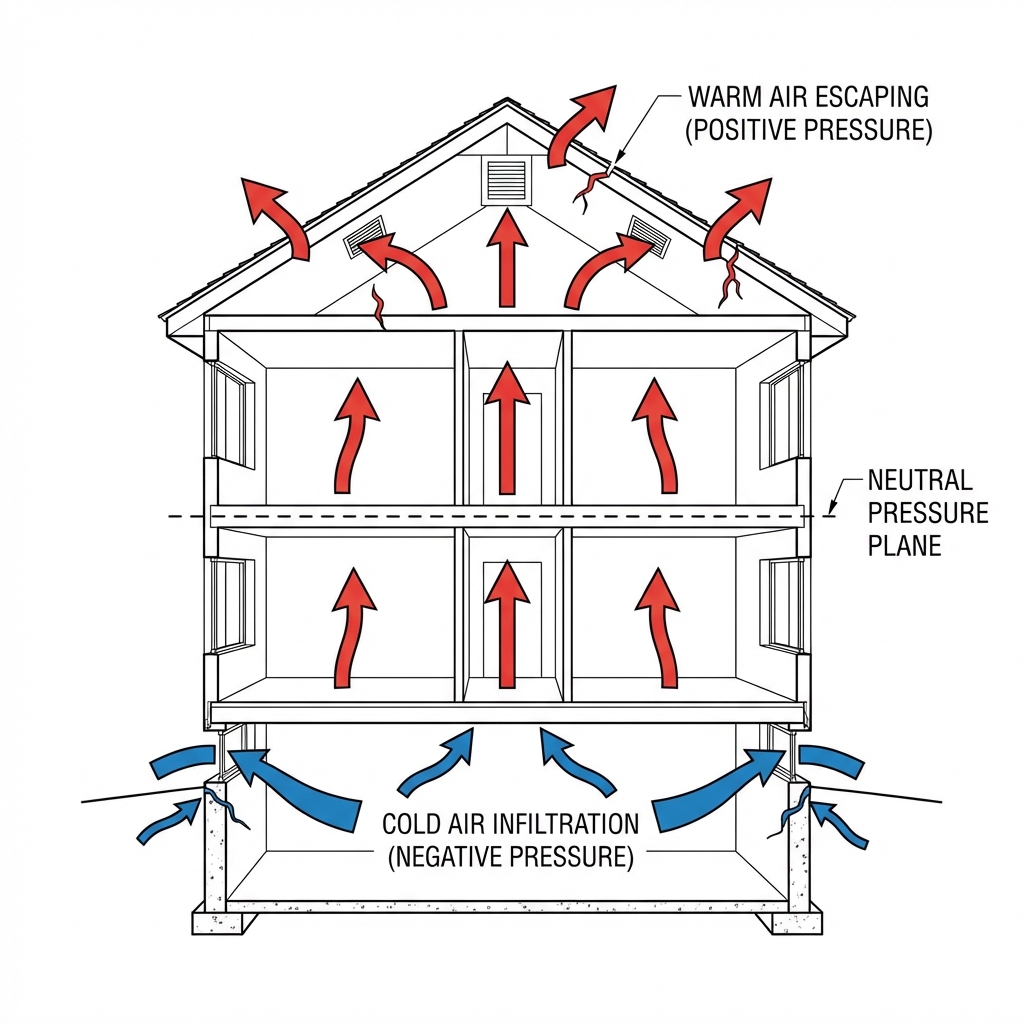
Visual Analysis: The Chimney Theft Effect
The diagram above illustrates the "Total House System" impact of an open fire:
- The Exhaust: A hot fire requires a massive amount of oxygen. It sends 200–600 cubic feet per minute (CFM) of warm room air directly up the chimney.
- The Negative Pressure Zone: Because the house is a sealed box, that air must be replaced. The house becomes a vacuum, sucking freezing 20°F air through window seals, door sweeps, and electrical outlets in the distant parts of the home.
- The Infiltration Tax: For every 1 BTU of heat the fire adds to the living room, it forces your furnace to work 1.5 BTUs harder to heat the cold drafts in the bedrooms.
Part 1: The Physics of "The Damper Hole"
Even when you aren't burning a fire, your fireplace is likely sabotaging your energy bill. A traditional cast-iron damper is a metal-on-metal seal. Over decades of heat cycles, these dampers warp and rust.
The "Stuck Window" Analogy
Leaving a fireplace damper "closed" in a 1920s house is often equivalent to leaving a 6-inch window wide open in every room.
- Exfiltration: In the winter, warm air rises. Your house acts like a hot air balloon. The "Neutral Pressure Plane" is pushed down, and your expensive heated air is squeezed out through the leaky damper 24 hours a day.
- The Candle Test: If you hold a lit candle near the fireplace opening on a cold day (with no fire lit), and the flame flickers toward the flue, you are witnessing your bank account venting into the atmosphere.
Part 2: The Modern Solution: The "Insert"
You don't have to brick up your beautiful masonry. You need an EPA-Certified Fireplace Insert. This is a high-tech steel or cast-iron stove that is professionally slid into the existing masonry opening.
How an Insert Fixes the Physics:
- Direct Venting: It uses a stainless steel liner that goes all the way up the chimney, sealing the "Big Hole" forever.
- Sealed Ceramic Glass: It separates the room's air from the fire's air. The fire no longer "consumes" your living room air.
- Secondary Combustion: Modern inserts re-burn the smoke at 1,000°F before it leaves the house, turning what was once air pollution into useable heat.
- Convection Blowers: A fan pulls cool floor air, runs it through a heat exchanger behind the fire, and pushes 140°F air back into the room.
Efficiency Jump:
- Open Fireplace: 5%
- High-End Wood Insert: 75% to 80%
Part 3: Health and the "PM2.5" Reality
Beyond energy, open fireplaces are significant sources of Indoor Air Pollution. Every time the wind gusts or the door opens, "Back-drafting" occurs, pushing fine particulate matter (PM2.5) into your lungs. PM2.5 is small enough to enter the bloodstream. By switching to a sealed insert, you reduce indoor smoke exposure by 99%, making your romantic evening much safer for your heart and lungs.
Part 4: The Chimney Balloon (The $50 Fix)
If you have a decorative fireplace that you never intend to use, do not leave it as-is.
- The Balloon: An inflatable pillow made of heavy-duty plastic that you shove up past the damper and inflate. It creates an airtight, custom-fit seal.
- The Plug: Similar to the balloon, a "Chimney Sheep" (made of thick wool) can be used to plug the throat of the chimney.
- ROI: These $50 devices typically pay for themselves in one winter season by stopping the parasitic air loss.
The Verdict: Ambiance vs. Utility
If you want a "Prop" for your Christmas photos, an open fireplace is fine—provided you accept it is costing you $20/night in wasted furnace fuel. If you want a Heating Appliance that can keep your family warm during a power outage, an Insert is the only scientifically sound solution.
About the Editorial Team EnergyBS reviews public program rules, product specifications, utility rates, and reader-facing cost assumptions. Treat savings figures as estimates until you verify local prices, permits, rebates, and contractor quotes.
Common Questions
What should I check first before using this heating advice?
Start with the numbers that apply to your home: climate, utility rate, equipment age, contractor quote, and local program rules. An open masonry fireplace has an efficiency of 10%. It sucks more heat out of your house than it adds. We explain the 'Stack Effect' and how to convert your chimney into a heater.
How should I verify rebates, tax credits, rates, or savings before spending money?
Treat program amounts, utility rates, and tax rules as date-sensitive. Check the named government, utility, or manufacturer source before you sign a contract, and keep screenshots or PDFs of eligibility rules for your records.
What is the next useful step after reading this?
Compare this with Spot Heating Strategy: Stop Heating Empty Rooms so you can check the cost, rebate, installation, or operating-risk angle before making a decision.
What to Read Next
Spot Heating Strategy: Stop Heating Empty RoomsUse this next to compare the cost, incentive, installation, or operating-risk angle before you make a home energy decision.Sources and Verification
Editorial Review
EnergyBS Editorial Team
EnergyBS publishes practical homeowner guides. Important program, product, and cost claims should be checked against the linked source and local project documents before you commit to work.
Related Guides
View All ArticlesSpot Heating Strategy: Stop Heating Empty Rooms
Is running a 1500W space heater cheaper than running a gas furnace? The physics says 'maybe'. determining the crossover point where space heaters become money pits.
The Physics of Steam Heat: Silencing the Banging Beast
Your steam radiator shouldn't bang, hiss, or spit. We explain the 'Hartford Loop', the math of EDR, and why steam is actually a masterpiece of engineering.
Heat Pump Sizing Guide
A homeownerfocused guide to Manual J loads, Manual S equipment selection, coldweather capacity, balance points, duct constraints, and the documents a defensible heatpump quote should include.