Chimney Liner Installation Cost 2026: What Relining Really Costs
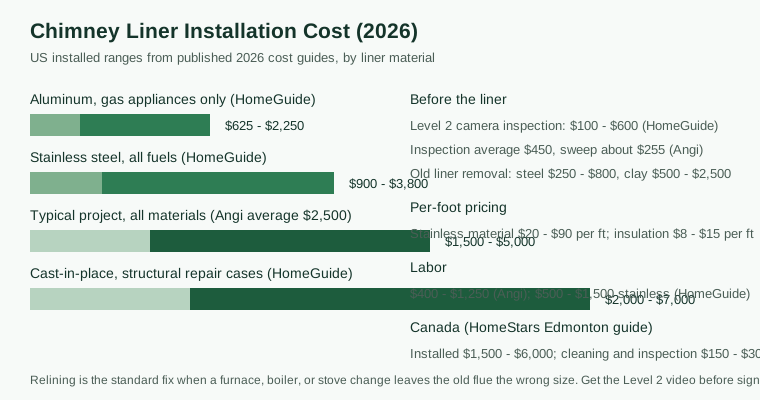
A chimney liner installation costs $1,500 to $5,000 in the US in 2026, averaging $2,500 (Angi, updated September 2026). HomeGuide prices relining at $1,200 to $4,600 allin: stainless steel installed at $900 to $3,800, aluminum for gas appliances at $625 to $2,250, clay at $2,000 to $3,500, and castinplace at $2,000 to $7,000. This guide prices each material per foot and installed, works a 25foot flue example from the published perfoot bands, explains why a furnace or boiler swap so often triggers a liner quote (the orphaned water heater problem), covers sizing rules, insulation, repairvsreline math, Canada pricing, and a 12point quote checklist.
Quick Checks
- 1Budget $2,500 as the US average for a professionally installed chimney liner in 2026 (Angi). Most projects land between $1,500 and $5,000; HomeGuide puts a complete reline at $1,200 to $4,600 including removal of the old liner.
- 2Stainless steel is the default for a reason: $900 to $3,800 installed (HomeGuide), works with wood, oil, and gas, and lasts 15 to 25 years. Aluminum at $625 to $2,250 is gas-only and lasts as little as 5 years (Angi), so the saving buys a much shorter clock.
- 3A liner quote that arrives with a furnace or boiler replacement is usually legitimate, and the mechanism has a name: orphaning. Removing the furnace from a shared flue leaves the water heater venting into a flue sized for two appliances, and an oversized cold flue drafts poorly and condenses. Price the liner as part of the heating project, not as an upsell to argue about.
- 4No video, no signature. A Level 2 camera inspection ($100 to $600, HomeGuide) is the step that shows whether you need a $250 to $1,000 tile repair, a resurface, or a full reline. A reline quote written from the driveway is a guess with your name on it.
- 5Insulation is not an upsell on solid-fuel flues. Blanket insulation adds $8 to $15 per linear foot (HomeGuide), keeps flue gases hot enough to draft and limit creosote, and fire codes require it in many solid-fuel installs depending on chimney construction and clearances.
Chimney Liner Installation Cost 2026: What Relining Really Costs
By EnergyBS Editorial Team | October 13, 2026
The Short Answer
Short Answer: A professionally installed chimney liner costs $1,500 to $5,000 in the US in 2026, averaging about $2,500 (Angi, updated September 21, 2026). HomeGuide prices the same work from the other direction, as a complete reline: $1,200 to $4,600 including removal of the old liner, with stainless steel installed at $900 to $3,800, aluminum at $625 to $2,250, clay tile at $2,000 to $3,500, and cast-in-place at $2,000 to $7,000. The spread is mostly material and chimney length. Liners are priced per linear foot, so a two-story colonial with a 30-foot flue and a ranch with an 18-foot flue are different projects wearing the same name.
Most liner quotes do not start with a fireplace. They start with a heating project: a furnace, boiler, or water heater replacement where the installer finds cracked clay tiles, an unlined flue, or a flue that is the wrong size for the appliance going in. Section 1 covers that mechanism, because it decides whether the quote in front of you is necessary work or padding. The rest of the guide prices the materials, works a full quote example from the published per-foot bands, and ends with repair-vs-reline math and a checklist for comparing bids.
1. Why a Heating Project Triggers a Liner Quote
A chimney liner does three jobs. It gives combustion gases a smooth, correctly sized path out of the house. It protects the masonry from the heat and the corrosive condensate those gases carry. And it keeps gases, including carbon monoxide, from leaking through cracked mortar joints into living space (HomeGuide). When any of the three fails, the fix is usually a new liner, because the original clay tiles in a masonry chimney cannot be patched back to a continuous, gas-tight surface once they crack and shift.
Three situations produce most residential liner work:
The appliance changed. A liner is sized to the appliance it serves. Replace a furnace or boiler with a unit of a different input rating or efficiency and the old flue may be the wrong diameter for the new exhaust volume. This is also why the inspection standard steps up at exactly this moment: under the NFPA 211 framework, a Level 2 inspection is required when an appliance is replaced with one of a dissimilar type, input rating, or efficiency, and when a flue is relined (see section 7).
The water heater got orphaned. In older houses, a furnace and a water heater often share one masonry flue, each with its own connector. The flue was sized for both appliances firing together. Swap the old furnace for a high-efficiency model that vents through plastic pipe out the side wall, and the water heater is left alone in a flue built for two. Its exhaust now rises slowly through an oversized, cold masonry channel, loses heat, and condenses inside the chimney. Draft gets weak, moisture attacks the mortar, and the water heater can spill exhaust at its draft hood. The standard fix is a properly sized metal liner for the water heater alone, run inside the old flue. If this is the quote you are holding, it is a real scope with a real mechanism, and it belongs in the budget next to the furnace replacement or the tank water heater replacement that caused it. Our heat pump vs gas furnace comparison flags the same risk from the other side: electrifying the furnace does not remove the water heater's venting problem.
The solid-fuel flue wore out. Wood stoves, pellet stoves, and fireplaces punish liners with heat cycles and creosote. Clay tiles crack, mortar joints open, and a chimney fire can damage a liner in one event. Anyone pricing a wood stove installation or a pellet stove installation into an existing masonry chimney should expect the liner question to come up, because the stove is only as safe as the flue above it.
One more trigger is administrative: a Level 2 inspection is also required on the sale or transfer of a property, so liner findings surface in real estate transactions, usually at the worst negotiating moment. An annual inspection habit finds the same problems years earlier, at repair prices.
2. Cost by Material
HomeGuide's 2026 table separates material cost per linear foot from installed totals, which is how quotes are actually built:
| Liner material | Material cost per foot (HomeGuide 2026) | Installed cost (HomeGuide 2026) | Lifespan | Fuel limits |
|---|---|---|---|---|
| Aluminum | $5 to $30 | $625 to $2,250 | 5 to 15 years | Gas appliances only |
| Stainless steel | $20 to $90 | $900 to $3,800 | 15 to 25 years | All fuels |
| Clay / terracotta tile | $6 to $15 | $2,000 to $3,500 | 15 to 50 years | All fuels, but a poor match for modern gas appliances |
| Cast-in-place | $40 to $120 | $2,000 to $7,000 | 50 years | All fuels |
| Ceramic coating (Thermocrete type) | $50 to $200 | $1,000 to $5,000 | Up to 50 years | Repair coating for a sound flue, not a liner for an unlined chimney |
Stainless steel is what most relines use. It goes into an existing chimney without opening the masonry, handles offsets and bends in flexible form, resists the corrosion that kills lesser metals, and is the material fire-protection professionals recommend most (HomeGuide). Angi puts its service life at 15 to 20 years; HomeGuide's table allows 15 to 25 with maintenance.
Aluminum is the budget line and the narrow one. It serves gas appliances only, corrodes faster, and Angi allows a lifespan as short as 5 years. It has a legitimate use case, a gas water heater or mid-efficiency gas furnace flue in a house that will change appliances again soon, but as a 20-year answer it is the wrong material at a tempting price.
Clay tile is the original liner in most masonry chimneys and the cheapest material per foot, but relining in clay means removing the old tiles and rebuilding the flue tile by tile, often opening the chimney wall at offsets. The labor erases the material saving, which is why the installed band sits above stainless. New clay belongs in new chimney construction, not in most relines.
Cast-in-place liners are pumped mortar formed around an inflatable form, then cured into a single continuous flue. The price buys two things stainless cannot do: it restores structural strength to a deteriorating chimney from the inside, and it fits narrow or odd-shaped flues. At a 50-year lifespan it is also the last liner most houses will need. It is the right answer for a structurally tired chimney worth saving, and an expensive answer to a simple cracked-tile problem.
Ceramic coatings sprayed onto the flue walls seal surface cracks and failed joints in a liner that is still structurally sound. HomeGuide is explicit that this is a repair technique for light damage, not a substitute liner for an unlined chimney, and building inspectors will not approve a sealant as a liner replacement. Treat any quote that presents a coating as a full reline with suspicion.
3. A Worked Quote: The 25-Foot Flue
Per-foot pricing makes liner quotes hard to sanity-check until you run the arithmetic yourself. Here is the build for a common job, with every input taken from the published bands above. Hypothetical example: a two-story house, 25-foot masonry flue, one gas furnace and water heater being relined in flexible stainless steel with blanket insulation, old steel liner already absent (unlined flue), straightforward roof access.
| Line | Basis | Low | High |
|---|---|---|---|
| Stainless liner material, 25 ft | $20 to $90 per ft (HomeGuide) | $500 | $2,250 |
| Blanket insulation, 25 ft | $8 to $15 per ft (HomeGuide) | $200 | $375 |
| Labor, stainless install | $500 to $1,500 (HomeGuide) | $500 | $1,500 |
| Cleaning and Level 2 inspection first | $150 to $250 cleaning and inspection (HomeGuide); Level 2 alone runs $100 to $600 | $150 | $600 |
| Permit | $100 to $150+ (HomeGuide) | $100 | $150 |
| Total | $1,450 | $4,875 |
The range is wide because the material band is wide: diameter, wall type (single vs double), and alloy move the per-foot price more than length does. The midpoint of this build, roughly $3,150, sits above Angi's $2,500 all-project average, which makes sense once you see what the average includes: shorter flues, gas-only aluminum jobs, and relines with no insulation. Use the table as a structure test for real quotes. A bid for this scope that lands under $1,450 has dropped a line, usually the insulation or the inspection. A bid over $4,875 needs a named reason: clay tile removal ($500 to $2,500, HomeGuide), a second flue, difficult roof access, or masonry repair.
Two add-ons change the build materially. Removing an old steel liner adds $250 to $800; removing clay tiles adds $500 to $2,500 because the tiles come out in pieces (HomeGuide). And if the stack above the roofline is crumbling, rebuilding it runs $1,000 to $3,500 before any liner discussion, because a liner needs a sound chimney around it.
4. Stainless in Detail: Wall, Form, and Insulation
Most relines are stainless, so the choices inside that one material decide most of the price and most of the service life.
Single-wall vs double-wall. HomeGuide prices single-wall material at $20 to $40 per foot and $35 to $70 per foot installed, against double-wall at $40 to $90 per foot and $50 to $160 per foot installed. Single-wall is flexible, corrugated, and can be ovalized to pass a narrow flue, which is why it dominates relines. Double-wall is heavier and smoother inside, so it sheds creosote better and cleans easier, but it cannot be ovalized and needs a flue with room to spare. For a gas or oil heating flue, single-wall with insulation is the standard build. For a wood stove flue with space available, the smooth interior of a heavier liner pays back in easier cleaning.
Rigid vs flexible. Rigid liner ($30 to $50 per foot, material) comes in 1 to 4 foot sections and suits straight chimneys only; every joint is a potential leak point. Flexible liner ($20 to $90 per foot) arrives as one continuous piece up to 50 feet, follows offsets, and has no mid-flue joints. Flexible is the default for existing chimneys for practical reasons, not marketing ones.
Alloy matched to fuel. HomeGuide's one caution on stainless is that it can corrode if the alloy does not match the appliance. Heating fuels differ in what their condensate does to metal, and oil and gas condensate is more corrosive than wood exhaust. The quote should name the alloy and the appliance it is listed for. A liner listed for all fuels, installed by a pro who can say why that grade suits your appliance, is the correct line item; an unnamed "stainless" at the bottom of the per-foot band deserves a question.
Insulation. Three forms, three prices (HomeGuide): a blanket wrap at $8 to $15 per foot, factory pre-insulated liner at $26 to $40 per foot, and poured insulation mix at $25 to $70 per cubic foot (effective, but messy to remove at the next reline). Insulation keeps exhaust hot on its way up, which preserves draft, cuts condensation inside the flue, and reduces creosote formation on wood systems. HomeGuide notes that fire codes require liner insulation for many solid-fuel installs, depending on chimney wall thickness and clearances to combustibles. On a heating flue, an insulated liner also warms up faster at burner startup, which is when condensation damage concentrates.
5. Sizing: The Flue Has to Match the Appliance
An oversized liner is not a safer liner. Exhaust that expands into a too-large flue slows down, cools, and drops its moisture and acids on the flue walls; on wood systems it also deposits creosote faster. An undersized liner restricts the appliance, spills exhaust, and fails inspection. HomeGuide's sizing rules are the ones installers work from:
- The liner diameter follows the appliance's exhaust outlet. It should never be smaller than that outlet, and the flue area should never exceed three times the outlet area.
- For an open fireplace, the flue opening runs about 1/10th to 1/12th the area of the fireplace opening.
- Length is measured over the full chimney height, with about 10 percent added for handling and the top termination.
- Standard residential flue diameters run 6 to 8 inches (Angi), with liner systems made from about 2 to 10 inches for smaller appliances (HomeGuide).
This is the technical core of the orphaned water heater problem in section 1. The water heater's small outlet, often 3 to 4 inches, was sharing a flue sized for a furnace as well. A dedicated 4 or 5 inch liner restores the ratio the appliance was designed for. If a quote proposes relining a heating flue at the same diameter as the existing clay tile without discussing the appliance outlet size, the sizing step was skipped, and sizing is the step the whole project exists for.
6. Repair, Reline, or Rebuild: The Decision Order
Not every bad inspection ends in a reline. The work sorts into three tiers, and the order that saves money is to price the cheapest tier that actually fixes the finding first.
Repair fits localized damage in an otherwise sound flue. HomeGuide prices flue repairs at $200 to $850: replacing individual cracked tiles at $250 to $1,000, fixing mortar joints, and resurfacing a full flue at $2,000 to $3,500 where the damage is surface-level and widespread. Repair is a temporary answer by nature, as HomeGuide puts it, and its weakness is access: replacing clay tiles can mean opening the chimney wall. Repairs make sense when the camera shows one problem area, the rest of the flue is continuous, and the appliance is not changing.
Reline fits a flue that is cracked in multiple places, unlined, corroded, or the wrong size for the appliance it now serves. That is the $1,200 to $4,600 complete-reline band (HomeGuide), or $1,500 to $5,000 on Angi's accounting. The decision test is continuity: a liner's job is to be one unbroken, correctly sized surface from appliance to sky. Any finding that breaks continuity in several places, or a sizing change from section 5, ends the repair conversation.
Rebuild fits a chimney that is structurally failing: leaning, spalling, or crumbling beyond the flue. Rebuilding the stack above the roofline runs $1,000 to $3,500 (HomeGuide), and a full rebuild is a much larger masonry project; HomeStars' Barrie guide puts overall chimney repair as high as $13,000 with an average of $3,647 across all repair types. Relining a chimney that cannot stand is money into a failing structure. If the masonry is the problem, the masonry is the project, and the liner follows it.
One timing rule cuts across all three tiers: if a boiler replacement or furnace replacement is already scheduled, do the flue work in the same mobilization. The inspection, the roof access, and the appliance connection are shared costs, and the new appliance should not fire into a flue that has not been cleared for it.
7. The Inspection Decides, So Get the Right One
Every price in this guide sits downstream of one document: the inspection report. The NFPA 211 framework defines three levels, and knowing which one you are buying prevents both under-inspection and overselling.
Level 1 is a visual check of readily accessible parts, the routine annual inspection for a system that has not changed. Level 2 adds a video camera scan of the inside of the flue and access to attics, crawl spaces, and basements near the chimney. Level 2 is required when a flue is relined, when an appliance changes type, input, or efficiency, when the property is sold, and after a chimney fire, malfunction, or storm damage. Level 3 adds removal of chimney or building components and is reserved for cases where Level 2 findings point to a hidden hazard that cannot be assessed any other way.
Pricing for the step itself: HomeGuide puts inspection and cleaning together at $150 to $250 and a Level 2 inspection at $100 to $600 depending on access and chimney type. Angi puts a professional inspection at a $450 average and the pre-installation sweep at about $255. The two sources frame the bundle differently, Angi separating sweep and inspection, but agree on the order of magnitude: a few hundred dollars stands between a guess and a documented flue condition.
Two practices protect you here. First, the deliverable is the video. A Level 2 inspection that produces a reline quote should come with camera footage or stills of the damage, tile cracks, open joints, corrosion, because that footage is what separates a $250 to $1,000 repair from a $4,600 reline. Second, HomeGuide flags the classic abuse directly: an inspector who declares the chimney dangerous and prescribes a full reline on thin evidence. The counter is structural, not argumentative: get the video, then get a second quote from a company that did not do the inspection. Companies that install liners expect this and price against competitors' footage routinely.
Certification is the other filter. In the US, look for CSIA (Chimney Safety Institute of America) certification; in Canada, WETT certification for solid-fuel systems (HomeStars advises WETT-certified professionals for assessment and repair). Neither guarantees a fair price, but both guarantee the inspector works to a published standard you can argue from.
8. What the Liner Costs per Year
Installed price alone ranks these materials wrong, because their clocks differ by a factor of ten. Divide the installed midpoint by a mid-range lifespan, using only figures from the tables above, and the ranking reshuffles. This is simple division for comparison, labeled as such; it leaves out inspections and sweeping, which every option needs anyway.
| Material | Installed midpoint | Lifespan used | Simple cost per year |
|---|---|---|---|
| Aluminum | $1,438 ($625 to $2,250) | 10 years (band 5 to 15) | about $144 |
| Stainless steel | $2,350 ($900 to $3,800) | 20 years (band 15 to 25) | about $118 |
| Cast-in-place | $4,500 ($2,000 to $7,000) | 50 years | about $90 |
Read the table with its limits in view. It ignores the time value of money, assumes the lifespan is actually reached, and clay is missing because a clay reline's lifespan (up to 50 years) would flatter a method whose labor cost and disruption the per-year figure cannot capture. Even with those limits, the direction is consistent: aluminum's low ticket is partly an illusion created by its short life, and stainless steel's mid-range price on a 20-year clock is the value center of the market for most houses. Cast-in-place wins the arithmetic outright and still only makes sense where its structural benefit is needed, because the extra $2,000 or so over stainless buys chimney structure, not liner performance.
The running costs that apply to every row: an annual inspection (recommended under NFPA 211 for all chimneys, fireplaces, and vents), sweeping for solid-fuel systems, and one warranty condition worth knowing before you sign. HomeGuide notes that most liner warranties require professional installation and annual professional inspection to stay in force. The inspection habit is not just safety practice; on a warrantied liner it is a contract term, and skipping years can void the coverage the premium price bought.
9. Canada Pricing
Canadian liner pricing follows the US structure with wider regional spread. HomeStars' Edmonton guide prices liner installation at $1,500 to $6,000, with stainless steel as the more economical route, its material table at $900 to $3,800 for stainless and $2,000 to $7,000 for clay and cast-in-place, and cleaning plus inspection generally at $150 to $300. HomeStars' Ottawa guide lists the same material bands. HomeStars' Barrie guide, in a higher-cost market, puts liner installation or replacement at $3,400 to $9,500 typically. The lesson in the spread is that Canadian quotes are local: chimney height, masonry condition through freeze-thaw cycles, and regional labor decide more than any national table.
Three Canada-specific points. First, solid-fuel work runs through WETT: a WETT inspection is the standard document insurers and municipalities ask for on wood-burning systems, and HomeStars advises hiring WETT-certified professionals for assessment and repair. A liner installed as part of a wood stove change should come with WETT documentation. Second, freeze-thaw punishes the masonry around the liner harder than the liner itself, so Canadian quotes more often carry crown, flashing, and repointing lines; price them as part of the chimney project, not as surprises. Third, a gas water heater orphaned by a furnace change is as common in Canadian housing stock as in the US, and the fix is the same dedicated small-diameter liner from section 5.
As with any incentive claim in either country, verify program rules with the program itself before counting a rebate. No federal credit in the US or Canada targets chimney liners as a standalone measure in 2026, so a quote that nets out an unnamed credit deserves the same skepticism as anywhere else in this guide.
10. Kits, DIY, and Why the Installed Price Is Not the Kit Price
The materials-only route looks cheap because the kit is cheap. HomeGuide prices liner kits at $120 to $800 without insulation: aluminum kits at $120 to $350, stainless kits at $300 to $800, pre-insulated stainless kits at $650 to $1,000, and a thermal blanket insulation kit at $125 to $380. Set against $900 to $3,800 installed for stainless, the gap is labor, access equipment, the inspection, and liability, on a job HomeGuide times at 4 to 8 hours for a standard single flue.
HomeGuide's position on DIY is blunt: building codes prohibit DIY liner installation in many jurisdictions because an incorrectly sized or installed liner is a fire and carbon monoxide hazard, and cast-in-place, clay, and poured-insulation systems are professional work in all cases. Add the warranty condition from section 8, professional installation is a requirement for most liner warranties, and the DIY saving narrows to the difference between a kit and a warrantied, inspected, permitted install. Where a handy homeowner can legitimately participate is upstream: clearing access, confirming the appliance outlet size from the rating plate, and being present for the camera inspection so the footage is reviewed together before any quote is written.
11. The 12-Point Quote Checklist
Compare liner quotes line by line. A complete quote names:
- The finding: Level 2 video or stills attached, with the damage described in words (cracked tiles, open joints, corrosion, unlined flue), not just a total.
- Scope per flue: which flues are relined, which appliances connect to each, and the appliance outlet size the liner diameter was matched to.
- Material and alloy: liner material, wall type (single or double), form (flexible or rigid), and the alloy or listing that suits your fuel.
- Diameter and length: the finished flue diameter and the measured chimney height the length was priced from.
- Insulation: included or not, which form (blanket, pre-insulated, poured), and the code or clearance reason behind the choice.
- Old liner removal: steel or clay removal priced as its own line ($250 to $800 or $500 to $2,500, HomeGuide), or stated as not required and why.
- Masonry condition: crown, flashing, and stack repairs priced separately from the liner, with the rebuild line if the stack is failing.
- Termination: top plate, storm collar, and rain cap included, as named parts.
- Permit and post-install inspection: who pulls the permit ($100 to $150+, HomeGuide) and who inspects the finished liner.
- Warranty split: the manufacturer's liner warranty (term, transferability) and the installer's workmanship warranty, plus the annual-inspection condition that keeps the liner warranty in force.
- Certification: CSIA in the US or WETT in Canada for solid-fuel systems, named on the quote.
- Cleanup and disposal: removed liner and debris hauled away, included or excluded.
A quote missing lines 1, 2, 5, and 9 is not a cheaper version of a complete quote. It is an undefined project, and undefined chimney projects get defined later at installed prices.
Frequently Asked Questions (FAQ)
How much does it cost to install a chimney liner in 2026?
Angi's 2026 data (updated September 21, 2026) puts professional installation at $1,500 to $5,000, averaging $2,500. HomeGuide prices a complete reline at $1,200 to $4,600 including old-liner removal. By material, installed: aluminum $625 to $2,250 (gas only), stainless steel $900 to $3,800, clay $2,000 to $3,500, and cast-in-place $2,000 to $7,000 (HomeGuide). Length, diameter, insulation, removal, and roof access move any specific quote inside those bands.
Why did my furnace replacement quote include a chimney liner?
Usually because the flue no longer matches the heating system. Two common cases: the old clay liner is cracked or the flue is unlined, which the required Level 2 inspection documents; or the new high-efficiency furnace vents through a side wall, leaving the water heater alone in a flue sized for two appliances. That orphaned water heater drafts poorly and condenses in the oversized flue, and a dedicated smaller liner is the standard correction. Ask for the inspection video and the sizing reasoning; a legitimate liner line comes with both.
How long does a chimney liner last?
It depends on the material. Angi: aluminum as little as 5 years, stainless steel 15 to 20 years, cast-in-place and clay up to 50 years. HomeGuide's table: aluminum 5 to 15 years, stainless steel 15 to 25, clay 15 to 50, cast-in-place 50. Most liners of any type are planned on a 15 to 20 year replacement cycle (HomeGuide), and annual professional inspection is both a safety practice and a condition of most liner warranties.
Can a cracked clay liner be repaired instead of relined?
Sometimes. HomeGuide prices flue repairs at $200 to $850, individual cracked tiles at $250 to $1,000, and full resurfacing at $2,000 to $3,500 for surface damage on a structurally sound flue. Repair fits one localized problem in an otherwise continuous flue serving an unchanged appliance. Cracks in several places, missing mortar joints throughout, an unlined flue, or an appliance change that alters the required flue size all point to relining, because the liner's job is to be one continuous, correctly sized surface.
Does a chimney liner need insulation?
Often, yes. Blanket insulation adds $8 to $15 per linear foot (HomeGuide) and keeps exhaust hot enough to draft well, limit condensation, and reduce creosote on wood systems. HomeGuide notes fire codes require insulation for many solid-fuel installs depending on chimney construction and clearances to combustibles. On heating flues it also reduces the cold-start condensation that corrodes liners and mortar. A quote that omits insulation on a solid-fuel reline should explain why in writing.
What is a Level 2 chimney inspection and what does it cost?
A Level 2 inspection adds a video camera scan of the flue interior to the Level 1 visual check, under the NFPA 211 framework. It is required when a flue is relined, when an appliance is replaced with one of a different type, input rating, or efficiency, when a property is sold, and after a chimney fire or damaging event. HomeGuide prices it at $100 to $600 and inspection with cleaning at $150 to $250; Angi averages a professional inspection at $450 with a sweep at about $255. The video record is the point: it is the evidence every repair or reline decision should rest on.
How much does a chimney liner cost in Canada?
HomeStars' Edmonton guide prices installation at $1,500 to $6,000 with cleaning and inspection at $150 to $300; its Ottawa guide lists stainless steel at $900 to $3,800 and clay or cast-in-place at $2,000 to $7,000; its Barrie guide puts liner installation or replacement at $3,400 to $9,500 in that market. Regional labor and masonry condition drive the spread. For wood-burning systems, hire WETT-certified professionals and get the WETT documentation, which insurers commonly require.
Can I install a chimney liner myself?
Kits are cheap ($120 to $800 for materials, HomeGuide) and the work looks simple from the ground. HomeGuide notes that building codes prohibit DIY liner installation in many jurisdictions, because a wrong-size or badly installed liner is a fire and carbon monoxide risk, and most liner warranties require professional installation plus annual professional inspection to remain valid. Cast-in-place, clay, and poured-insulation systems are professional-only in practice. The money a DIY install saves is real; so is the uninspected flue it can leave behind.
What should I read next before deciding?
Price the connected projects in the same pass: the furnace replacement cost guide and the boiler replacement cost guide for the appliances that trigger most liner work, the wood stove installation cost guide and pellet stove installation cost guide if the flue serves a stove, and the tank water heater replacement cost guide if an orphaned water heater is your case.
Prices in this guide are planning ranges from the published 2026 sources cited above, not quotes for your house. Material, flue length and diameter, insulation, old-liner removal, masonry condition, roof access, and local labor decide the final figure. Start with the Level 2 video, match the liner diameter to the appliance outlet, and make sure the cheapest quote is also a complete one.
What to Read Next
Wood Stove Installation Cost 2026: What Installation Really CostsUse this next to compare the cost, incentive, installation, or operating-risk angle before you make a home energy decision.Sources and Verification
- Angi How Much Does a Chimney Liner Cost? [2026 Data], updated September 21, 2026 (installation $1,500 to $5,000, average $2,500; labor $400 to $1,250; professional inspection average $450; chimney sweep about $255 before installation; standard flue diameter 6 to 8 inches; liner lifespan 15 to 25 years overall, aluminum about 5 years, stainless steel 15 to 20 years, castinplace and clay up to 50 years)
- HomeGuide How Much Does a Chimney Liner Cost to Install? (2026), updated February 9, 2026 (materials $6 to $120 per linear foot: stainless steel $20 to $90, clay $6 to $15, castinplace $40 to $120, aluminum $5 to $30, ceramic Thermocrete $50 to $200; stainless installed $900 to $3,800 and lasts 15 to 20 years, rigid $30 to $50 per foot, flexible $20 to $90 per foot; singlewall installed $35 to $70 per foot, doublewall installed $50 to $160 per foot; clay installed $2,000 to $3,500; castinplace $2,000 to $7,000; aluminum installed $625 to $2,250, kit $120 to $350; Thermocrete $1,000 to $5,000; relining total $1,200 to $4,600; remove old steel liner $250 to $800, remove clay tiles $500 to $2,500; inspection and cleaning $150 to $250; Level 2 inspection $100 to $600; insulation $8 to $15 per foot, preinsulated liner $26 to $40 per foot; labor $500 to $1,500 for stainless or aluminum, $800 to $3,000 castinplace; permits $100 to $150+; total install $1,000 to $7,000; flue repairs $200 to $850, cracked tiles $250 to $1,000, resurfacing $2,000 to $3,500; kits $120 to $800, preinsulated stainless kits $650 to $1,000; installation takes 4 to 8 hours; lifespan table clay 15 to 50 years, aluminum 5 to 15, stainless 15 to 25, castinplace 50; stack rebuild above roofline $1,000 to $3,500)
- HomeStars Chimney Costs in Edmonton: What to Expect, Canada (liner installation $1,500 to $6,000 with stainless steel the more economical route; cleaning and inspection generally $150 to $300; liner material table stainless steel $900 to $3,800, clay and castinplace $2,000 to $7,000)
- HomeStars Chimney Cost in Barrie: What You Need to Know, Canada (chimney liner installation or replacement typically $3,400 to $9,500; chimney repair overall $452 to $13,000, average $3,647; HomeStars advises hiring WETTcertified professionals for assessment and repair of solidfuel systems)
- NFPA 211 inspection levels as summarized by chimney professionals (Level 1 covers readily accessible parts for routine annual checks; a Level 2 inspection with video scanning is required when a flue is relined, when an appliance is replaced with one of a different type, input rating, or efficiency, on sale or transfer of the property, and after a malfunction or external event that may have damaged the chimney; annual inspection of chimneys, fireplaces, and vents is recommended)
Editorial Review
EnergyBS Editorial Team
EnergyBS publishes practical homeowner guides. Important program, product, and cost claims should be checked against the linked source and local project documents before you commit to work.
Related Guides
View All ArticlesWood Stove Installation Cost 2026: What Installation Really Costs
A wood stove installation costs $1,500 to $4,000 in the US in 2026, averaging $3,000 (Angi, updated July 2026), with labor alone at $500 to $3,000. HomeGuide puts a full stoveandventing project at $3,000 to $8,000, a stove plus new chimney at $2,300 to $7,000, and an insert into an existing fireplace at $1,200 to $3,400. This guide prices catalytic, noncatalytic, and hybrid stoves, cast iron vs steel, the size ladder, chimney liners ($900 to $3,800 installed), firewood and inspection running costs, Canada pricing, 2026 code and credit notes, and a 12point quote checklist.
Furnace Replacement Cost 2026: What Installation Really Costs
Replacing a gas furnace in 2026 typically costs $3,800$12,000 installed in the US ($4,000$7,500 in Canada). This guide breaks down equipment vs. labor, efficiency tiers, sizing, the 80%to90% conversion risk, and repairvsreplace math.
Pellet Stove Installation Cost 2026: What Installation Really Costs
A pellet stove costs $1,600 to $4,100 installed for a freestanding model in the US in 2026 (HomeGuide), with the unit alone at $900 to $2,600 and labor at $700 to $1,500. Angi puts professional installation at $1,009 to $3,667 and the average unit at about $2,000. Inserts run $2,500 to $7,000 installed. This guide prices freestanding, wallmounted, and insert models, the BTU size ladder, pellet venting, running costs at $300 to $400 per ton, EPA efficiency at 70% to 83%, Canada notes, and a 12point quote checklist.