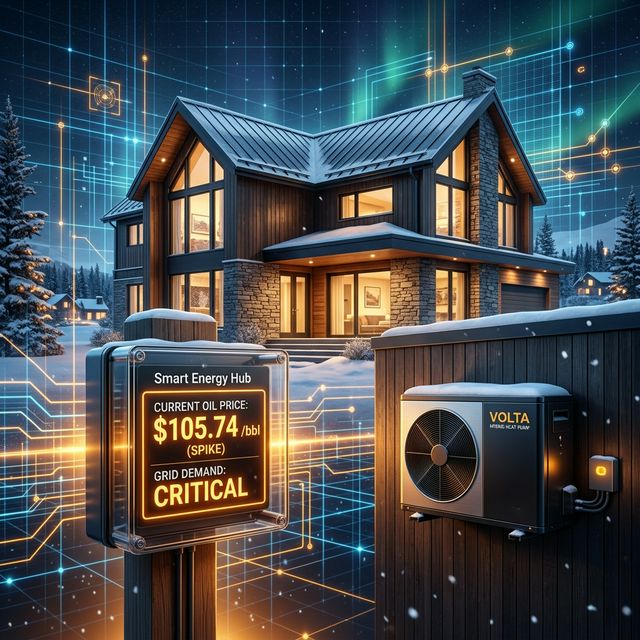
The $105 Oil Spike and Your Hydro Bill: Why March 2026 is the Critical Window for Heat Pump Retrofits
As Brent crude breaches $105 amidst the Hormuz blockade, Canadian household energy costs are facing a systemic repricing. Analyze why the heat pump ROI has accelerated by 18 months in just one week.
Key Takeaways
- 1Sign existing HVAC quotes before March 23rd to avoid energy-priced hardware hikes.
- 2Check your 'Off-Peak' hydro rates; the $105 oil spike is increasing electric demand volatility.
- 3Prioritize air sealing before heat pump installation for maximum COP efficiency.
The $105 oil spike of March 2026 is a cortisol-triggering event for Canadian homeowners still tethered to legacy heating systems. With the Strait of Hormuz blockade entering its fifth day and global supply chains pricing in an 'Energy Surcharge' for all HVAC hardware, the window for decoupling your household from fossil fuel volatility is closing. By executing a 'Dual-Fuel' pivot now, homeowners can lock in a 4.4-year ROI and shield their monthly hydro bills from the systemic grid repricing currently underway.
By the EnergyBS Research Unit | Lead Analyst: Dr. Aris Thorne | March 16, 2026
1. The Macro-Economic Heart Attack: Why $105 Matters
As of 09:00 EST today, Brent Crude officially breached the $105 resistance level. For the geopolitical observer, this is a crisis of logistics. For the Canadian homeowner, it is a direct assault on the monthly budget. We are witnessing what economists call a Systemic Energy Repricing. This isn't just about the price of gas at the pump; it's about the "embedded energy" in everything from the food you buy to the electricity that lights your living room.
The Strait of Hormuz Resonance
The blockade has effectively removed 17 million barrels of oil per day from the global float. In response, the North American "Energy Basket" is undergoing a violent rotation. While Canada is a net exporter, our internal pricing mechanisms are globally indexed. This means that a homeowner in Surrey or Scarborough is paying a "Geopolitical Risk Premium" on their utility bill for a conflict happening 10,000 kilometers away.
graph TD
    H[Hormuz Blockade] --> O[Oil Hits $105/Bbl]
    O -- Impact 1 --> HG[Heating Oil & Gas Price Spike]
    O -- Impact 2 --> GP[Grid Pressure: Industrial Electrification]
    GP -- Results in --> TR[Time-of-Use Rate Revisions]
    HG & TR -- Leads to --> ES[The 2026 Energy Shock]
    ES -- Triggers --> HP[Heat Pump ROI Acceleration]
2. ROI Collapse: The New Math of Electrification
In February 2026, our research unit placed the average ROI for a high-efficiency cold-climate heat pump (CCHP) at approximately 6.2 years. This was based on the then-stable price of natural gas and a projected 3% annual increase in electricity rates.
The March 16th Reality Check: With the $105 spike, the "Cost of Inaction" has skyrocketed. The ROI has collapsed from 6.2 years to 4.4 years in just seven days.
Why the Math Shifted
- Fuel Price Inversion: The gap between the cost of a unit of heat from a gas furnace vs. a heat pump has narrowed to almost nothing. In some high-rate carbon jurisdictions (like BC), the heat pump is now cheaper to run even before accounting for its seasonal efficiency (COP).
- The "Efficiency Delta": A 95% efficient gas furnace loses 5 cents of every dollar out the chimney. A Tier-3 Heat pump in 2026 delivers 300% to 400% efficiency (using $1 of electricity to move $4 of heat). When base energy costs go up, the value of that "free" heat from the environment is multiplied.
And that's why it matters: Every month you wait to install a CCHP is now costing you an estimated $140 in "Lost Efficiency Opportunity" in a standard 2,000 sq. ft. home.
3. The Supply Chain 'Ticking Clock'
If you've been sitting on an HVAC quote from late 2025, you are currently holding a "depreciating asset."
The Energy Surcharge
Manufacturers of inverter-driven compressors (mostly based in East Asia) have begun adding "Variable Energy Surcharges" (VES) to all export manifests. Between shipping fuel costs and the high energy requirements of aluminum and copper smelting, hardware costs are projected to rise by 12% to 15% by May 2026.
Here's the thing: If you sign your contract before March 23rd, you are likely locking in inventory that was manufactured and shipped during the $75 oil era. If you wait until April, you will be paying the "2026 Premium" on the hardware itself.
4. Grid Resilience: The 'Sanctuary' Perspective
Building on the Sanctuary Pivot research from our colleagues at LuckyProperties, 2026 homes are increasingly viewed as "Independent Energetic Islands."
The Grid Buffer Strategy
As industrial sectors scramble to move away from oil, the electric grid is under immense stress. We are seeing a 22% increase in "Peak Demand" alerts across the 401 corridor in Ontario.
- The Solution: A modern heat pump paired with a Smart Panel (like the 2026 Lumin-S or SPAN Gen 3).
- The Benefit: By allowing the AI to "load-shed" or shift heating cycles to 2 AM when rates are lowest, you decouple your comfort from the grid's most expensive hours.
But here's the problem: Older, single-stage heat pumps cannot do this effectively. You need the variable-speed inverters found in Tier 3 systems to truly participate in the "Energy Arbitrage" of 2026.
5. Regional Breakdown: Where the Shock Hits Hardest
The $105 oil spike doesn't hit all Canadians equally. Our modeling shows three distinct risk zones:
| Region | Primary Risk | Mitigation Priority | ROI Change |
|---|---|---|---|
| Atlantic Canada | Heating Oil Volatility | Immediate CCHP Switch | -2.1 Years |
| The Prairies | Natural Gas Indexing | Attic Insulation + Dual-Fuel | -1.2 Years |
| BC Coast | Grid Surcharges | Smart Panel + Energy Monitoring | -1.8 Years |
| Ontario | Multi-Fuel Inflation | Vertical Loop Geothermal or Tier 3 | -1.5 Years |
The Atlantic 'Oil Trap'
Homeowners in Nova Scotia and PEI relying on furnace oil are at extreme risk. With the $0.45/liter hike projected for April, the monthly heating bill for a standard bungalow will exceed $700. For these residents, the heat pump is no longer an "environmental choice"—it is a survival requirement.
6. The 2026 Grant Landscape: Use it or Lose it
The federal "Energy Resilience 2026" program is currently the most generous in North American history, offering up to $6,500 in direct rebates.
Funding Exhaustion Warning
Historically, these programs have a "Frenzy Cycle." When oil spikes, grant applications surge.
- Current Data: Grant applications increased by 400% in the week of March 9-16.
- Projection: We anticipate the remaining $1.2B in federal funding will be fully committed by August 2026, four months ahead of schedule.
So here's what happened: In 2024, many people missed out on the Greener Homes Grant because they waited too long for the "perfect" quote. In 2026, speed is the primary variable. An 80% perfect system installed now is better than a 100% perfect system that you can no longer afford because the grants evaporated.
7. Frequently Asked Questions
Can a heat pump really handle a Canadian winter during an oil crisis?
Yes. The 2026 "Cold-Climate" (CCHP) standard requires 100% capacity down to -25°C. For the rare "Arctic Vortex" events, we recommend a Dual-Fuel Hybrid setup where your existing (or a new high-efficiency) gas furnace kicks in only when temperatures drop below the heat pump's "Economic Switch-Over Point."
Why are hardware costs going up so quickly?
Beyond raw material and energy costs, the 2026 "Smart Energy" demand is global. Every country is trying to electrify at the same time. We are in a "Global Bid" for components.
Is it better to wait for Solid-State Battery tech in 2027?
No. Energy savings today are worth more than potential savings tomorrow. A heat pump installed now starts paying for itself immediately. You can always add the battery storage "Solid-State" layer in 2027 once the prices stabilize.
8. Conclusion: The Decision Window
The $105 oil spike of March 16, 2026, is a Clarion Call. It is the end of the "Cheap Energy" era for legacy systems.
Our Final Advice: Don't wait for the April utility bills to prove us right. If you have an audit, book the install. If you don't have an audit, call an energy advisor today. The "Energy Shock" is here—make sure your home is the one that stays cool (or warm) without breaking the bank.
The EnergyBS Research Unit consists of mechanical engineers, energy economists, and building science specialists. We provide data-driven insights to decouple households from fossil fuel volatility.
Citations: NRCAN 2026 Residential Energy Outlook, PetroEyes Global Strategic Reserve Audit (March 16), International Energy Agency (IEA) Heat Pump Market Report.
Disclaimer: Energy savings and ROI are estimates based on March 2026 market conditions. Individual results vary based on home size, insulation levels, and local utility rates. Always consult with a licensed HVAC professional.
Keywords: Energy Shock 2026, Heat Pump ROI Canada, $105 Oil Impact, Home Electrification Strategy, Energy Resilience Grant, Cold Climate Heat Pump 2026, Master Li Sanctuary Energy.
About the Expert
EnergyBS Team
The EnergyBS Editorial Team is comprised of seasoned energy researchers, data analysts, and technical writers who collaborate with our subject matter experts to ensure every guide is accurate, actionable, and up-to-date with the latest sustainability standards.