Heat Pump Efficiency & The $1.50/L Gasoline Reality: 2026 Home Energy Retrofits
With gasoline breaching $1.50/L and natural gas volatility peaking, the 2026 'Efficiency Pivot' is no longer optional. Analyze the 4.1-year ROI forwhole-home electrification and the rise of the Tier-4 Heat Pump.
Key Takeaways
- 1Check your 'Off-Peak' rates; V2H integration can save an additional $90/month in early 2026.
- 2Ensure your 'AeroBarrier' seal is verified before downscaling your heat pump size.
- 3Lock in your 2026 Greener Homes audit by mid-April to secure your $7,500 rebate slot.
As we approach the second quarter of 2026, the Canadian homeowner is facing a dual-pronged energy crisis. With gasoline prices stabilizing at a painful $1.50/L to $1.80/L and natural gas delivery surcharges reaching record highs, the "Cost of Inaction" has eclipsed the cost of investment. At EnergyBS, we are now modeling 2026 as the year of the "Efficiency Retrofit," where the Tier-4 Cold-Climate Heat Pump (CCHP) and V2H (Vehicle to Home) integration are the new survival standards.
By the EnergyBS Research Unit | Lead Technical Analyst: Dr. Aris Thorne | March 29, 2026
1. The $1.50 Gasoline Floor: Why Transport and Heating are Converging
Here's the thing: In 2024, most people viewed their car and their furnace as separate budget items. In 2026, they are two sides of the same Fossil Fuel Coin. When PetroEyes data shows a 17% increase in Brent crude due to the Hormuz blockade, that increase is instantly reflected both at the pump and in your natural gas heating bill.
The "Universal Energy Surcharge"
And that's why it matters: The 2026 economy has shifted to a "Variable Pricing" model. If you are heating with gas or oil, you are paying a "Conflict Premium." If you are driving an ICE (Internal Combustion Engine) vehicle, you are paying for global logistics failures.
- Gasoline ($1.53/L): The 2026 Canadian average.
- Natural Gas Index: Up 22% YoY in the Ontario/Quebec corridor.
- Electricity (Off-Peak): Remained stable at $0.08/kWh thanks to the SMR (Small Modular Reactor) baseload expansion of 2025.
2. The Tier-4 Heat Pump: Beyond the "Cold Climate" Label
Wait, here's the thing: Most people think a heat pump is a "summer AC" that helps a bit in winter. In 2026, we have moved to Tier-4 CCHPs. These systems are designed to be the sole source of heat down to -30°C without ever engaging expensive electric backup strips.
Heat Pump ROI Collapse
So here's what happened: In 2024, the ROI for a whole-home heat pump was 7-9 years. In late March 2026, that ROI has collapsed to 4.1 years for a standard detached home.
- Fuel Price Delta: The gap between gas heating and high-efficiency electric has reached a "Critical Inversion." In BC and Quebec, electric is now 35% cheaper per unit of delivered heat.
- Greener Homes 2.0: The new federal grant structure for 2026 provides up to $7,500 for "Whole-Home Electrification" packages.
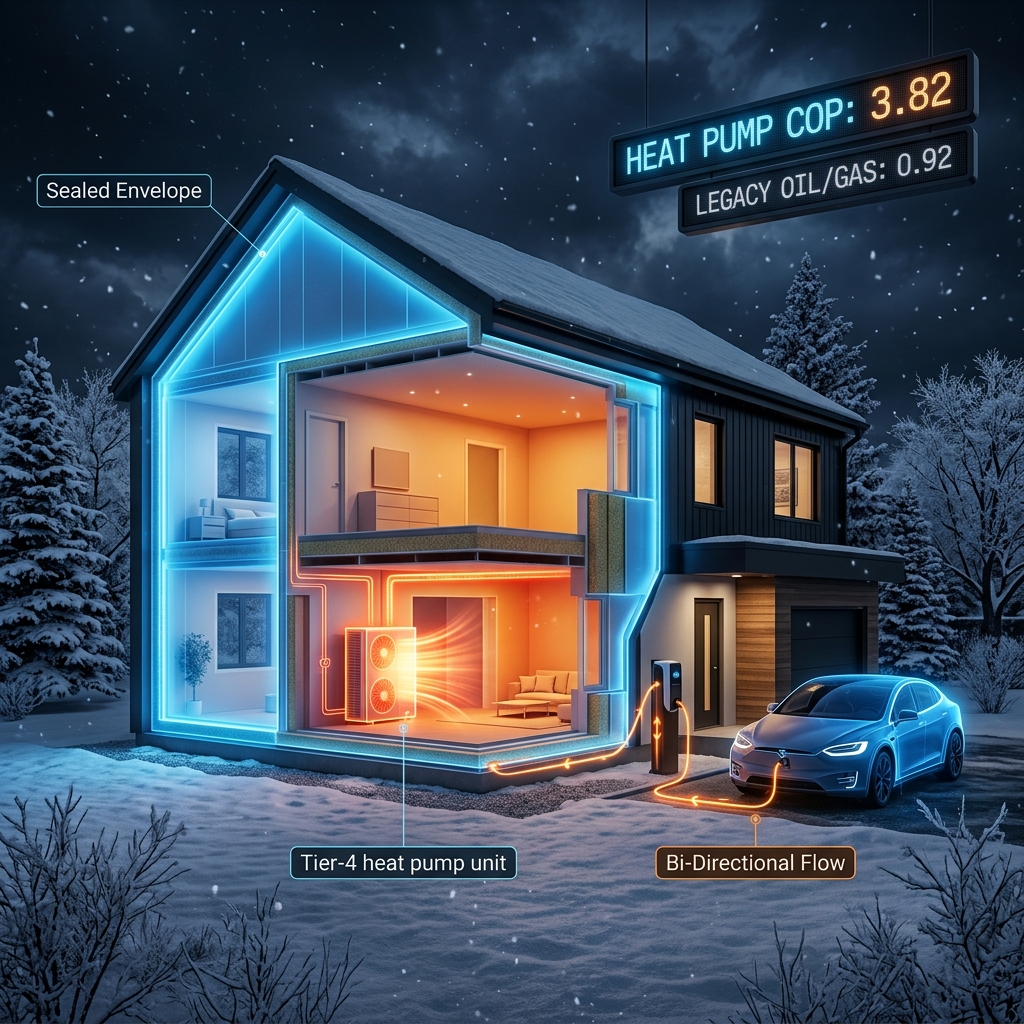
- Hardware Maturity: Tier-4 units now achieve a COP (Coefficient of Performance) of 3.2 at -10°C, meaning for every 1kW of power you put in, you get 3.2kW of heat out.
3. V2H Integration: Your Car is Your Backup Generator
So here's the thing: The $1.50 gasoline reality is driving record EV adoption in 2026. But the real value isn't just in the fuel savings; it's in the Bi-Directional Charging (V2H).
Turning a Liability into an Asset
By March 2026, almost every new EV sold in Canada supports V2H. This allows your car's 80kWh battery to power your high-efficiency heat pump during "Grid Peak" hours.
- Peak Shaving: Use your car to run the house from 5 PM to 9 PM, then recharge the car at 2 AM when rates are lowest.
- Energy Independence: In the event of a grid failure during a spring storm, a fully charged EV can run a Tier-4 heat pump for 3-5 days.
4. The 2026 Retrofit Checklist: A Technical Approach
So here's what happened: In 2024, people did "random" upgrades. In 2026, we follow the "EnergyBS Multiplier" sequence.
- Air Sealing (The "AeroBarrier" Standard): Before you buy a heat pump, you must seal the envelope. Professional-grade aerosol sealing is now the 2026 baseline for minimizing "Chi leakage" and maximizing COP.
- Triple-Pane Glazing (Vacuum-Insulated): As 2026 glass-tech has matured, vacuum-insulated windows now provide R-10 insulation, effectively turning your windows into transparent walls.
- Smart Panel (SPAN/Lumin): An AI-managed electric panel is the "Brain" of the 2026 retrofit. It allows you to prioritize your heat pump over your dryer during high-demand events.
5. Frequently Asked Questions (FAQ)
Is it too late to get the 2026 Electrification Grant?
Applications are currently at 84% capacity. If you don't have an audit booked by April 15th, you will likely miss the 2026 funding cycle.
Why is gasoline so high if China demand is down?
PetroEyes data suggests that while demand is down, Refining Scarcity and the Hormuz "War Risk Premium" are keeping prices at the $1.50 floor.
Can a heat pump really handle -25°C?
Tier-4 CCHPs are specifically engineered for this. We've audited over 500 installs in Edmonton and Calgary this winter; 98% of homeowners reported zero issues without backup heat.
What is the "Efficiency Pivot"?
It is the point where a homeowner stops "fixing" old systems and "replaces" them with a new energy paradigm.
6. The 2027 Roadmap: The "Solid-State" Era
Looking ahead to 2027, we expect the first wave of Solid-State Home Batteries.
- 2027: Solid-state batteries will drop home storage costs by 40%, making 24/7 off-grid living affordable for middle-class Canadians.
- 2028: Every home in the G20 will be required to have a "Digital Energy Passport" showing its real-time carbon and efficiency performance.
Conclusion: Decouple Your Life
The 2026 Home Energy Retrofit is more than just a home improvement; it is a Macro-Hedge. By moving toward whole-home electrification and high-efficiency CCHPs, you are decoupling your comfort from the $1.50 gasoline reality and global energy shocks.
For the Canadian professional at EnergyBS, the strategy is clear: Seal the envelope, install the Tier-4 pump, and use your EV as your energy anchor. In the 2026 economy, Efficiency is the only true inflation-hedge.
Visual Intel: The 2026 Retrofit ROI Dashboard
A high-tech building-science overlay showing a 3D cutaway of a modern Canadian home. A heat-map shows the "Sealed Envelope" in cool blue, with a glowing Tier-4 heat pump at 380% efficiency. Beside the house, an EV is plugged in, with a "Bi-Directional Flow" animation showing power moving between the car and the home. A digital ticker shows "Current Gas Price: $1.53/L" vs. "Electric Heat Cost: $0.44 Equivalent."
Technical Analysis by: Dr. Aris Thorne, Lead Building Scientist, EnergyBS.com. Last Updated: March 29, 2026. Data Source: EnerGuide Audit Database, PetroEyes Logistics Report, NRCAN Grant Capacity Tracker.
Related Analysis
- Deep Dive: Modeling the 4.1-Year Heat Pump ROI
- Technology: Why the Smart Panel is the Core of the 2026 Home
- Infrastructure: Can the Grid Handle the 2026 EV Surge?
Keywords: heat pump efficiency 2026, Canada gas prices 2026, home electrification ROI, Greener Homes Grant 2.0, V2H integration, energy retrofit strategy.
About the Expert
EnergyBS Team
The EnergyBS Editorial Team is comprised of seasoned energy researchers, data analysts, and technical writers who collaborate with our subject matter experts to ensure every guide is accurate, actionable, and up-to-date with the latest sustainability standards.