Basement Waterproofing Cost 2026: What Installation Really Costs
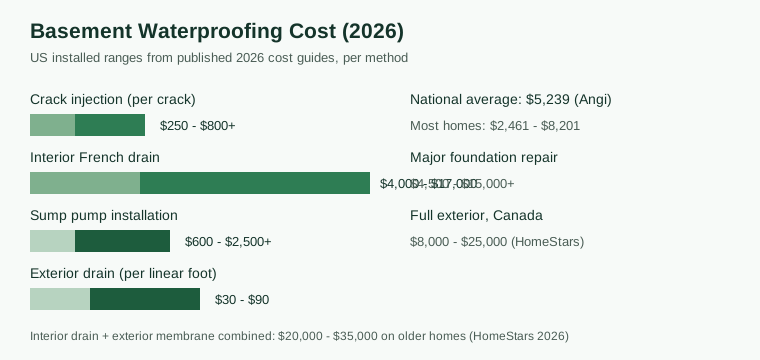
Waterproofing a basement in 2026 averages $5,239 in the US (Angi, updated July 2026), with most homeowners paying $2,461 to $8,201. This guide prices every method: crack injection at $250 to $800+ per crack, interior drains at $4,000 to $17,000, exterior membranes at $100 to $300 per linear foot in Canada, and the fullsystem math that moves quotes past $15,000. Includes interiorvsexterior decision logic, Canada pricing, rebates, and a 13point quote checklist.
Quick Checks
- 1Budget $5,239 as the US national average for basement waterproofing in 2026. Angi puts the working range at $2,461 to $8,201, with minor crack fixes starting near $600 and full exterior systems reaching $15,000 and up.
- 2The method moves the price more than the house does. Epoxy crack injection runs $250 to $800+ per crack in US data, an interior French drain $4,000 to $17,000, and exterior drains $30 to $90 per linear foot in HomeGuide's 2026 guide.
- 3In Canada, HomeStars puts interior drainage at $3,000 to $10,000 and full exterior excavation and waterproofing at $8,000 to $25,000, with per-linear-foot pricing of $70 to $230 inside versus $100 to $300 outside.
- 4Fix the outside water before paying to seal the inside. Regrading at $1,000 to $5,000 plus downspout work at $220 to $625 can eliminate the problem that a $10,000 interior drain would only manage.
- 5Insurance does not cover it. Standard homeowners policies exclude seepage and groundwater damage, so waterproofing is maintenance money, not a claim, and the system needs to earn its place on lifespan: 10 to 30+ years for interior drains and sump systems, 10 to 15 for exterior membranes.
Basement Waterproofing Cost 2026: What Installation Really Costs
By EnergyBS Editorial Team | October 11, 2026
The Short Answer
Short Answer: Basement waterproofing costs $5,239 on average in the US in 2026, with most homeowners paying between $2,461 and $8,201 in Angi's 2026 data (updated July 20, 2026). Minor fixes like crack injection start near $600, while a complete exterior system can total $15,000 or more. The method decides the number more than the house does: epoxy crack injection runs $250 to $800+ per crack in HomeGuide's 2026 guide, an interior French drain $4,000 to $17,000, and exterior drain systems $30 to $90 per linear foot. In Canada, HomeStars' 2026 guide puts interior drainage at $3,000 to $10,000 and full exterior excavation and waterproofing at $8,000 to $25,000. This guide prices every method, compares interior and exterior with the actual numbers, and lists the add-on lines that move quotes apart.
A dry basement earns a place on an energy site for four reasons. Wet insulation is worthless insulation: fiberglass in a damp wall assembly loses thermal resistance and breeds mold, so the money spent on basement insulation and air sealing below grade sits directly downstream of waterproofing. A chronically damp basement runs a dehumidifier or a sump pump on the electric meter for as long as it stays damp, turning a one-time project into a permanent load. Below-grade moisture is also the transport system for radon and mold spores into the living space. And waterproofing is the one retrofit where doing the wrong scope first can strand thousands of dollars, because sealing a crack while the water enters at the floor joint buys nothing at all.
1. Price by Method: The Menu and What Each Line Buys
HomeGuide's 2026 guide prices eight distinct methods. No single home needs all eight, and almost every real project is a combination of two to four. Read this table as the menu the contractor is ordering from.
| Method | Installed cost, US (HomeGuide 2026) | What it is |
|---|---|---|
| Epoxy/polyurethane crack injection | $250 to $800+ per crack | Seals a single non-structural crack from the inside |
| Waterproof paint / concrete sealer | $2 to $10 per sq ft | Surface coating on interior walls; dampness only |
| Waterproof membrane | $4 to $7 per sq ft installed | Sheet or liquid barrier on exterior foundation walls |
| Sump pump installation | $600 to $2,500+ | Pump in a floor basin, moves collected water out |
| Exterior French drain | $30 to $90 per linear foot | Trenched drain intercepting water before the wall |
| Interior French drain | $4,000 to $17,000 | Perimeter channel under the slab edge, piped to a sump |
| Regrading around the house | $1,000 to $5,000 | Reshapes soil so surface water runs away from the wall |
| Foundation leak repair | $250 to $5,000+ minor; $4,500 to $15,000+ major | Structural-scope repairs at the water source |
The Canadian table from HomeStars' 2026 guide reads in the same shape with its own numbers:
| Method | Cost, Canada (HomeStars 2026) |
|---|---|
| Crack injection (per crack) | $500 to $1,500 |
| Interior drainage system | $3,000 to $10,000 |
| Sump pump installation | $1,200 to $3,000 |
| Backwater valve installation | $1,600 to $3,500 |
| Window well installation (per window) | $1,600 to $3,800 |
| Exterior waterproofing (per linear foot) | $100 to $300 |
| Full exterior excavation and waterproofing | $8,000 to $25,000 |
Canada adds two lines that do not appear in the US table. The backwater valve is a one-way device in the sewer lateral that blocks municipal sewage from backing up into the basement during heavy rain, and the window well line covers wells and drains at below-grade windows, a common entry point that gets misdiagnosed as wall seepage. Both sit on the flood-protection side of waterproofing rather than the dampness side, and both commonly carry municipal rebate eligibility, covered in section 10.
2. Price by Scope: Four Situations, Four Budgets
Contractors quote the situation, not the table above. HomeStars' 2026 Canada guide frames total project costs by situation, which is the more useful way to budget:
| Situation | Typical total cost, Canada (HomeStars 2026) |
|---|---|
| Small home, minor seepage, interior repair | $1,200 to $4,000 |
| Average detached home, interior drainage system | $4,000 to $13,000 |
| Average detached home, full exterior waterproofing | $15,000 to $25,000 |
| Older home with foundation damage, combined approach | $20,000 to $35,000 |
Angi's US data supplies the size ladder that explains the spread. At $3 to $10 per square foot, a 500-square-foot basement lands at $1,500 to $5,000, 1,000 square feet at $3,000 to $10,000, 1,500 square feet at $4,500 to $15,000, and 2,000 square feet at $6,000 to $20,000. The 1,000-square-foot row brackets Angi's national average of $5,239 almost exactly, which is a useful check: the average project is an average-sized basement at a middle method.
A labeled hypothetical shows why quotes for the same basement can sit far apart. Take a 1,200-square-foot basement with a 120-linear-foot perimeter and water entering along the wall-floor joint:
- Interior path: interior drain at HomeStars' $70 to $230 per linear foot puts 120 linear feet at $8,400 to $27,600, plus a sump at $1,200 to $3,000, for a combined $9,600 to $30,600 installed. The wide band is excavation labor, concrete thickness, and access.
- Exterior path: exterior membrane at $100 to $300 per linear foot puts 120 linear feet at $12,000 to $36,000, plus separate excavation at $1,500 to $5,000 where the waterproofing company subcontracts it out, plus restoration at $500 to $2,000, for a combined $14,000 to $43,000.
Both numbers are real. They describe different projects, not different prices for the same project. The comparison a homeowner actually needs is in section 5.
3. The Diagnosis Order That Saves Money
Most overpaid waterproofing jobs share one cause: the contractor priced a treatment before naming the entry point. The order below costs nothing and it separates the $600 fix from the $10,000 one.
Start outside, at grade. Walk the perimeter after rain. Water pouring off a roofline without gutters, downspouts discharging at the foundation, soil sloping toward the wall, and a driveway pitched at the garage door are surface-water problems, and surface water is the cheapest water to move. Regrading at $1,000 to $5,000 and downspout replacement or extension at $220 to $625 (HomeGuide) can end seepage that would otherwise be priced as an interior-drain job. The EPA's guidance on moisture control says the same thing in plainer language: fix leaks and drainage at the source before spending money on what sits downstream.
Then look for the single entry point. A crack that weeps in one spot during storms, with dry walls everywhere else, is the one case where injection earns its price. HomeGuide prices epoxy injection at $250 to $800+ per crack, and HomeStars notes polyurethane suits active leaks while epoxy suits cracks needing structural reinforcement. HomeStars' key insight applies here: injection is cost-effective only when the crack is the actual entry point. Where water enters along the floor-wall joint or through multiple points, injection alone will not hold, and the $800 crack repair becomes the prelude to a $10,000 drainage job. Several crack repairs should be quoted per crack with a ceiling, not per visit.
Then price the system for the pattern. Water arriving along the full perimeter during wet seasons is a drainage problem, not a crack problem. The choice is interior management versus exterior prevention, and that choice is section 5. Water that arrives as standing inches after storms is a flood problem: sump capacity, backwater valves, and discharge, not wall coatings.
Never buy paint for a pressure problem. HomeGuide is explicit that sealers and waterproof paint create a barrier against moisture but will not stop water under pressure. A $2-to-$10-per-square-foot coating is a fine layer inside a real system. As the entire system it is a temporary cosmetic, and it should be sold as one, not as waterproofing.
4. Interior vs Exterior: Manage the Water or Stop the Water
This is the central decision in basement waterproofing, and the two options do different work at different prices.
Interior waterproofing manages water after it enters. A perimeter channel under the slab edge collects what comes through the wall-floor joint and routes it to a sump pit. HomeStars prices interior work at $70 to $230 per linear foot, and its interior drainage band of $3,000 to $10,000 applies to a typical detached home. It is less disruptive, less expensive, and practical where excavation is not feasible: narrow side yards, attached garages, shared lot lines, mature landscaping worth preserving. Its real limitation is that the wall still gets wet. The water enters the masonry, and the system intercepts it before it reaches the living space. Below-grade insulation on that wall still sits against a wet surface.
Exterior waterproofing stops water before it reaches the wall. Excavation exposes the foundation, a membrane or drainage board goes on, and the weeping tile is replaced before backfill. HomeStars prices exterior work at $100 to $300 per linear foot, with full exterior excavation at $8,000 to $25,000. It costs more and the digging is substantial, but it is the more thorough, longer-protection option. It is generally the right call where the original exterior membrane has failed on an older home, where interior repairs have not held, or where structural concerns sit alongside the moisture.
In practice the two are often combined. An exterior membrane addresses the primary entry point while an interior drain and sump handle residual moisture. HomeGuide puts full-system thinking at the high end of its data for exactly this reason.
The foundation material moves both prices. HomeGuide notes poured concrete is easier and cheaper to waterproof than block, which has more seams and joints, while stone foundations with irregular surfaces present the biggest challenge and the highest costs. This is one reason two quotes for the same street can differ: the 1920s block foundation and the 1990s poured wall are different jobs.
5. The Lines Outside the Quote: What Else Shows Up on the Bill
Waterproofing projects draw a crowd of trades. HomeStars' 2026 Canada guide names four, and Angi's 2026 data prices the repair side.
- Excavation contractor. Some waterproofing companies dig in-house; others subcontract. Where separate, budget $1,500 to $5,000 depending on depth, soil, and access (HomeStars). Confirm before signing, because a quote without excavation and a quote with it are not the same project.
- Structural engineer. Significant cracking, bowing walls, or stepped cracks through block mean an assessment before any waterproofing contract: $300 to $700 (HomeStars). A contractor who does not raise it when the damage looks serious is a contractor to interview further.
- Landscaper / site restoration. Backfill is not a lawn. Restoration after exterior excavation runs $500 to $2,000 on a typical project (HomeStars), and HomeGuide prices replacement sod and planting at $300 to $1,000+. Confirm whether the quote includes it.
- Mold remediation. Where water has been entering for a while, remediation precedes waterproofing and is priced separately: $500 to $6,000 for a residential basement (HomeStars), $500 to $3,500 (Angi), $1,500 to $15,000 (HomeGuide). The range reflects severity and area. The EPA's rule applies: wet materials dried within 24 to 48 hours usually avoid mold; beyond that, remediation enters the scope.
- Water damage repairs. Angi budgets $1,360 to $6,290 for repairing what the water already ruined: finished walls, flooring, and trim that must be rebuilt after the waterproofing goes in.
- Dehumidifier. Portable units run $130 to $300; whole-house units installed run $1,500 to $3,500 (HomeGuide). A chronically damp basement often needs one as part of the system. Our whole-house dehumidifier cost guide prices the installed units and the sizing math.
- Permits. Typically $100 to $500 in Canada (HomeStars) and $150 to $500 in Angi's US data. Required for structural foundation work or drainage modifications in many municipalities.
- Backwater valve and sump rebates. Section 10 covers these; they subtract rather than add, but only with pre-approval.
One bundling note from the sump-pump side applies here. A waterproofing project that needs a sump pit should price the pump, the battery backup, and the alarm on the same contract. Our sump pump installation cost guide prices replacement at $400 to $700 but a first-time pit cut into a concrete floor at $2,500 to $5,000. Fitting the pit while the floor is already open for an interior drain costs far less than opening the floor twice.
6. Running and Ownership Costs: The Part After Installation
The purchase price is the down payment. The system keeps a small account on the electric meter for as long as it works.
Sump pump electricity. A pump draws real power only while running. On the math in our sump guide, a pump drawing 6 amps at 120 volts uses about 0.72 kilowatts while pumping; at a labeled example of 15 running minutes a day, that is roughly 66 kilowatt-hours a year, on the order of $11 at a 17-cent example rate. The number is small by design. A pump that adds hundreds of dollars to a bill is running continuously, which signals a switch, valve, or discharge fault, not a cost of ownership.
Dehumidifier electricity. A whole-house dehumidifier is a refrigeration appliance with a fan, and its draw is the operating cost of every system that manages rather than prevents moisture. This is the energy-site argument for exterior waterproofing where the house supports it: a wall that never gets wet needs no machine running to keep the air below 60 percent relative humidity, the EPA's line for mold control.
Battery and maintenance. Backup batteries are consumables on a 3-to-5-year clock. Sump switches and check valves are wear parts in the tens of dollars. Interior channels need their cleanouts; exterior systems need their discharge outlets kept clear.
Lifespan. HomeGuide puts quality systems at 10 to 30 years or more, with a split inside that band: exterior waterproof membranes typically last 10 to 15 years, while interior French drains and sump pumps can function for 20 to 30 years with upkeep. A labeled hypothetical on ownership shows why the cheaper installation can be the more expensive system. An interior drain at $10,000 lasting 25 years costs $400 a year of purchase price before running costs. An exterior membrane at $20,000 replaced once at year 13 costs $1,538 a year of purchase price over the same 26 years, before the second excavation's disruption. Lifespan belongs in the comparison next to the installation price, not after it.
7. Insurance, Value, and Rebates: Three Money Questions Answered
Insurance. Standard homeowners insurance does not cover basement waterproofing or damage from seepage and flooding. HomeGuide states it plainly: groundwater, drainage, and preventable maintenance problems are excluded, and coverage against flooding comes from separate flood insurance. Sudden pipe bursts are the exception that some policies cover. Read the policy's water exclusion before assuming anything, and treat waterproofing as maintenance money from the start.
Resale value. Waterproofing makes a home more attractive to buyers: a dry basement is usable square footage and a signal the house was maintained. But HomeGuide's FAQ advises against pricing it as a value-add renovation, because buyers will not recoup the full cost at resale. Buy it as protection for the foundation, the insulation, and the finished space below grade, and let any buyer premium be a bonus.
Rebates. Canada has real money here, with one strict rule. HomeStars notes many municipalities subsidize sump pump and backwater valve installation, typically with pre-approval required before work begins. The named example is Toronto's Basement Flooding Protection Subsidy Program: up to 80 percent of eligible installation costs, with a maximum of $6,650 per property as of May 2026. A rebate applied for after the fact is usually ineligible. Check the city program before the first shovel, not after the final invoice.
8. Timing, Season, and How to Buy the Project
Buy in the slow season. HomeStars' 2026 guide notes waterproofing contractors are busiest in spring and early summer, when water damage is most visible. Booking in late summer or fall, when demand drops, can mean better pricing or faster scheduling. The work is also less miserable then: open excavation in a dry week is a different project than excavation in a wet one.
Interview on diagnosis, not just price. The quote checklist in section 9 is the tool. A contractor who names the entry point, explains why the chosen method fits that point, and prices excavation, restoration, and permits as named lines is the contractor the checklist is built to find. HomeGuide's own contractor questions include the minimum fee for an inspection, which methods are recommended and why, whether structural problems threaten the wall, and whether the estimate covers materials, labor, delivery, and cleanup in writing.
Get the warranty in named terms. HomeStars notes many contractors back injection work with a multi-year warranty, which is worth getting in writing with its exclusions: what voids it, whether it transfers to the next owner, and whether it covers the wall, the system, or both. A lifetime warranty that excludes hydrostatic pressure is a marketing document.
9. The 13-Point Quote Checklist
- Entry point named: where exactly is the water entering, in the contractor's words.
- Method matched to the entry point: crack injection only for isolated cracks that are the actual entry; drainage for joint and perimeter entry; exterior where the membrane has failed.
- Interior or exterior rationale: why the chosen side, with lot constraints named where excavation is ruled out.
- Linear footage measured: the perimeter length the price is based on, verifiable on the property.
- Excavation: in-house or subcontracted, with its cost named; soil, depth, and access noted.
- Materials specified: membrane type, drain pipe diameter, sump pump model and horsepower, backwater valve where applicable.
- Sump backup: battery or water-powered backup priced on the same contract where a pit goes in; battery replacement interval in writing.
- Discharge route: where the water goes, with the municipal rule on sewer discharge answered (many municipalities prohibit sump discharge to the sanitary sewer).
- Mold and damage: remediation and repair lines priced separately before the waterproofing work starts.
- Permits and inspection: required or not at the address, and who pulls them.
- Restoration: lawn, planting, driveway, and interior floor patching named as included or excluded.
- Warranty: term, coverage, exclusions, and transferability in writing.
- Payment terms: tied to milestones with the final payment after a water test, not after the trench is closed.
A quote missing lines 1, 3, 5, and 9 is not yet comparable to one that has them. The cheapest complete quote describing the same scope is the one to buy.
Frequently Asked Questions (FAQ)
How much does basement waterproofing cost in 2026?
In the US, Angi's 2026 data puts the average at $5,239, with most homeowners paying $2,461 to $8,201. Minor crack fixes start near $600; full exterior systems reach $15,000 and up. In Canada, HomeStars puts minor interior seepage repair at $1,200 to $4,000, an interior drainage system at $4,000 to $13,000, full exterior waterproofing at $15,000 to $25,000, and combined approaches on older homes at $20,000 to $35,000. Method bands: crack injection $250 to $800+ per crack (US) or $500 to $1,500 per crack (Canada); interior French drain $4,000 to $17,000 (US); exterior drain $30 to $90 per linear foot (US) or $100 to $300 per linear foot (Canada).
Is interior or exterior waterproofing better?
They do different work. Exterior waterproofing stops water before it reaches the wall and is the more thorough, longer-protection option, but it costs more and requires excavation: $100 to $300 per linear foot in Canada against $70 to $230 inside (HomeStars). Interior waterproofing manages water after entry and redirects it away, and it is the practical choice where excavation is blocked by lot conditions, attached structures, or budget. Combine them where the budget allows: an exterior membrane on the primary entry point plus an interior drain and sump for residual moisture. The right one depends on where the water enters, which the diagnosis order in section 3 is built to establish first.
Does homeowners insurance cover basement waterproofing?
No. Standard homeowners policies exclude damage from seepage, groundwater, and drainage problems, and waterproofing itself is maintenance, not a covered loss. Separate flood insurance covers flooding. A sudden pipe burst is the exception some policies cover. Check the water exclusion in the actual policy.
How long does basement waterproofing last?
HomeGuide puts quality systems at 10 to 30 years or more, with exterior waterproof membranes typically lasting 10 to 15 years and interior French drains and sump pumps running 20 to 30 years with regular upkeep. Section 6 works the ownership math: a $10,000 interior system lasting 25 years costs $400 a year of purchase price, while a $20,000 exterior system replaced once at year 13 costs $1,538 a year over 26 years, before disruption. Lifespan belongs in the comparison.
Can I just seal the walls with waterproof paint?
For minor dampness, as a layer inside a real system, yes. As the whole system against water under pressure, no. HomeGuide is direct: sealers create a barrier against moisture but will not stop water under pressure. Paint over a wall that weeps through the floor joint hides the symptom until the coating fails, which it will. Paint belongs on the maintenance shelf, not the waterproofing contract.
When is crack injection enough?
When one non-structural crack in a poured wall is the actual, verified entry point and the rest of the wall stays dry. Injection costs $250 to $800+ per crack in US data (HomeGuide) or $500 to $1,500 per crack in Canada (HomeStars). It is not enough where water enters along the floor-wall joint, through multiple cracks, or through a block foundation, in which case it becomes the prelude to a drainage project rather than the solution. Several cracks should be quoted per crack with a ceiling.
What time of year should I do it?
Late summer or fall. Contractors are busiest in spring and early summer when damage is most visible, and booking in the slower season can mean better pricing or faster scheduling (HomeStars). The work itself goes easier in dry weather, and an open trench in a dry week is a different project than the same trench in a wet one.
What should I read next before deciding?
If the project includes a sump, read our sump pump installation cost guide for the pit, pump, and battery math that pairs with the drain. For the humidity side, our whole-house dehumidifier cost guide prices the installed units and the sizing. If the pit doubles as a radon entry point, our radon mitigation cost guide covers the sealed-cover half of that job, and the standby generator cost guide prices backup power for the pump circuit. For the crawl space version of the same decision, see crawl space encapsulation costs.
Prices in this guide are planning ranges from the published 2026 sources cited above, not quotes for your house. Entry point, foundation type, basement size, soil, access, permits, and local labor decide the final figure. Fix the outside water first, get the entry point named before the method, confirm excavation and restoration lines on the quote, and check municipal rebate pre-approval before any work begins.
What to Read Next
Sump Pump Installation Cost 2026: What Installation Really CostsUse this next to compare the cost, incentive, installation, or operating-risk angle before you make a home energy decision.Sources and Verification
- Angi How Much Does Basement Waterproofing Cost? [2026 Data], updated July 20, 2026 (average $5,239, normal range $2,461 to $8,201, $600 low end to $15,000 full system, $3 to $10 per square foot, size ladder, water damage repairs $1,360 to $6,290, mold remediation $500 to $3,500, permits $150 to $500)
- HomeGuide How Much Does Basement Waterproofing Cost? (2026 Guide) (method bands: interior French drain $4,000 to $17,000, exterior drain $30 to $90 per linear foot, epoxy injection $250 to $800+ per crack, sealers $2 to $10 per sq ft, membrane $4 to $7 per sq ft, regrading $1,000 to $5,000, leak repair bands, insurance exclusions, 10 to 30 year lifespan)
- HomeStars Basement Waterproofing Cost in Canada: 2026 Guide (situation bands $1,200 to $35,000, method bands, interior $70 to $230 vs exterior $100 to $300 per linear foot, crack injection $500 to $1,500 per crack, excavation $1,500 to $5,000 separate, engineer $300 to $700, Toronto subsidy up to 80 percent / $6,650 as of May 2026, latesummer booking note)
- U.S. EPA A Brief Guide to Mold, Moisture and Your Home (dry wet materials within 24 to 48 hours; keep indoor humidity below 60 percent; fix leaks and drainage at the source)
Editorial Review
EnergyBS Editorial Team
EnergyBS publishes practical homeowner guides. Important program, product, and cost claims should be checked against the linked source and local project documents before you commit to work.
Related Guides
View All ArticlesSump Pump Installation Cost 2026: What Installation Really Costs
Installing a sump pump in 2026 typically costs $600 to $2,500 in the US, with replacement in an existing pit at $400 to $700 and concrete floor work pushing a new pit to $2,500 to $5,000. This guide prices pedestal, submersible, battery backup and waterpowered options, works through sizing in gallons per hour, running cost, Canada pricing, and a quote checklist.
Whole House Dehumidifier Cost 2026: What Installation Really Costs
A ducted whole house dehumidifier installed in 2026 typically costs $1,500 to $3,500 in the US, with most jobs landing near $2,200. This guide prices the work by capacity, separates unit cost from duct and drain labor, works through running cost and sizing, and covers when a portable unit or a crawl space unit is the better buy.
Radon Mitigation System Cost 2026: What Installation Really Costs
A radon mitigation system installed in 2026 typically costs $1,200 to $2,000 in the US, with active soil depressurization doing most of the work. This guide prices each system type, the testing that comes before it, the fan electricity that runs for decades, and the quote lines that separate a complete job from a cheap one.