Smart Thermostats
Is a $250 thermostat just a fancy light switch? We explore the hidden physics of PID control, the power of geofencing, and why 'zonal heating' is the future of comfort.
Quick Checks
- 1Don't setback your heat by more than 4°F if you have a Heat Pump (it triggers inefficient resistence backup).
- 2Geofencing beats 'learning' algorithms for erratic schedules.
- 3A smart thermostat pays for itself in under 2 years for most homes.
It's Not Just a WiFi Switch
Short Answer: Is a $250 thermostat just a fancy light switch? We explore the hidden physics of PID control, the power of geofencing, and why 'zonal heating' is the future of comfort.
You've seen the ads. A sleek glass puck on the wall. A smiling family controlled by an app. The promise of "23% savings" magically appearing on your bill.
But how?
Most people assume smart thermostats save money simply by turning off when you aren't home. While true, that's the "dumb" part of the smart thermostat. A $20 programmable timer from 1990 could do that.
The real magic of modern heating control lies in calculus, predictive algorithms, and a fundamental shift in how we think about heating space. It's about moving from "heating the house" to "heating the people."
In this guide, we're going to ignore the marketing fluff and look at the engineering under the hood of Ecobee, Nest, and proper zonal control systems.
Part 1: The Physics of Control (The Death of Hysteresis)
Your old round dial thermostat was a mechanical switch. It used a bi-metallic strip that curled as it warmed.
- Set Point: 70°F
- Reality: The heat clicks on at 68°F. It runs. The room hits 70°F. The radiator is purely hot, so it keeps radiating heat even after the boiler stops. The room overshoots to 74°F. You sweat. The room cools to 68°F. You freeze. Repeat.
This "swing" is called Hysteresis. It is inefficient and uncomfortable.
Enter the PID Controller.
Modern smart thermostats use a Proportional-Integral-Derivative (PID) algorithm—the same control logic used in cruise control and industrial robotics.
- Proportional: How far are we from the target?
- Integral: How long have we been away from the target?
- Derivative: How fast are we approaching the target?
A PID thermostat "learns" the thermal mass of your home. It knows that if it turns off the furnace at 69.5°F, the residual heat in the ducts will coast the room exactly to 70.0°F and stop. No overshoot. No wasted energy.
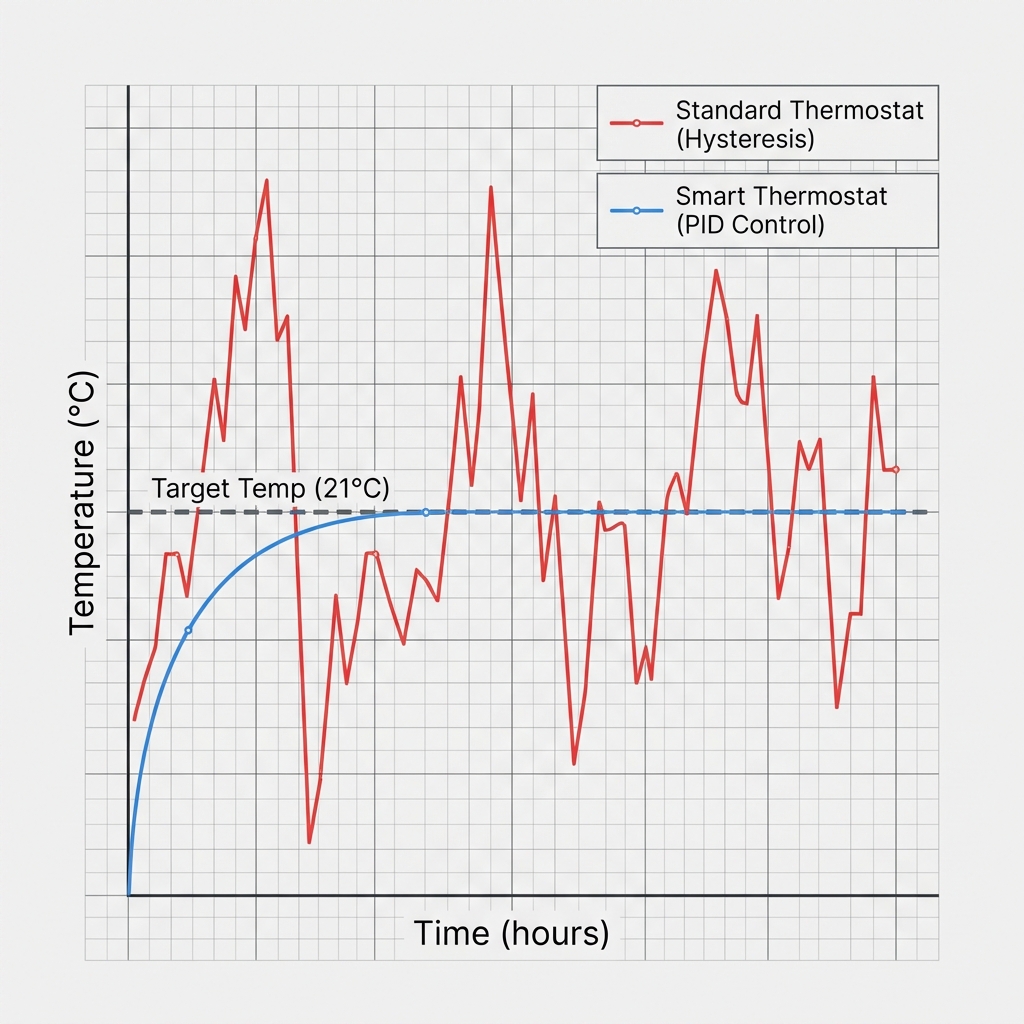
The result: You are comfortable at a lower set point because you aren't constantly fighting the "chills" of the undershoot cycle.
Part 2: The Holy Grail – Zonal Control
Here is the single stupidest thing about North American housing: We have one thermostat for 2,000 square feet.
Imagine if you had one light switch for your entire house. When you wanted to read in bed, you had to turn on every light in the kitchen, garage, and basement. You would call that insane. Yet that is exactly how we heat our homes.
The Solution: Zoning.
1. The Hydronic Advantage (Europe/UK Model)
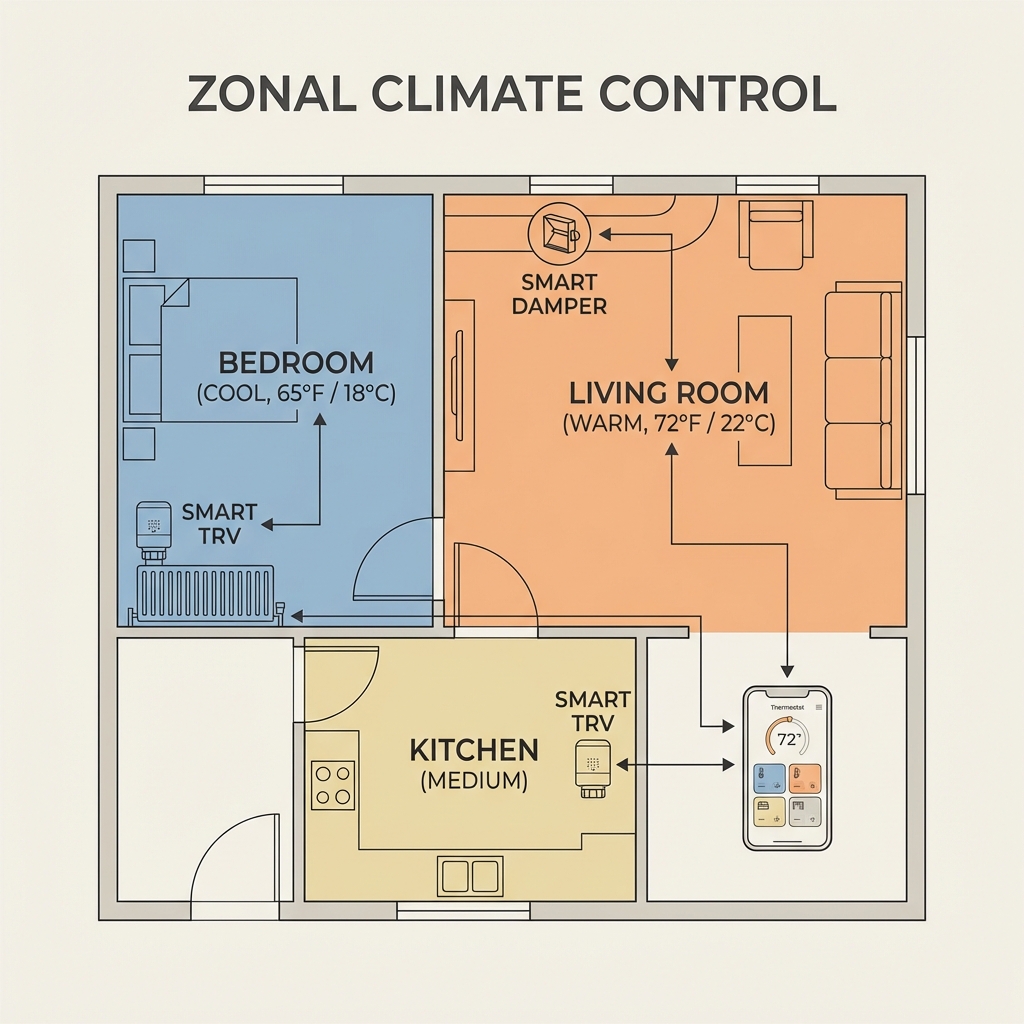
In homes with radiators (hot water), zoning is easy. You replace the manual knob on the radiator with a Smart TRV (Thermostatic Radiator Valve).
- Bedroom: Set to 18°C (65°F) for sleeping.
- Living Room: Set to 21°C (70°F) for evening TV.
- Kitchen: Set to 19°C (66°F) because the oven provides heat.
The boiler only fires if one of these zones calls for heat.
2. The Forced Air Challenge (North American Model)
Zoning ductwork is harder but possible. It requires Smart Dampers—motorized flaps installed inside your ducts.
- A sensor in each room tells the central controller which dampers to open or close.
- Warning: You cannot just close all vents. Furnaces need airflow to prevent overheating. Developing a proper zoned air system requires a "bypass duct" or a variable-speed blower motor (ECM) that can ramp down excess pressure.
Part 3: Geofencing vs. Learning (Ecobee vs. Nest)
The two giants of the industry take philosophically different approaches to crucial efficiency.
The "Learning" Approach (Google Nest)
- Philosophy: "Humans are lazy. We will watch them and program ourselves."
- How it works: It uses motion sensors and manual adjustments to build a schedule. If you turn it down every Tuesday at 9 AM, it learns you leave for work then.
- The Flaw: If you are home but reading a book (not moving), it thinks you're gone. If your schedule is erratic (gig work, shift work), it gets confused.
The "Geofencing" Approach (Ecobee / Honeywell)
- Philosophy: "Your phone knows where you are."
- How it works: It creates a virtual fence around your home radius. When your phone leaves the circle, it triggers "Away" mode. When you cross the line coming back, it triggers "Home" mode.
- The Advantage: It doesn't care about schedules. It reacts to reality. For modern, chaotic lives, geofencing is often superior to "learning."
Part 4: Time-of-Use (TOU) Arbitrage
This is the frontier of 2026 energy management.
Electricity rates are no longer static. In many zones (California, Ontario, Texas), power is cheap at night and expensive at 5 PM.
A "Smart" thermostat should be smart enough to know this.
- Pre-Cooling (Supercooling): In summer, the AC cranks hard from 1 PM to 3 PM (cheap power), dropping the house to 68°F.
- The Coast: At 4 PM (expensive power starts), the AC turns off. The house slowly drifts up to 74°F by 8 PM.
- The Result: You stayed cool, but you bought your cooling at half price.
Check if your utility offers a "Demand Response" program—they might even pay you $50/year to let them make these tiny adjustments automatically.
Part 5: Installation Reality Check (The C-Wire Logic)
The #1 reason smart thermostat returns happen is the "C-Wire" (Common Wire).
Old thermostats were simple switches. They didn't need power. They just connected the Red (Power) wire to the White (Heat) wire. Smart thermostats act like mini-computers. They need 24V constant power to run their WiFi radios and screens.
If you pull off your old thermostat and only see 2 wires (R and W):
- Look in the wall: Sometimes the installer ran 5-wire cable but just tucked the extra wires back. You might get lucky.
- Use a PEK (Power Extender Kit): Most modern units (Ecobee/Nest) come with a small module you install at the furnace end that multiplexes the signal, allowing you to use 4 wires to do the job of 5.
- Run new wire: If you have 2-wire heat-only, you likely need to fish new 18/5 thermostat wire through the wall.
The Verdict
A smart thermostat is not a magic wand. If your house has no insulation (see our Air Sealing guide), a smart thermostat is just putting lipstick on a pig.
But if your envelope is decent, a smart thermostat offers the highest ROI of any mechanical upgrade.
- Cost: $150 - $250
- DIY Time: 1 Hour
- Payback: Often < 2 years
To see how much you can save based on your specific climate and regional electricity rates, read our detailed Smart Thermostat Savings by Region study.
Don't buy it for the cool touchscreen. Buy it for the PID algorithm and the geofencing. That's where the money is.
About the Editorial Team EnergyBS reviews public program rules, product specifications, utility rates, and reader-facing cost assumptions. Treat savings figures as estimates until you verify local prices, permits, rebates, and contractor quotes.
Common Questions
What should I check first before using this smart home advice?
Start with the numbers that apply to your home: climate, utility rate, equipment age, contractor quote, and local program rules. Is a $250 thermostat just a fancy light switch? We explore the hidden physics of PID control, the power of geofencing, and why 'zonal heating' is the future of comfort.
How should I verify rebates, tax credits, rates, or savings before spending money?
Treat program amounts, utility rates, and tax rules as date-sensitive. Check the named government, utility, or manufacturer source before you sign a contract, and keep screenshots or PDFs of eligibility rules for your records.
What is the next useful step after reading this?
Compare this with Smart Thermostat Savings by Region 2026 Tool so you can check the cost, rebate, installation, or operating-risk angle before making a decision.
What to Read Next
Smart Thermostat Savings by Region 2026 ToolUse this next to compare the cost, incentive, installation, or operating-risk angle before you make a home energy decision.Sources and Verification
Editorial Review
EnergyBS Editorial Team
EnergyBS publishes practical homeowner guides. Important program, product, and cost claims should be checked against the linked source and local project documents before you commit to work.
Related Guides
View All ArticlesSmart Thermostat Savings by Region 2026 Tool
How much money does a smart thermostat actually save? We analyze weather data, utility rates, and regional climate differences across North America to calculate the real ROI of smart heating and cooling control.
Spot Heating Strategy: Stop Heating Empty Rooms
Is running a 1500W space heater cheaper than running a gas furnace? The physics says 'maybe'. determining the crossover point where space heaters become money pits.
Are Smart Vents Safe? A StaticPressure and 2026 Analysis
Decide whether retrofit smart registers can correct a hot or cold room without restricting required HVAC airflow. Includes baseline tests, closure limits, failsafe controls, and acceptance checks.