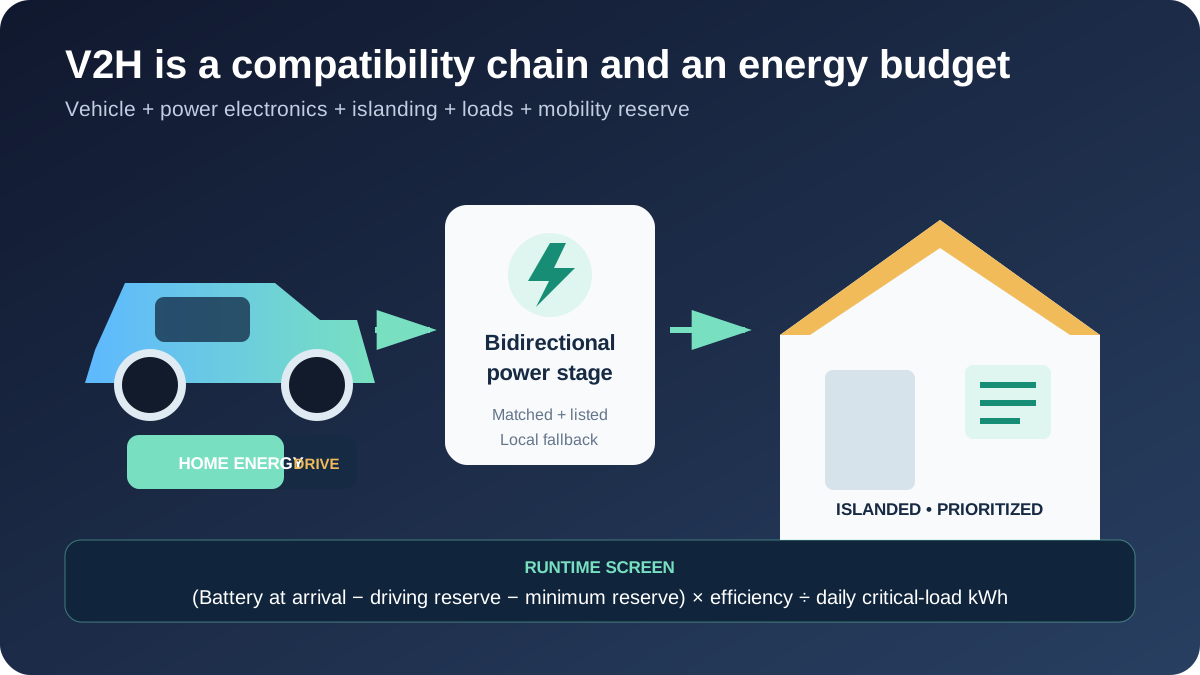
VehicletoHome (V2H)
Plan EV backup power from a verified vehiclechargerhome equipment match, criticalload profile, reserve state of charge, islanding design, conversion losses, solar behavior, and utility approvals.
Direct Answer
Plan EV backup power from a verified vehiclechargerhome equipment match, criticalload profile, reserve state of charge, islanding design, conversion losses, solar behavior, and utility approvals.
V2H Works Only as a Verified System
Short answer: Vehicle-to-home power requires more than an EV with a large battery. The exact vehicle trim and software, bidirectional charger or power-export interface, inverter, transfer/islanding equipment, panel, meter, firmware, and utility/AHJ approvals must be compatible as a complete system. Size backup from critical-load kilowatts and kilowatt-hours, preserve a driving reserve, include conversion and standby losses, and confirm what happens when the car is absent, nearly empty, too cold or hot, or disconnected during an outage.
DOE defines a bidirectional EV as one that can receive energy from compatible electric vehicle supply equipment (EVSE) and provide energy to an external load when paired with similarly capable equipment. V2H supplies an isolated home or selected home loads. V2G exports to the utility grid under an interconnection and market arrangement. An EV's cabin outlet or truck-bed receptacle is yet another architecture, often called vehicle-to-load (V2L). Do not assume capability in one mode proves capability in another.
This guide focuses on the buying, installation, reserve, and runtime decision. It avoids model lists because compatibility and approvals change faster than the house wiring.
Start by Naming the Use Case
“Use the car as a battery” can mean four different things:
| Mode | Power destination | Typical purpose | Key approval question |
|---|---|---|---|
| V2L | Plug-in loads connected to vehicle outlets or an approved adapter | Tools, camping, a few appliances | What loads and connection methods does the vehicle permit? |
| V2H | An islanded home or backed-up panel | Outage backup, solar self-consumption, peak avoidance | Is the complete home-integration system listed and approved? |
| V2B | A building or campus electrical system | Facility resilience and demand management | Does the site design and interconnection permit it? |
| V2G | Utility grid | Grid services or export compensation | Does the utility allow reverse power flow and enroll this equipment? |
One installation may support more than one mode, but V2H capability does not automatically authorize V2G export. DOE notes that utility interconnection agreements may not permit reverse power flow from vehicles. Treat any revenue claim as program-specific and current only on the date verified.
The Compatibility Chain
Every link must match.
1. Vehicle
Confirm the exact model year, trim, battery option, onboard/offboard bidirectional architecture, connector, software version, maximum export power, usable state-of-charge range, thermal limits, and warranty terms. A product family may include some trims that export and others that do not.
2. EVSE or bidirectional power converter
Some architectures convert battery DC to house AC in offboard equipment; others use an onboard inverter and export AC. The charger must support the vehicle's protocol and power direction. A standards claim such as ISO 15118 support does not by itself prove end-to-end interoperability. DOE's vehicle-grid assessment says standards and consensus remain in development and not all manufacturers implement them alike.
3. Home integration and islanding equipment
The home must disconnect from the utility during an outage so it cannot energize utility lines. A listed transfer device, microgrid interconnection device, or integrated system establishes the island and coordinates the neutral, grounding, overcurrent protection, and permitted loads according to the design. Never improvise a backfeed through a receptacle or charger.
4. Electrical panel and circuits
The design may support a critical-load subpanel, selected controllable circuits, or a whole-home panel subject to the system's power limit. Whole-home connection does not mean every load can run simultaneously. The 100-amp load-management guide explains priority controls and failure testing.
5. Utility, permit, and inspection
Even an outage-only system may require utility notification, meter compatibility, permits, and inspection. A grid-export mode has additional interconnection requirements. Ask the utility and AHJ about the exact equipment combination before purchase.
6. Firmware and accounts
Vehicle, charger, inverter, home controller, and apps may all need supported software versions and accounts. Confirm which outage functions operate locally without internet, cellular service, or vendor cloud access.
Use a Compatibility Evidence Table
Do not accept “V2H-ready” as the final specification.
| Component | Exact model/trim/version | Evidence of compatibility | Installer/AHJ/utility confirmation |
|---|---|---|---|
| Vehicle and battery | OEM V2H documentation | ||
| Connector/cable | Approved equipment list | ||
| Bidirectional EVSE/inverter | Listing and matched-system documentation | ||
| Transfer/islanding device | Listing and one-line diagram | ||
| Panel/critical-load equipment | Design ratings | ||
| Meter/interconnection | Utility written approval | ||
| Firmware | Supported versions | ||
| Solar/battery integration | Approved topology |
Require the vendor or installer to identify who supports the system when components communicate poorly. Multiple warranties are not the same as one accountable integrator.
Size Power and Energy Separately
V2H has two limits:
- Power (kW): how much can operate at one moment.
- Energy (kWh): how long the supported load can operate.
A 100 kWh vehicle battery does not run a 12 kW load if the export system is limited to 9.6 kW. Conversely, a 19.2 kW interface does not provide long runtime when the vehicle arrives at a low state of charge.
Create a critical-load inventory:
| Load | Running watts | Starting/surge requirement | Hours/day or duty cycle | Daily kWh | Priority |
|---|---|---|---|---|---|
| Refrigerator/freezer | High | ||||
| Medical equipment | Essential | ||||
| Sump/sewage pump | Site-specific essential | ||||
| Heating controls/blower/pumps | Climate dependent | ||||
| Well pump | High where applicable | ||||
| Lighting | Moderate | ||||
| Communications | Moderate/high | ||||
| Cooking appliance | Managed | ||||
| Cooling/dehumidification | Climate/health dependent | ||||
| Water heating | Usually managed | ||||
| EV driving reserve | — | — | — | Reserved kWh | Essential mobility |
Use measured circuit data or appliance nameplates plus realistic duty cycles. Starting current for motors and compressors can exceed running power; the inverter and control system must support the relevant surge under the approved design.
Calculate Usable Home Energy
Begin with the vehicle's energy at outage start:
battery energy present = usable battery capacity × starting state of charge
Subtract the mobility and minimum reserves:
energy available to home = battery energy present − driving reserve − OEM minimum reserve
Then account for conversion and standby losses:
AC energy available ≈ energy available to home × discharge-path efficiency − standby energy
Suppose an illustrative vehicle has 90 kWh usable capacity and arrives at 80%:
- present energy: 90 × 0.80 = 72 kWh;
- driving reserve: 20 kWh;
- protected vehicle minimum: 5 kWh;
- energy released from battery: 47 kWh;
- assumed discharge-path efficiency: 90%;
- AC energy before standby: about 42.3 kWh.
If critical loads consume 12 kWh/day and the conversion system uses 0.5 kWh/day in standby, screening runtime is:
42.3 ÷ (12 + 0.5) = about 3.4 days
This is not a guarantee. Temperature, battery conditioning, equipment efficiency at low load, driving, solar input, load cycling, and state-of-charge estimation change the result.
Set a Driving Reserve From a Real Evacuation Trip
A generic 20% reserve may be too small or unnecessarily large. Define:
- distance to a safe destination or operating charger;
- winter or adverse-weather vehicle efficiency;
- elevation, towing, and payload effects;
- detour allowance;
- minimum arrival state of charge;
- possible charger outage or queue.
Example:
reserve kWh = planned emergency distance ÷ conservative miles per kWh + arrival buffer
For 75 miles at a conservative 2.0 miles/kWh plus a 10 kWh arrival buffer:
75 ÷ 2.0 + 10 = 47.5 kWh reserve
That reserve could leave far less home-backup energy than a percentage rule suggests. In a dense area with a nearby safe destination and multiple chargers, the mobility reserve may be smaller. Review it seasonally.
Define the Critical-Load Panel or Whole-Home Limit
Critical-load subpanel
A dedicated backed-up panel makes priorities physically clear. It can exclude large loads such as resistance strips, electric water heaters, spas, or high-power EV charging. It may require circuit relocation and can be less flexible later.
Whole-home connection with load controls
An integrated panel can shed or inhibit loads to keep the home under V2H power. This offers flexibility but adds control complexity. Ask what happens if sensors, relays, communications, or cloud services fail.
Manual load management
Some approved systems rely partly on occupants to avoid simultaneous loads. This is appropriate only when the inverter and upstream protection remain safe if a mistake occurs. A laminated outage checklist can help, but behavior must not be the sole overcurrent protection.
Set both a continuous power budget and surge policy. A heat pump compressor, well pump, refrigerator, and microwave starting together may exceed the interface even when their average daily energy is modest.
Heating and Cooling Can Dominate Runtime
“An average home uses X kWh per day” is a weak outage estimate. Electric heating or cooling can consume most of the battery during extreme weather—the same conditions that cause outages.
For a heat pump, record:
- input power at relevant outdoor temperatures;
- startup and defrost behavior;
- indoor fan power;
- resistance auxiliary stages and whether backup mode blocks them;
- thermostat and controller behavior in an island;
- minimum outdoor operating temperature;
- rooms that truly require conditioning.
Electric resistance backup can exceed many V2H power limits. A control plan may lock out strips, lower the heat-pump stage, and use a smaller comfort zone, but only within manufacturer, code, and freeze-safety requirements. Test the approved configuration before winter.
A gas furnace also requires electricity for controls, inducer, ignition, and blower. Confirm startup power, waveform compatibility, grounding/neutral requirements, and transfer design. V2H does not make combustion maintenance or carbon-monoxide alarms optional.
In hot-humid climates, preserve refrigeration, medically necessary cooling, and humidity control. A single efficient room unit may extend runtime compared with central cooling, but installation and condensate safety matter.
Solar During an Outage: Ask About the Exact Topology
Grid-tied solar normally shuts down when utility power is absent unless approved equipment forms an island and coordinates generation. Adding V2H does not automatically let an existing solar inverter recharge the car during an outage.
Ask:
- Can solar operate in the V2H island?
- Which device forms and regulates the island?
- Can solar charge the EV, serve house loads, or both?
- What happens when solar production exceeds load and the car reaches its limit?
- Can the system black-start after every battery reaches its minimum?
- Does it recover automatically the next morning?
- Are the solar inverter and V2H equipment approved together?
A system can have ample solar energy over a day but still shut down when instantaneous production and storage controls do not match the load.
V2H Versus a Stationary Battery
An EV may contain much more energy than one residential wall battery, but “the battery is free with the car” ignores important differences.
| Decision factor | V2H | Stationary battery |
|---|---|---|
| Availability | Leaves when driven | Always at the house unless failed/empty |
| Primary purpose | Transportation | Building energy/resilience |
| Capacity | Often large | Configurable by number of units |
| Home power | Vehicle/system specific | Product/system specific |
| Reserve | Must preserve mobility | Can reserve solely for building |
| Integration | Vehicle, EVSE, home equipment all must match | Inverter/battery/home match |
| Replacement cycle | Tied to vehicle ownership | Tied to stationary system |
| Solar outage integration | Architecture specific | Often designed as part of home system, still product specific |
| Warranty | Automotive and export terms | Stationary cycling/throughput terms |
A small stationary battery can bridge the home when the EV is away, support a solar black start, or carry short outages without connecting the car. An EV can extend long-outage energy. Hybrid designs may be valuable, but interoperability and control priorities must be verified.
Use the home battery decision guide to compare outage frequency, tariff, solar, and financial objectives. Then build the stationary side with the critical-load sizing and runtime method, which tests energy, continuous power, surge, seasonal loads, controls, and solar recharge separately.
Conversion Losses and Arbitrage
Energy crosses power electronics when charging and again when discharging. Exact efficiency depends on equipment, power level, temperature, battery conditioning, and standby consumption. Use manufacturer curves or measured data rather than assuming a universal 85% or 95% round trip.
For a TOU arbitrage screen:
cost of one delivered kWh = off-peak price ÷ round-trip efficiency
gross value = peak price avoided − delivered-kWh cost
At $0.12/kWh off-peak and 85% round-trip efficiency, stored electricity costs about $0.141 per delivered kWh before degradation and standby. If the peak price is $0.30, gross spread is about $0.159 per delivered kWh.
Multiply by realistic throughput and eligible days, then subtract:
- incremental equipment and installation;
- standby energy;
- subscription or program charges;
- battery degradation or warranty value;
- reserve opportunity cost;
- driving electricity that must be restored later;
- taxes and tariff restrictions.
The TOU interval-data guide shows how to model imports and exports without claiming generic savings.
Battery Degradation and Warranty
Do not claim V2H cycling has negligible degradation for every battery. Aging depends on chemistry, temperature, average state of charge, depth of discharge, charge/discharge rate, calendar time, and thermal management. Low-power home discharge may be gentler than hard acceleration, but added energy throughput and time at high or low state of charge still matter.
Read current warranty terms for:
- whether bidirectional export is allowed;
- required approved equipment and software;
- years, distance, capacity-retention threshold, or throughput limits;
- commercial/V2G exclusions;
- ownership transfer;
- diagnostic data access;
- consequences of third-party chargers or adapters.
Preserve the dated warranty document. Do not assume a standards-compatible charger preserves warranty coverage.
Commissioning: Prove the Outage Mode
Installation is incomplete until the system safely islands and supports the planned loads under a controlled test. The contractor and utility/AHJ should determine the procedure.
Record:
- vehicle and charger software versions;
- transfer/islanding equipment operation;
- loss-of-grid detection and reconnection sequence;
- continuous and surge power limits;
- critical-load or shed priorities;
- starting state of charge and configured reserve;
- voltage and frequency under representative loads;
- motor/compressor starting tests;
- solar production behavior if integrated;
- internet/cloud-disconnected behavior;
- low-state-of-charge shutdown;
- vehicle disconnect and reconnect process;
- automatic restart after grid restoration;
- alarms, notifications, and manual stop.
Test scenarios
| Scenario | Expected behavior | Observed result |
|---|---|---|
| Utility outage with car connected | Home islands; approved loads remain/return | |
| Large load requested | System starts it or sheds lower priorities safely | |
| Internet unavailable | Local outage controls remain functional as specified | |
| Vehicle reaches reserve | Home discharge stops in a controlled way | |
| Car is unplugged | Home falls back to stationary source or shuts down safely | |
| Solar exceeds load | System curtails/stores according to approved design | |
| Grid returns | Synchronization/reconnection follows approved sequence |
Test seasonally if heating and cooling loads differ greatly. Maintain a paper quick-start guide near the equipment.
Plan for the Car Being Away
The largest V2H weakness is obvious: the battery moves. Build scenarios for:
- weekday outage while the car is at work;
- two-driver household where the V2H vehicle leaves first;
- evacuation that removes the home's energy source;
- storm warning that arrives when state of charge is low;
- charger cable or port damage;
- vehicle replacement with a noncompatible model;
- service visit that removes the car for days.
Possible mitigations include a stationary battery, smaller uninterruptible supplies for communications/medical loads, a separate approved generator, a second compatible vehicle, or a non-electric safe relocation plan. Each option needs its own safety and maintenance program.
Outage Operating Plan
Before a forecast event:
- raise the vehicle to the planned state of charge if grid guidance and rates allow;
- confirm it is parked where the cable reaches safely;
- check alerts, firmware status, and equipment indicators;
- set the mobility reserve;
- precondition the house within safe comfort limits;
- reduce unnecessary refrigeration openings and discretionary loads;
- verify carbon-monoxide, smoke, and other required alarms;
- review water shutoff and freeze-protection plans.
During the outage:
- track state of charge and daily kWh, not just estimated days;
- avoid simultaneous high-power loads;
- preserve the driving reserve;
- respond to alarms rather than repeatedly resetting equipment;
- follow public safety and evacuation instructions;
- never connect unauthorized cords or backfeed methods.
After restoration, inspect event logs, confirm normal grid connection, restore appliance schedules gradually, and recharge based on mobility and utility guidance.
Quote Comparison
| Requirement | Bid A | Bid B | Bid C |
|---|---|---|---|
| Exact compatible vehicle trims | |||
| Export power and usable SOC range | |||
| Bidirectional EVSE/inverter model | |||
| Transfer/islanding equipment | |||
| Critical-load or whole-home design | |||
| Continuous and surge power | |||
| Solar/stationary battery integration | |||
| Local offline operation | |||
| Utility/AHJ approval included | |||
| Warranty and support owner | |||
| Commissioning scenarios included | |||
| Subscriptions/recurring fees | |||
| Vehicle replacement path |
Request a one-line diagram, equipment list, permit scope, utility scope, and written sequence of operation. A bundled price without these documents is hard to compare and harder to service.
Frequently Asked Questions
Can every EV power a house?
No. The vehicle must support the relevant export mode and be paired with compatible approved equipment and software. A large battery or AC charging port does not prove V2H capability.
How long can an EV power a home?
Runtime equals usable home energy divided by actual daily backed-up energy, after mobility reserve and losses. Heating, cooling, water pumping, and low starting state of charge can change the estimate dramatically.
Does ISO 15118-20 guarantee that any bidirectional car works with any charger?
No. Standards support communication and interoperability goals, but implementation, connectors, approvals, firmware, power architecture, and manufacturer support still determine the matched system.
Can V2H operate during a blackout without a transfer device?
House-connected backup requires approved islanding/transfer equipment so the home cannot energize utility lines. V2L receptacles can power permitted plug loads under vehicle instructions but must not be backfed into house wiring.
Can rooftop solar recharge the EV during an outage?
Only if the approved system is designed to operate solar in the island and coordinate the inverter, vehicle, house loads, and state of charge. Ordinary grid-tied solar often shuts down when the grid is absent.
Will daily V2H void the vehicle warranty?
Terms vary by manufacturer, model year, equipment, and use. Read the current warranty and approved-equipment requirements before enabling routine cycling or V2G services.
Is V2H cheaper than a home battery?
It may offer more energy capacity when the vehicle is present, but compare home-integration cost, power, availability, reserve, warranty, solar behavior, and replacement cycle. The vehicle battery is not always available to the house.
Can I earn money from V2G immediately?
Only where a current utility or market program accepts the specific vehicle and equipment, interconnection permits export, and program economics work. DOE notes that such programs are not yet widespread for vehicle applications.
The Decision Rule
Buy V2H integration when the exact compatibility chain is documented, critical loads fit within export power, usable energy still meets runtime after a defensible mobility reserve, the islanding and solar topology is approved, and the household accepts the car's absence as a backup limitation. Prefer a stationary or mixed resilience plan when essential loads must operate while the vehicle is away or when support depends on an uncertain product roadmap.
The useful question is not “How many days does this battery hold?” It is “Which loads, from what starting state of charge, under which weather, with what driving reserve, through which approved equipment, and what happens when any link is missing?”
About the Editorial Team EnergyBS reviews public program rules, product specifications, utility rates, and reader-facing cost assumptions. Treat savings figures as estimates until you verify local prices, permits, rebates, and contractor quotes.
What to Read Next
V2H Technical Guide 2026: Your Car as a Home BatteryUse this next to compare the cost, incentive, installation, or operating-risk angle before you make a home energy decision.Sources and Verification
Editorial Review
EnergyBS Editorial Team
EnergyBS publishes practical homeowner guides. Important program, product, and cost claims should be checked against the linked source and local project documents before you commit to work.
Related Guides
View All ArticlesV2H Technical Guide 2026: Your Car as a Home Battery
Bidirectional Charging 101: Hardware, software, and battery health implications of using your EV to power your home through the ISO 1511820 standard.
Smart Panel or Load Management? Electrifying a 100Amp
Compare a service upgrade, lowerpower appliances, managed EV charging, circuit sharing, targeted load controls, and a smart panel for a 100amp electrification plan.
Is Home Battery Storage Worth It in 2026? Costs, Backup
Home batteries have evolved from emergency backups to active financial assets. We break down the real costs of Tesla Powerwall 3 and Enphase 5P in 2026, analyze Virtual Power Plant payments, and run the payback math.