Water Scarcity Solutions: Smart Conservation for 2026
The Colorado River is drying up. Aquifers are collapsing. We act like water is infinite, but it's not. Here is how to xeriscape and recycle graywater.
The Invisible Crisis Beneath Your Feet
Short Answer: The Colorado River is drying up. Aquifers are collapsing. We act like water is infinite, but it's not. Here is how to xeriscape and recycle graywater.
While we debate carbon emissions and energy policy, a more immediate crisis is unfolding quietly across the American West: we're running out of water.
The Colorado River—which supplies water to 40 million people across seven states and northern Mexico—is shrinking. Lake Mead, the nation's largest reservoir, has dropped to historic lows, revealing bathtub rings on canyon walls marking where water levels used to be. In 2024, the lake fell below 1,050 feet elevation for the first time since the reservoir was filled in the 1930s.
But it's not just the West. Aquifers—underground water reserves that took thousands of years to accumulate—are being pumped dry across the country:
- The Ogallala Aquifer beneath the Great Plains has declined by 100+ feet in parts of Kansas and Texas
- Wells in California's Central Valley have dropped over 100 feet since 2013
- Some Arizona communities have been cut off from groundwater entirely as their wells run dry
This isn't a future problem. It's happening now. And whether you live in Phoenix or Philadelphia, the ripple effects of water scarcity will reach you through food prices, migration patterns, and infrastructure costs.
What can you do about it? More than you think.
Where Your Water Actually Goes
Before we can conserve effectively, we need to understand where water goes in a typical American home:
| Use Category | Percentage | Gallons per Day (Family of 4) |
|---|---|---|
| Toilets | 24% | 72 gallons |
| Showers | 20% | 60 gallons |
| Faucets | 19% | 57 gallons |
| Clothes Washer | 17% | 51 gallons |
| Leaks | 12% | 36 gallons |
| Dishwasher | 1% | 3 gallons |
| Other | 7% | 21 gallons |
And for homes with lawns, outdoor irrigation typically doubles total water consumption during summer months.
Total indoor + outdoor average: 400-600 gallons per day per household.
The biggest targets for conservation are obvious: toilets, showers, and that lawn.
Kill Your Lawn: The Xeriscaping Revolution
Here's an uncomfortable truth about the American lawn: it's an absurd holdover from 17th-century English aristocracy, where vast green grass demonstrated you were wealthy enough to waste land on non-productive plants. In the British Isles, where it rains constantly, this made some sense.
In Phoenix, where annual rainfall is 8 inches? In Las Vegas, averaging 4 inches? It's environmental insanity.
The facts about lawn irrigation:
- Lawns consume 30-60% of residential water in arid climates
- A 1,000 sq ft lawn in the Southwest requires 20,000+ gallons per year
- 50% of that water is typically wasted to evaporation, runoff, or overwatering
- Grass provides almost no ecological benefit (compared to native plants)
What Is Xeriscaping?
Xeriscaping (from the Greek "xeros" meaning dry) is landscaping designed for minimal irrigation. It's not just rocks and cacti—done well, xeriscaping is beautiful, low-maintenance, and dramatically more water-efficient than traditional lawns.
Core principles:
- Native plants: Species evolved for your local climate need little to no supplemental water
- Appropriate turf: If you want some grass, use drought-resistant varieties in limited areas
- Efficient irrigation: Drip systems deliver water directly to roots, minimizing waste
- Mulching: Organic mulch retains moisture and reduces evaporation
- Soil improvement: Healthy soil holds water better than compacted dirt
Getting Started with Xeriscaping
Step 1: Audit your current water use Check your water bill for summer vs. winter usage. The difference is almost entirely irrigation. This tells you exactly how much water your lawn is drinking.
Step 2: Identify your climate zone Resources like the USDA Plant Hardiness Zone Map and Sunset Climate Zones help identify plants suited to your specific conditions.
Step 3: Design zones by water need Group plants with similar water requirements. Place the few plants that need regular water nearest your house (where you'll see them and where watering is convenient). Put drought-tolerant species farther out.
Step 4: Start small You don't have to rip out the entire lawn at once. Convert one section to native plants. See how it goes. Expand gradually.
Cost: Residential xeriscaping costs $3-15 per square foot for professional installation, or significantly less DIY. Many water utilities offer rebates of $1-3 per square foot for lawn removal.
Payback: A 2,000 sq ft lawn converted to xeriscaping saves 40,000+ gallons/year. At typical water rates ($5-10 per 1,000 gallons), that's $200-400+ annually—often with a 3-5 year payback even before rebates.
Gray Water: Stop Flushing Drinking Water
Here's a simple question: why do we use perfectly clean, treated, drinking-quality water to flush toilets and water lawns?
The answer: because our plumbing was designed before anyone thought about water scarcity.
Gray water is gently-used water from sinks, showers, and washing machines that can be repurposed for irrigation or toilet flushing instead of sending it to the sewer.
The Simplest Gray Water System: Laundry to Landscape
The easiest gray water system requires no permit in most jurisdictions and costs under $300 for DIY installation.
How it works:
- A three-way valve diverts washing machine discharge
- When you do laundry, water flows through a hose to your landscape rather than the sewer
- The water irrigates trees, shrubs, or perennial beds
- Flip the valve back to sewer when needed (if soil is waterlogged, etc.)
What you can water: Fruit trees, ornamental trees, established shrubs, perennials. Avoid: vegetable gardens (hygiene concerns), areas near wells, waterlogged soil.
Soap considerations: Use plant-friendly detergent (no boron, low sodium). Brands like Oasis, ECOS, and Seventh Generation work well.
Savings: A typical household generates 100+ gallons of laundry water per week—over 5,000 gallons annually. That's meaningful irrigation in any climate.
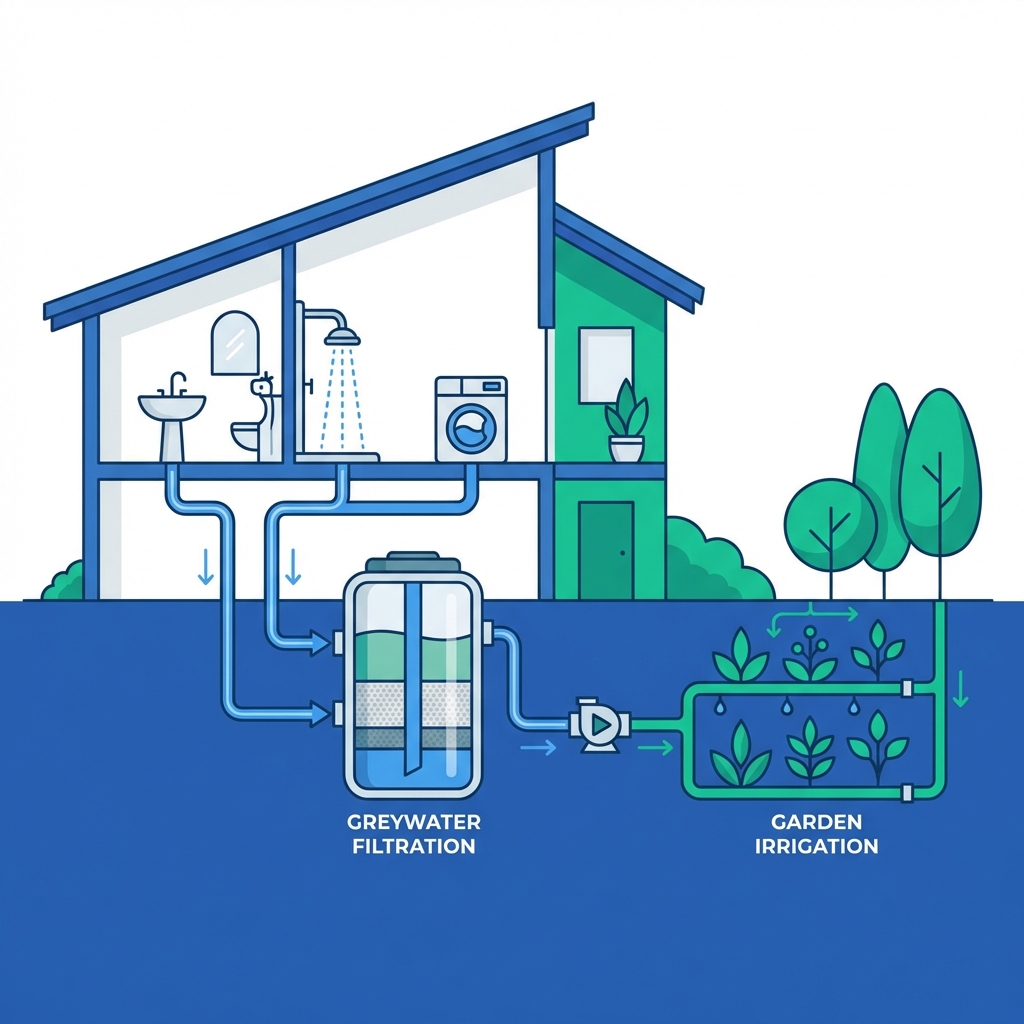 Figure 1: Greywater Recycling Path - Diversion systems allow homeowners to reuse water from showers and laundry for safe, effective garden irrigation.
The Bucket Flush: Zero-Cost Graywater
The simplest graywater system costs nothing: keep a bucket in your shower.
How it works:
- Put a 2-gallon bucket in the shower
- Collect the cold water that runs while you wait for hot
- Use that water to flush the toilet
Why this matters: Most shower setups waste 1-2 gallons per shower waiting for hot water. For a family of four showering daily, that's 2,100-4,200 gallons per year. Capturing this for toilet flushing cuts toilet water use by 25-50%.
Low-Flow Fixtures: The Easiest Win
Swapping old fixtures for modern low-flow alternatives is the lowest-effort, highest-return water conservation investment available.
Showerheads
Old standard: 2.5 gallons per minute (GPM) or more Modern low-flow: 1.5-2.0 GPM Ultra-efficient: 1.0-1.25 GPM
The technology: Modern low-flow showerheads use air induction to mix air with water, maintaining shower pressure and spray coverage while using less water. The shower feels identical—you won't notice the difference except on your water bill.
Top-rated options (2025):
- High Sierra Showerhead (1.5 GPM, $40) - widely considered the best feeling low-flow head
- Niagara Earth Massage (1.25 GPM, $12) - incredibly cheap, very efficient
- Delta H2Okinetic (1.75 GPM, $50) - high-end feel at moderate efficiency
Savings: Switching from 2.5 GPM to 1.5 GPM for a family of four saves approximately 7,500 gallons and $75/year (assuming 8-minute showers).
Toilets
Toilets are the single largest water user inside the home. Older toilets (pre-1994) use 3.5-7 gallons per flush. Modern toilets use 1.28 gallons or less.
Dual-flush toilets offer two options: 0.8-0.9 GPF for liquids, 1.28-1.6 GPF for solids. Since most flushes are liquids, dual-flush toilets average well under 1 GPF.
The Niagara Stealth (0.8 GPF single flush, vacuum-assist, very quiet, $300) is considered the gold standard of water efficiency.
Savings: Replacing a 3.5 GPF toilet with a 1.28 GPF model saves approximately 12,000 gallons per person per year. For a family of four, that's nearly 50,000 gallons and $250-500 annually.
Faucet Aerators
The cheapest possible fixture upgrade: screw-on aerators that reduce faucet flow from 2.2 GPM to 1.0-1.5 GPM.
Cost: $3-5 per faucet Installation: Unscrew old aerator, screw on new one (30 seconds) Savings: 30-50% reduction in faucet water use
Leak Detection: The Silent Water Thief
The EPA estimates that household leaks waste nearly 1 trillion gallons of water annually in the US—enough to supply 11 million homes. The average home with leaks wastes 10,000+ gallons per year.
Common culprits:
- Running toilets (constantly trickling even when not in use)
- Dripping faucets (a faucet dripping once per second wastes 3,000 gallons/year)
- Irrigation system leaks (underground and invisible)
- Water heater pressure relief valves (often discharge to an unmonitored drain)
The Toilet Test
- Remove the tank lid
- Drop in a dye tablet or 10 drops of food coloring
- Wait 15 minutes (don't flush)
- If color appears in the bowl, the flapper is leaking
Toilet flappers cost $5-10 and take 5 minutes to replace. A running toilet wastes 200+ gallons per day.
Smart Leak Detectors
Modern smart home water monitors detect leaks automatically:
- Flo by Moen ($500 + installation): Installs on your main water line, detects micro-leaks, automatically shuts off water if major leak detected
- Phyn Plus ($700): Similar capabilities to Flo, excellent app
- Flume 2 ($200): Non-invasive clamp-on sensor, monitors usage patterns to detect likely leaks
These devices often pay for themselves by preventing a single water damage incident (average water damage claim: $13,000).
The Mindset Shift
Water conservation isn't about deprivation. It's about recognizing that what we treat as abundant is actually precious.
Some perspective:
What 1,000 gallons of water represents:
- Two 10-minute showers with an old showerhead
- About $5-10 on your water bill
- 500 toilet flushes with a modern dual-flush
- 2+ months of drinking water for one person
- Enough to grow 4-5 pounds of almonds (in an arid climate with irrigation)
When you turn on the tap and water flows, you're accessing infrastructure it took billions of dollars to build, drawing from reservoirs that may take decades to refill, and using a resource that is genuinely finite.
The goal isn't guilt. It's awareness—and practical actions that respect reality.
Action Plan: Start This Weekend
Saturday morning (1 hour):
- Read your water bill—note monthly and annual usage
- Check toilets with the dye test
- Walk your property looking for irrigation leaks
Saturday afternoon (1-2 hours):
- Install low-flow showerheads ($20-50 investment)
- Replace faucet aerators ($15-25 total)
- Set up a shower bucket
Next month:
- Research xeriscaping or native plant options for your climate
- Check utility rebates for lawn removal or efficient toilet rebates
- Consider graywater-to-landscape for your next plumbing project
This year:
- Replace old toilets with 1.28 GPF or lower models
- Convert at least some lawn to drought-tolerant landscaping
- Fix all identified leaks
The Bottom Line
Water scarcity isn't a future problem—it's current reality in much of the country, and trends are worsening. The infrastructure we depend on was built assuming endless supply, but the aquifers are declining, the rivers are shrinking, and the climate is shifting.
Individual action matters, but not in a moral sense. It matters practically: homes and communities that prepare for water constraints now will be far better positioned as restrictions tighten.
Plus, most water conservation measures save money. Xeriscaping eliminates lawn maintenance costs. Low-flow fixtures reduce water and water heating costs. Leak repair prevents damage. These are investments with real returns.
The water crisis is here. The question is whether you'll adapt proactively—or wait until you're forced to.
About the Editorial Team EnergyBS reviews public program rules, product specifications, utility rates, and reader-facing cost assumptions. Treat savings figures as estimates until you verify local prices, permits, rebates, and contractor quotes.
Common Questions
What should I check first before using this zero waste advice?
Start with the numbers that apply to your home: climate, utility rate, equipment age, contractor quote, and local program rules. The Colorado River is drying up. Aquifers are collapsing. We act like water is infinite, but it's not. Here is how to xeriscape and recycle graywater.
How should I verify rebates, tax credits, rates, or savings before spending money?
Treat program amounts, utility rates, and tax rules as date-sensitive. Check the named government, utility, or manufacturer source before you sign a contract, and keep screenshots or PDFs of eligibility rules for your records.
What is the next useful step after reading this?
Compare this with Zero Waste Kitchen Guide: reducing Food Waste in 2026 so you can check the cost, rebate, installation, or operating-risk angle before making a decision.
What to Read Next
Zero Waste Kitchen Guide: reducing Food Waste in 2026Use this next to compare the cost, incentive, installation, or operating-risk angle before you make a home energy decision.Sources and Verification
Editorial Review
EnergyBS Editorial Team
EnergyBS publishes practical homeowner guides. Important program, product, and cost claims should be checked against the linked source and local project documents before you commit to work.
Related Guides
View All ArticlesZero Waste Kitchen Guide: reducing Food Waste in 2026
The average family produces 1,500 lbs of trash a year. Most of it is kitchen packaging. Here is how to shop bulk and ditch the plastic.
Sustainable Fashion Guide: Materials to Look For in 2026
Polyester is plastic. Your yoga pants are shedding microplastics into the ocean every time you wash them. Here is how to build a capsule wardrobe.
Composting Guide
Stop sending 30% of your groceries to the landfill. Composting isn't smelly if you do it right. Here is the carbonnitrogen formula.