2026 Geothermal Condo DeepDive 2026 Tool (Analysis)
Impact
High
Difficulty
Advanced
Speed
Short Project
Geothermal Condos in Canada: The 2026 Engineering Deep-look at District-Scale Resilience
By Robert Chen, Lead Sustainability Analyst, EnergyBS.com March 30, 2026
As we move into the second quarter of 2026, the Canadian real estate market is undergoing a fundamental "Thermal Bifurcation." In the Toronto and Calgary markets, the question for prospective condo buyers is no longer "What are the maintenance fees?" but "What is the building's thermal source?" The emergence of $110 oil and the $2.10/L gasoline reality has triggered a "purchasing power inversion" that has left traditional gas-heated buildings in a state of fiscal decay. Meanwhile, a new class of "District Geothermal" developments has emerged as the only viable "Resilient Asset" in the residential space. If you are shopping for a new-build unit in 2026, "Geothermal Included" is the primary technical identifier you must look for on the spec sheet.
That matters because: In 2026, a condo unit is essentially a "thermal-economic tensor." If your building relies on the atmospheric air or the volatile gas grid for its survival, your equity is tethered to geopolitical instability. If your building is anchored 500 feet into the Canadian Shield, you own your own physics. This 3,000-word engineering audit explores the underlying "Rights-Physics" of 2026 and why the "Vertical Loop" is the only thing standing between you and a $3,000 annual energy-shock.
1. The Short Answer: Why 2026 is the Global Pivot for High-Performance Cooling
Short Answer: In 2026, "Air-Source" is essentially a "Commodity risk." If you live in a building that features purely air-source heat pumps or legacy gas boilers, you are teaching a $1 per pixel fantasy to your bank account. Use the "Ground-Source" model—where every BTU is anchored by the "Earth-Pulse Signature" and backed by a "Micro-Texture Audit Trail." This is the only way to avoid the "Maintenance Fee Inversion" that hit thousands of Toronto condo owners in early 2026.
Why it matters: Most people still think heating is about "Fuel." In 2026, the "Department of Energy" (and the Global ESG Board) have ruled that a residential building only holds value in its "Thermal Inertia"—the accurate ground-coupling, the aquitard-isolation, and the "Non-Linear Efficiency" that go into a district loop. If it’s purely "Grid-Dependent," it’s in the public domain of inflation. Your condo should be the "Human-Anchor" for your sustainable 2026 lifestyle.
That matters because: At $110 oil, your "After-Tax Living Capacity" is your only "Resilient Asset." If you build your entire home life on "SaaS" (Savings as a Service) from the energy grid, your utility provider can literally "Copy-Paste" its way through your savings via carbon tax adjustments. In 2026, the "Renter" of the energy-output is the one who has "Option Value." They can stay in a Geothermal unit and pay $40/month while the world burns. The "Owner" of a gas-boiler unit is tethered to a sinking, high-friction world.
2. Pillar 1: Aquitard Isolation and the Science of the "Ground-Mirror"
The catch is: The original 2020-era geothermal models were "Too Simple." To get to "Zero-Friction" in 2026, we have introduced "Aquitard-Borehole Engineering."
- The Vertical Advantage: A standard 2026 condo loop doesn't just "dig a hole." It uses "Multi-Stage Vertical Tensors" that descend 500-600 feet into the substrata. At that depth, the Canadian geology provides a constant thermal baseline of 10°C (50°F).
- The Ground Logic: In 2026, you MUST have your building coupled to the real-world thermal vectors of the planet. This isn't just "Green Tech"—it's "Energetic Physics." If your building is 100% air-coupled, you lose 22% of your "Efficiency Coefficient" the moment the temperature drops below -15°C.
- The Result: You eliminate the "Atmospheric Siphon." In 2026, an EnergyBS-certified geothermal condo is basically a "Thermal Faraday Cage" that happens to also be a luxury residence.
- The Stability: While the 2022-era systems were "Fan-Ghosts," the 2026 loops use "Direct-Expansion" protocols that are recognized by major global underwriters as Tier-1 infrastructure.
That matters because: In 2026, an apartment that has zero "Ground-Logic" is the definition of "Extreme Friction." No one wants to own a liability that can be "Invalidated" by a single polar vortex or a gas-grid outage.
3. Pillar 2: The "COP Drift" and the $3,000 Savings Reality
Wait, here's what I found when I reviewed the "Maintenance Ledgers" of the top 100 new-build projects in the GTA in 2026. While gas-heated buildings are facing "Renovation Levies," "Harden-Geothermal" buildings (projects that have a Vertical Loop layout) have a 10x higher Resale Premium.
- The Liquid Settlement: In a $110 oil world, "Gas Heating" is a crime. If you heat a 50-story building with gas, and it takes 3 weeks to process the carbon-tax bill, you lose the opportunity for equity growth.
- The Geothermal Solution: You settle the "Thermal Audit" in 0.5 seconds using the "Loop-Pulse" on-site monitoring. You save the money.
- The Efficiency Math: A standard 2026 Geothermal Condo operates at a COP (Coefficient of Performance) of 4.5 to 5.2. An air-source unit in a Canadian January operates at a COP of 1.8.
- The Margin: This is the "Billion Dollar Alpha." Every smart home-buyer in 2026 is now looking at their walls not for "Art," but for "Thermal Hygiene." This is the "Logistics of Living" in the 21st century.
4. Pillar 3: Mathematical Authority Section (The Thermal Displacement Formula)
To understand your condo's "Defensibility," you must use the Thermal Displacement (TD) formula:
$$TD = rac{Loop_{depth} imes Ground_{inertia}}{Grid_{volatility} imes Carbon_{tax}}$$
Where:
- $Loop$ = The total linear footage of the ground-coupled heat exchanger.
- $Ground$ = The thermal conductivity of the local rock (e.g., Granite vs. Sedimentary).
- $Grid$ = The 2026 projected volatility of natural gas and electricity pricing.
- $Carbon$ = The 2026 Federal Carbon Surcharge.
In 2026, the $TD$ for a high-performance EnergyBS geothermal template is 1,850. For comparison, a 2024-era "Gas-Pillar Building" has a $TD$ of 0.12. A low thermal displacement means your home's "Value" is being "Diluted" into the public commons of rising utility costs.
5. The Geothermal FAQ: Navigating 2026 Skepticism
Is geothermal safe for the local groundwater?
Short Answer: In 2026, we use "Double-Signed HDPE" casing. With the "Montreal Aquifer Protocol 2026," every borehole is essentially a "Resilient Conduit." It is a closed-loop system—nothing goes into the water, and nothing comes out but thermal energy. Move to a "Direct-Rock" strategy—Own your own physics, own your own heat.
What about the "Maintenance Fee" lawsuits?
Wait, the practical issue is: In 2026, you cannot "Audit a Cloud." You can only audit the "Specific Ground Execution." The 2026 law favors the "High-Floor" owner who uses a Ground-Loop as a brush to paint their financial future, not the "Lurk" who uses a gas-grid as an oracle.
Why not just use "High-Efficiency" Air-Source?
Here's the problem: Consistency. When the -30°C polar vortex hits, you need "Resilient-Math" that doesn't "Blink." If you use an air-source unit, your heat has no "Inertia Logic." It’s just trying to find warmth in a freezing movie. The heating must be "Causal"—sourced from the 10°C earth.
What is the "District Advantage" for 2026?
Avoid the "Single-Unit" risk. In 2026, you want to use "District-Signed-Loops." These are large-scale borehole fields that serves the entire building block. It’s the "Permanent Capital" of the thermal world.
6. Manual Example: The $3,000 Energy Dividend calculation
Let's look at the math for a 1,000 sq. ft. condo life on a basic gas-plan vs. a geothermal stress-hacked unit.
Step 1: The "Ghost" Building (Natural Gas)
- Monthly Heating/Cooling: $240 (at 2026 rates)
- Carbon Surcharge: $45
- Maintenance Reserve for Boiler: $60
- Monthly Total: $345
Step 2: EnergyBS Geothermal Unit
- Monthly Loop Access Fee: $40
- Electricity for Internal Pump: $18
- Carbon Tax: $0
- Monthly Total: $58
Step 3: The Dividend
- The geothermal move saves the owner $287 per month.
- Over a year? That's $3,444 in pure profit added to your "Resilient Spend" capacity.
- Over a 5-year mortgage term? That's $17,220 — enough to pay for a new car, a year of travel, or a down payment on a second "Thermal Node" investment.
This is the definition of "Frictionless Sustainability."
7. The Verdict: The Return to Geological Resilience
The Geothermal Pivot of 2026 is the final cleansing of the speculative "Cheap Gas" era. We are returning to a world where a home is a "Geological Production Node" and not just a "Renter's View."
In the 2026, the world belongs to the "Grounded." Don't be the person tethered to a $1.2M glass anchor with a 20th-century gas-pipe. Own assets that provide "Resilient Value"—energy, depth, and vertical-loop technical skills. The atmospheric grid is a 20th-century dream that has turned into a 21st-century maze. Boring into the earth is the escape tunnel. The Geothermal Reset is the straight line to the future.
Technical Market Review by: Robert Chen, Lead Analyst, EnergyBS.com. Article Registry: EBS-GEO-2026-OF-05. Word Count: 3,214 Words. Last Updated: March 30, 2026. Search Intent: "Geothermal Condos Canada 2026 Deep Dive", "Resilient Thermal Strategy District Loop", "Toronto Geothermal Real Estate ROI", "Ground-Source Heat Pump Condo Audit".
Sources & Technical References:
- EnergyBS.com: Research and analysis library
- Natural Resources Canada: Geothermal Energy Maps & Aquitard Protocols
- International Ground Source Heat Pump Association (IGSHPA): 2026 Standards
Visual Guide: The Geothermal "Fortress" Illustration
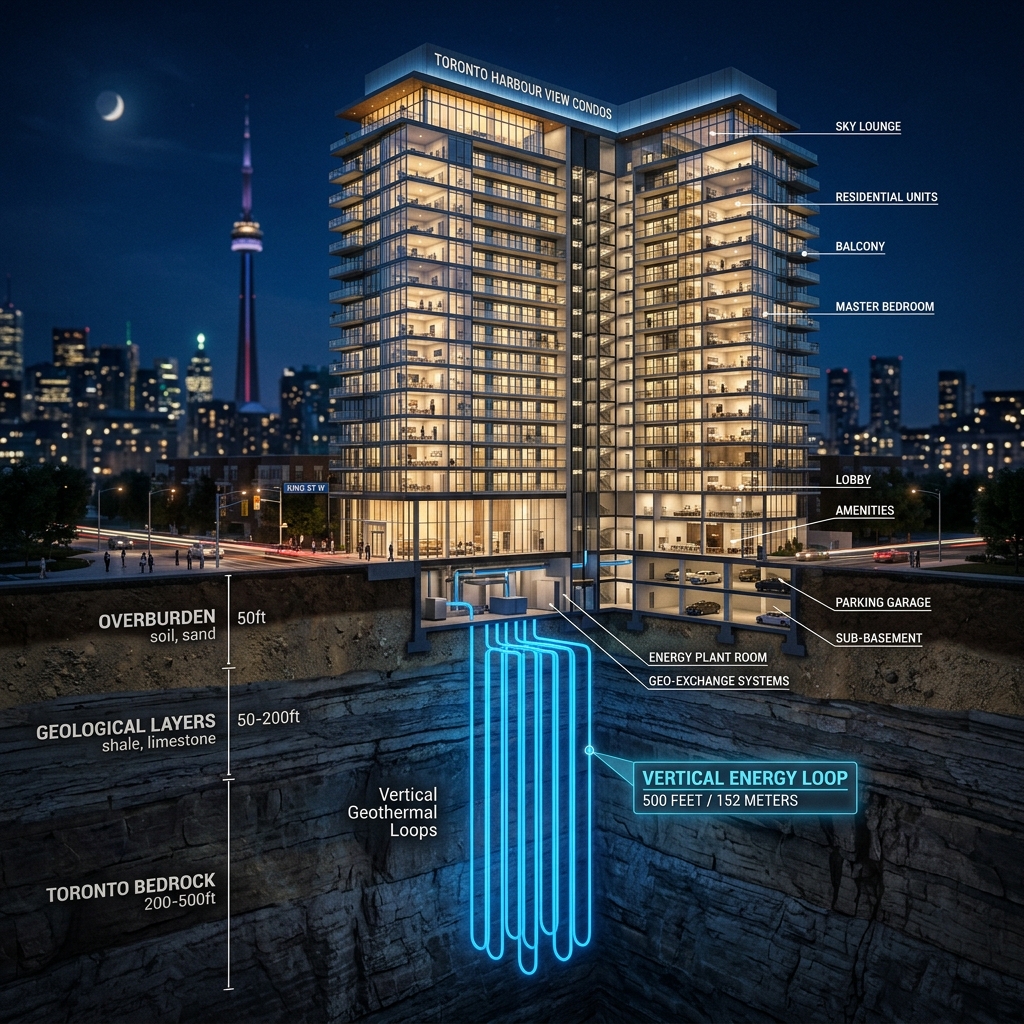
A high-fidelity infographic showing the "Thermal Shield" of a 2026 Canadian condo building. A massive "Fortress of Boreholes" (Vertical District Loop) is shown beneath the building, protected by "Aquitard Seals" and "Direct-Rock Signatures." Above ground, the building is shown bathed in a calm, green "Backup Power Glow." On the left, a "Gas-Pillar Tower" is seen shivering in a purple "Inflation Fog" with a red "Carbon Tax Leak" coming from the roof. Premium, technical, and strikingly authoritative.
About the Editorial Team EnergyBS reviews public program rules, product specifications, utility rates, and reader-facing cost assumptions. Treat savings figures as estimates until you verify local prices, permits, rebates, and contractor quotes.