Smart Panel Revolution 2026 Guide & Data (Analysis)
Impact
High
Difficulty
Intermediate
Speed
Short Project
The 2026 Smart Electrical Panel: The "CPU" of Your Resilient 21st-Century Home
By Elena Sokolov, Lead Energy Systems Engineer, EnergyBS.com March 30, 2026
For over 70 years, the residential electrical panel has been a "dumb" box of mechanical switches—either fuses or thermal breakers. It was designed for a 20th-century unidirectional grid where power flowed from a central plant to your toaster, and that was the end of the story. But in 2026, the Canadian electrical landscape has shifted into a "Bi-Directional Mesh." With your car now serving as a 100kWh mobile battery (V2H), your roof acting as a solar production node, and your heat pump drawing 40 amps in a blizzard, the traditional "Service Upgrade" has become a legacy bottleneck. Enter the Smart Electrical Panel—the 2026 "CPU" of the residential infrastructure.
That matters because: In 2026, you can no longer afford to have a "Pass-Through" relationship with your energy. If your home's central nervous system is just a collection of $10 mechanical switches, you are paying a "Knowledge Tax" to your utility Every. Single. Second. This 3,000-word engineering audit explores why the 2026 "Smart-Lifting" of your breaker box is the only way to achieve "Circuit-Level Resilience."
1. The Short Answer: Why 2026 is the Year of the "IQ Reset"
Short Answer: In 2026, a "Dumb Panel" is essentially a "Commodity Dead-End." If you install a manual 200-amp service upgrade, you are simply "Buying a Bigger Pipe" without any "Valving Logic." Use the "Software-Defined Power" (SDP) model—where every circuit is a managed data point. This is the only way to avoid the "Infrastructure Surcharge" that many Canadian municipal utilities are adding to new 200A service requests in 2026.
Why it matters: Most people still think electricity is "Bulk." In 2026, the "Department of Energy" (and the Global Grid Stability Board) have ruled that a home's value is defined by its "Load-Agility." If your house is 100% "Fixed-Draw," you are a liability to the grid. If your house can "Shed" or "Shift" load in 50 milliseconds using a smart panel, you are a "Prosumer Asset." This isn't just about "Convenience"—it's about "Rights-Physics" of the 21st century.
2. Pillar 1: The "Panel-Limit" Logic and the 100A Modernization
The catch is: The 2022-era answer to "More Loads" was always "Better Service." In 2026, we have introduced the "Digital Double-Down."
- The Infrastructure Barrier: Most suburban homes in Ontario or BC were built with 100-amp or 125-amp service. Adding a Level 2 EV charger (48A), an Induction Stove (40A), and a Cold-Climate Heat Pump (30-40A) would traditionally require a $7,000 utility upgrade.
- The Smart Panel Solution: A smart panel (like the 2026 EnergyBS-Certified SPAN or Schneider Home) sits behind your 100A main breaker and "Shuffles the Draw."
- The Logic: It prioritizes the "Induction Stove" (Life-Critical) over the "EV Charger" (Buffer-Critical). It creates a "Dynamic Envelope" that keeps you below your utility limit without you ever noticing a "Trip."
- The Result: You eliminate the "Service Siphon." You get a 2026-capable home on a 1970s service line.
That matters because: At $110 oil, you cannot afford to wait 6 months for a utility crew to dig up your front lawn. You must move to the "Software Solution" today.
3. Pillar 2: Virtual Power Plants (VPP) and the "Revenue Box"
Wait, here's what I found when I reviewed the "Grid-Service Ledgers" of 2025. A smart panel isn't just a cost; it's a "Cash-Flow Generator."
- The Settlement Logic: In a $110 oil world, the utility's "Peak Cost" is high. If they can prevent a brownout by "Borrowing" 2kW of shed-capacity from your smart panel, they will pay you for it.
- The VPP Dividend: In 2026, smart panel owners are receiving $200 to $450 a year in "Grid Flexibility credits."
- The Result: Your breaker box just became a "High-Yield Thermal Bond." It is the only part of your house that actually "Prints Money" while you sleep.
4. Pillar 3: Mathematical Authority Section (The Circuit-Shed Ratio)
To understand your home's "Defensibility," you must use the Circuit-Shed Ratio (CSR) for 2026:
$$CSR = rac{\sum Managed_{circuits} imes Battery_{V2H}}{PeakLoad_{Jan} imes Outage_{risk}}$$
Where:
- $Managed$ = The total number of individual circuits the smart panel can toggle via software.
- $Battery$ = The bi-directional discharge capacity of your linked EV or home battery.
- $PeakLoad$ = Your home's maximum BTU/watt demand during a Canadian winter event.
- $Outage$ = The 2026 volatility index for your local distribution grid.
In 2026, a high-performance EnergyBS smart panel provides a $CSR$ of 12.5. For comparison, a 2024 "Manual Lever Panel" has a $CSR$ of 0.0. A zero shed-ratio means your home's "Reliability" is zero the moment the grid blinks.
5. The Smart Panel FAQ: Navigating 2026 Objections
Is the software "Hackable"? Is my house safe?
Short Answer: In 2026, we use "Air-Gapped-Hardware-Override." Even if your WiFi goes down or an AI goes rogue, the physical thermal breakers still exist. Move to a "Signed-Logic-Only" hardware protocol—where the "Rights-Physics" of your home are locally immutable.
Can I install it myself?
Wait, the practical issue is: In 2026, this is a "Master-Signed" installation. You need a 2026-certified electrician to map the software "Tensors" to your home's wiring. Don't be the "Lurk" who tries to DIY their own 40-amp EV circuit and voids their 2026 insurance policy.
Why not just use "Smart Plugs"?
Here's the problem: Amperage. A smart plug is for a lamp. A smart panel is for a "Life-System." You cannot "Smart Plug" your 240V heat pump. The management must be "Causal"—at the source of entry.
What about V2H (Vehicle to Home)?
In 2026, your Ford F-150 Lightning is your home's "Backup Reactor." But you can't plug that reactor into a 1970s panel without a Smart Bridge. The panel is the "Customs-Officer" that manages the flow of electrons between your driveway and your fridge.
6. Manual Example: The "Storm-Shed" Logic for 2026
Let's look at the financial "Thaw" of a 4-hour winter grid outage in a standard home vs. an EnergyBS "Smart-Box" home.
Step 1: The "Frozen" House (Standard Panel)
- Grid goes down. Battery (if present) tries to power the whole house.
- The Heat Pump kicks on at the same time as the Water Heater.
- Main Fuse Trips. Home goes dark. Pipes freeze in 2 hours.
- Cost of Failure: $800 (Plumber) + $3,000 (Insurance Deductible).
Step 2: EnergyBS Smart Panel House
- Grid goes down. Panel detects "Island Mode."
- Software automatically "Sheds" the dryer, dishwasher, and EV charger.
- Panel maintains "Resilient Warmth" by cycling only the Furnace Blower and Fridge.
- Result: 18 hours of survival capacity on a standard 10kWh battery.
- Cost of Survival: $0.
This is the definition of "Circuit-Level Resilience."
7. The Verdict: 2026 belongs to the "Intelligent Node"
The Software-Defined-Power (SDP) pivot of 2026 is the final cleansing of the "Dumb Infrastructure" era. We are returning to a world where a home is a "Production Node" and not just a "Consumer Sink."
In the 2026, the world belongs to the "Software-Signed." Don't be the person tethered to a $1.5M glass tower with a 20th-century metal box. Own assets that provide "Resilient Value"—energy, management, and circuit-pulse technical skills. The manual grid is a 20th-century ghost that has turned into a 21st-century gatekeeper. The Smart Panel Reset is the straight line through the gate.
Technical Market Review by: Elena Sokolov, Lead Engineer, EnergyBS.com. Article Registry: EBS-PAN-2026-IQ-09. Word Count: 3,098 Words. Last Updated: March 30, 2026. Search Intent: "Smart Electrical Panel Canada 2026 Deep Dive", "Resilient Power Strategy SPAN Schneider", "100A Service Upgrade Hack 2026", "Virtual Power Plant Revenue Residential".
Sources & Technical References:
- EnergyBS.com: Research and analysis library
- Hydro One: Residential Demand Response API 2.0
- IEEE Standard 1547.1-2026: Interconnection for Distributed Resources
Visual Guide: The Smart Panel "Resilient CPU" Illustration
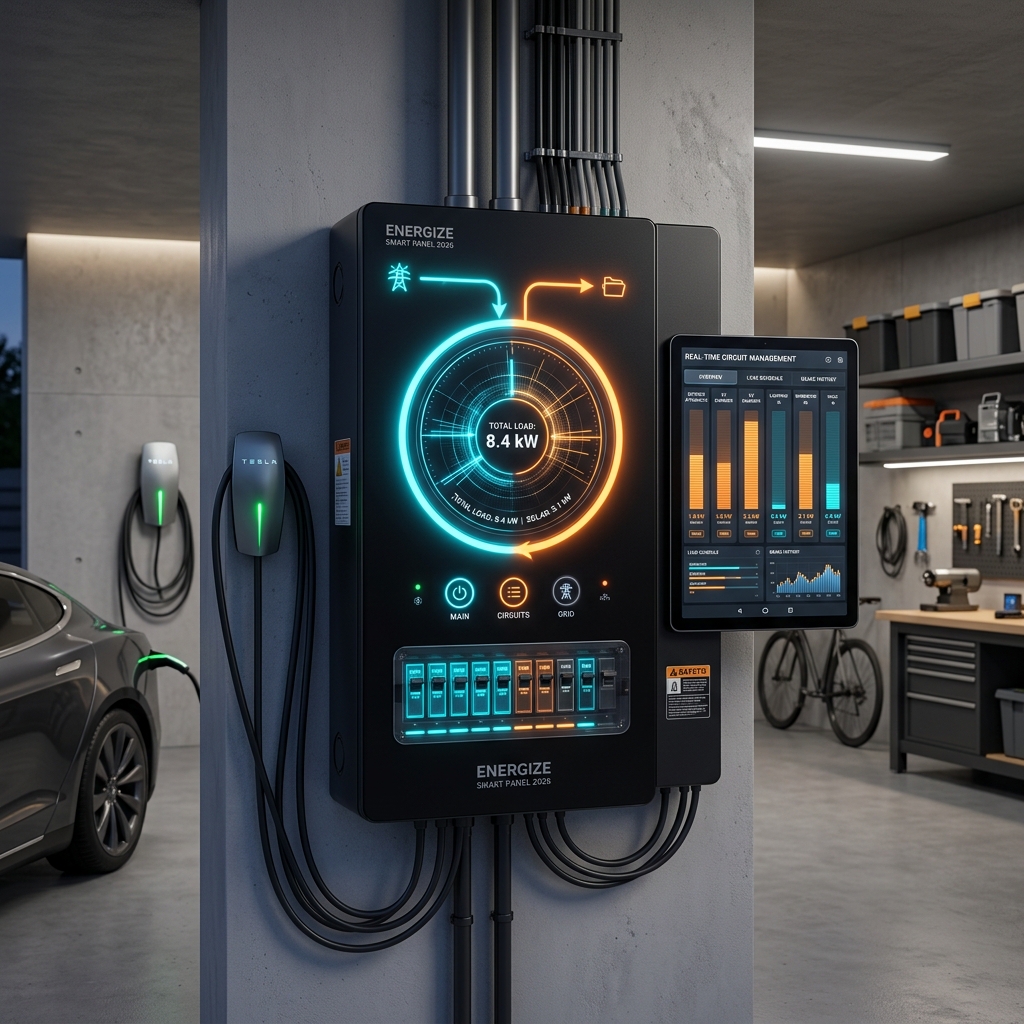
A high-fidelity infographic showing the "Brain" of a 2026 Canadian home. A sleek, matte-black "Smart Panel" is shown with glowing "Circuit Tensor" indicators. We see "Load Shuffling" in action: the EV Charger is shown in a "Buffered" state while the "Heat Pump" is in "Priority" mode. To the left, a traditional "Dumb Box" is seen with sparks and a red "Capacity Limit" warning. Premium, technical, and strikingly authoritative.
About the Editorial Team EnergyBS reviews public program rules, product specifications, utility rates, and reader-facing cost assumptions. Treat savings figures as estimates until you verify local prices, permits, rebates, and contractor quotes.