3D Printed Homes
Are 3D printed homes energy efficient? We analyze concrete wall Rvalues, insulation methods, and the real environmental impact of printed housing.
The Reality Check: Concrete vs. Physics
Short Answer: Are 3D printed homes energy efficient? We analyze concrete wall R-values, insulation methods, and the real environmental impact of printed housing.
3D printed homes are sweeping the construction headlines, promising a revolution of speed, affordability, and robotic precision. From ICON in Texas to COBOD in Europe, giant gantries are printing houses in days. But for the energy-conscious homeowner, a critical question remains: Are 3D printed concrete homes actually energy efficient?
The answer is complex: Raw printed concrete is a terrible insulator. Without specific, added insulation strategies, a "robot-built" home can be an energy hog.
This guide analyzes the thermal performance of printed homes, the "R-value problem," and the specific technologies—like cavity walls and EIFS—that turn a printed shell into a high-performance home.
[!NOTE] Field Note from Marcus Vance: "I recently visited a printed home site in Austin to inspect the wall assembly. The 'cool factor' is undeniable, but the thermodynamics are tricky. Touching the uninsulated printed wall on a sunny day, you feel the heat instantly. That thermal bridge is what we need to break."
The Core Problem: Concrete Has No R-Value
In building science, R-value measures a material's resistance to heat flow. Higher is better.
- Fiberglass insulation: ~R-3.5 per inch
- Spray foam (closed cell): ~R-6.5 per inch
- Solid Concrete: ~R-0.08 to R-0.2 per inch
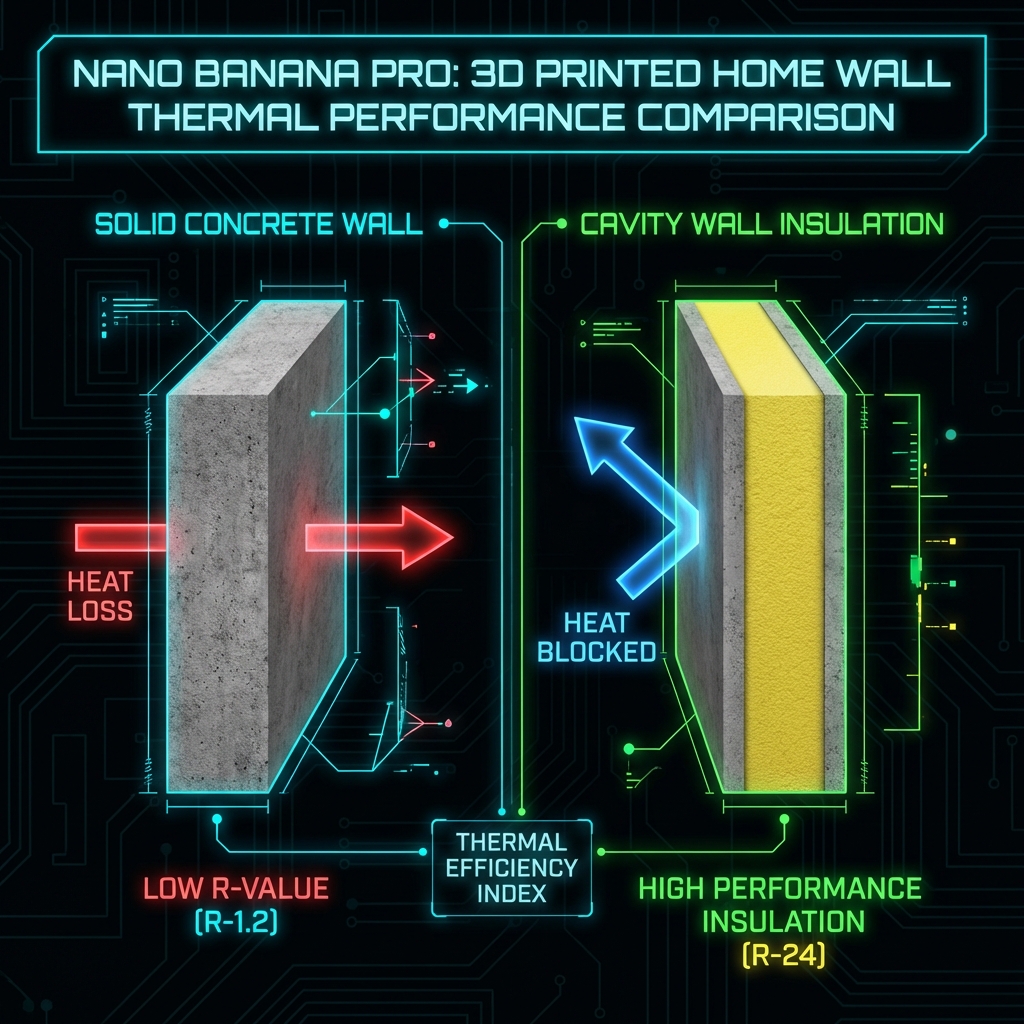
A standard 6-inch solid concrete wall provides an R-value of roughly R-1.2. For context, modern building codes (IECC 2021) typically require wall R-values between R-20 and R-30.
The "Thermal Mass" Myth
Proponents often argue that concrete's thermal mass (its ability to store heat) makes up for low insulation.
- Reality: Thermal mass is useful in specific climates (like desert environments with huge day/night temperature swings).
- Limitation: In cold winters or hot, humid summers, thermal mass without insulation essentially acts as a "thermal bridge," bleeding heat out of your home in winter and radiating absorbed solar heat into your home in summer. You cannot rely on mass alone; you need insulation.
4 Ways To Insulate a 3D Printed Home
Since the printed wall itself provides almost no insulation, the efficiency of a 3D printed home depends entirely on how insulation is added.
1. The Cavity Wall (Double Shell)
This is the most common and effective method used by leaders like ICON.
- The Method: The printer extrudes two parallel thin walls (shells) with a 3-5 inch gap between them.
- The Insulation: After printing, this gap is filled with high-performance insulation (typically poured or injected foam).
- Result: A "sandwich" wall that can achieve R-20 to R-30, meeting or exceeding energy codes.
- Verdict: ✅ Excellent. This creates a truly high-performance envelope.
2. Exterior Insulation (EIFS)
- The Method: A solid concrete wall is printed, and then rigid foam insulation is attached to the exterior, covered by a stucco-like finish.
- The Result: The concrete is on the inside (providing stable thermal mass for the interior), while the insulation wraps the outside like a blanket.
- Verdict: ✅ Superior. This is arguably the best building science approach, eliminating "thermal bridging" completely.
3. Integrated Core Insulation
- The Method: Experimental printers attempt to extrude insulation material simultaneously with the concrete.
- Verdict: ⚠️ Developing. Still largely experimental and rare in residential deployment.
4. Interior Framing
- The Method: Printing a concrete shell and then building a traditional wood-stud wall inside it to hold fiberglass batts.
- Verdict: ❌ Inefficient. This negates the labor-saving benefits of 3D printing (you're building two walls) and loses the interior thermal mass benefits.
Embodied Carbon: The tradeoff
While operationally efficient (if insulated), concrete is carbon-intensive. Cement production allows for about 8% of global CO2 emissions.
- Standard Concrete: High carbon footprint.
- "Lavacrete" and Proprietary Mixes: Many 3D printing companies use proprietary mixes with additives to improve flow and set time. Some claim lower carbon, but independent verification is key.
- Future Tech: Look for "geopolymer" concrete or hempcrete prints which could potential turn walls into carbon sinks.
Key Buyer Questions for 3D Printed Homes
If you are considering buying or commissioning a printed home, ask these specific questions:
- "What is the total wall assembly R-value?" (Do not accept "it has high thermal mass" as an answer. Demand an R-number).
- "Is the insulation continuous?" (Continuous insulation prevents hot/cold spots).
- "How is air sealing handled at the roof line?" (The connection between the printed wall and the traditional roof is a common air leak spot. See our Air Sealing Guide for why this matters).
FAQ: 3D Printed Home Efficiency
Are 3D printed homes cheaper to heat and cool?
Only if they are built with a "cavity wall" design filled with insulation. A solid printed wall will be more expensive to heat than a standard wood-frame house.
How long do 3D printed homes last?
Concrete is exceptionally durable. A well-printed home should easily last 100+ years, resisting rot, termites, and mold better than wood.
Can you 3D print with insulation?
Generally, no. The printer extrudes mortar/concrete. Insulation is added into or onto the wall in a separate step.
Summary
3D printed homes are a fascinating solution for labor shortages and construction speed, but they are not a magic bullet for energy efficiency. The robot doesn't save you energy—the insulation does.
- Best approach: Double-wall print with foam core or Exterior Insulation (EIFS).
- Worst approach: Solid single-bead wall without added insulation.
Before investing, ensure the Passive Solar orientation and insulation strategy are sound. A printed house is still just a house—physics still applies.
About the Editorial Team EnergyBS reviews public program rules, product specifications, utility rates, and reader-facing cost assumptions. Treat savings figures as estimates until you verify local prices, permits, rebates, and contractor quotes.
Common Questions
What should I check first before using this efficiency advice?
Start with the numbers that apply to your home: climate, utility rate, equipment age, contractor quote, and local program rules. Are 3D printed homes energy efficient? We analyze concrete wall Rvalues, insulation methods, and the real environmental impact of printed housing.
How should I verify rebates, tax credits, rates, or savings before spending money?
Treat program amounts, utility rates, and tax rules as date-sensitive. Check the named government, utility, or manufacturer source before you sign a contract, and keep screenshots or PDFs of eligibility rules for your records.
What is the next useful step after reading this?
Compare this with Electrical Panel Capacity for Home Electrification so you can check the cost, rebate, installation, or operating-risk angle before making a decision.
What to Read Next
Electrical Panel Capacity for Home ElectrificationUse this next to compare the cost, incentive, installation, or operating-risk angle before you make a home energy decision.Sources and Verification
Editorial Review
EnergyBS Editorial Team
EnergyBS publishes practical homeowner guides. Important program, product, and cost claims should be checked against the linked source and local project documents before you commit to work.
Related Guides
View All ArticlesElectrical Panel Capacity for Home Electrification
A decision guide for homeowners adding heat pumps, EV charging, induction, water heating, solar, or batteries: service ratings, load calculations, demand data, panel space, load management, project sequencing, and quote review.
Smart Thermostat Savings by Region 2026 Tool
How much money does a smart thermostat actually save? We analyze weather data, utility rates, and regional climate differences across North America to calculate the real ROI of smart heating and cooling control.
Is Home Battery Storage Worth It in 2026? Costs, Backup
Home batteries have evolved from emergency backups to active financial assets. We break down the real costs of Tesla Powerwall 3 and Enphase 5P in 2026, analyze Virtual Power Plant payments, and run the payback math.