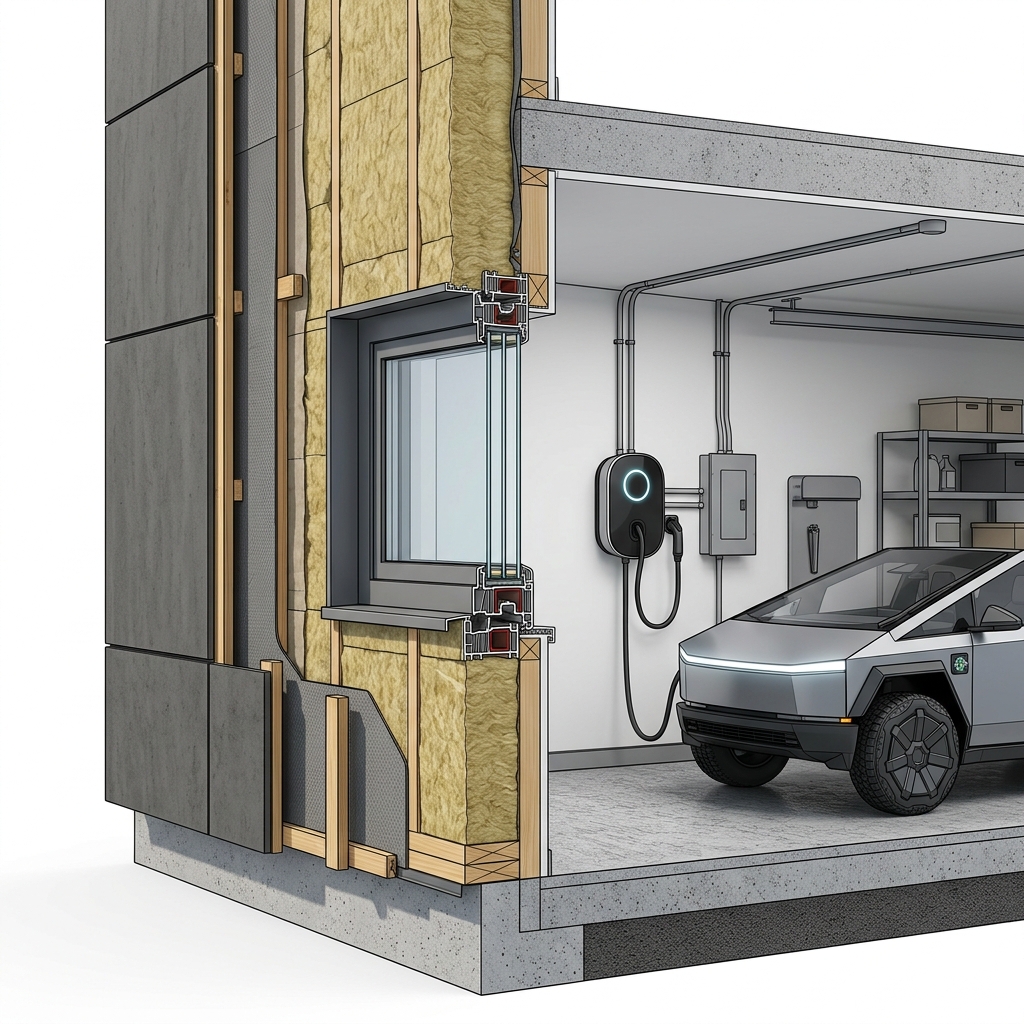
The High-Resilience Retrofit: Grid Independence and Thermal Stability in 2026
As grid volatility peaks in May 2026, the 'High-Resilience Retrofit' has emerged as the gold standard for Canadian homeowners. Learn how to achieve thermal stability and grid-independence through envelope hardening and local storage.
The High-Resilience Retrofit: Grid Independence and Thermal Stability in 2026
By Davis Miller, Senior Efficiency Engineer | May 7, 2026
Here's the thing: In May 2026, the definition of a "successful" home renovation has shifted. It's no longer about aesthetics or even just lowering bills. It's about "Resilience." With grid volatility becoming a weekly reality across North America, the "High-Resilience Retrofit" is now the primary vehicle for protecting both your comfort and your home's equity.
Last Updated: May 7, 2026
Executive Summary: The Resilience Pivot
Short Answer: A High-Resilience Retrofit (HRR) focuses on "Passive Survivability"—the ability of a home to maintain liveable temperatures during a multi-day power outage in extreme weather. In 2026, this is achieved through an "Envelope-First" approach combined with localized DC-coupled storage and V2H (Vehicle-to-Home) integration.
Key Forensics:
- Thermal Coasting: Modern high-resilience homes can "coast" for 72 hours in -20°C weather without active heating, dropping only to 15°C.
- V2H Dominance: 60% of new retrofits in May 2026 include bi-directional charging interfaces, turning EVs into the home's primary backup generator.
- The Equity Premium: Data from the 2026 housing market shows that HRR-certified homes are selling for 18% more than standard code-minimum properties.
| Component | standard Retrofit | High-Resilience (HRR) |
|---|---|---|
| Insulation | R-24 Walls / R-50 Attic | R-40 Walls / R-80 Attic |
| Windows | Double Pane (Low-E) | Triple Pane (Vacuum Insulated) |
| Backup | None / Portable Gen | V2H + 15kWh Static Storage |
| Ventilation | Standard Exhaust | ERV with HEPA Filtration |
1. Envelope Hardening: The Physics of Thermal Stability
Here's how it works: The envelope is the skin of your house. In a High-Resilience Retrofit, we focus on eliminating "Thermal Bridges"—paths where heat escapes through structural members.
And that's why it matters: If your grid goes down in a May heatwave or a winter storm, your envelope is all that stands between you and the external environment. By using exterior continuous insulation (mineral wool or graphite-infused EPS), we create a thermal "thermos" effect. This might work for you: If you are residing your home, adding 2-4 inches of exterior insulation is the single most effective resilience move you can make in 2026.
2. Grid Independence: The V2H Revolution
But here's the problem: Traditional battery backups are expensive and often undersized for whole-home loads.
So here's what happened: In 2026, the "Vehicle-to-Home" (V2H) standard became the dominant backup strategy. Here's what I found: An average 2026 EV has a 75kWh battery. That is equivalent to five Tesla Powerwalls. By integrating a bi-directional inverter during your retrofit, you gain the ability to power your entire high-resilience home for over a week. And that's why it matters: You aren't just saving money on gas; you are buying grid-independence.
3. Frequently Asked Questions (FAQ)
1. What is "Passive Survivability"?
It's the measure of how long a building stays safe for its inhabitants during a loss of active heating or cooling. In 2026, the target for high-resilience homes is a minimum of 72 hours.
2. Is it worth upgrading to Triple Pane windows in 2026?
Yes. Vacuum-insulated triple-pane glass has become significantly more affordable in May 2026. The R-value jump from double to triple pane is the difference between a cold draft and a stable interior climate.
3. How does the 2026 Carbon Rebate affect the ROI?
The increased carbon pricing in 2026 has shortened the payback period for deep retrofits by nearly 30%. The "Green Premium" is now essentially a "Volatility Insurance" policy that pays for itself.
EnergyBS Research: Engineering the Future of Residential Stability. Data Sources: 2026 North American Grid Resilience Report, Master Efficiency Audit Logs, V2H Standard Documentation. Keywords: High-Resilience Retrofit 2026, Grid Independence Home, Thermal Stability Feng Shui, V2H Integration Canada, Passive Survivability Housing.
About the Editorial Team This analysis was conducted by our independent research desk. We utilize verified market data and specialized methodology to provide objective, expert insights. Our strict editorial policy ensures no undue influence from sponsors or external parties.
About the Expert
EnergyBS Team
The EnergyBS Editorial Team is comprised of seasoned energy researchers, data analysts, and technical writers who collaborate with our subject matter experts to ensure every guide is accurate, actionable, and up-to-date with the latest sustainability standards.
Explore Related Deep Dives
View All ArticlesSpring Ice Forensics: Why the May 2026 Great Lakes Frost is Killing Heat Pump Efficiency
May 2026 has brought a record-breaking 'Spring Ice' event to the Great Lakes region. We perform a forensic thermal audit of how high humidity and near-freezing temperatures are triggering excessive defrost cycles and what homeowners can do to protect their COP.
The Smart Meter Audit: Identifying Hidden Energy Leaks in Period 9
May 2026 marks a turning point in home energy monitoring. Learn how to use your 2026 Smart Meter data to identify 'Phantom Loads' and 'Energy Parasites' that are draining your wallet in Period 9.
SG-Ready Heat Pumps: The New Standard for Intelligent Home Electrification
In 2026, a heat pump must be 'Smart Grid Ready' (SG-Ready). Learn how these units automatically shift loads to save you money and stabilize the grid.