Interior Storm Windows vs. Replacement 2026 Tool
Decide whether an interior storm panel, exterior lowe storm, repair, or full replacement best fits an existing window. Includes fit, condensation, egress, acoustic, and quote checks.
Direct Answer
Decide whether an interior storm panel, exterior lowe storm, repair, or full replacement best fits an existing window. Includes fit, condensation, egress, acoustic, and quote checks.
Use a Storm Panel When the Primary Window Is Worth Keeping
Short answer: An interior storm panel can be a strong retrofit when the primary window is structurally sound, operable, and repairable. It adds a second air barrier and insulating space without removing the frame. Choose a rated low-e product where energy performance is the priority, measure every opening, preserve required egress and ventilation, and manage moisture deliberately. Replace the full window when rot, failed structure, chronic water entry, unsafe operation, or the wall connection needs reconstruction.
The decision is not “old wood good, vinyl bad” or “storm insert equals triple pane.” Existing conditions and tested performance matter. A well-fitted low-e storm over single clear glass can sharply improve comfort and reduce heat transfer. A loose acrylic sheet may mainly reduce drafts. Neither will repair a rotten sill, failed flashing, broken sash balance, or water entering from the wall.
Pick the Project Path Before the Product
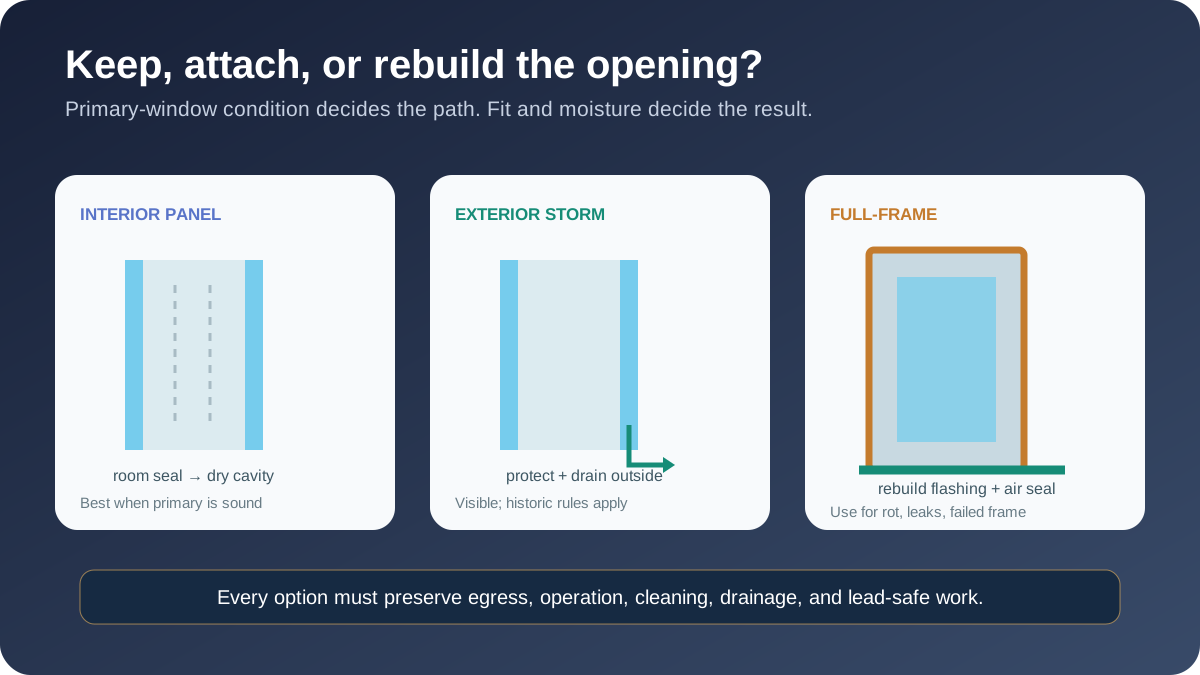
Start with four options:
- Repair and weatherstrip only. Best when the window is sound and the main problem is local sash leakage or hardware.
- Interior storm or insulating panel. Best when exterior appearance must remain unchanged, exterior access is difficult, or a removable interior air seal is useful.
- Exterior low-e storm. Best when protecting the primary sash from weather and using an exterior attachment is acceptable.
- Insert or full-frame replacement. Best when the existing assembly is beyond repair or the project must rebuild the opening.
ENERGY STAR says storm windows work best over primary windows that remain in good condition. Its guidance points homeowners toward replacement when the existing unit is rotten, inoperable, or damaged beyond reasonable repair.
Inspection table
| Existing condition | Likely path | Why |
|---|---|---|
| Sound frame, single clear glass, repairable sash | Repair plus rated storm | Preserves window and adds thermal/air layer |
| Sound clear double pane without low-e | Storm may help; model payback | Smaller improvement than over single pane |
| Modern low-e double pane in good condition | Usually keep as is | Additional layer may have limited value |
| Rotten sill or frame | Repair scope or full-frame replacement | Attachment cannot restore structure |
| Water entering behind trim or cladding | Diagnose wall/flashing first | Storm can hide rather than solve leak |
| Failed insulated-glass seal only | Compare sash/glass replacement | Whole frame may not need removal |
| Required emergency escape opening | Operable, code-compliant solution | Fixed insert can obstruct egress |
| Historic façade restrictions | Confirm local rules; interior often attractive | Exterior appearance may be regulated |
How an Interior Storm Changes Heat and Airflow
The panel creates another boundary between room air and the primary glass. Its benefit comes from three effects:
- added resistance from the panel and enclosed gap;
- lower radiative heat transfer when low-e material is used;
- reduced air leakage when the perimeter seal is continuous.
Gap depth alone does not guarantee performance. Air in a cavity can convect when the gap and temperature difference allow circulation. Product geometry, emissivity, edge seal, and leakage all influence the result.
DOE's storm-window program distinguishes glass low-e products from some acrylic insulating panels. Acrylic panels may offer strong air sealing even when they lack a low-e coating. Compare the rated product, not the generic material.
Low-e versus clear panels
A low-emissivity surface reduces long-wave radiant heat transfer. ENERGY STAR certifies storm windows by climate-appropriate low-e and solar performance. Northern products may admit more solar energy, while southern products can use lower solar transmittance to reduce cooling load.
A clear removable panel can still help drafts and surface temperature. But “clear acrylic” and “low-e storm” are not equivalent specifications. Ask for:
- certification or attachment rating;
- emissivity and solar transmittance where reported;
- air-leakage rating or test method;
- glazing material and thickness;
- frame and perimeter-seal design;
- use over single, double, tinted, or coated primary glass;
- orientation and climate designation.
Interior Versus Exterior Storms
| Factor | Interior storm/panel | Exterior storm |
|---|---|---|
| Exterior appearance | Usually unchanged | Visible from outside |
| Primary-window weather protection | No | Yes |
| Access | Installed from room side | May need ladder/scaffold |
| Moisture path | Room air must be kept out of cold cavity | Interior sash should limit room-air leakage; exterior storm needs drainage |
| Historic review | Often easier, still verify | Frequently regulated |
| Screens/operation | Product specific | Combination units may integrate screens |
| Wind/weather exposure | Protected indoors | Must resist exterior conditions |
| Cleaning | Panel removal or access needed | Track/panel access needed |
Exterior storms typically include weep paths to drain incidental moisture. Do not caulk those shut. Interior panels need a dependable room-side seal so humid indoor air does not leak into the colder space and condense on the primary glass.
Condensation: The Claim That Needs the Most Care
An interior storm can reduce room-side condensation because its inner surface stays warmer and the primary glass no longer contacts room air directly. It can also create hidden condensation if warm humid air leaks past the insert and reaches cold primary glass. Diagnose the moisture location and dew-point conditions first with the winter window-condensation guide.
The outcome depends on:
- indoor temperature and relative humidity;
- outdoor temperature;
- interior-panel surface temperature;
- perimeter air leakage;
- primary-window leakage to outdoors;
- curtains or shades that restrict air movement;
- moisture sources in the home;
- drainage and condition of the sill.
There is no safe universal statement that an insert “reverses” rot. Interior panels do not protect exterior wood from rain, failed paint, or bad flashing. Inspect primary sashes and sills during the season.
A moisture commissioning routine
- Measure indoor relative humidity with a reliable meter.
- Inspect the cavity after cold nights during the first weeks.
- Look at bottom corners, meeting rails, and cold frame edges.
- Check for frost, liquid water, staining, or musty odor.
- Confirm the panel seal has not pulled away.
- Adjust indoor humidity or repair leakage if condensation appears.
- Remove and dry the assembly before storing seasonal panels.
If water appears around the wall or trim rather than on the glass, investigate exterior drainage and flashing. Do not attribute every wet sill to indoor humidity.
Measure Every Opening
Old openings are rarely identical or square. Measure each one at several points with the product maker's instructions.
Record:
- width at top, middle, and bottom;
- height at left, center, and right;
- diagonal measurements or an out-of-square check;
- jamb depth and obstructions;
- latch, blind, handle, alarm sensor, and shade clearances;
- sill slope and trim condition;
- desired mounting plane;
- window ID and room;
- whether the opening must remain operable or meet egress rules.
Use the smallest relevant dimension only if the manufacturer directs that method. Compression-fit, magnetic, screw-mounted, and track systems use different allowances. A panel cut “tight” without accounting for seasonal movement or out-of-square trim can bow or become difficult to remove.
Make a low-cost template first
For an irregular opening, make a rigid template following the product vendor's accepted process. Test it in the exact mounting plane. Number the template and photograph its orientation. This reduces expensive remakes and avoids assuming mirrored windows are identical.
Perimeter Seal Choices
Compression fit
A flexible edge presses against the jamb or casing. It can be visually quiet and removable. Performance depends on consistent contact around uneven trim and the material's long-term compression set.
Magnetic attachment
Magnetic tape or channels can give repeatable placement. Check adhesion, corner continuity, substrate condition, and whether painted historic trim can accept the attachment without damage.
Mechanical fasteners or tracks
These can support larger or operable panels but make more permanent changes. Confirm fastener location, lead-paint handling, egress, and cleaning access.
Shrink film
Seasonal plastic film is a low-cost draft control. It has different durability, optics, operation, and acoustic performance from a rigid storm product. Treat it as a temporary measure rather than evidence of how a rated low-e panel will perform.
Egress, Ventilation, and Daily Use
Bedrooms and other rooms may require emergency escape and rescue openings under local code. A fixed insert that takes tools or significant force to remove may obstruct that path. Ask the AHJ which products and release methods are acceptable.
Also check:
- whether the primary window still opens for ventilation;
- whether insect screens remain usable;
- how the panel is removed in an emergency;
- whether a child or older adult can operate it;
- where removed panels are stored safely;
- whether window air conditioners, exhaust hoses, or alarms conflict;
- whether the added layer blocks a required combustion-air opening.
Do not cover bedroom egress, required ventilation, or life-safety equipment to save energy.
Sound Control: Ask for Tested Assemblies
An added panel can reduce outdoor noise because it adds mass, another sealed layer, and an air space. Different materials and pane thicknesses can help reduce resonance. But claims such as “STC 45 from acrylic” cannot be generalized.
Sound performance depends on:
- primary window and wall leakage;
- panel mass and stiffness;
- air-gap depth;
- perimeter seal;
- glass thickness differences;
- frame transmission;
- the frequency of traffic, aircraft, rail, or voices;
- vents, walls, roofs, and flanking paths.
Ask for an STC or OITC report for the tested primary-plus-storm assembly or a close match. OITC is often more relevant for low-frequency outdoor transportation noise. Test one room before buying a whole house if sound is the main goal.
Historic and Lead-Paint Work
Storm panels can preserve historic sash, glass, profiles, and exterior appearance. That does not remove the need to repair failing glazing putty, paint, joinery, hardware, or exterior drainage. Check preservation-district rules before ordering.
Painted windows in U.S. homes built before 1978 can contain lead. EPA says sanding, cutting, and window replacement can create hazardous dust. Paid contractors working in covered housing must follow the applicable Renovation, Repair and Painting requirements; EPA recommends lead-safe certified contractors for homeowners. State or tribal programs may add rules.
Interior inserts sometimes disturb less paint than replacement, but measuring, drilling, scraping, or repairing the sash can still disturb coatings. Test or use lead-safe practices as the law and project require.
Compare Costs Without Universal Prices
Quote each path for the same set of openings:
- tune and weatherstrip primary sash;
- add rated interior storms;
- add rated exterior storms;
- replace glass or sash only;
- insert replacement;
- full-frame replacement with flashing and trim.
Include:
- product and installation;
- primary-window repairs;
- lead-safe setup and cleaning;
- paint and finish work;
- screens and operable panels;
- storage racks or bags;
- delivery, templates, and remake policy;
- permits or historic review;
- product and labor warranty;
- expected maintenance.
ENERGY STAR publishes national savings estimates for certified low-e storms over single clear windows. Those are modeled averages, not a promise for one home. Local climate, fuel, HVAC efficiency, existing leakage, number and size of windows, shading, and installed fit control the result.
Simple payback screen
simple payback = installed net cost ÷ estimated annual bill savings
Run a conservative and optimistic case. Keep comfort, sound, preservation, and avoided repair as separate benefits rather than inventing dollar values.
One-Room Pilot
Before a whole-house order, install a representative panel in the room with the worst draft or cold-glass discomfort.
Record for two comparable weather periods:
- indoor and outdoor temperature;
- indoor relative humidity;
- inner-surface temperature if measured safely;
- visible condensation;
- subjective draft and radiant comfort;
- sound level or a repeatable noise observation;
- ease of removal and operation;
- any odor or finish interaction;
- fit gaps after several temperature cycles.
The pilot will not prove annual savings, but it can catch fit, appearance, cleaning, and condensation problems before a large purchase.
Quote Scorecard
| Requirement | Bid A | Bid B | Bid C |
|---|---|---|---|
| Primary-window condition/repair included | |||
| Interior, exterior, fixed, or operable | |||
| ENERGY STAR/AERC or other rating | |||
| Low-e/emissivity and solar data | |||
| Air-leakage data | |||
| Exact measuring and remake policy | |||
| Egress/operation preserved | |||
| Condensation inspection plan | |||
| Lead-safe scope | |||
| Cleaning, removal, and storage | |||
| Product/installation warranty | |||
| Pilot opening offered |
Seasonal Operation and Storage Plan
Removable panels create an annual job. Price the labor and storage before choosing a whole-house seasonal system.
Label each panel with a non-damaging opening ID. Store rigid panels vertically in a dry rack with separators so surfaces do not rub. Keep them away from heat sources and follow the material maker's temperature limits. Acrylic and other plastics can scratch or bow if they are stacked carelessly.
Before installation each season:
- clean the primary window and repair loose paint or glazing;
- clear exterior storm weeps and sill drainage;
- inspect perimeter gaskets, magnets, tracks, and corners;
- confirm the primary sash still locks and operates;
- dry every surface before closing the cavity;
- verify bedroom release and egress operation;
- photograph pre-existing stains or damage.
During removal, check the cold cavity before room air reaches it. Water marks, corrosion, mold, or swollen wood reveal a moisture problem that may disappear after drying. Record which opening and weather produced it.
Fixed year-round panels
A fixed panel avoids storage but can interfere with natural ventilation, cleaning, alarms, and emergency access. It may also change summer solar behavior. Choose a climate-appropriate low-e product and verify that the room still meets ventilation and egress needs.
If summer cooling is the main issue, exterior shading or a southern-zone low-solar-gain attachment may be more useful than a high-solar-gain northern storm. Do not leave a winter-oriented panel installed by habit without checking the cooling effect.
Renters, Condominiums, and Shared Buildings
Renters need written owner approval before attaching tracks, magnets, screws, or sealants. A compression-fit removable panel may be less invasive, but it can still damage weak paint or obstruct an owner's required window operation.
Ask the owner to address rotten frames, failed locks, water entry, lead paint, and code defects. A tenant-supplied insert should not become a substitute for required maintenance.
In a condominium or cooperative, windows may be part of the common elements even when reached from inside. Check alteration rules, appearance standards, fire requirements, insurance, and who owns future repairs. Exterior storms often need formal approval.
Accessibility check
Test the real handling task with the person who will use the panel. Large acrylic sheets can be light for their area but awkward. Glass can be heavier. Magnetic or compression seals may demand grip strength.
For an operable bedroom opening, time the removal without tools under normal room conditions. Keep furniture, blinds, and storage from blocking it. If the release is confusing, label it with plain instructions that remain visible in an emergency.
Compare Draft Reduction With a Simple Field Test
A smoke pencil or theatrical fog used by a trained auditor during a blower-door test can show leakage around the panel perimeter. Do not use candles, incense, or other combustion sources near curtains or suspected lead dust.
Record leakage in three states:
- primary window closed without the storm;
- storm installed as intended;
- storm installed after any gasket adjustment.
The test shows air movement, not U-factor. Pair it with surface-temperature and condensation observations. A panel can seal well yet lack low-e performance; another can have good glazing data but leak at an uneven jamb.
Approve the Sample Before the Full Order
Ask for a full-size pilot or a returnable corner sample that shows the real glazing, frame, gasket, fastener, and finish. View it beside the primary window in daylight and after dark. Check reflections, tint, optical distortion, edge visibility, blind clearance, and how the seal crosses uneven trim.
Keep the approved sample, written color, and product code with the order. If the seller changes glazing material, low-e option, frame profile, or attachment method, require a revised performance comparison. A showroom photograph cannot reveal how an insert looks across wavy historic glass or deep wood casing.
Frequently Asked Questions
Can an interior storm match a replacement window?
Some primary-plus-storm assemblies can perform near certain replacement products for specific metrics. Do not generalize. Compare rated U-factor or attachment performance, air leakage, solar gain, operation, and installation for the exact options.
Is acrylic better than glass?
Each has tradeoffs in weight, stiffness, scratch resistance, optics, low-e availability, fire behavior, size, and sound. Select from tested product data and the room's needs.
Will an interior storm stop window condensation?
It may warm the room-side surface and reduce condensation there. If humid indoor air leaks into the cavity, it can condense on the colder primary glass. Fit, humidity, and monitoring matter.
Should the cavity be vented to the room?
Follow the product and building-science design. An interior storm generally aims to keep room air out of the cold cavity. Exterior storms use controlled drainage and may manage pressure differently. Do not drill holes by guesswork.
Are magnetic DIY panels effective?
They can reduce leakage when the perimeter is continuous and the material is suitable. Performance varies with fit and may lack the tested low-e and air-leakage data of rated products. Start with one opening.
Can I put a storm over a tinted or low-e primary window?
The combination can change glass temperature, solar absorption, visible light, and seal stress. Ask both manufacturers to approve the exact pairing. ENERGY STAR notes that adding a storm to tinted glass may make the opening darker.
Do interior storms protect historic wood?
They reduce room-air contact and may improve thermal conditions. They do not protect the exterior from rain, failed paint, or poor flashing. Maintain the primary window.
What to Read Next
If the frame is damaged or the opening needs rebuilding, use the high-performance replacement-window guide. Its quote scorecard covers whole-product ratings, insert versus full-frame scope, flashing, and installation acceptance.
About the Editorial Team EnergyBS reviews public program rules, product specifications, utility rates, and reader-facing cost assumptions. Treat savings figures as estimates until you verify local prices, permits, rebates, and contractor quotes.
Sources and Verification
Editorial Review
EnergyBS Editorial Team
EnergyBS publishes practical homeowner guides. Important program, product, and cost claims should be checked against the linked source and local project documents before you commit to work.
Related Guides
View All ArticlesHighPerformance Windows (2026 Guide & Data)
Specify replacement windows by wholeproduct NFRC ratings, climate and orientation, comfort, durability, and roughopening installation. Includes a label decoder and quote scorecard.
Blower Door Test: What Is Your ACH50 Score? 2026 Analysis
Prepare for a calibrated blower door test, understand CFM50 and ACH50, map leakage safely, compare testin and testout results, and know what the score cannot tell you.
Air Sealing Guide: Stop Heat Loss & Save Money
Insulation without air sealing is a waste of money. Learn how the Stack Effect sucks heat from your home and how to seal your attic layout effectively.