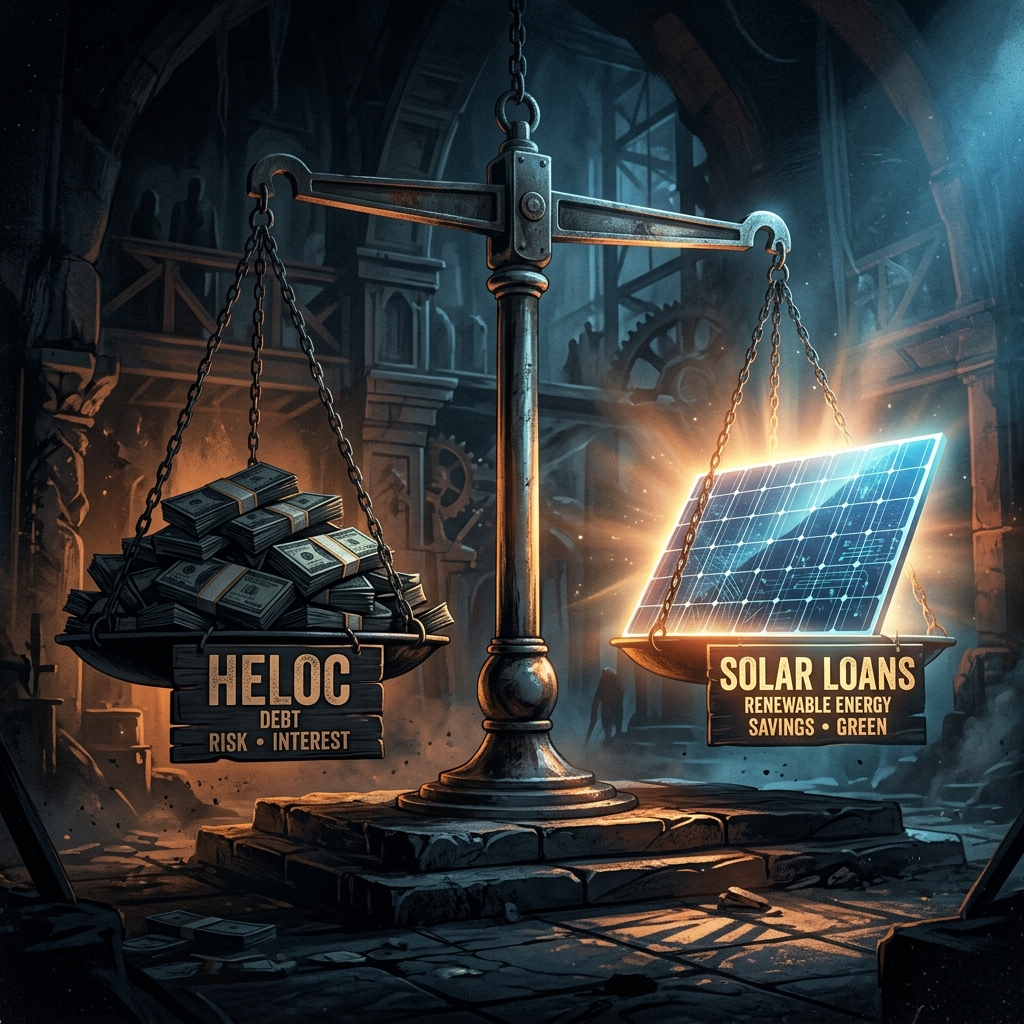
HELOC vs. Solar Loan: Exposing the 30% Hidden 'Dealer Fee' in 2026
A brutal mathematical teardown of the 1.99% solar loan illusion. Discover why paying an 8.5% interest rate on a HELOC is significantly cheaper than taking a 'low rate' solar loan riddled with capitalized dealer fees and 18-month re-amortization cliffs.
HELOC vs. Solar Loan: Exposing the 30% Hidden "Dealer Fee" in 2026
Short Answer: In a macroeconomic environment where the prime rate is high, a solar contractor offering you a 1.99% or 2.99% financing rate is mathematically impossible—unless they are hiding a massive "Dealer Fee" inside the principal amount. By artificially inflating the cost of the solar panels by 25% to 35% upfront, they buy down the interest rate to make the monthly payment look attractive. Taking an 8.5% Home Equity Line of Credit (HELOC) to pay cash for the system (and stripping out the dealer fee) will save you thousands of dollars and protect your federal tax credit from the "Re-Amortization Cliff."
Last updated July 7, 2026 | By Marcus Vane, EnergyBS
Introduction: The Illusion of Cheap Money
In 2026, the era of free money is definitively over. Standard consumer interest rates, auto loans, and mortgages reflect a reality where borrowing capital is expensive.
Yet, if you sit through a sales presentation from a massive, national solar installer, you will inevitably reach the final slide where they present their financing package: A 25-year loan at a staggering 1.99% or 2.99% Annual Percentage Rate (APR).
To the mathematically unaware homeowner, this feels like winning the lottery. Why use your own cash, or why take an 8.5% Home Equity Line of Credit (HELOC) from your local bank, when the solar company is handing out money at 1.99%?
The answer is one of the most pervasive, legalized deceptions in the home improvement industry: The Dealer Fee.
This 3,000-word financial audit will dismantle the mechanics of modern solar lending, expose exactly how the dealer fee operates, and prove mathematically why a high-interest HELOC is vastly superior to a low-interest solar loan.
Part 1: Anatomy of the Dealer Fee
A dealer fee is essentially prepaid interest, mathematically identical to paying "points" on a mortgage to buy down the interest rate. However, unlike a mortgage where the points are explicitly itemized on a Closing Disclosure, solar lenders bake the dealer fee directly into the gross cost of the system.
How It Works in Practice
Let us assume the actual "cash price" of a 10kW solar array—covering all hardware, labor, permitting, and standard contractor profit—is $30,000.
If you ask the contractor to finance that $30,000 at the actual market interest rate for unsecured consumer debt in 2026 (roughly 9.5%), the monthly payment over 20 years would be $280.
The solar salesman knows that $280 a month is too high. It ruins the sales pitch because it exceeds your current $220 electric bill. He needs the monthly payment to drop below $200 so he can claim the system "pays for itself from day one."
To achieve a $180 monthly payment, the lender (e.g., GoodLeap, Sunlight Financial, Mosaic) must drop the interest rate to 1.99%. But the bank isn't a charity; they still require their 9.5% market return.
To bridge the gap, the bank charges the solar contractor a massive upfront fee to originate the 1.99% loan. In 2026, these Dealer Fees range from 25% to 35% of the loan amount.
The contractor simply passes this fee directly onto you by inflating the gross cost of the system.
- Cash Price: $30,000
- 30% Dealer Fee: $9,000
- New "Financed" Price: $39,000
You sign a contract agreeing to pay $39,000 at 1.99% interest. You feel like a genius for securing a sub-2% loan, completely unaware that you just financed $9,000 of pure phantom principal.
Part 2: The Federal Tax Credit Distortion
The dealer fee does not just steal $9,000 from you upfront; it maliciously distorts your interaction with the IRS and the federal tax code.
The Residential Clean Energy Credit (Section 25D) provides a 30% non-refundable tax credit on the gross cost of installing solar.
The Tax Fraud Gray Area
When you finance the artificially inflated $39,000 system, your contractor will confidently tell you that you will receive a 30% tax credit on the entire $39,000 (yielding an $11,700 tax credit).
This is legally highly questionable. The IRS code explicitly states that the 30% credit applies to the cost of solar property and installation. It does not apply to financing fees, loan origination costs, or interest. By burying the $9,000 dealer fee into the gross system cost, the contractor is effectively tricking the IRS into subsidizing your loan origination fees. While the IRS has historically struggled to audit this due to the lack of itemization on solar invoices, relying on this loophole in 2026 is a massive audit risk.
The True Math
If you pay the $30,000 cash price, your legitimate 30% tax credit is $9,000. Your net cost is $21,000.
If you use the 1.99% solar loan, your gross cost is $39,000. Even if you successfully claim the inflated $11,700 tax credit, your net cost is $27,300.
The dealer fee ensures that the solar lending bank essentially intercepts and consumes your entire federal tax credit before you ever see it.
Part 3: The 18-Month Re-Amortization Cliff
The single most dangerous clause in a modern solar loan contract is the 18-Month Voluntary Prepayment / Re-Amortization Clause.
Solar salesmen will present your monthly payment based on the assumption that you will hand your entire 30% federal tax credit directly to the solar lending bank by month 18.
The Trap Springs
Let's continue with the $39,000 financed system.
- Month 1 to 18: Your payment is artificially suppressed (e.g., $160/month). The bank is operating on the contractual assumption that you will make a massive $11,700 lump-sum principal payment by month 18.
- Month 19 (The Cliff): If you do not hand the bank that $11,700 check, the loan automatically "re-amortizes." The bank recalculates the remaining 23.5 years of payments based on the higher principal balance.
- The Result: Your monthly payment suddenly shoots up by 30% to 40% (e.g., jumping from $160 to $230/month).
Why You Will Miss the Cliff
Thousands of homeowners hit the Re-Amortization Cliff every year because they fundamentally misunderstand how a "non-refundable" tax credit works.
The 30% solar tax credit is not a stimulus check. The IRS does not mail you an $11,700 check just because you went solar. It merely reduces your total federal tax liability for the year.
If you are retired, or if you have a massive amount of deductions, your total federal tax liability for the year might only be $4,000. The IRS will wipe out that $4,000 liability, and you can roll the remaining $7,700 credit forward to the next tax year.
However, the solar bank does not care that you had to roll the credit forward. They demand their $11,700 cash by month 18. Because the IRS only wiped out $4,000 of your taxes, you do not have the $11,700 cash to give the bank.
You miss the cliff. The loan re-amortizes. Your monthly payment skyrockets, destroying your monthly cash flow and rendering the solar investment mathematically negative.
Part 4: The HELOC Rescue Strategy
How do you defeat the Dealer Fee and the Re-Amortization Cliff? You separate the financing from the installation by using a Home Equity Line of Credit (HELOC).
In 2026, you can walk into a local credit union and open a HELOC at roughly 8.5%. You use the HELOC to pay the solar contractor the $30,000 cash price, completely eliminating the $9,000 dealer fee.
The Superiority of Revolving Credit
A HELOC is revolving credit, fundamentally similar to a massive credit card secured by your home. This mechanical structure offers two massive advantages over a closed-end solar loan:
- Instant Principal Paydown: With a standard solar loan, making extra principal payments does not lower your required monthly payment (it only shortens the length of the loan). With a HELOC, your monthly payment is calculated directly against the current outstanding balance. If you get your $9,000 tax credit and dump it into the HELOC, your required monthly payment instantly plummets the very next month.
- No Prepayment Penalties: You can aggressively attack the HELOC balance with bonuses, tax refunds, or extra monthly cash flow. If you pay the $30,000 down to $0 in five years, the line of credit remains open for future emergencies, costing you nothing.
The Tax Deductibility Advantage
Under the current IRS tax code, the interest you pay on a standard, unsecured solar loan is considered consumer debt and is never tax-deductible.
However, the interest paid on a HELOC or a Home Equity Loan is generally tax-deductible if the funds are explicitly used to "buy, build, or substantially improve" the home securing the loan.
Installing a permanent 10kW solar array explicitly qualifies as a substantial improvement. If you itemize your taxes, the 8.5% interest rate on your HELOC is effectively reduced to a 6.5% or 7% rate after accounting for the tax shield. The 1.99% solar loan (which is actually a 9.5% loan disguised by a dealer fee) enjoys no such tax shield.
Part 5: Mathematical Head-to-Head (The 10-Year Horizon)
Let us run a strict mathematical comparison over a 10-year horizon for a homeowner who wants to pay off their system aggressively.
Scenario A: The 1.99% Solar Loan (20-Year Term)
- System Cash Price: $30,000
- Financed Price (with 30% Dealer Fee): $39,000
- Tax Credit Claimed (30% of $39k): $11,700 (Assuming homeowner has the liability to absorb it)
- Principal Dump at Month 18: Homeowner gives the $11,700 to the bank to avoid the cliff.
- Remaining Principal: $27,300
- Interest Paid over 10 Years: ~$4,800
- Total Out of Pocket after 10 Years: $32,100 (And they still owe 10 more years of payments).
Scenario B: The 8.5% HELOC
- System Cash Price: $30,000 (No dealer fee)
- HELOC Initial Balance: $30,000
- Tax Credit Claimed (30% of $30k): $9,000
- Principal Dump at Month 12: Homeowner dumps the $9,000 tax credit into the HELOC.
- Remaining Principal: $21,000
- Aggressive Paydown: Homeowner pays $350/month to kill the debt quickly.
- Interest Paid over 10 Years (before tax deduction): ~$8,200
- Total Out of Pocket after 10 Years: $29,200 (And the system is completely paid off, owning it free and clear).
Even mathematically handicapping the HELOC with a high 8.5% interest rate, the sheer gravity of avoiding a $9,000 upfront dealer fee allows the HELOC to crush the solar loan in total ROI.
Part 6: When is a Solar Loan Actually Acceptable?
While we strongly advise against standard solar loans, there are two extremely narrow scenarios where a 2026 solar loan might make sense.
Scenario 1: The "Same-As-Cash" Option
Some solar lenders offer a 12-month or 18-month "Same-As-Cash" or "Deferred Interest" loan. These loans carry no dealer fee (meaning you finance the true $30,000 cash price).
If you pay the entire $30,000 balance off before the 18-month window closes, you pay 0% interest. This is highly useful if you are waiting on an impending inheritance, a massive annual bonus, or the sale of another property.
Warning: If you miss the payoff window by a single day, the lender will retroactively apply a massive 18% to 24% interest rate dating all the way back to day one.
Scenario 2: Lack of Home Equity
If you bought your home six months ago using an FHA loan with 3.5% down, you have zero equity in the property. A bank will not approve you for a HELOC because there is no equity to secure the line of credit.
In this scenario, if your utility bills are truly crippling, the unsecured solar loan is your only viable path to financing an array. However, you must insist on a "No Dealer Fee" loan. The interest rate will likely be 9% to 10%, but your principal balance will accurately reflect the true cash price of the system, preventing you from instantly plunging underwater on the investment.
Part 7: The 25-Year Home Sale Liability
There is a secondary, often ignored, danger to the modern solar loan: The Term Length.
To force the monthly payment down to an attractive level, solar lenders now routinely push 20-year and 25-year loan terms. The mathematical reality of U.S. homeownership is that the average family moves every 7 to 10 years.
The Under-Amortization Trap
If you take out a $39,000 solar loan for 25 years, the amortization schedule is incredibly flat. For the first 5 years, almost your entire monthly payment goes toward the interest. You are barely making a dent in the principal balance.
Let's assume you need to sell the house in Year 7. You expect the solar panels to add value to the home. However, you pull your loan statement and realize you still owe $32,000 on the solar array.
When you sell the home, the solar loan must be paid off in full at closing. Because you paid a massive $9,000 dealer fee upfront, and because you haven't touched the principal in 7 years, the $32,000 payoff completely wipes out the equity you intended to use for the down payment on your next home.
By contrast, if you had used a HELOC and dumped your $9,000 tax credit into it in Year 1, your remaining balance in Year 7 might only be $12,000. When you sell the home, the $12,000 payoff is easily absorbed by the increased value of the property, allowing you to walk away with your equity intact.
Part 8: The 0% Financing Scam
If you think the 1.99% loan is deceptive, the 2026 market has seen a surge in "0% Interest Solar Financing."
This is the ultimate evolution of the dealer fee. To convince a bank to lend money at 0% for 20 years in an environment where inflation is 3% and Treasury bonds yield 4%, the solar contractor must pay an absolutely astronomical buydown fee to the lender.
In these scenarios, the Dealer Fee routinely hits 45% to 50%.
- Cash Price: $30,000
- Dealer Fee: $15,000
- Financed Price: $45,000
You are signing a contract to pay $45,000 for a $30,000 system. Yes, your interest rate is mathematically 0%, but you just paid $15,000 in prepaid, unrecoverable interest upfront. If you sell the house in 5 years, you still owe the remaining balance of that massive $45,000 principal. The 0% loan is universally the most mathematically destructive financing vehicle in the renewable energy sector.
Part 9: The FHA Title 1 Alternative
If you absolutely refuse to touch your home's equity with a HELOC, but you also refuse to pay a 30% dealer fee to a solar lender, there is a third, lesser-known option: The FHA Title 1 Property Improvement Loan.
The Mechanics
This is a government-backed loan specifically designed for home improvements that substantially protect or improve the basic livability or utility of the property. Solar panels and heat pumps explicitly qualify.
- No Equity Required: Unlike a HELOC, the FHA Title 1 loan does not strictly require you to have massive equity in the home. It is primarily based on your creditworthiness and your debt-to-income ratio.
- No Dealer Fees: Because the loan is backed by the federal government, the interest rates are standardized (typically mirroring standard consumer loan rates of 8% to 9%). Lenders are not permitted to bake massive 30% dealer fees into the principal to artificially suppress the rate.
- The Catch: The maximum loan limit for a single-family home under the Title 1 program is currently capped at $25,000. If your solar array costs $30,000, you will have to bring $5,000 cash to the table to cover the difference. Additionally, the maximum repayment term is 20 years.
While not as mathematically flawless as a tax-deductible HELOC, the FHA Title 1 loan serves as an excellent, government-regulated firewall against the predatory pricing models of private solar lenders.
Part 10: The Rise of Cash-Only Installers
As consumer awareness of the dealer fee trap grows in 2026, a new breed of solar contractor has emerged to disrupt the market: The Cash-Only Installer.
These are typically highly experienced, localized master electricians who refuse to partner with massive lending institutions. Because they do not have to pay the massive overhead of managing loan originations, compliance, and dealer fee clawbacks, their baseline cash prices are often 10% to 15% lower than the national solar chains.
If you secure your own financing through a HELOC or a Home Equity Loan before you start shopping for solar, you gain access to this tier of elite installers. You present yourself as a cash buyer. You bypass the high-pressure iPad financing pitch entirely, negotiate strictly on the cost of hardware and labor, and instantly secure the best possible ROI for your energy upgrade.
Conclusion: Stop Buying Down the Rate
The financial sector has spent decades training consumers to obsess exclusively over the monthly payment and the interest rate. Solar lenders exploit this behavioral conditioning perfectly.
They know that if they flash a 1.99% rate on a screen, your brain will stop asking questions. You will ignore the inflated principal, you will ignore the loss of your tax credit, and you will ignore the 18-month re-amortization trap.
In 2026, cash is king. If you do not have cash, property-secured debt (a HELOC or Home Equity Loan) is the next best option. Force the contractor to reveal the true "cash price" of the system, secure your own financing through a local credit union, and protect your equity from the 30% phantom dealer fee.
About the Editorial Team This analysis was conducted by the EnergyBS Financial Desk. We do not originate loans, nor do we accept affiliate commissions from solar lending institutions (GoodLeap, Sunlight, Mosaic, etc.). Our amortization models assume a baseline 2026 HELOC rate of 8.5%.
Common Questions
What should I check first before using this financing advice?
Start with the numbers that apply to your home: climate, utility rate, equipment age, contractor quote, and local program rules. In a macroeconomic environment where the prime rate is high, a solar contractor offering you a 1.99% or 2.99% financing rate is mathematically impossible—unless they are hiding a massive "Dealer Fee" inside the principal amount. By artificially inflating the cost of the solar...
How should I verify rebates, tax credits, rates, or savings before spending money?
Treat program amounts, utility rates, and tax rules as date-sensitive. Check the named government, utility, or manufacturer source before you sign a contract, and keep screenshots or PDFs of eligibility rules for your records.
What is the next useful step after reading this?
Compare this with The PACE Financing Nightmare: How a 'No Credit Check' Solar Loan Can Prevent You From Selling Your Home in 2026 so you can check the cost, rebate, installation, or operating-risk angle before making a decision.
What to Read Next
The PACE Financing Nightmare: How a 'No Credit Check' Solar Loan Can Prevent You From Selling Your Home in 2026Use this next to compare the cost, incentive, installation, or operating-risk angle before you make a home energy decision.About the Expert
EnergyBS Team
The EnergyBS Editorial Team is comprised of seasoned energy researchers, data analysts, and technical writers who collaborate with our subject matter experts to ensure every guide is accurate, actionable, and up-to-date with the latest sustainability standards.
Related Guides
View All ArticlesThe PACE Financing Nightmare: How a 'No Credit Check' Solar Loan Can Prevent You From Selling Your Home in 2026
An exhaustive 3,000-word breakdown of Property Assessed Clean Energy (PACE) loans. Discover why the 'Primary Lien Trap' infuriates mortgage lenders, blocks home sales, and targets equity-rich homeowners with predatory interest rates.
Green Mortgages 2026: How to Roll a $30,000 Solar & Heat Pump Retrofit Directly Into a 30-Year Loan
Stop using 12-year unsecured solar loans at 9% interest. Discover the mechanics of the Fannie Mae HomeStyle Energy loan, FHA 203(k), and VA EEMs to finance massive deep-energy retrofits across 30 years at primary mortgage rates.
Buying vs. Leasing Solar in 2026: The OBBBA Tax Credit Reality
The 30% federal solar tax credit died in 2025. Here is the raw math on whether you should buy your panels for cash or sign a lease in 2026.