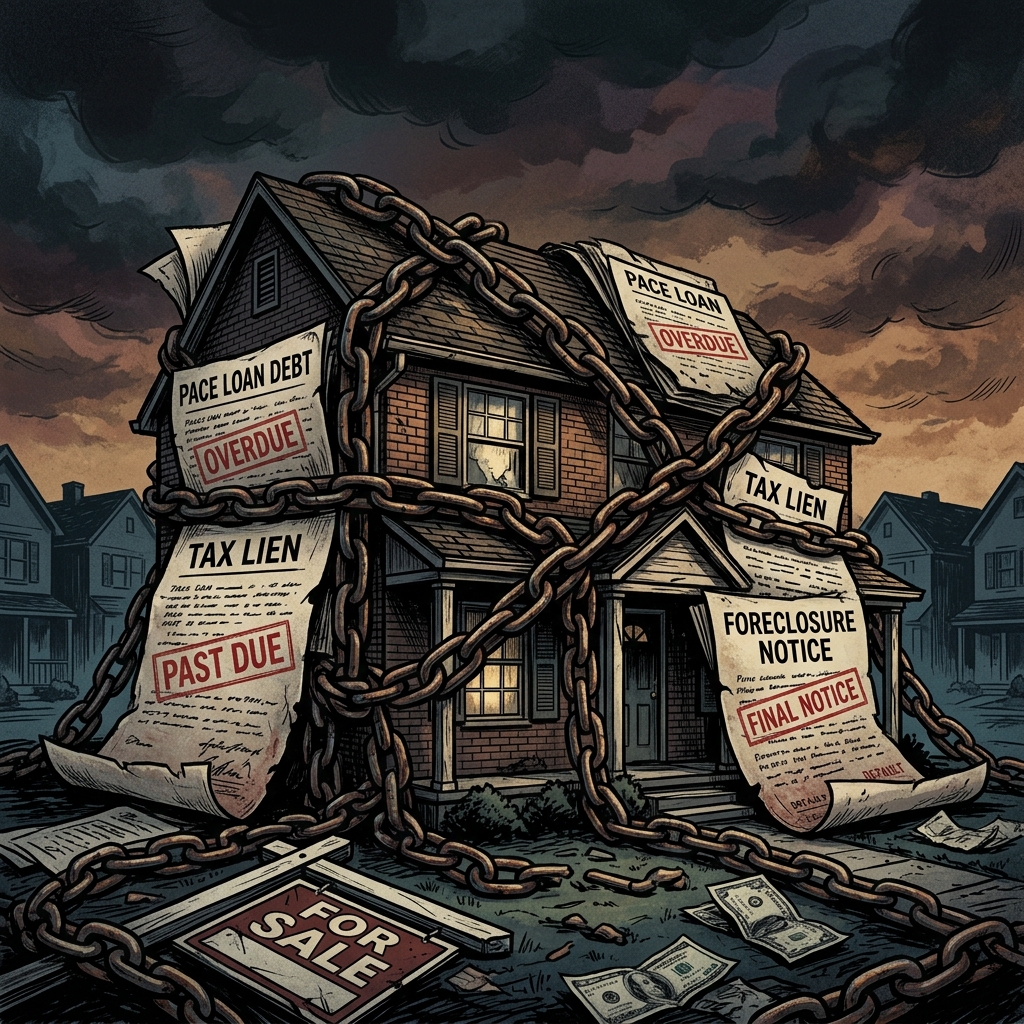
The PACE Financing Nightmare: How a 'No Credit Check' Solar Loan Can Prevent You From Selling Your Home in 2026
An exhaustive 3,000-word breakdown of Property Assessed Clean Energy (PACE) loans. Discover why the 'Primary Lien Trap' infuriates mortgage lenders, blocks home sales, and targets equity-rich homeowners with predatory interest rates.
The PACE Financing Nightmare: How a "No Credit Check" Solar Loan Can Prevent You From Selling Your Home in 2026
Short Answer: Property Assessed Clean Energy (PACE) financing is marketed as a magical, no-credit-check way to install $40,000 of solar panels and heat pumps. The reality is that PACE is not a standard loan; it is a massive property tax assessment. Because it takes "super-priority" lien status over your primary mortgage, Fannie Mae and Freddie Mac refuse to touch it. If you try to sell or refinance your home with an active PACE lien in 2026, you will hit a brutal, expensive brick wall.
Last updated July 7, 2026 | By Marcus Vane, EnergyBS
Introduction: The "No Credit Check" Trap
In 2026, the high-interest-rate macroeconomic environment has severely restricted traditional borrowing. Unsecured solar loans that used to carry 2% interest rates now effectively cost 8% to 10%, assuming the borrower even has the FICO score to qualify.
Into this void stepped the aggressive resurgence of Property Assessed Clean Energy (PACE) financing.
Contractors love PACE. It allows them to close a $40,000 solar or HVAC deal with a homeowner who has a 550 credit score and zero cash in the bank. The sales pitch is intoxicatingly simple:
- "No credit check required!"
- "No money down!"
- "The loan is attached to the house, not you!"
- "When you sell the house, the new owner just takes over the payments!"
Almost every single one of those bullet points hides a devastating financial reality. This 3,000-word audit will tear down the mechanics of PACE financing, expose why the banking industry hates it, and explain exactly why an active PACE lien can completely freeze a real estate transaction.
Part 1: The Anatomy of a PACE Assessment
To understand why PACE is so dangerous, you must understand that a PACE agreement is technically not a loan.
When you take out a standard auto loan or a personal loan, the bank evaluates your income, your debt-to-income (DTI) ratio, and your FICO score. The loan is tied to your Social Security Number. If you stop paying, the bank ruins your credit and sends you to collections.
PACE fundamentally bypasses the entire consumer credit system.
- PACE is established through a public-private partnership between a financing company (like Ygrene or Renew Financial) and your local municipal government.
- Because it is a government-sanctioned program, the cost of your solar panels is not recorded as a standard loan. It is recorded as a Special Tax Assessment on your property.
- You do not write a monthly check to the solar company. Instead, your annual county property tax bill suddenly spikes by $3,000 to $4,000.
- Because property taxes are fundamentally secured by the physical real estate itself, the PACE administrator does not care about your credit score. They only care that you have enough equity in the home to cover the assessment if they are forced to foreclose on you.
The Equity Mining Strategy
This structure makes PACE inherently predatory. It systematically targets "equity-rich, cash-poor" individuals—very often elderly homeowners who have paid off their mortgages but live on fixed incomes.
A contractor knocks on the door, promises "free" solar panels that will eliminate the electric bill, and secures the funding entirely against the homeowner's hard-earned equity without ever verifying if the homeowner can afford a $4,000 spike in their annual property taxes. When the elderly homeowner defaults on their taxes, the municipal government can foreclose on a $500,000 home over a $30,000 solar panel assessment.
Part 2: The "Super-Priority" Lien Trap
The core mechanical flaw of PACE financing—and the reason it triggers massive crises in real estate transactions—is the concept of "Lien Priority."
When a bank writes a 30-year mortgage to help you buy a house, they require "First Lien Position." This means that if you stop paying your mortgage and the bank forecloses, the bank is the first entity in line to get paid from the proceeds of the foreclosure auction.
The bank's entire risk model relies on First Lien Position.
The Government Always Gets Paid First
In real estate law, there is one entity that always jumps ahead of the bank in the lien line: the local government collecting property taxes. Property taxes hold "Super-Priority" status.
Because a PACE assessment is legally classified as a property tax, the PACE lien instantly jumps ahead of your primary mortgage lender.
If you default on your property taxes, the county can foreclose on the home, sell it, pay off the municipal government, pay off the PACE solar assessment, and the primary mortgage lender is left fighting for whatever scraps remain.
The Fannie Mae / Freddie Mac Blockade
The banking industry (specifically the Federal Housing Finance Agency) recognized this extreme risk.
In response, the two massive government-sponsored enterprises that buy and back the vast majority of U.S. mortgages—Fannie Mae and Freddie Mac—issued a strict, uncompromising directive: They will not purchase or refinance any mortgage on a property that has an active PACE lien.
Because almost every local bank and credit union relies on selling their mortgages to Fannie Mae or Freddie Mac to maintain liquidity, standard lenders will outright refuse to underwrite a mortgage on a home with a PACE assessment.
Part 3: The Real Estate Transaction Nightmare
The sales pitch for PACE relies heavily on the promise of transferability: "Because the assessment is tied to the property taxes, you don't have to pay it off when you move! The new buyer just assumes the tax payments!"
In 2026, this is a catastrophic lie.
The Escrow Crisis
Imagine you are trying to sell your home. You owe $30,000 on a PACE solar assessment. You find a buyer willing to pay your asking price. The buyer goes to their bank (e.g., Chase or Wells Fargo) to get a mortgage.
During the underwriting process, the title company pulls the preliminary title report and discovers the PACE tax assessment.
- The Bank Rejects the Loan: The buyer's bank sees the Super-Priority PACE lien. Because they cannot sell the loan to Fannie Mae, the bank instantly suspends the buyer's mortgage application. They issue an ultimatum: "We will not fund this mortgage unless the PACE lien is paid off in full before closing."
- The Buyer Refuses to Pay: The buyer, already stretching their budget at 2026 interest rates, has absolutely no intention of assuming a $3,000/year property tax penalty for solar panels they didn't ask for. Furthermore, their bank won't let them assume it anyway.
- The Seller's Ultimatum: To save the transaction, the title company turns to you (the seller). You are forced to pay off the entire $30,000 PACE balance out of the proceeds of your home sale.
The Equity Erasure
If you thought you were going to walk away from the closing table with $100,000 in equity, you will only walk away with $70,000. The "free" solar panels you installed via PACE three years ago have now directly cannibalized the equity you spent decades building.
The promise of transferability is a myth because modern mortgage mechanics explicitly prohibit it.
Part 4: The Refinancing Blockade
Perhaps you don't want to sell your home. Perhaps interest rates drop in late 2026, and you want to refinance your 7.5% mortgage down to a 5.5% rate.
If you have an active PACE lien, you cannot execute a standard rate-and-term refinance.
The Subordination Request
When you attempt to refinance, the new bank is writing a brand-new mortgage. To do so, they require First Lien Position. But the PACE assessment is sitting there with Super-Priority status.
To proceed, your new bank must ask the PACE administrator for a "Subordination Agreement." This is a legal document where the PACE administrator formally agrees to step back in line behind the new mortgage lender.
- The Problem: Many PACE administrators outright refuse to subordinate. Their entire business model relies on the absolute security of Super-Priority tax status. Why would they voluntarily surrender that protection?
- The Result: Without a subordination agreement, the new bank will deny your refinance application. You are trapped in your high-interest mortgage simply because you wanted to finance a heat pump without a credit check.
Part 5: Exiting a PACE Loan (The Rescue Operation)
If you are currently trapped in a PACE assessment in 2026, you must execute a strategic rescue operation to clear your title before attempting to sell or refinance.
Strategy 1: The Cash-Out Refinance
If you have significant equity in your home, you can initiate a Cash-Out Refinance specifically designed to swallow the PACE loan.
- You apply for a new, larger primary mortgage.
- The bank agrees to the loan on the strict condition that the cash extracted is sent directly to the PACE administrator to pay off the assessment in full.
- Because the PACE lien is being extinguished simultaneously at the closing table, the bank is guaranteed First Lien Position.
- The Downside: You are rolling a 15-year solar assessment into a 30-year mortgage, which means you will pay significantly more interest over the lifespan of the debt.
Strategy 2: The HELOC Rescue
If you do not want to touch your primary mortgage (e.g., you locked in a 3% rate back in 2021), the best tool is a Home Equity Line of Credit (HELOC).
- You take out a $30,000 HELOC against your home's equity.
- Because the HELOC is a secondary lien (subordinate to your primary mortgage), banks are often willing to write the HELOC even with the PACE assessment present.
- You immediately use the HELOC funds to pay off the PACE assessment in full.
- The Benefit: Your property tax bill instantly drops back to normal. The Super-Priority lien is removed, making your home infinitely easier to sell in the future. You simply pay off the HELOC independently.
Part 6: The 2026 Regulatory Crackdown
The rampant abuse of PACE financing by unscrupulous contractors has not gone unnoticed. By 2026, massive regulatory crackdowns and class-action lawsuits have severely restricted the program in several states.
The California Overhaul
California, once the undisputed capital of PACE lending, passed aggressive legislation following a wave of foreclosures on elderly residents. In 2026, California PACE administrators must strictly verify the homeowner's income and ability to pay (essentially running the same financial stress tests as a standard bank loan). Furthermore, contractors are strictly forbidden from pitching PACE as a "free" or "government-funded" program.
The Florida Resistance
Florida remains one of the last major battlegrounds for PACE financing, primarily driven by the need for hurricane-impact windows and HVAC replacements. However, aggressive pushback from county tax collectors (who are tired of foreclosing on their own constituents on behalf of private solar lenders) has led to multiple counties completely banning the PACE program within their municipal borders.
Part 6: The Mathematics of "Escrow Shock"
Even if you have no intention of selling or refinancing your home, an active PACE assessment can still trigger a devastating short-term financial crisis through a mechanism known as "Escrow Shock."
To understand this, you must understand how your monthly mortgage payment is structured. If you have a traditional mortgage, you do not just pay Principal and Interest to the bank. You pay PITI (Principal, Interest, Taxes, and Insurance). The bank collects the "Taxes and Insurance" portion and holds it in an Escrow Account, paying the county tax collector on your behalf at the end of the year.
Banks do this because they are terrified of the Super-Priority tax lien. They want to absolutely guarantee your property taxes are paid so the county doesn't foreclose on their collateral.
The Delayed Tax Bill
When you sign a PACE contract in June 2026, the solar panels are installed on your roof. However, the county tax assessor only updates the tax rolls once a year (typically in November or December).
For the first 6 to 12 months, your monthly mortgage payment remains exactly the same. Your bank doesn't know the PACE lien exists yet. You think you've beaten the system: you have free solar panels and your mortgage hasn't gone up.
The Escrow Shortage Eruption
In December, the county sends the new property tax bill to your bank. The bank opens the bill and realizes your property taxes have suddenly spiked from $4,000 a year to $8,000 a year because of the new PACE assessment.
The bank immediately pays the $8,000 to the county to protect their lien position. But the bank's escrow account only had $4,000 in it. The bank just floated you a $4,000 shortage.
In January, the bank sends you a brutal "Escrow Analysis" letter. They are going to penalize you aggressively to fix the math.
- The Base Increase: They must increase your monthly payment by $333 ($4,000 / 12) just to cover the higher taxes for the upcoming year.
- The Shortage Recovery: They must also recover the $4,000 they just floated you for the previous year. They typically divide this by 12 and add it to your payment. That is another $333 per month.
Your monthly mortgage payment just skyrocketed by $666 a month, with virtually no warning. This massive, sudden spike in monthly overhead forces thousands of PACE borrowers into severe financial distress or outright foreclosure.
Part 7: C-PACE vs. R-PACE (The Commercial Exception)
To be mathematically objective, we must clarify that PACE is not inherently evil. In the commercial real estate sector, PACE is a highly functional and brilliant financial instrument. The disaster strictly lies in Residential PACE (R-PACE).
Understanding the difference between Commercial PACE (C-PACE) and R-PACE illuminates exactly why the residential product is so flawed.
Why C-PACE Works
In commercial real estate, a developer might want to retrofit a massive 50-story office building with high-efficiency HVAC chillers and LED lighting, costing $5 million.
- Institutional Underwriting: Commercial lenders and C-PACE administrators are dealing with sophisticated developers, lawyers, and financial analysts. There are no fast-talking door-to-door salesmen targeting the elderly.
- Consent is Required: In C-PACE, the primary mortgage lender (the bank holding the loan on the skyscraper) must explicitly sign a consent form allowing the C-PACE lien to take super-priority status. The bank runs the math, realizes the $5 million energy savings will dramatically increase the building's Net Operating Income (NOI), and willingly agrees to subordinate their position.
- Transferability Actually Works: When an office building is sold to a new Real Estate Investment Trust (REIT), the new buyers are perfectly happy to assume the C-PACE tax assessment because the building is generating the cash flow to cover it.
The R-PACE Disaster
Residential PACE completely lacks these institutional safeguards.
- No Lender Consent: When a homeowner signs a PACE contract for solar panels, the primary mortgage lender (e.g., Bank of America) is never notified. They do not consent to the super-priority lien. They only find out about it when the tax bill spikes.
- Lack of Financial Sophistication: R-PACE relies on a fundamental asymmetry of information. The contractor understands the devastating legal weight of a tax lien; the homeowner just wants a lower electric bill.
- Subjective Valuation: A commercial buyer evaluates an office building purely on math. A residential homebuyer evaluates a house on emotion. A homebuyer will not assume a $30,000 tax assessment for solar panels if they don't value solar panels. They will simply demand the seller pay it off, or they will walk away from the deal.
The system that works flawlessly for skyscrapers collapses catastrophically when applied to single-family suburbs.
Part 8: Federal Intervention (The CFPB Crackdown)
The sheer volume of residential foreclosures and predatory lending complaints associated with PACE loans eventually forced the federal government to intervene. By 2026, the Consumer Financial Protection Bureau (CFPB) has fundamentally altered the landscape of PACE financing.
Enforcing TILA Standards
Historically, PACE administrators argued that because PACE was technically a tax assessment, they were exempt from standard consumer protection laws. The CFPB formally rejected this argument, ruling that R-PACE is fundamentally a consumer credit transaction.
Because of this ruling, PACE administrators are now required to comply with the Truth In Lending Act (TILA).
- The Ability-to-Repay (ATR) Rule: PACE administrators must now rigorously verify a homeowner’s income, assets, and current debt obligations. They can no longer simply look at a property appraiser's website, see $100,000 in home equity, and issue a $40,000 tax assessment without asking for a W-2 or a pay stub.
- Standardized Disclosures: PACE contracts must now include the standard federal Loan Estimate and Closing Disclosure forms. These documents explicitly state the Annual Percentage Rate (APR), the total cost of the loan over its 20-year lifespan, and the exact dollar amount the monthly payment (and property taxes) will increase.
The Contraction of the Industry
The CFPB regulations were the death knell for many of the most aggressive PACE administrators. When forced to actually underwrite the loans and disclose the true APRs—which often exceeded 10% when all origination fees and capitalized interest were factored in—their conversion rates plummeted.
Contractors who built their entire business models on the "no credit check, sign on an iPad" PACE pitch saw their revenue collapse overnight. The industry is currently contracting, with remaining administrators pivoting toward commercial (C-PACE) projects where the regulations do not apply.
Conclusion: The Final Mathematical Verdict
In the realm of energy efficiency financing, PACE is the nuclear option. It should never be your first choice, nor your second.
If a contractor tries to sell you solar panels and emphasizes that the payments will simply be added to your property taxes, walk away.
If you have the credit score to qualify for a standard, unsecured Home Improvement Loan, take it. The interest rate might seem higher initially, but an unsecured loan will never prevent you from selling your home, and it will never threaten you with municipal foreclosure.
If you do not have the credit score or the cash to finance the upgrades conventionally, the brutal mathematical truth of 2026 is that you cannot afford the upgrades. Do not risk your home equity—and your future ability to sell your property—to finance a solar array through a tax assessment trap.
About the Editorial Team This analysis was conducted by the EnergyBS Financial Desk. Our insights are sourced from federal lending guidelines, Fannie Mae underwriting directives, and county tax assessment data. We do not accept referral fees from PACE administrators or solar lending institutions.
Common Questions
What should I check first before using this financing advice?
Start with the numbers that apply to your home: climate, utility rate, equipment age, contractor quote, and local program rules. Property Assessed Clean Energy (PACE) financing is marketed as a magical, nocreditcheck way to install $40,000 of solar panels and heat pumps. The reality is that PACE is not a standard loan; it is a massive property tax assessment. Because it takes "superpriority" lien status...
How should I verify rebates, tax credits, rates, or savings before spending money?
Treat program amounts, utility rates, and tax rules as date-sensitive. Check the named government, utility, or manufacturer source before you sign a contract, and keep screenshots or PDFs of eligibility rules for your records.
What is the next useful step after reading this?
Compare this with Green Mortgages 2026: How to Roll a $30,000 Solar & Heat Pump Retrofit Directly Into a 30-Year Loan so you can check the cost, rebate, installation, or operating-risk angle before making a decision.
What to Read Next
Green Mortgages 2026: How to Roll a $30,000 Solar & Heat Pump Retrofit Directly Into a 30-Year LoanUse this next to compare the cost, incentive, installation, or operating-risk angle before you make a home energy decision.About the Expert
EnergyBS Team
The EnergyBS Editorial Team is comprised of seasoned energy researchers, data analysts, and technical writers who collaborate with our subject matter experts to ensure every guide is accurate, actionable, and up-to-date with the latest sustainability standards.
Related Guides
View All ArticlesGreen Mortgages 2026: How to Roll a $30,000 Solar & Heat Pump Retrofit Directly Into a 30-Year Loan
Stop using 12-year unsecured solar loans at 9% interest. Discover the mechanics of the Fannie Mae HomeStyle Energy loan, FHA 203(k), and VA EEMs to finance massive deep-energy retrofits across 30 years at primary mortgage rates.
HELOC vs. Solar Loan: Exposing the 30% Hidden 'Dealer Fee' in 2026
A brutal mathematical teardown of the 1.99% solar loan illusion. Discover why paying an 8.5% interest rate on a HELOC is significantly cheaper than taking a 'low rate' solar loan riddled with capitalized dealer fees and 18-month re-amortization cliffs.
Buying vs. Leasing Solar in 2026: The OBBBA Tax Credit Reality
The 30% federal solar tax credit died in 2025. Here is the raw math on whether you should buy your panels for cash or sign a lease in 2026.