AirSource vs. GroundSource Heat Pumps 2026 Tool
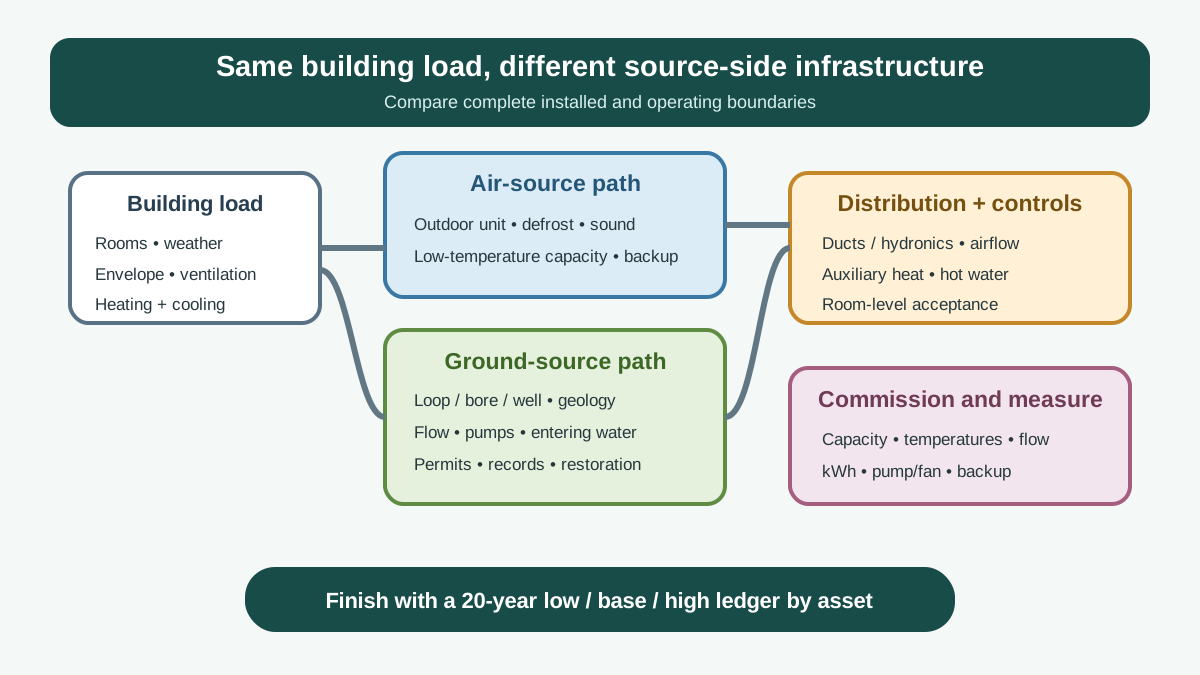
Compare airsource and groundsource heat pumps using the same room loads, climate data, distribution system, loop or outdoorunit design, backup strategy, utility rates, commissioning, and 20year ledger.
The Short Answer
Short Answer: Air-source heat pumps usually have the simpler and lower-cost retrofit path because they exchange heat with outdoor air and avoid drilling, trenching, wells, or a water body. Ground-source systems can deliver stable performance by exchanging heat with the ground or groundwater, but their value depends on site access, geology or water conditions, loop design, permitting, drilling risk, distribution, and long ownership. Neither technology wins from a national average.
Price both systems against the same room-by-room load, indoor conditions, weather data, distribution scope, backup requirement, electricity tariff, and commissioning standard. For ground source, separate the buried loop from indoor equipment in the cost and replacement ledger. For air source, include low-temperature capacity, defrost, outdoor-unit placement, sound, and backup operation.
The Same Building, Two Heat Sources
Both are electrically driven heat pumps. In heating mode they move heat into the building; in cooling mode they move heat out. The main difference is the source/sink boundary.
- Air source: exchanges heat with outdoor air through an exterior coil and fan.
- Ground source: circulates fluid through a ground, groundwater, or surface-water heat exchanger and transfers energy through indoor heat-pump equipment.
DOE notes that air-to-air and ground-source/geothermal are two major duct-connected heat-pump categories. DOE's geothermal overview describes the underground collector, heat pump, and building distribution as three parts of the system. A comparison that prices only the indoor cabinet omits the defining ground-source asset.
The Whole-System Boundary
Complete this scope before accepting either proposal:
| Design input | Air-source proposal | Ground-source proposal |
|---|---|---|
| Room-by-room heating/cooling loads | ||
| Design outdoor conditions | ||
| Required leaving-air/water temperatures | ||
| Rated and design-condition capacity | ||
| Distribution airflow/water flow | ||
| Source-side design | outdoor coil/location | loop/well/water body |
| Supplemental/backup heat | ||
| Electrical demand and panel impact | ||
| Domestic-hot-water interaction | ||
| Permits, approvals, environmental review | ||
| Commissioning and test-out | ||
| Installed low/base/high cost | ||
| Annual low/base/high kWh and cost | ||
| Replacement boundary at years 10/15/20 |
If the proposals do not provide comparable service, their prices are not comparable.
Start With Room-by-Room Loads
Do not select a heat pump from floor area or existing equipment nameplate alone. Obtain a room-by-room heating and cooling load calculation using documented assumptions for:
- local design temperatures;
- orientation, wall, roof, floor, window, and door performance;
- infiltration and intended ventilation;
- occupancy and internal gains;
- indoor temperature and humidity criteria;
- completed or planned envelope work;
- attached garages, crawlspaces, basements, additions, and high ceilings;
- distribution losses outside conditioned space.
The calculation should produce both whole-building and room requirements. A system can meet the total load while a remote bedroom remains uncomfortable because the distribution does not match the room load.
Run the calculation after confirmed air sealing or insulation scope when practical. Otherwise identify which envelope assumptions are conditional. Buying ground loop or compressor capacity for a load that will soon be removed can lock in unnecessary capital.
Use the Manual J heat-pump sizing guide to challenge inputs and the air-sealing physics guide to sequence enclosure work.
Compare Capacity at the Conditions That Matter
Rated efficiency and rated capacity are not the same. Ask for manufacturer performance data at relevant outdoor air temperatures for air source and entering-water temperatures/flows for ground source.
Air-source questions
- Heating capacity and input at the winter design condition?
- Cooling capacity and latent performance at summer design?
- Modulation range at mild conditions?
- Defrost control and supplemental heat operation?
- Balance point under the proposed controls?
- Capacity and efficiency of the exact indoor/outdoor match?
- Effect of required line length and lift within manufacturer limits?
Ground-source questions
- Closed-loop, open-loop, or other configuration?
- Entering and leaving water temperatures at design and over years?
- Ground/groundwater thermal assumptions and evidence?
- Loop flow, pump power, antifreeze concentration, and pressure drop?
- Heating and cooling runout used to size the loop?
- Consequences of unbalanced annual heat extraction/rejection?
- Exact water-to-air or water-to-water equipment match?
DOE FEMP emphasizes accurate building loads and geothermal-resource properties because the ground heat exchanger is a significant cost. For larger systems, thermal properties may be measured. A residential proposal should still explain where its soil, bore, loop, temperature, and flow assumptions came from.
Air-Source System Design
Air source avoids earthwork but exposes the source-side coil to weather. The outdoor unit needs a location that supports airflow, drainage, service, sound, snow, ice, wind, roof runoff, leaves, and protection from vehicle or yard damage without blocking the manufacturer's clearances.
Cold-weather performance
As outdoor temperature falls, the building load generally rises while an air-source unit's available capacity and coefficient of performance can change. Modern cold-climate products may retain substantial capacity at low temperature, but use the exact model's data. Do not substitute the product family headline for the matched equipment and design point.
Defrost temporarily changes operation to clear the outdoor coil. Document defrost drainage and ice formation. Avoid placing discharge where meltwater refreezes on a walkway or where roof water can fall into the unit.
Supplemental heat
Supplemental electric resistance, a retained furnace in a dual-fuel system, or another backup can cover load beyond the heat pump's capacity or operate during controls/fault conditions. Record:
- equipment and fuel;
- staging and lockout temperatures;
- thermostat/control logic;
- electrical demand;
- operating-cost model;
- maintenance and fuel fixed charges;
- behavior during outages.
A quote that lists “10 kW heat kit” without modeling when it operates leaves a major bill and panel input unresolved.
Distribution options
Air source includes ducted, ductless, and other configurations. Existing ducts should be tested for condition, leakage, insulation, static pressure, airflow, and room delivery. Ductless heads need placement, condensate, line-set, service, and room-airflow planning. Do not count an open doorway as guaranteed heat delivery to a closed bedroom.
Ground-Source Loop Choices
Ground source is a site and civil project as well as an HVAC project. Common concepts include closed-loop horizontal trenches, closed-loop vertical boreholes, open-loop groundwater systems, and water-body configurations where lawful and appropriate. Names do not determine feasibility.
Horizontal closed loop
Horizontal trenches may be practical where sufficient accessible land exists and soil/excavation conditions are suitable. Scope:
- trench length, depth, spacing, and layout;
- pipe material, fusion method, headers, and burial marking;
- conflicts with utilities, septic, wells, trees, foundations, drainage, future structures, and easements;
- restoration of grading, topsoil, landscaping, irrigation, fences, and access route;
- seasonal groundwater, rock, and unstable soil;
- pressure testing, flushing, purging, and fluid documentation.
Do not treat available lawn area as automatically buildable loop field.
Vertical closed loop
Vertical boreholes reduce surface area but add drilling, grouting, geology, mobilization, spoils, access, and subsurface uncertainty. Ask for:
- bore count, depth, diameter, separation, and header routing;
- drilling basis and allowances for rock, casing, lost circulation, water, and abandoned holes;
- grout specification and assumed thermal conductivity;
- borefield layout and long-term thermal model;
- drilling access, overhead clearance, noise, traffic, and restoration;
- well/bore records and as-built coordinates;
- responsibility for underground surprises and permit conditions.
The least expensive drilling allowance can become the most expensive change order if its exclusions are broad.
Open loop and groundwater
An open-loop system depends on adequate groundwater quantity, quality, temperature, legal withdrawal, discharge/return, well performance, and long-term fouling/corrosion control. It is not merely a cheaper loop.
Test water and document flow under relevant conditions. Identify how water is returned and which well, environmental, or underground-injection rules apply. EPA regulates some ground-source return flows as Class V injection wells; state and local requirements can be more specific. Obtain authoritative local approvals before treating the design as feasible.
Include pumps, treatment, sampling, well service, discharge impact, and failure response in the ledger.
Pond or surface-water loop
This requires a suitable, permitted water body with stable depth, temperature, access, anchoring, environmental compatibility, freeze protection, and maintenance plan. A decorative shallow pond is not automatically a heat sink.
Ground-Loop Quality Is the Long-Lived Asset
The underground heat exchanger can outlast the indoor heat-pump equipment, which makes design records valuable. Require:
- final load and loop-sizing report;
- bore/trench/well logs;
- pipe, fittings, grout, and fluid documentation;
- fusion technician and test records where applicable;
- pressure-test, flush, purge, and flow results;
- antifreeze type and concentration;
- pump model, flow, head, and input;
- as-built map with coordinates/depths;
- commissioning entering/leaving temperatures;
- owner maintenance and emergency instructions.
Future owners should be able to replace indoor equipment without guessing what is buried.
Compare Efficiency Metrics Correctly
Air-source heat pumps commonly use SEER2 for seasonal cooling and HSPF2 for seasonal heating, plus capacity and COP/EER data at specific conditions. Ground-source ENERGY STAR criteria use EER and COP under the applicable water-to-air, water-to-water, open-loop, closed-loop, or direct-geoexchange test category.
Do not compare an air-source HSPF2 number directly with a ground-source COP as though they were percentages. Convert performance into an annual model using hourly or bin loads, equipment data, auxiliary heat, defrost, fans, loop pumps, controls, and distribution.
Keep source-side pumping inside the ground-source energy boundary. A high heat-pump COP with excessive loop pump power is not the whole-system result. Keep indoor blowers, crankcase heaters, standby controls, and backup heat inside both boundaries.
Distribution Can Erase Equipment Advantages
Both technologies ultimately have to deliver heat or cooling to rooms. Audit:
- duct leakage and insulation;
- filter and coil pressure drop;
- supply/return sizing;
- closed-bedroom return paths;
- zone dampers and bypasses;
- hydronic emitter output at proposed water temperature;
- pump/fan electrical input;
- condensate disposal;
- ventilation integration.
A ground-source water-to-water unit may pair well with low-temperature radiant distribution, but an old high-temperature radiator system requires an emitter and design-temperature analysis. An air-to-water alternative may also be relevant. Do not assume every “geothermal” unit plugs into every existing distribution system.
Domestic Hot Water and Desuperheaters
Some ground-source proposals include a desuperheater or water-heating function. Define it precisely:
- preheat or full water-heating service;
- expected seasonal contribution;
- storage tanks, controls, pumps, mixing, and backup;
- priority relative to space conditioning;
- cooling-season versus heating-season operation;
- commissioning and maintenance.
Do not subtract a generic water-heating credit without an annual model. Compare the integrated design with a separate heat-pump water heater or other actual alternative.
Electrical Capacity and Peak Demand
Record running and maximum electrical requirements for compressor, indoor fan, loop pumps, auxiliary heat, controls, crankcase heat, and any domestic-water equipment. Verify panel, service, feeder, breaker, conductor, disconnect, and backup-power implications with the appropriate qualified professionals.
Ground source may reduce extreme-weather compressor demand relative to an air-source design, but loop pumps add load. Air-source backup resistance can create a large coincident peak. Model the exact sequence rather than assigning a generic winner.
If service capacity is uncertain, use the electrical panel electrification guide before assuming an upgrade.
Build the 20-Year Cost Ledger
Separate assets so replacement assumptions are visible:
| Cost line | Air source | Ground source |
|---|---|---|
| Load/design/engineering | ||
| Indoor equipment and controls | ||
| Outdoor unit / ground loop or wells | ||
| Distribution corrections | ||
| Electrical work and backup | ||
| Drilling/trenching/restoration risk allowance | n/a | |
| Permits and approvals | ||
| Commissioning | ||
| Annual electricity: low/base/high | ||
| Annual maintenance | ||
| Repair allowance | ||
| Equipment replacement year/cost | ||
| Loop/well/pump work | n/a | |
| Verified incentives | ||
| Residual value at year 20 |
Use local marginal electricity prices, including time or demand components if applicable. Do not use a global electricity average.
Worked comparison method
Suppose the annual model—not a quote shortcut—estimates:
- air-source whole-system energy: 8,100 kWh/year;
- ground-source whole-system energy: 5,900 kWh/year;
- difference: 2,200 kWh/year.
At an illustrative $0.19/kWh, the first-year difference is $418. If the installed ground-source premium is $18,000, simple energy-only payback is about 43 years. If the difference is 5,000 kWh/year at $0.28/kWh, it is $1,400/year and a very different case. Both examples omit escalation, maintenance, repairs, financing, replacements, incentives, and residual value; they demonstrate why site inputs control.
Use low/base/high weather, rate, loop-pump, backup, and replacement assumptions. Show which single assumption reverses the decision.
Incentives Are Conditional, Not Discounts in Advance
Programs change by location, date, income, tax situation, installer, equipment certification, and documentation. Treat an incentive as zero until the official administrator confirms:
- the exact technology and model qualify;
- project and purchaser eligibility;
- pre-approval or audit requirement;
- eligible cost categories, including or excluding loop work;
- installation and placed-in-service deadline;
- contractor or permit requirements;
- interaction with other incentives;
- tax-credit usability and basis treatment;
- application and inspection steps.
Keep the official rule, date, application, invoices, model/serial, certifications, permit, and commissioning record. Do not rely on a contractor's projected net price alone.
Quote Comparison Requirements
Send every bidder the same request:
- room-by-room load and design conditions;
- exact equipment model combinations;
- performance at design and part-load conditions;
- distribution scope and measured baseline;
- source-side design and assumptions;
- backup and control sequence;
- electrical scope;
- sound, condensate, drainage, and service access;
- permits, environmental/well approvals, and inspections;
- commissioning readings and acceptance criteria;
- warranties split among equipment, labour, loop/well, drilling, and restoration;
- exclusions, allowances, and change-order rates;
- annual energy model with editable inputs;
- owner documents and training.
Use the heat-pump quote comparison worksheet to normalize proposals.
Commissioning: Air Source
Require documentation appropriate to the exact system:
- equipment matches approved submittal;
- airflow or hydronic flow meets design;
- refrigerant procedures and measurements follow manufacturer requirements;
- controls, stages, balance point, and backup lockouts work;
- defrost and drainage paths are safe;
- supply/return temperatures and room delivery meet acceptance criteria;
- thermostat and utility schedules are explained;
- sound and vibration are acceptable;
- filter and maintenance access are preserved;
- baseline electricity and runtime are recorded for follow-up.
Commissioning: Ground Source
Add source-side verification:
- loop/well pressure, flow, pump staging, and power;
- entering/leaving water temperatures;
- heat extraction/rejection data where required;
- antifreeze and water-quality documentation;
- purge and air-removal result;
- open-loop well/discharge operation;
- alarms, safeties, freeze protection, and backup sequence;
- as-built ground-loop and header map;
- comparison with modeled design values.
Schedule seasonal follow-up because a single mild-day test cannot prove winter or summer design behavior.
Plan for Ownership Transfer and Future Replacement
The ground loop, well, buried headers, and interior heat-pump cabinet do not share one replacement clock. Put their ownership and records into the property file. A future equipment bidder should know the loop configuration, design flow, fluid, entering-water range, pressure test, bore or trench locations, and original load—not rediscover them through excavation.
For air source, preserve the refrigerant line route, allowable reuse criteria, condensate route, outdoor electrical details, wall penetrations, mounting, sound documentation, and matched component records. A future replacement may reuse some infrastructure only after it is inspected against the new manufacturer's requirements.
If the property may be sold, describe the system accurately. “Geothermal” should not conceal an open-loop well with unresolved discharge, and “cold climate” should not substitute for the exact model and low-temperature performance. Transfer warranties where permitted, give the buyer maintenance history, and disclose known loop, well, drainage, sound, backup, or control issues.
Site Patterns That Change the Answer
Dense retrofit with limited outdoor land
Drilling access, setbacks, buried utilities, landscaping, and neighbour constraints make a private ground loop costly or infeasible. A carefully placed cold-climate air-source system or networked/community geothermal option may be more realistic.
New construction with open excavation
The project can coordinate load reduction, low-temperature distribution, trenching or drilling, headers, electrical work, and site restoration before finishes. Ground source deserves a full bid, but it still needs thermal design and long-term records.
Rural home replacing delivered fuel
Both options may reduce fuel exposure. Ground source can be attractive when the site, drilling cost, and ownership horizon work; air source may preserve capital. Include the fixed charges and maintenance of any retained backup fuel system.
Large heating-dominated load with constrained electrical peak
Ground source may offer a stronger design case, but loop size, soil/groundwater, pump energy, and building load become critical. Compare it with envelope work and properly selected air-source staging rather than treating peak as an equipment-only problem.
Small, efficient home
The absolute annual energy difference may be too small to recover a private-loop premium. Air source or a shared ambient loop may be the more proportionate infrastructure.
Red Flags
- selection from floor area alone;
- no room-by-room load calculation;
- air-source quote without low-temperature capacity or backup logic;
- ground-source quote without loop/well calculations and as-built records;
- annual-cost claim that omits fans, pumps, backup, or distribution;
- direct comparison of unlike rating metrics;
- drilling allowance with undefined rock/water/casing responsibility;
- open-loop proposal without water quantity, quality, discharge, and approvals;
- incentive deducted without official eligibility;
- no test-out readings or seasonal follow-up;
- “maintenance-free for life” language;
- pressure to sign before site feasibility is confirmed.
Frequently Asked Questions
Is ground source always more efficient?
It can provide very high equipment efficiency from stable ground temperatures, but whole-system results include loop pumps, fans, controls, auxiliary heat, distribution, and actual entering-water conditions. Compare annual modeled and measured system kWh.
Is air source unsuitable for cold climates?
No. Modern cold-climate products can operate at low temperatures, but capacity and efficiency change by model and condition. Use certified/model performance at the design temperature and document backup.
How long does a ground loop last?
Loops can be long-lived infrastructure, but lifespan depends on design, materials, fusion, installation, ground conditions, fluid, and documentation. Treat the loop separately from pumps and indoor heat-pump equipment.
Are horizontal loops always cheaper than boreholes?
Not always. Land, excavation, soil, groundwater, restoration, access, pipe length, and conflicts control cost. Obtain site-specific designs and risk allowances.
Can I use an existing water well?
Only after quantity, quality, temperature, well condition, legal withdrawal/discharge, return method, and long-term operation are established. Do not assume a domestic well is a compliant heat-exchange system.
Which system is quieter?
Ground source has no conventional outdoor compressor/fan, which can reduce exterior sound. Indoor equipment, pumps, ducts, structure, and air terminals still make noise. Air-source sound depends on the exact model, placement, mounting, mode, and neighbouring surfaces.
Which is better during a power outage?
Both generally need electricity for compressors, controls, fans or pumps. Ground source may change peak requirements, but neither is inherently outage-proof. Model backup power and safe shutdown for the exact loads.
Should I use simple payback?
Use it as a screening view, then add maintenance, repairs, replacements, financing, incentives, residual loop value, and uncertainty. A 20-year net-present-cost comparison is more informative for a long-lived ground asset.
What to Read Next
Verify the load with the Manual J sizing guide, compare cold-climate performance data, normalize bids in the heat-pump quote worksheet, and reduce uncertain load through the air-sealing guide.
About the Editorial Team EnergyBS reviews public program rules, product specifications, utility rates, and reader-facing cost assumptions. Treat savings figures as estimates until you verify local prices, permits, rebates, and contractor quotes.
Sources and Verification
- DOE Energy Saver: Heat Pump Systems
- DOE: Geothermal Heat Pumps
- DOE FEMP: Purchasing EnergyEfficient Geothermal Heat Pumps
- ENERGY STAR: Geothermal Heat Pumps
- ENERGY STAR: Geothermal Heat Pump Key Product Criteria
- ENERGY STAR: AirSource Heat Pumps
- ENERGY STAR: Heat Pump Equipment and Installation Contractor Guide
- EPA: Class V Wells for GroundSource Heat Pump Return Flow
Editorial Review
EnergyBS Editorial Team
EnergyBS publishes practical homeowner guides. Important program, product, and cost claims should be checked against the linked source and local project documents before you commit to work.
Related Guides
View All ArticlesHeat Pump Sizing Guide
A homeownerfocused guide to Manual J loads, Manual S equipment selection, coldweather capacity, balance points, duct constraints, and the documents a defensible heatpump quote should include.
Cold Climate Heat Pump Performance Data 2026 Tool
Can heat pumps handle subzero winters? We audit realworld performance data, Coefficient of Performance (COP) curves in extreme cold, and actual utility bill impacts.
Heat Pump Quote Comparison Worksheet 2026 Tool
A sidebyside homeowner worksheet for comparing heatpump and HVAC bids by load calculations, exact matched equipment, ducts, electrical work, refrigerant piping, controls, commissioning, warranties, exclusions, and true installed cost.