Energy Myth 5: The 'Heat Pumps Don't Work in the Cold' Fallacy
Debunking the 'Back to Gas' argument: How modern ColdClimate Heat Pumps (ccASHP) harvest thermal energy from 20°F air using vapor injection and advanced thermodynamics.
The "Backup Heat" Safety Blanket
Short Answer: Debunking the 'Back to Gas' argument: How modern Cold Climate Heat Pumps (ccASHP) harvest thermal energy from 20°F air using vapor injection and advanced thermodynamics.
For decades, homeowners in the Northern US and Europe were told a simple truth: "Heat pumps are great for Florida, but in Minnesota, you need a gas furnace." This advice was based on the technology of the 1990s, when single-stage heat pumps would indeed freeze up and switch to "Emergency Heat" (expensive electric resistance coils) once the thermometer dipped below 32°F (0°C).
In 2026, this advice is not just outdated; it is thermodynamically incorrect.
Modern Cold-Climate Air Source Heat Pumps (ccASHP) are now the standard heating solution for Maine, Norway, and Alaska. To understand why, we must revisit the definition of "Heat."
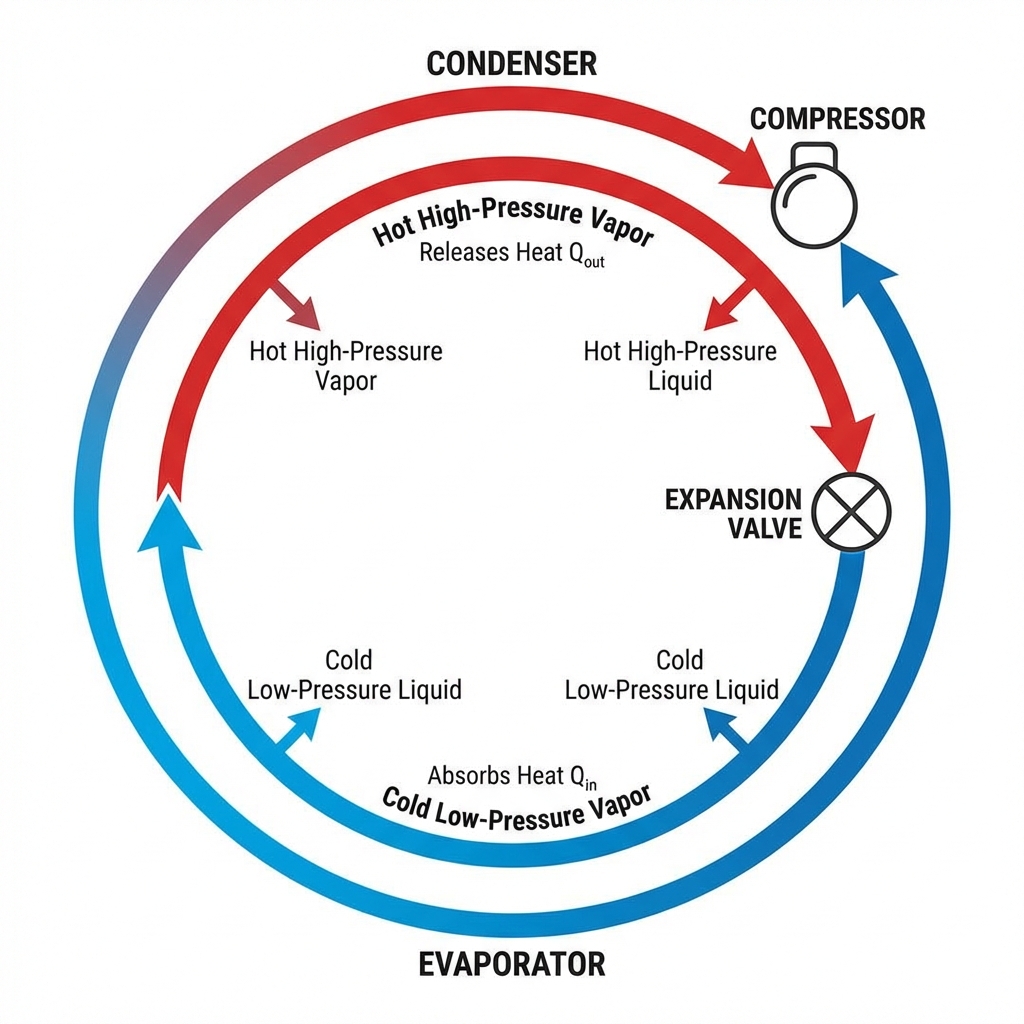
Visual Analysis: Harvesting Heat from Zero
This thermodynamic schematic demonstrates how a heat pump operates in sub-zero conditions. By using a refrigerant with an extremely low boiling point (-44°F), the system can still "boil" the fluid using the "heat" present in -20°F air. The compressor then concentrates this vapor to deliver useable warmth indoors, creating a heat multiplier effect.
1. Absolute Zero and the Science of "Heat"
The common misconception is that 0°F (-18°C) air has "no heat" in it.
- Physics Reality: Absolute Zero (0 Kelvin) is -460°F. This is the point where molecular motion stops.
- The Relative Heat: Air at 0°F is actually 460 degrees hotter than absolute zero. It is packed with thermal energy; humans just perceive it as cold relative to our body temperature.
A heat pump doesn't "make" heat; it moves it. Its job is to extract the thermal energy from that 0°F air and compress it until it becomes 100°F air.
2. Chemical Engineering: The Boiling Point
The magic lies in the Refrigerant.
- Old systems used R-22, which had limits on its pressure curve.
- Modern systems use R-410A, R-32, or R-290 (Propane) which have boiling points as low as -44°F (-42°C).
This means that even on a freezing winter night, the outside air is hot enough to boil the refrigerant into a gas. Once it's a gas, the compressor can squeeze it, concentrating that sparse heat into a hot blast for your living room.
3. The "COP" Argument: Efficiency at -15°F
Skeptics argue: "Sure, it runs, but it's inefficient." Let's look at the Constant of Performance (COP).
- Electric Resistance (Space Heater): COP of 1.0 (1 unit of electricity = 1 unit of heat).
- Gas Furnace: COP of 0.95 (1 unit of gas = 0.95 units of heat).
- Modern Heat Pump at 47°F: COP of 4.0.
- Modern Heat Pump at 0°F: COP of 2.1 to 2.5.
The Verdict: Even at zero degrees, a modern heat pump is 250% more efficient than a gas furnace or an electric baseboard heater. It is creating more than twice the heat energy than the electrical energy it consumes.
4. Flash Injection: The Turbo Button
How do 2026 units maintain capacity when it's utterly freezing? Enhanced Vapor Injection (EVI). This technology acts like a turbocharger for the compressor. It injects a mid-pressure vapor into the compressor head, cooling the internal mechanism and allowing it to run at higher speeds without overheating. This allows the unit to deliver 100% of its rated heating capacity down to -5°F, with output continuing all the way to -22°F.
Conclusion: The Gas Line is Obsolete
In 2026, building a new home with a gas connection "just for backup" is a financial error. The "Dual Fuel" strategy is no longer a requirement; it's a lack of faith in thermodynamics.
Cold is just heat waiting to be compressed.
Practical Decision Framework
Use this page as a starting point for Energy Myth #5: The 'Heat Pumps Don't Work in the Cold' Fallacy, then verify the numbers against your own home. Debunking the 'Back to Gas' argument: How modern Cold-Climate Heat Pumps (ccASHP) harvest thermal energy from -20°F air using vapor injection and advanced thermodynamics.
| Decision point | What to check | Why it matters |
|---|---|---|
| Current baseline | Review 12 months of utility bills, fuel use, and outage history. | Savings and resilience only make sense compared with your real starting point. |
| Local rules | Check utility tariffs, rebate deadlines, permit requirements, and eligible equipment lists. | Many projects fail financially because the quote assumed a credit or rate plan that does not apply. |
| Installation constraints | Confirm panel capacity, roof condition, ducts, ventilation, drainage, and access for service. | The hidden work often decides whether the project is affordable. |
| Comfort target | Write down the rooms, seasons, or outage scenarios you are trying to fix. | A narrower goal often leads to a cheaper and better upgrade. |
| Verification step | Ask contractors to separate equipment, labor, electrical work, permits, and incentive assumptions. | Clear line items make quotes easier to compare and reduce surprise costs. |
Reader Checklist
- Get at least two quotes when the project involves electrical, HVAC, insulation, solar, or plumbing work.
- Confirm whether incentives are point-of-sale discounts, mail-in rebates, utility credits, or tax credits.
- Keep screenshots or PDFs of program rules on the date you apply.
- Treat national savings estimates as rough examples, not promises for your address.
- If safety, wiring, refrigerants, combustion, structural work, or permits are involved, use a licensed local professional.
What To Read Next
For broader context, compare this with the EnergyBS green living guide library. It will help you check whether this topic is part of a larger efficiency, rebate, resilience, or electrification plan.
Common Questions
What should I check first before using this hvac advice?
Start with the numbers that apply to your home: climate, utility rate, equipment age, contractor quote, and local program rules. Debunking the 'Back to Gas' argument: How modern Cold Climate Heat Pumps (ccASHP) harvest thermal energy from 20°F air using vapor injection and advanced thermodynamics.
How should I verify rebates, tax credits, rates, or savings before spending money?
Treat program amounts, utility rates, and tax rules as date-sensitive. Check the named government, utility, or manufacturer source before you sign a contract, and keep screenshots or PDFs of eligibility rules for your records.
What is the next useful step after reading this?
Compare this with Heat Pump Sizing Guide: How to Read a Manual J and Avoid an Oversized System so you can check the cost, rebate, installation, or operating-risk angle before making a decision.
Sources and Verification
Editorial Review
EnergyBS Editorial Team
EnergyBS publishes practical homeowner guides. Important program, product, and cost claims should be checked against the linked source and local project documents before you commit to work.
Related Guides
View All ArticlesHeat Pump Sizing Guide: How to Read a Manual J and Avoid an Oversized System
A homeownerfocused guide to Manual J loads, Manual S equipment selection, coldweather capacity, balance points, duct constraints, and the documents a defensible heatpump quote should include.
Ductless MiniSplit Head Placement: A RoombyRoom Planning Guide
A homeowner planning method for locating ductless indoor units by room load, air throw, doors, sensors, noise, condensate, line routes, service access, and wholehome comfort—not wall convenience alone.
Portable Dehumidifier Sizing and Placement: Capacity, Drainage, Temperature, and Operating Cost
Size and place a portable dehumidifier using space area, uncontrolled moisture condition, temperature, air connection, drainage, electrical supply, sound, filtration, energy, heat release, commissioning, and sourcecontrol evidence.