Gas Fireplace Installation Cost 2026: Insert, BuiltIn, and Conversion Prices
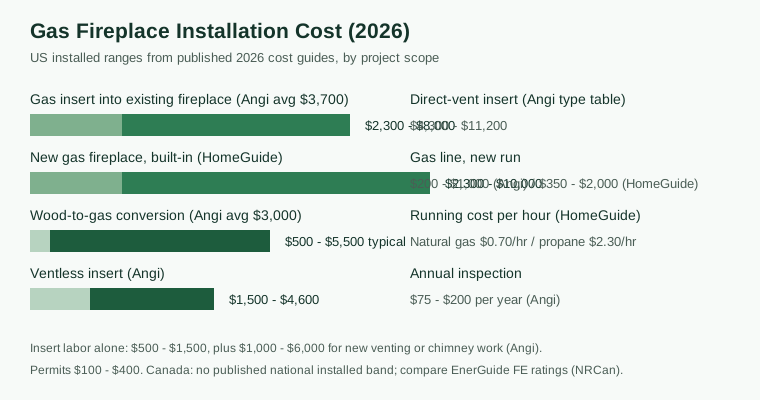
A gas fireplace insert installed into an existing fireplace averages $3,700 in Angi's 2026 data, with most projects between $2,300 and $8,000. A brandnew builtin gas fireplace runs $2,300 to $10,000 in HomeGuide's 2026 data, and converting a wood fireplace to gas averages $3,000 (Angi), from about $500 for a simple ventless log job to $5,500 for a vented insert conversion. The venting choice sets the price: Angi prices ventless inserts at $1,500 to $4,600 and directvent inserts at $4,300 to $11,200 in its type table, because the directvent unit needs a sealed vent through the chimney, wall, or roof. This guide prices every scope separately, then the gas line, the surround, the permits, the running cost per hour, the Canadian EnerGuide Fireplace Efficiency rating, and a 12point quote checklist.
Quick Checks
- 1Budget $3,700 as the US average for a gas fireplace insert in 2026 (Angi, most projects $2,300 to $8,000). A new built-in gas fireplace where no fireplace exists runs $2,300 to $10,000 (HomeGuide).
- 2The venting choice sets the price. Angi prices ventless inserts at $1,500 to $4,600 and direct-vent inserts at $4,300 to $11,200, because direct-vent needs a sealed vent run and ventless needs none.
- 3Converting a wood fireplace to gas averages $3,000 (Angi): about $1,500 for a ventless conversion and about $5,000 vented, with most insert or log conversions landing between $2,000 and $5,000.
- 4The gas line is its own line item: $200 to $1,000 on Angi's conversion data, $350 to $2,000 on HomeGuide's, at $15 to $50 or more per linear foot depending on the route.
- 5Running cost is small per hour and real per season: HomeGuide puts natural gas at $0.70 per hour and propane at $2.30 per hour, and Angi puts a gas insert at $400 to $640 per heating season. A standing pilot burns gas all year; electronic ignition does not (NRCan).
Gas Fireplace Installation Cost 2026: Insert, Built-In, and Conversion Prices
By EnergyBS Editorial Team | October 19, 2026
The Short Answer
Short Answer: A gas fireplace insert installed into an existing fireplace averages $3,700 in the US in 2026, with most projects between $2,300 and $8,000 (Angi, updated October 2026). A brand-new built-in gas fireplace, where no fireplace exists today, runs $2,300 to $10,000 installed (HomeGuide 2026), with labor alone at $1,200 to $6,000. Converting a wood-burning fireplace to gas averages $3,000 (Angi), from about $500 for a simple ventless log job to $5,500 at the top of the typical range. The single biggest price decision is the venting: Angi's type table prices ventless inserts at $1,500 to $4,600 and direct-vent inserts at $4,300 to $11,200, because the direct-vent unit needs a sealed vent through the chimney, the wall, or the roof, and the ventless unit needs no vent at all.
The job in six steps:
- Pick the scope: insert into an existing fireplace, a conversion with gas logs, or a new built-in unit.
- Pick the venting: direct-vent (sealed, vents outside), B-vent (uses the chimney and room air), or ventless where local code allows it.
- Confirm the firebox or fireplace opening fits the unit, and have the chimney inspected and cleaned first.
- Run or extend the gas line to the fireplace, with a permit and a pressure test.
- Set the unit, run the venting, connect gas and any electrical for a blower or electronic ignition, and finish the surround.
- Pass the inspection, then set the thermostat or remote and schedule the annual inspection.
A gas fireplace is bought for two different reasons, and the reason decides which scope makes sense. As a heater, it is a sealed appliance that warms one room well; Natural Resources Canada is direct that a gas fireplace is not an efficient way to heat a whole house. As a conversion, it takes the least-used feature in many houses, an open wood fireplace that pulls heated air up the chimney, and turns it into heat you can start with a remote. Our fireplace efficiency guide covers the physics of what the open fireplace was doing to the house. This guide prices the gas side of that decision, line by line.
1. Price by Scope: Insert, Conversion, or New Built-In
Every gas fireplace project is one of three scopes, and quoting one scope against another is the most common budgeting mistake in this category.
Scope A: a gas insert into an existing fireplace. This is the headline market. Angi's 2026 average is $3,700, with most homeowners between $2,300 and $8,000. The insert is a sealed firebox that slides into the existing masonry or factory-built fireplace, connects to a gas line, and vents through the existing chimney (usually with liners) or a new direct-vent run. The existing fireplace does the structural work, which is why this scope costs less than building a fireplace from nothing. Natural Resources Canada describes the same product the same way: inserts are installed in an existing fireplace cavity to convert a wood-burning fireplace to gas or propane.
Scope B: a wood-to-gas conversion with gas logs. The lightest scope. Angi puts the conversion average at $3,000, the typical range at $500 to $5,500, and the full span at $300 to $12,000 when major chimney work enters the job. HomeGuide prices the log version directly: $300 to $2,000 to convert with gas logs, against $2,000 to $5,000 for an insert conversion. Gas logs themselves run $180 to $1,100 as a set (HomeGuide). A log set keeps the open-fireplace look and much of its inefficiency; an insert seals the firebox and keeps the heat. Same chimney, two different appliances, and the $2,000 to $3,000 gap between them is mostly the sealed box and its venting.
Scope C: a new built-in gas fireplace where none exists. HomeGuide's $2,300 to $10,000 band, with the firebox unit at $1,100 to $2,900 for a vented gas unit and labor at $2,500 to $2,822 before any flue work in its material-and-labor table. Across all fireplace types, HomeGuide puts the unit at $1,100 to $2,800 (about $1,800 on average) with installation and finishing adding $800 to $2,800, for a general installed band of $1,900 to $5,600 before a veneer, hearth, or mantel. The gas built-in runs higher than that general band because the job adds a gas line, a vent run, and finishing carpentry around a framed chase. Two reference points inside the band: a basement install and a free-standing gas fireplace both run $1,700 to $4,300 installed (HomeGuide), and a linear (contemporary rectangular) gas fireplace runs $2,300 to $4,000, the same as a standard gas unit.
Before collecting quotes, name your scope in the contractor's language. An insert quote and a built-in quote for the same room can differ by $4,000 while both being fair prices for different jobs.
2. The Venting Decision: Direct-Vent, B-Vent, and Ventless
Venting is where the money, the efficiency, and the code questions all sit. There are three systems.
Direct-vent. A sealed firebox with a glass front. One pipe brings outside air in for combustion and another sends exhaust out, through the existing chimney with liners, horizontally through an exterior wall, or vertically through the roof. Room air never enters the firebox, so combustion products stay out of the living space. HomeGuide gives direct-vent fireplaces an energy rating of 60 to 80 percent. Angi's insert type table prices direct-vent inserts at $4,300 to $11,200, the top of the insert market, because the vent run is real construction: HomeGuide prices a ventilation system at $200 to $3,000, averaging $1,200 installed, and a chimney flue at $58 to $80 per linear foot.
B-vent (natural vent). The unit vents through a vertical metal flue or the existing chimney and draws its combustion air from the room. It costs less to vent where a suitable chimney already exists, and it gives some of its heat up the flue. It is the older of the two vented designs and the one most sensitive to house pressure changes, because the room is part of the system.
Ventless (vent-free). No vent at all. The burner is designed to burn cleanly enough that combustion products, including water vapor, are released into the room, and the unit carries an oxygen depletion sensor that shuts it off if room oxygen falls. Angi prices ventless inserts at $1,500 to $4,600, and its conversion guide puts a ventless conversion at about $1,500 on average against about $5,000 vented. HomeGuide prices a ventless propane fireplace at about $1,200 on average. The savings are the missing vent. The tradeoffs are the ones both sources name: pollutants and moisture enter the living space, HomeGuide notes ventless units are not recommended for people with breathing problems such as asthma, and legality is local. Angi notes ventless fireplaces are banned in California and that some building departments outlaw them; HomeGuide notes some states will not allow them. A ventless quote is only a quote if your jurisdiction allows the appliance.
The practical reading: direct-vent is the default recommendation for a primary room you will heat daily, because the sealed system is the one that behaves the same in a tight, renovated house as in a drafty one. Ventless is a price decision that has to clear a code check and an indoor-air decision first. B-vent is a fit decision: reasonable where a sound chimney already stands in the right place, harder to justify as new construction.
3. The Unit: Types and Sample Prices
HomeGuide publishes sample unit prices that show what the firebox alone costs before any installation:
| Unit (HomeGuide sample) | Type | Unit price |
|---|---|---|
| Empire Tahoe Deluxe 36-inch | Direct-vent | $1,600 |
| Majestic 35-inch | Direct-vent insert | $3,000 |
| Pleasant Hearth 36-inch Compact | Ventless | $700 |
| Empire fireplace insert | Vent-free | $1,300 |
| Pleasant Hearth 46-inch (propane) | Ventless | $1,300 |
Natural Resources Canada sorts the same market into three forms, and the form affects heating as much as price. Inserts go into an existing cavity. Factory-built (zero-clearance) units are framed into a wall during construction or renovation, which is what makes a new built-in possible without masonry. Free-standing units stand in the room like a wood stove, with all surfaces exposed, and NRCan notes they tend to heat more effectively than the other types for exactly that reason: the whole box radiates into the room instead of into a chase.
Two unit features belong in the purchase decision because they set running costs for the life of the appliance. The first is ignition. A continuous (standing) pilot burns a small flame all the time, including all summer, and NRCan notes that this extra energy use adds up significantly over time; an electronic ignition lights the pilot only when the fireplace runs. NRCan's guidance is to prefer electronic ignition, or a pilot that is simple to shut off and relight, with battery backup if you want heat during a power failure. The second is a blower. HomeGuide prices a fireplace blower at $40 to $250 as an add-on, and it is the cheapest heat-delivery upgrade in the category: the firebox gets hot either way, and the blower is what moves that heat into the room instead of up the wall. A new outlet for the blower or ignition runs $150 to $350 (HomeGuide) where the fireplace has no power today.
4. The Cost Stack: Where the Money Goes
Angi publishes the prep and finish lines around an insert installation. Read together, they explain why two insert quotes for the same room can sit $3,000 apart.
| Cost line | Price (US, 2026) | Source |
|---|---|---|
| Insert installation, total | $2,300 to $8,000, average $3,700 | Angi |
| Labor, straightforward install | $500 to $1,500 | Angi |
| Added labor for new venting or chimney work | $1,000 to $6,000 | Angi |
| New gas line | $200 to $1,000 | Angi |
| Chimney cleaning before install | $100 to $150 | Angi |
| Chimney repair | $160 to $750 | Angi |
| Chimney rebuild | $1,000 to $5,000 | Angi |
| Old insert removal | $600 to $2,500 | Angi |
| Full fireplace removal | $4,000 to $10,000 | Angi |
| Permits | $100 to $400 | Angi |
The surround is priced separately and by the square foot, which is why a quote can be firm on the appliance and vague on the total. Angi's 2026 surround rates: wood $9 to $75, metal $10 to $50, tile $10 to $125, brick $30 to $50, stone $10 to $300, and marble $20 to $300 per square foot. A modest tile surround and a full-height stone wall are both "the surround line" in conversation and differ by thousands of dollars in the quote. Get the surround specified by material and by measured area, or exclude it from the appliance quote entirely and price it as its own project.
The chimney lines deserve attention because they are the surprise lines. A cleaning at $100 to $150 is routine prep. A repair at $160 to $750 is common on older masonry. A rebuild at $1,000 to $5,000 is the line that turns an insert project into a masonry project, and it is discovered by the pre-install inspection, not by the salesperson. This is why the sequence matters: inspection and cleaning first, unit selection second, quote third. Our chimney liner cost guide prices the liner work that direct-vent and insert jobs often need inside that same chimney.
5. The Gas Line: Priced by the Foot and by the Route
Most homes adding a gas fireplace already have natural gas in the house for a furnace or water heater, but not at the fireplace. The line from the existing system to the firebox is a separate trade's work, priced two ways in the sources.
As a lump inside a fireplace job, Angi allows $200 to $1,000 for running a natural gas line in its conversion breakdown, and $200 to $1,000 again for a new gas line in its insert prep table. HomeGuide allows $350 to $2,000 for a gas line to a fireplace, and $250 to $500 on average for the cheaper case of extending an existing line that already passes nearby. As a standalone project, Angi's gas line guide puts the average at $540, with most homeowners paying $260 to $820.
By the foot, Angi's conversion guide gives $15 to $25 per linear foot for running gas lines, and HomeGuide gives $15 to $50 or more per linear foot, with its interior meter-to-fireplace rate at $30 to $40 per linear foot. The spread is the route. A short run through an unfinished basement prices at the low end. A run that crosses finished rooms, goes up a floor, or trenches outside prices at the high end. A plumber's rate of $75 to $100 per hour (Angi) is the labor underneath all of these figures, and the permit and pressure test that close the job run $100 to $300 for the permit and $75 to $150 for the test on Angi's gas line data.
Propane homes skip the street connection and work from the tank instead. The line still prices by the same route logic, and the tank side of the system is priced in our propane tank installation cost guide, including the placement rules that decide how long that line has to be. There is no DIY version of any of this: both Angi guides state the gas work belongs to a licensed professional, and the permit inspection is the step that verifies it.
6. Running Costs: Per Hour, Per Season, and the Pilot Light
A gas fireplace is cheap to run per hour and worth adding up per season, because the season is how it is actually used.
HomeGuide's per-hour figures are the cleanest starting point: natural gas $0.70 per hour, propane $2.30 per hour, and, for comparison, an electric fireplace $0.15 per hour. HomeGuide also gives a light-use annual figure of about $60 per year for natural gas, which fits occasional evening use. Angi's insert data sits at the heavier-use end: running a gas fireplace insert costs $400 to $640 per heating season on average. The two are not in conflict. They are the same rate at different hours of use, and the worked example below shows the arithmetic.
Labeled hypothetical, built only from HomeGuide's published per-hour rates. A household that runs the fireplace 4 hours a day for 120 heating days runs it 480 hours in a season. At $0.70 per hour on natural gas, that is $336 for the season. The same hours on propane at $2.30 per hour are $1,104. At 2 hours a day instead, the figures halve: $168 on natural gas and $552 on propane. Your own season is your hours times your fuel's rate, and the honest way to use Angi's $400 to $640 band is as a check: a natural gas household landing far above it is either running the fireplace as a primary heater or paying a high per-unit gas price, and either fact is worth knowing before the second season, not after.
Maintenance is the other recurring line. Angi puts an annual professional inspection at $75 to $200, and HomeGuide recommends a yearly inspection at about $125 covering the venting, pilot, fan, and burner. Repairs between inspections run $200 to $1,000 (Angi) when they happen. The standing pilot is the quiet third line: it burns gas whenever it is lit, including months when the fireplace never runs, which is why NRCan flags it and why electronic ignition or a seasonal pilot shutoff belongs in the purchase decision in section 3.
Set against the alternatives, the running cost is the gas fireplace's strength. It needs no wood to buy, stack, or carry, and no chimney sweep for creosote, because there is no wood smoke. What it cannot do is replace the furnace: it heats the room it is in, and NRCan's warning stands that it is not an efficient whole-house heating method. Households pricing heat for a whole floor should compare the heat pump and furnace options alongside this guide, not instead of it.
7. Efficiency Ratings: Two Yardsticks, Neither of Them the Box Copy
Gas fireplace efficiency is quoted in two different systems, and mixing them produces bad comparisons.
In the US market material, HomeGuide gives direct-vent fireplaces an energy rating of 60 to 80 percent. That figure describes steady operation of a sealed unit: most of the fuel's heat stays in the room, and the rest leaves with the exhaust.
In Canada, the comparison number is the EnerGuide Fireplace Efficiency (FE) rating, and Natural Resources Canada explains what it is: a voluntary label on the product literature showing the model's FE as a percentage, tested and certified to CSA standard P.4.1-02, with models currently on the market ranging between 30 and 70 percent. The FE is an annual rating, not a best-moment rating, which is why its numbers sit lower than steady-state figures for the same kind of appliance. NRCan's point for buyers is the comparison itself: the label exists so different models can be compared on one tested basis, and the higher the FE, the more efficient the model. All gas fireplaces sold in Canada are also subject to Canada's Energy Efficiency Regulations, which set the testing standard and keep the least efficient products off the market.
Whichever country you are buying in, compare like with like: FE against FE in Canada, and the same manufacturer's stated basis in the US. A unit advertised at a high steady-state number and a unit with a middling FE number can be the same appliance measured two ways. And keep the ventless headline number in its place: a ventless unit keeps nearly all its heat in the room by definition, because nothing is vented, and it puts its combustion products there too. Efficiency measured that way is not the same achievement as a sealed unit's 60 to 80 percent.
8. Two Labeled Worked Examples
These are hypothetical examples assembled only from the ranges cited above. Change every line to your own quotes before using either total.
Property A: a direct-vent insert into an existing wood fireplace. Unit at $3,000 (HomeGuide's sample price for a Majestic 35-inch direct-vent insert). Installation labor at $1,250 (inside Angi's $500 to $1,500 straightforward band, at the high end because liners go up the existing chimney). New gas line at $600 (inside Angi's $200 to $1,000). Chimney cleaning at $125 (inside Angi's $100 to $150). Permit at $250 (inside Angi's $100 to $400). Total: $5,225. Cross-check: inside Angi's $2,300 to $8,000 insert band and inside its $4,300 to $11,200 direct-vent type table. The same fireplace converted with a ventless log set instead would price near Angi's $1,500 ventless conversion average, and would give up the sealed firebox and a large share of the heat to do it.
Property B: a new direct-vent built-in in a room with no fireplace. Firebox at $1,900 (inside HomeGuide's $1,085 to $2,861 vented gas firebox band). Labor at $2,650 (inside HomeGuide's $2,500 to $2,822). Venting at $1,200 (HomeGuide's average for a ventilation system). Gas line at $800 (inside HomeGuide's $350 to $2,000). New outlet at $250 (inside HomeGuide's $150 to $350). Permit at $250. Framing, chase, and basic tile surround are excluded here and priced by the square foot in section 4, which is where this scope grows. Subtotal before finishing: $7,050. Cross-check: inside HomeGuide's $2,300 to $10,000 new gas fireplace band, in its upper half, which is where a from-nothing build with a new gas line should land before the surround is chosen.
The two properties end with similar appliances and a $1,800 gap that buys nothing about heat. It buys the absence of a fireplace to start from. That is the correct way to read every quote in this category: the appliance is a third to a half of the money, and the house is the rest.
9. Canada: FE Ratings, Licensed Gas Work, and What to Compare
There is no published national CAD band for gas fireplace installations, so treat any single Canadian installed figure with suspicion and compare quotes on their lines. HomeStars' city cost pages put hearth and fireplace pros at C$75 to C$150 per hour in major markets, which is the labor basis Canadian quotes are built from, in the same shape as the US bands after currency conversion.
Three Canada-specific points belong in the buying process. First, shop by the EnerGuide FE rating (section 7): it is on the product literature, it is tested to CSA P.4.1-02, and NRCan publishes a product list for comparing current models. Second, the appliance choice is narrower than US marketing suggests. Canada's rated system covers vented gas fireplaces, installs follow the CSA B149.1 natural gas and propane installation code adopted by the provinces, and unvented (ventless) models are restricted in Canada in a way they are not in parts of the US. Confirm any ventless unit's certification and your provincial authority's rules before buying one, and expect most Canadian dealers to quote direct-vent. Third, the safety note is official, not decorative: NRCan carries an explicit alert about the risk of carbon monoxide spillage with gas and wood fireplaces, which is one more reason the install is licensed gas work with a permit and an inspection, and why a working carbon monoxide alarm belongs in the same budget as the fireplace.
For a Canadian quote, get the model and its FE rating, the venting route, the gas line length and rate, the permit, and the finishing scope as separate lines. Two quotes written that way can be compared completely, which is the Canadian equivalent of the US cost stack in section 4.
10. Gas Fireplace vs the Alternatives
A gas fireplace competes with the other ways to put fire, or the look of fire, in the same room. Installed-cost context from the cited 2026 sources and this site's sibling guides:
| Option | Installed cost, US | The tradeoff |
|---|---|---|
| Gas insert into existing fireplace | $2,300 to $8,000, average $3,700 (Angi) | Real flame and real heat, instant on and off; needs gas line and venting |
| New built-in gas fireplace | $2,300 to $10,000 (HomeGuide) | No existing fireplace needed; framing and finishing add to the appliance price |
| Gas logs conversion | $300 to $2,000 (HomeGuide) | Cheapest route to a gas flame; keeps open-fireplace heat loss |
| Wood stove | See our wood stove cost guide | Cheapest fuel where wood is local; daily labor; needs a chimney |
| Pellet stove | See our pellet stove cost guide | Thermostat convenience with a real flame; needs electricity and pellet storage |
| Electric fireplace | $200 to $3,000 or more (HomeGuide) | No gas line, no vent, lowest running cost per hour at $0.15; least heat of the group |
The gas unit's niche is the middle: more heat and more realism than electric, far less daily work than wood, and an install price that sits between them once the gas line is counted. It is also the only option in the table whose fuel arrives by pipe, which is either its best feature (no deliveries, no storage) or its constraint (the house needs gas service, or a propane tank, at the fireplace's wall). For cold-room supplemental heat without any flame, a garage heater style unit heater or a mini split will usually beat every fireplace in this table on cost per unit of heat; the fireplace is bought when the flame itself is part of the point.
11. The 12-Point Quote Checklist
- Scope named in writing: insert, gas logs conversion, or new built-in, with the existing fireplace's condition stated from an actual inspection.
- Unit specified: make, model, type (direct-vent, B-vent, or ventless), BTU input, and, in Canada, the EnerGuide FE rating.
- Venting route drawn: through the existing chimney with liners, through the wall, or through the roof, with the vent system's price as its own line.
- Chimney condition priced honestly: cleaning included, and repair or liner work quoted separately rather than left as a change order.
- Gas line as its own line: length in feet, the per-foot rate, and whether it is a new run or an extension of an existing line.
- Fuel confirmed: natural gas or propane, with any tank or regulator work named (propane sizing rules are in our propane tank guide).
- Ignition type stated: electronic ignition, or a standing pilot with its shutoff method explained.
- Blower and power: blower included or priced, and the outlet work quoted if the fireplace has no electrical supply today.
- Surround specified by material and measured area, or explicitly excluded from the appliance quote.
- Permits and inspection: who pulls the gas and building permits, the fees, and the final inspection included before final payment.
- Removal lines named: old insert or fireplace removal priced, or stated as not part of the job.
- Warranty and service split: the manufacturer's appliance warranty, the installer's workmanship warranty, and the annual inspection cost, stated separately.
A quote missing lines 3, 5, and 10 is not comparable to one that has them. In this category the cheapest complete quote is the benchmark, because the missing lines do not disappear; they reappear during the job, priced as surprises.
Frequently Asked Questions (FAQ)
How much does it cost to install a gas fireplace in 2026?
It depends on the scope. A gas insert into an existing fireplace averages $3,700, with most projects between $2,300 and $8,000 (Angi 2026). A new built-in gas fireplace where none exists runs $2,300 to $10,000 installed (HomeGuide 2026), with labor alone at $1,200 to $6,000. Converting a wood fireplace to gas averages $3,000 (Angi). The venting type, the gas line route, and the surround explain most of the spread inside every one of those bands.
How much does a gas fireplace insert cost?
Angi's 2026 data puts the installed total at $2,300 to $8,000, averaging $3,700. By type, its table prices direct-vent inserts at $4,300 to $11,200 and ventless inserts at $1,500 to $4,600. Labor for a straightforward install runs $500 to $1,500, with new venting or chimney work adding $1,000 to $6,000. HomeGuide's sample direct-vent insert unit, before installation, is $3,000.
Is direct-vent or ventless better?
Direct-vent is the safer default for a room you heat often: the firebox is sealed behind glass, combustion air comes from outside, exhaust goes outside, and HomeGuide rates direct-vent units at 60 to 80 percent efficiency. Ventless costs less (Angi averages about $1,500 for a ventless conversion against about $5,000 vented) because there is no vent to build, but it releases combustion products and water vapor into the room, is not recommended for people with breathing problems (HomeGuide), and is banned or restricted in some jurisdictions, including California (Angi). Check your local code before pricing a ventless unit at all.
How much does it cost to convert a wood fireplace to gas?
The average conversion costs $3,000, with a typical range of $500 to $5,500 and a full span of $300 to $12,000 when major chimney work is involved (Angi 2026). HomeGuide splits it by appliance: $300 to $2,000 for a gas logs conversion and $2,000 to $5,000 for an insert installed in the existing fireplace. Budget separately for the gas line ($200 to $1,000, Angi) and a chimney cleaning first ($100 to $150).
How much does it cost to run a gas fireplace?
HomeGuide puts natural gas at $0.70 per hour and propane at $2.30 per hour, with light natural gas use at about $60 per year. Angi puts a gas insert at $400 to $640 per heating season at average use. Both describe the same arithmetic at different hours: multiply your fuel's hourly rate by the hours you actually run the fireplace. A standing pilot adds a small continuous burn on top; electronic ignition does not (NRCan).
Do I need a permit to install a gas fireplace?
In most places, yes, for the gas work at minimum. Angi puts insert-project permits at $100 to $400, and its gas line data puts gas permits at $100 to $300 with a pressure test at $75 to $150. The installer should pull the permits, and the inspection verifies the gas connection and the venting. Gas line work is licensed work; neither Angi guide treats it as a DIY job, and an unpermitted gas connection is a problem that surfaces at resale or after an incident, not before.
Can a gas fireplace heat a whole house?
No, and Natural Resources Canada says so directly: a gas fireplace is not an efficient way to heat a whole house. It is a room heater with a flame. Free-standing units heat their room most effectively because all their surfaces are exposed (NRCan), and a blower ($40 to $250, HomeGuide) helps move that heat around the room, but the furnace or heat pump still carries the rest of the house. Buy it as supplemental and zone heat, and judge it on that basis.
How efficient is a gas fireplace?
It depends which rating you are reading. HomeGuide gives direct-vent fireplaces an energy rating of 60 to 80 percent in steady operation. In Canada, models carry an EnerGuide Fireplace Efficiency rating tested to CSA P.4.1-02, and current models range from 30 to 70 percent FE (NRCan); the FE is an annual rating, so it reads lower than a steady-state figure for a comparable unit. Compare FE to FE, or one maker's stated basis to itself, never one system against the other.
What should I read next before deciding?
If your starting point is an open wood fireplace, our fireplace efficiency guide explains why the open box loses heat and what sealing it changes. If you are choosing the fuel rather than the appliance, compare the wood stove installation costs and the pellet stove installation costs for the same room. If the house runs on propane, the propane tank installation cost guide prices the supply side that feeds the fireplace.
Prices in this guide are planning ranges from the published 2026 sources cited above, not quotes for your house. Scope, venting route, chimney condition, gas line length, surround material, permits, and local labor decide the final figure. Have the chimney inspected before choosing the unit, get the gas line and venting as separate lines on every quote, and make sure the cheapest quote is also a complete one.
What to Read Next
Wood Stove Installation Cost 2026: What Installation Really CostsUse this next to compare the cost, incentive, installation, or operating-risk angle before you make a home energy decision.Sources and Verification
- Angi How Much Does a Gas Fireplace Insert Cost? [2026 Data], updated October 16, 2026 (insert installation $2,300 to $8,000, average $3,700; directvent inserts $4,300 to $11,200 and ventless inserts $1,500 to $4,600 in the type table; prep work: new gas line $200 to $1,000, chimney cleaning $100 to $150, chimney repair $160 to $750, chimney rebuild $1,000 to $5,000, insert removal $600 to $2,500, fireplace removal $4,000 to $10,000; surround materials per square foot: wood $9 to $75, metal $10 to $50, tile $10 to $125, stone $10 to $300, marble $20 to $300, brick $30 to $50; permits $100 to $400; labor $500 to $1,500 for a straightforward project plus $1,000 to $6,000 for new venting or chimney work; running a gas insert $400 to $640 per heating season; annual inspection $75 to $200; repairs $200 to $1,000; ventless units banned in California)
- Angi How Much Does It Cost to Convert a Fireplace to Gas? [2026 Data], updated July 8, 2026 (conversion $300 to $12,000 full span, average $3,000, typical range $500 to $5,500; vented conversion average $5,000, ventless average $1,500; breakdown: running a natural gas line $200 to $1,000, chimney cleaning $100 to $150, installing a gas log or insert $500 to $2,000; most homeowners pay $2,000 to $5,000 for an insert or gas logs conversion; gas lines $15 to $25 per linear foot; plumber $75 to $100 per hour; running a gas line where none exists averages $540, most pay $260 to $820)
- HomeGuide How Much Does a Fireplace Cost to Install or Build? (2026) (new gas fireplace $2,300 to $10,000 installed, labor alone $1,200 to $6,000; vented gas firebox material $1,085 to $2,861 with labor $2,500 to $2,822; firebox units $1,100 to $2,800 averaging about $1,800 with installation and finishing $800 to $2,800; sample units: Empire Tahoe Deluxe 36inch directvent $1,600, Majestic 35inch directvent insert $3,000, Pleasant Hearth 36inch ventless $700, Empire ventfree insert $1,300; gas logs $180 to $1,100, installed gas fireplace including logs $2,300 to $4,000; conversion $300 to $2,000 for gas logs and $2,000 to $5,000 for an insert; gas line $15 to $50 or more per linear foot or $350 to $2,000, extending an existing line $250 to $500; ventilation system average $1,200, range $200 to $3,000; linear gas fireplace $2,300 to $4,000; basement and freestanding installs $1,700 to $4,300; ventless propane fireplace average $1,200; running cost natural gas $0.70 per hour or about $60 per year, propane $2.30 per hour, electric $0.15 per hour; directvent energy rating 60 to 80 percent; yearly inspection about $125; blower $40 to $250; new outlet $150 to $350)
- Angi How Much Do Gas Line Installation or Repairs Cost? [2026 Data] (adding a gas line averages $540, most homeowners pay $260 to $820, full span $120 to $1,350; underground line work $15 to $25 per linear foot; permit fees $100 to $300; pressure test $75 to $150)
- Natural Resources Canada Gas fireplaces (three basic types: inserts installed in an existing fireplace cavity, factorybuilt zeroclearance units for new construction or renovation, and freestanding units, which tend to heat more effectively; continuous pilot lights burn constantly and add up in energy use, electronic ignition saves energy; gas fireplaces are not an efficient way to heat a whole house; carbon monoxide spillage alert for gas and wood fireplaces; Canada's Energy Efficiency Regulations set a testing standard for gas fireplaces)
- Natural Resources Canada Gas fireplaces, EnerGuide (the voluntary EnerGuide label shows the model's Fireplace Efficiency (FE) rating as a percentage, tested and certified to CSA standard P.4.102; models currently on the market have FE ratings between 30 and 70 percent; the higher the number, the more energy efficient the model)
- HomeStars Hearth and BBQ pro cost pages, Canada (fireplace and BBQ pros $75 to $150 per hour in major markets; fireplace installation $1,000 to $3,500 covering unit connection and venting, listed as a labor reference point in the wood stove guide's Canada research)
Editorial Review
EnergyBS Editorial Team
EnergyBS publishes practical homeowner guides. Important program, product, and cost claims should be checked against the linked source and local project documents before you commit to work.
Related Guides
View All ArticlesWood Stove Installation Cost 2026: What Installation Really Costs
A wood stove installation costs $1,500 to $4,000 in the US in 2026, averaging $3,000 (Angi, updated July 2026), with labor alone at $500 to $3,000. HomeGuide puts a full stoveandventing project at $3,000 to $8,000, a stove plus new chimney at $2,300 to $7,000, and an insert into an existing fireplace at $1,200 to $3,400. This guide prices catalytic, noncatalytic, and hybrid stoves, cast iron vs steel, the size ladder, chimney liners ($900 to $3,800 installed), firewood and inspection running costs, Canada pricing, 2026 code and credit notes, and a 12point quote checklist.
Pellet Stove Installation Cost 2026: What Installation Really Costs
A pellet stove costs $1,600 to $4,100 installed for a freestanding model in the US in 2026 (HomeGuide), with the unit alone at $900 to $2,600 and labor at $700 to $1,500. Angi puts professional installation at $1,009 to $3,667 and the average unit at about $2,000. Inserts run $2,500 to $7,000 installed. This guide prices freestanding, wallmounted, and insert models, the BTU size ladder, pellet venting, running costs at $300 to $400 per ton, EPA efficiency at 70% to 83%, Canada notes, and a 12point quote checklist.
The Fireplace Fallacy: Why Your Hearth is a Energy Thief
An open masonry fireplace has an efficiency of 10%. It sucks more heat out of your house than it adds. We explain the 'Stack Effect' and how to convert your chimney into a heater.