Best MERV Rating for a Home 2026 Guide & Data
Choose an HVAC filter by particleremoval goal, clean and loaded pressure drop, filter area, and measured system airflow. Includes a MERV decision table and commissioning worksheet.
Direct Answer
Choose an HVAC filter by particleremoval goal, clean and loaded pressure drop, filter area, and measured system airflow. Includes a MERV decision table and commissioning worksheet.
The Best MERV Rating Is the Highest One Your System Can Deliver Air Through
Short answer: For better particle removal, the U.S. EPA recommends MERV 13—or the highest rating the system fan and filter slot can accommodate. “Can accommodate” is the essential condition. Do not choose from MERV alone. Compare the filter's pressure-drop data at your airflow, confirm that it fits without bypass gaps, and measure HVAC airflow or total external static pressure before and after the change. A deep, large-area MERV 13 filter can be easier on a system than a cramped one-inch filter with a lower rating.
The familiar advice to use MERV 8 in every one-inch slot and MERV 13 in every deep-media cabinet sounds convenient. It is not a reliable engineering rule. Filters with the same MERV and nominal dimensions can have different resistance. Systems with the same equipment can have different return ducts, coils, blower settings, and remaining pressure budget. The correct question is not “How high can I make the label?” It is “Can this filter provide the particle capture I need while the installed system still moves the manufacturer's required airflow?”
What MERV Measures—and What It Does Not
MERV means Minimum Efficiency Reporting Value. The rating comes from a standardized test of how efficiently a filter removes particles in specified size ranges. On the residential portion of the scale, a higher value generally means better capture of smaller particles that pass through the filter.
The EPA's current MERV table illustrates the practical difference. MERV 8 begins reporting performance in the 1–3 micrometre range, while MERV 11 and 12 add defined capture in the 0.3–1 micrometre range. MERV 13 must demonstrate at least 50% average capture efficiency in that smallest test bin. That makes MERV 13 relevant to fine particles, including much of wildfire smoke.
MERV does not tell you:
- how much air will pass through the filter in your house;
- the pressure drop at your system's actual airflow;
- how the pressure drop changes as dust accumulates;
- whether air leaks around a loose filter;
- how often the central fan runs;
- whether pollutants are particles or gases;
- whether a portable cleaner would clean a priority room more effectively.
MERV is an efficiency rating for air that passes through the media. A high-rated filter installed crooked in an oversized slot can allow dirty air to bypass around its edges. A perfect filter in an idle air handler does not clean room air. A particle filter also does not remove carbon monoxide or most gases; combustion safety, source control, and ventilation remain separate jobs.
Start With the Pollutant and the Exposure Path
Before buying a filter, write down the problem you want to solve. The answer changes the appropriate intervention.
| Goal | Useful first action | Role of the HVAC filter |
|---|---|---|
| Protect the coil and blower from ordinary dust | Seal filter bypasses and keep an appropriately rated filter installed | Basic equipment protection |
| Reduce pollen or pet-related airborne particles | Control sources, clean with a sealed vacuum, and increase particle filtration | Helpful when the fan circulates enough air |
| Reduce wildfire-smoke particles | Limit smoke entry, use recirculation as appropriate, and create a cleaner room | MERV 13 or highest compatible rating can supplement a correctly sized portable cleaner |
| Address cooking particles | Use an effective range hood vented outdoors and operate it while cooking | Supplemental, because capture at the source is faster |
| Address moisture or mold growth | Repair the moisture source and remove damaged material safely | A filter may catch airborne spores but cannot stop growth |
| Address odors, VOCs, radon, or carbon monoxide | Identify the source and use pollutant-specific control, ventilation, or mitigation | Standard particle filtration is not the solution |
EPA describes filtration as a supplement to source control and ventilation, not a replacement for them. That order matters. Capturing cooking emissions at the range, keeping smoke out during an outdoor event, and fixing a damp basement reduce the amount the filter must handle.
MERV 8, 11, and 13: A Decision Table
The table below is a screening tool, not a universal prescription. Product resistance data and installed measurements decide the final choice.
| Candidate | Why a homeowner might choose it | What must be checked |
|---|---|---|
| MERV 8 | Equipment protection and capture of many larger household particles; often widely available | Fit, bypass, pressure drop, and whether it meets the actual air-quality goal |
| MERV 11–12 | More capture across smaller particle ranges than MERV 8 | Product-specific initial resistance and system airflow at operating fan speeds |
| MERV 13 | EPA-preferred target for fine-particle filtration when the system can accommodate it; useful during smoke events | Fan capability, filter-rack size, clean and loaded resistance, runtime, and change plan |
| Above MERV 13 | Specialized filtration objective or a purpose-designed air-cleaning system | Equipment design, manufacturer approval, pressure budget, sealing, controls, and commissioning |
Do not infer pressure drop from MERV alone. MERV describes capture efficiency, while resistance depends on media design, pleat geometry, face area, airflow, and loading. Compare the manufacturer's pressure-drop curve for the exact product and size. A marketing phrase such as “high airflow” without a curve at relevant airflow is not a commissioning document.
Why Filter Area and Face Velocity Matter
Air must cross the face of the filter before it enters the folded media. A simple screening calculation is:
Face velocity = airflow in cubic feet per minute ÷ filter face area in square feet
Suppose a system moves 1,200 CFM through one nominal 16 × 25-inch filter. The nominal face area is about 2.78 square feet, so the face velocity is roughly 432 feet per minute. If a redesigned return uses two equal filters sharing the flow, each sees about half the airflow and a much lower face velocity. Lower velocity can reduce pressure drop, though the actual result still comes from product data and measurement.
Filter depth is often useful because deeper pleats can package more media area. It is not a guarantee. The visible 4-inch cabinet depth is not four times the face area, and different manufacturers use different pleat counts and media. Compare rated resistance rather than estimating performance from thickness.
A deep-media conversion may involve more than cutting a larger slot. The cabinet should be accessible, sealed to the return, oriented correctly, and sized so the selected filter can be removed without bending. If the return duct itself is undersized, a larger cabinet can reduce one bottleneck but may not fix the rest of the system.
Pressure Drop Is a Budget, Not a Single Universal Limit
The blower must overcome resistance from the return ducts, filter, indoor coil, supply ducts, dampers, grilles, and other components. Technicians commonly describe this resistance using inches of water column. Total external static pressure is obtained by measuring the return-side and supply-side pressures at defined locations outside the air-moving equipment and adding their absolute values.
Do not treat 0.5 in. w.c. as a universal residential pass/fail number. Some blower tables are rated around that point, while other equipment and configurations differ. The authoritative limits are the matched equipment's installation instructions, blower-performance table, and required airflow at the selected fan setting.
Think of the blower table as a map. It shows the approximate airflow delivered at a particular fan setting and external static pressure. ENERGY STAR's commissioning materials teach contractors to measure static pressure and use the OEM table—or another accepted airflow method—to determine delivered airflow. A static-pressure reading without the fan setting and blower table is incomplete.
Measure the filter separately when possible
Two pressure measurements, one immediately upstream and one immediately downstream of the filter, reveal filter pressure drop. Record the value with:
- the exact filter brand, model, dimensions, and MERV;
- the fan mode and speed or airflow target;
- whether the filter is new or has been in service;
- total external static pressure;
- estimated or measured system airflow;
- heating or cooling stage operating during the test.
This separates “the system has high static pressure” from “this filter consumes too much of the available pressure budget.” The restriction may instead be a small return grille, collapsed flex duct, dirty coil, closed damper, or undersized supply network.
A Safe Before-and-After Filter Upgrade Test
A homeowner can inspect fit and collect product data, but pressure and airflow commissioning should be done by a qualified HVAC technician. Gas-furnace temperature rise, refrigerant performance, and cabinet access involve safety and equipment-specific procedures. If burners repeatedly stop mid-call, use the furnace short-cycling guide to record the limit, flame, vent, and thermostat sequence.
Use this sequence:
- Identify the equipment. Photograph the air-handler or furnace data plate, filter rack, existing filter label, thermostat equipment settings, and any zoning controls.
- Find required airflow and limits. Obtain the installation manual and blower-performance data for the exact indoor unit. Note heating temperature-rise requirements and cooling airflow requirements.
- Document the current filter. Record dimensions, MERV, age, condition, and any gaps, bends, or crushed edges.
- Establish the baseline. With a clean baseline filter, record total external static pressure, filter pressure drop, fan setting, and delivered airflow. Measure temperature rise in heating and relevant cooling performance using manufacturer procedures.
- Select a candidate from data. Compare initial resistance at the expected airflow. Do not assume two products with the same MERV are interchangeable.
- Install and seal correctly. Follow the airflow arrow, seat the filter squarely, close the access panel, and eliminate bypass around—not through—the media.
- Repeat at the same operating condition. Record static pressure, pressure drop, airflow, temperature behavior, and blower watt draw if available.
- Check all important modes. A variable-speed system may use different airflow in continuous fan, first-stage cooling, high-stage cooling, heat-pump heating, and furnace heating.
- Set a monitoring plan. Establish an inspection interval and replacement trigger for the house rather than relying only on a generic calendar.
Filter-upgrade acceptance worksheet
| Field | Baseline | Candidate | Acceptance basis |
|---|---|---|---|
| Filter model, size, MERV | Exact product documented | ||
| Fan mode and setting | Same test condition | ||
| Filter pressure drop, new | Within product and system design | ||
| Total external static pressure | Within OEM limits | ||
| Delivered airflow | Meets OEM/design requirement | ||
| Furnace temperature rise | Within nameplate range | ||
| Blower input watts | No unexplained penalty | ||
| Noise at return/registers | Acceptable in occupied rooms | ||
| Bypass around filter | None observed |
A contractor who recommends a filter should be able to state the acceptance basis. “We always install this one” is not equivalent to checking the system.
Clean Versus Loaded Pressure Drop
Initial resistance describes a new filter under stated test conditions. A filter accumulates particles in service, and its pressure drop can change. The rate depends on outdoor air, pets, renovation dust, fan runtime, smoke events, housekeeping, and filter area.
That variability is why “change every 30 days” and “lasts 12 months” are both weak universal rules. A lightly loaded deep filter in a low-dust home may remain usable far longer than a one-inch filter during a wildfire or renovation. Conversely, waiting for a filter to look black may allow resistance to climb beyond the system's pressure budget.
A practical plan combines:
- the filter manufacturer's instructions;
- frequent visual checks until the home's loading pattern is known;
- earlier checks during smoke, construction, or unusually long fan runtime;
- a differential-pressure threshold established during commissioning, where practical;
- system symptoms such as reduced airflow or new noise as reasons to investigate, not as the primary replacement sensor.
Write the installation date and baseline pressure drop on the filter frame or maintenance log. If a technician establishes a maximum acceptable filter pressure drop for the system, record that value and the test condition too.
Wildfire Smoke: Central Filter Plus a Cleaner-Room Plan
Fine particles from wildfire smoke can enter through leaks, open windows, doors, and outdoor-air intakes. EPA recommends considering MERV 13 or higher when the HVAC system can accommodate it, ensuring a snug fit, and replacing a heavily soiled filter more frequently. The agency also recommends becoming familiar with outdoor-air controls and using recirculation appropriately during smoke events.
Central filtration has limits. It cleans only while the fan moves air, and longer fan runtime uses electricity. In humid cooling climates, control choices can also affect moisture performance. A correctly sized portable air cleaner in a room where people spend the most time can provide targeted clean-air delivery without forcing the central system beyond its pressure budget.
Prepare before smoke arrives:
- buy compatible replacement filters before regional demand spikes;
- identify the HVAC recirculation and outdoor-air settings from the manual;
- select a portable cleaner by smoke CADR and room volume, not floor area alone;
- choose a room with closable doors and few leakage paths;
- keep windows and doors closed when outdoor air is unhealthy, while considering heat safety;
- avoid indoor particle sources such as smoking, candles, and unnecessary frying;
- monitor official outdoor-air information and indoor PM2.5 if a suitable monitor is available.
Never disable required ventilation permanently or block combustion-air provisions. Smoke-event operation is a temporary risk-management mode, and houses with combustion appliances need special attention to safe venting and pressure relationships.
Portable Cleaner or Central Filter?
The best answer is often both, assigned to different jobs.
A central filter is attractive when:
- the ducted system reaches the occupied rooms;
- the fan and filter cabinet can support the selected media;
- the filter is sealed and accessible;
- circulation runtime is sufficient and acceptable;
- whole-home particle reduction is the goal.
A portable cleaner is attractive when:
- one bedroom or cleaner room is the priority;
- the central system has little pressure headroom;
- the home lacks central ducts;
- occupants need filtration outside heating and cooling calls;
- a rented home cannot be modified.
For particles, use clean air delivery rate (CADR) to compare portable units. EPA's consumer guide notes that more fan speed and runtime generally produce more filtration. Place the unit so curtains and furniture do not obstruct its inlet or outlet. Avoid products that intentionally generate ozone.
Common Filter Mistakes
Buying from a proprietary rating without finding MERV
Retailers may display MPR, FPR, or another brand scale. EPA identifies MERV as the national-consensus rating among these systems. Find the actual MERV and product performance data before comparing.
Assuming a one-inch MERV 13 always fails
Some systems can support one; others cannot. The correct rejection or approval comes from pressure drop, blower capability, and airflow—not thickness alone.
Assuming a deep filter always succeeds
A deep cabinet can still contain restrictive media, be undersized for the airflow, or connect to a constrained return. Test the installed system.
Leaving a gap because “air will take the easy path”
It will. Air bypassing the filter carries particles toward the blower and coil. Use the correct nominal and actual dimensions, a compatible cabinet, and manufacturer-approved sealing details.
Closing registers to “send more air through the filter”
Closing supplies changes system resistance and room pressure relationships; it is not an air-cleaning strategy. If rooms are uncomfortable, use the smart-vent and room-airflow commissioning guide to diagnose the distribution system.
Treating a filter problem as the whole duct problem
If pressure remains high after installing a low-resistance clean filter, inspect the return path, coil, supply network, dampers, and duct condition. The duct leakage testing and sealing guide explains how leakage and restriction require different tests and different repairs.
What to Ask an HVAC Contractor
Send these questions before the visit:
- Will you measure total external static pressure and filter pressure drop?
- How will you determine delivered airflow—OEM blower table, flow grid, pressure matching, or another accepted method?
- Which operating modes will you test?
- What airflow and temperature-rise requirements apply to my exact equipment?
- What is the proposed filter's pressure drop at my system airflow?
- Is the filter cabinet large enough, sealed, and serviceable?
- What change trigger should I use as the filter loads?
- Will the report include readings, test locations, fan settings, and the final filter model?
If the return is the limiting factor, ask for options such as a larger cabinet, a second return/filter path, or a better transition. Request measurements for each option rather than accepting a promise that “bigger is better.”
Frequently Asked Questions
Is MERV 13 safe for every home HVAC system?
No universal rating is safe for every installed system. EPA recommends MERV 13 or the highest rating the fan and slot can accommodate. Verify compatibility from product resistance data, equipment instructions, and installed airflow or static-pressure measurements.
Does a higher MERV always create higher pressure drop?
Not across every product. Higher-efficiency media can add resistance, but pleat design, media area, dimensions, and airflow also matter. Compare exact filters at the same airflow.
Is MERV 8 enough for wildfire smoke?
It captures some particles but is not EPA's preferred fine-particle target. For smoke, consider MERV 13 or the highest compatible rating, paired with smoke-entry control and a properly sized portable cleaner where needed.
Can a furnace filter remove odors or carbon monoxide?
Ordinary particle filters do not solve those hazards. Carbon monoxide requires working alarms, safe combustion equipment, and immediate response to an alarm. Odors and gases need source-specific control.
How often should I change the filter?
Follow manufacturer instructions, inspect it regularly, and shorten the interval during smoke, renovation, heavy fan use, or high dust. A pressure-based replacement limit established for the system is more defensible than a universal calendar.
Should the fan run continuously for cleaner air?
Longer runtime sends more air through the filter, but increases fan energy and may affect humidity control depending on the equipment and controls. Compare that strategy with a high-CADR portable cleaner in the priority room and follow manufacturer guidance.
The Practical Rule
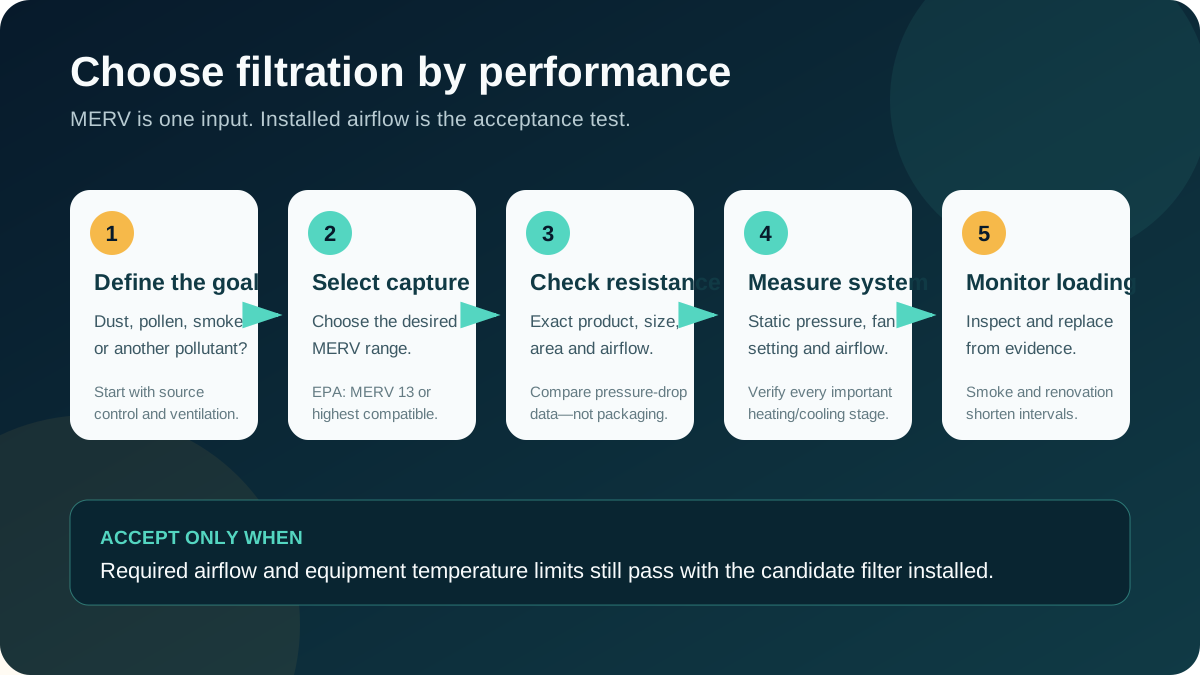
Choose filtration in this order: define the pollutant, control the source, select the desired MERV, compare exact pressure-drop data, provide enough filter area, seal the installation, and verify delivered airflow. The best filter is not the cheapest, deepest, or highest-numbered product. It is the filter that removes the particles you care about while the HVAC system continues to heat, cool, dehumidify, and protect its equipment as designed.
For the broader maintenance picture, continue with the HVAC static-pressure maintenance guide. It covers the coil, outdoor unit, blower response, and the other restrictions a filter measurement can reveal.
About the Editorial Team EnergyBS reviews public program rules, product specifications, utility rates, and reader-facing cost assumptions. Treat savings figures as estimates until you verify local prices, permits, rebates, and contractor quotes.
What to Read Next
HVAC Maintenance Physics: The Science of Static PressureUse this next to compare the cost, incentive, installation, or operating-risk angle before you make a home energy decision.Sources and Verification
Editorial Review
EnergyBS Editorial Team
EnergyBS publishes practical homeowner guides. Important program, product, and cost claims should be checked against the linked source and local project documents before you commit to work.
Related Guides
View All ArticlesHVAC Maintenance Physics: The Science of Static Pressure
Changing a filter isn't just about dust; it's about fluid dynamics. We explain how airflow restriction leads to 'Liquid Slugging', cracked heat exchangers, and the $3,000 'Death Spiral'.
Duct Leakage Testing and Sealing: A Homeowner's Guide to DuctBlaster Results
A practical guide to total duct leakage, leakage to outdoors, CFM25 results, pressure problems, sealing materials, contractor scopes, safety checks, and postwork verification.
Home Energy Audit Guide: Stop Leaking Money (2026)
Choose and prepare for a professional home energy assessment, evaluate diagnostic evidence, turn recommendations into a sequenced retrofit plan, and verify completed work.