Pellet Stove Installation Cost 2026: What Installation Really Costs
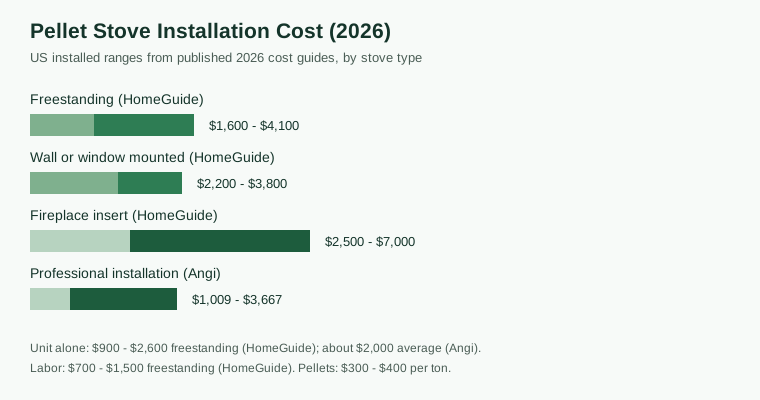
A pellet stove costs $1,600 to $4,100 installed for a freestanding model in the US in 2026 (HomeGuide), with the unit alone at $900 to $2,600 and labor at $700 to $1,500. Angi puts professional installation at $1,009 to $3,667 and the average unit at about $2,000. Inserts run $2,500 to $7,000 installed. This guide prices freestanding, wallmounted, and insert models, the BTU size ladder, pellet venting, running costs at $300 to $400 per ton, EPA efficiency at 70% to 83%, Canada notes, and a 12point quote checklist.
Quick Checks
- 1Budget $1,600 to $4,100 installed for a freestanding pellet stove in 2026 (HomeGuide). The unit is $900 to $2,600 of that and labor is $700 to $1,500. Angi puts professional installation at $1,009 to $3,667.
- 2An insert costs more than a freestanding stove: $2,500 to $7,000 installed (HomeGuide), and a chimney liner, if the flue needs one, adds $1,500 to $4,000 on its own line.
- 3Pellet vent is not a wood stove chimney. A freestanding pellet stove vents with small-diameter pellet vent through a wall or roof, which is why it can go in rooms with no fireplace at all.
- 4Price fuel by the ton, not the bag: $300 to $400 per ton (HomeGuide) or about $350 per ton (Angi), at 2 to 3 tons a year for a heating household. Bags at $6 to $10 each are the convenience price.
- 5A pellet stove stops when the power stops. It needs electricity for the auger, fans, and igniter (EPA). Budget $150 to $600 for a backup power supply (Angi) if outages are part of your winter.
Pellet Stove Installation Cost 2026: What Installation Really Costs
By EnergyBS Editorial Team | October 12, 2026
The Short Answer
Short Answer: A freestanding pellet stove costs $1,600 to $4,100 installed in the US in 2026, with the unit alone at $900 to $2,600 and installation labor at $700 to $1,500 (HomeGuide). Angi frames the same job from the installer side: professional installation runs $1,009 to $3,667, and the average pellet stove unit costs about $2,000, with most units between $1,000 and $3,000. A fireplace insert costs more, at $2,500 to $7,000 installed. The spread comes from three things: the type of stove, the vent run, and whether an existing fireplace and flue can be reused or need a new liner.
A pellet stove is a different purchase from the wood stove we priced this morning. A wood stove is a steel or cast iron box and a chimney. A pellet stove is a small automated furnace with a hopper, a motor-driven auger, an igniter, and fans, and it vents through a small pipe instead of a full chimney. That automation is the point of the product: you load pellets, set a thermostat, and the stove feeds itself. It is also the source of its two defining limits. It needs electricity to run, and it has moving parts that wear. This guide prices the stove by type and size, the venting, the add-ons, the fuel, and the maintenance, then sets pellet against wood and the electric alternatives, with a 12-point quote checklist at the end.
1. Price by Type: Freestanding, Wall-Mounted, Insert
HomeGuide's 2026 table is the cleanest starting point because it separates the unit price from the installed price for each type:
| Type | Unit price, US (HomeGuide 2026) | Installed, US (HomeGuide 2026) |
|---|---|---|
| Freestanding | $900 to $2,600 | $1,600 to $4,100 |
| Wall or window mounted | $1,500 to $2,500 | $2,200 to $3,800 |
| Fireplace insert | $1,500 to $4,500 | $2,500 to $7,000 |
Angi's 2026 type bands are wider ($1,000 to $5,000 for freestanding and wall or window units, $2,000 to $6,000 for inserts) because they include deluxe models. HomeGuide notes deluxe freestanding stoves at $3,000 to $5,500 per unit alone, with programmable Wi-Fi thermostats and longer warranties. If a quote lands above HomeGuide's installed band, the first question is whether you are buying a deluxe unit or paying deluxe money for a standard one.
Freestanding is the default and the cheapest install. The stove sits on a hearth pad and vents through an exterior wall or up through the ceiling and roof with pellet vent pipe. No fireplace is required, which is why this type goes into basements, additions, and open-plan main floors that have no chimney at all. HomeGuide notes freestanding models are the most common and the easiest to position, and Angi's data puts freestanding at 65% of stove installations, with inserts at 23%.
Wall or window mounted units are compact stoves for smaller spaces. HomeGuide puts their heating reach at up to 1,000 sq ft. They vent directly outside, and the install cost sits in the sealing work around the unit: a wall opening has to be cut, sleeved, and weather-sealed, which is more fussy labor than setting a freestanding stove on a pad.
Insert models slide into an existing masonry fireplace and use its chimney for venting. The unit costs more, the fitting work costs more (flanges fill the gaps around the insert face), and the flue may need a liner: HomeGuide prices chimney liner installation at $1,500 to $4,000. That liner line is the one that pushes insert projects toward the $7,000 top of the band. The offsetting gain is real: HomeGuide notes an insert cuts heat loss up the chimney by about 50% compared with the open fireplace it replaces. Our fireplace efficiency guide explains why an open fireplace loses so much heat in the first place.
Get the type settled before you compare quotes. A freestanding quote and an insert quote are not two prices for the same job.
2. Price by Size: The BTU Ladder
Pellet stoves are sold by heat output in BTUs. The two 2026 sources price the ladder differently because they count different things, and the difference is instructive.
HomeGuide's table prices freestanding units only, excluding installation and delivery:
| Output | Heats (HomeGuide) | Unit price (HomeGuide 2026) |
|---|---|---|
| 30,000 BTU | 800 to 1,500 sq ft | $900 to $1,200 |
| 35,000 BTU | 1,500 to 1,800 sq ft | $1,000 to $1,600 |
| 40,000 BTU | 1,800 to 2,200 sq ft | $1,100 to $2,200 |
| 45,000 BTU | 2,200 to 2,400 sq ft | $1,200 to $2,400 |
| 50,000 BTU | 2,400 to 3,000 sq ft | $1,400 to $2,600 |
Angi's table runs from smaller units and lands higher at the top: 9,000 BTU at $800 to $1,200, 15,000 BTU at $1,000 to $1,500, 20,000 BTU at $1,500 to $3,000, 30,000 BTU at $2,000 to $3,500, and 50,000 BTU at $3,000 to $5,000. Angi is pricing a broader set of models, including higher-end units at each size. Read the two tables together and the pattern is consistent: output is cheap at the bottom of the range and expensive at the top, and brand and features move a given size by as much as the size step itself.
The EPA puts the full certified range wider than either retail table: EPA-certified pellet stoves run from 8,000 to 90,000 Btu per hour, with over 90 certified models. Most houses shopping this guide need the middle of that range. The sizing error to avoid is the same one as with wood stoves, but with a pellet-specific twist. An oversized pellet stove short-cycles on its thermostat and spends its life at the lowest feed rate, where ash builds up faster in the burn pot. A correctly sized stove runs longer at a steady mid-range feed, which is the cleaner and lower-maintenance operating point. Ceiling height, floor plan openness, and insulation move the right answer as much as square footage does, and HomeGuide flags vaulted ceilings and multi-level layouts as cases that need more output than the raw area suggests. Ask the installer to show the sizing basis in writing. It is item 3 on the checklist in section 10.
3. How a Pellet Stove Works, and Why It Changes the Install
Pellets sit in a hopper. An electric auger drops them into a burn pot at a rate the control board sets. An electric igniter lights them. A combustion fan pulls air through the pot and pushes exhaust out the vent, and a separate blower pushes heated room air back into the house. The thermostat closes the loop: call for more heat and the auger feeds faster.
Three install consequences follow from that mechanism.
First, the stove needs a standard electrical outlet within reach of its cord. If the chosen wall has none, HomeGuide prices outlet installation at $150 to $350. It is a small line that should be on the quote, not discovered on install day.
Second, the vent is pellet vent: small-diameter, double-wall pipe rated for pellet exhaust, run horizontally through an exterior wall with the required clearances and termination distances, or vertically through the ceiling and roof. It is far cheaper than building a masonry or Class A wood stove chimney. It is not interchangeable with gas direct-vent pipe or single-wall stove pipe, and the quote should name the vent system and its total length.
Third, the stove needs floor and wall protection per its listing. A factory hearth pad is the usual answer. HomeGuide prices a custom stone hearth at $500 to $600 installed, with hearth masonry at $30 to $100 per sq ft, and cheaper results from tile, metal, or concrete pads. Freestanding installs through high ceilings cost the most in HomeGuide's data, because the vertical vent run gets long.
Clearances come from the stove's certification label and manual, not from a generic rule. The installer confirms them, the permit inspection checks them, and the insurance company cares about both. That chain is the practical reason professional installation is the norm for this appliance even though the mechanical work looks simple.
4. The Add-On Stack
Angi's 2026 add-on table prices the extras that appear on real quotes:
| Add-on | Cost, US (Angi 2026) |
|---|---|
| Backup power supply | $150 to $600 |
| Hopper extender | $150 to $300 |
| Metal ash vacuum | $50 to $140 |
| Vent brush | $30 to $80 |
| CO detector | $10 to $30 |
| Smart thermostat | $15 to $250 |
HomeGuide's enhancement list overlaps and adds two installation-side lines: a backup generator at $500 to $2,500 as the heavier alternative to a battery backup unit, and the $150 to $350 outlet noted above.
Work through the list by need, not by salesmanship. The backup power supply is the one with a functional argument behind it. A pellet stove without power is a cold box of unburned pellets: the auger, igniter, and fans are all electric (EPA). Angi puts electricity use at 360 to 460 watts at ignition and 80 to 345 watts per hour while burning, which is a modest load a battery backup can carry for a limited time. HomeGuide puts the monthly electricity cost at $10 to $20; Angi puts it at about $10 per month. If your house loses power for days at a time in winter and the pellet stove is your main heat, backup power is part of the system cost, and our standby generator cost guide prices the whole-house version of that decision.
The hopper extender doubles or triples hopper capacity (Angi) for $150 to $300, which matters if the stove heats a cottage you visit on weekends or a shop you do not enter daily. Extenders are model-specific, usually bought from the stove's manufacturer. The ash vacuum and vent brush are maintenance tools you will use weekly and seasonally; a metal ash vacuum is the safe version of a job people try to do with a household vacuum, which is a fire risk with fine ash. The CO detector at $10 to $30 (Angi, device only) is not optional in any practical sense. HomeGuide prices professionally installed smoke or CO detection at $90 to $150, which is the wired-in version of the same line.
5. Running Costs: Pellets, Electricity, Cleaning
Fuel is the recurring decision. Pellets cost $300 to $400 per ton on average (HomeGuide), or about $350 per ton for a pallet of 50 40-lb bags, at about $7.50 per bag bought singly (Angi). HomeGuide's per-bag band is $6 to $10. Buying by the ton saves about $25 per ton against Angi's single-bag price, and the ton is the unit to budget in: HomeGuide puts typical use at 2 to 3 tons per year burned over 3 to 10 months, and Angi puts a pallet lasting one to two months in heating season.
Monthly running cost lands at $130 to $220 per month in HomeGuide's summary table, and $120 to $200 per month for pellets plus $10 to $20 for electricity in its detailed section. Use the wider $130 to $220 planning band for a stove doing real heating work in a cold month, and expect shoulder-season months to cost far less because the stove runs at a low feed rate or not at all.
Storage is the quiet advantage over cordwood. A ton of pellets is 50 bags that stack in a garage corner or a dry basement, roughly a pallet footprint. A cord of firewood is a 4 by 4 by 8 ft stack that needs outdoor seasoning space. Pellets must stay dry: a bag that takes on moisture swells and crumbles into sawdust that jams an auger. Buy from a supplier whose storage you trust, and keep your own stack off a damp floor.
Pellet quality is a running-cost variable, not a preference. The EPA notes pellets differ in how well they are made and how well they burn, with lower-quality pellets giving less heat and more fine dust, and it points buyers to certified fuel: the PFI Standards Program in the US, ENplus, and CANPlus in Canada. Many manufacturers recommend certified pellets only, and ash content is the number that drives your cleaning interval. Cheap pellets with high ash cost you time every week.
Cleaning is the other recurring line. The EPA directs owners to clean the stove regularly and have it professionally cleaned at least once a year, following the owner's manual. HomeGuide prices a chimney sweep with deep cleaning and inspection at $150 to $375. Pellet venting produces far less creosote than a wood stove flue, which is one reason the annual service costs less than the wood stove equivalent, but ash, the burn pot, the heat exchanger, and the fans all need the annual visit.
6. A Labeled 10-Year Ownership Example
Installed price is the entry fee. The decade tells you what the heat costs. The example below is a labeled hypothetical built from the cited bands, with assumptions stated so you can rerun it with your own numbers: a freestanding stove bought mid-band at $1,750 for the unit, installed at $3,000 total (inside HomeGuide's $1,600 to $4,100 band, including a hearth pad and a short wall vent run), burning 2.5 tons of pellets a year at $350 per ton (Angi's per-ton figure, inside HomeGuide's $300 to $400 band), electricity at $15 per month for 6 heating months, one $250 professional cleaning a year (inside HomeGuide's $150 to $375 band), and $500 allowed across the decade for wear parts such as an igniter or auger motor, labeled as an estimate rather than a cited price.
| Line | 10-year cost |
|---|---|
| Installed (unit, labor, vent, pad) | ~$3,000 |
| Pellets: 2.5 tons x $350 x 10 yrs | $8,750 |
| Electricity: $15/mo x 6 mo x 10 yrs | $900 |
| Annual professional cleaning: $250 x 10 yrs | $2,500 |
| Wear parts allowance (labeled estimate) | ~$500 |
| Illustrative 10-year total | ~$15,650 |
HomeGuide puts pellet stove lifespan at 10 to 15 years with regular cleaning and good pellets, so a 10-year window is a fair planning horizon and not a pessimistic one.
Read two things off the table. First, fuel is more than half the decade's money. The difference between $300 and $400 per ton, over 25 tons, is $2,500, which is larger than the price gap between a standard and a deluxe stove. Your local pellet supply, and whether you can buy by the ton in summer, matters more than showroom features. Second, this stove earns its money only against the fuel it displaces. Against electric baseboard heat or oil or propane in a high-price market, 2.5 tons of pellets doing the main floor's heating is cheap heat. Against a low-cost natural gas furnace, the same stove is a comfort purchase: a very good one for the room it sits in, with a real flame and a warm corner, but not a savings project. Price your current fuel per unit of delivered heat before you shop, using your own bills.
7. Efficiency, Emissions, and the 2026 Credit Picture
EPA-certified pellet stoves usually fall in the 70% to 83% efficiency range (EPA; HomeGuide gives the same band). That is the delivered-heat share of the fuel's energy, and it is high for a solid-fuel appliance because the auger feeds fuel at a controlled rate and the combustion fan supplies air to match. The EPA also notes that used correctly, pellet stoves produce very little smoke or creosote, and creosote is the main cause of chimney fires. The certification label is the document that carries the efficiency and emissions numbers for the specific model. Buy from the label, not from a brochure range.
New pellet stoves sold in the US must meet the EPA's 2020 new source performance standards for residential wood heaters. In practice that means shopping from the EPA-certified list and confirming the hang tag on the unit you are quoted, the same discipline as with wood stoves.
On credits, be careful with stale pages. Some 2026 cost guides still show a 30% federal credit for biomass stoves running to 2032. That was the old Section 25C schedule. The credit ended for property placed in service after December 31, 2025, the same termination that applies to wood stoves, so in 2026 there is no federal installation credit to subtract from a pellet stove quote. If a quote nets out a federal credit, ask the installer to remove it and reprice. State, provincial, and utility programs change on their own schedules. Verify any claimed rebate against the program's own current rules, in your jurisdiction, before signing.
8. Pellet vs Wood: The Decision in One Section
Our wood stove installation cost guide priced the wood side this morning: $1,500 to $4,000 installed on Angi's 2026 data, averaging $3,000, and $3,000 to $8,000 for a full system on HomeGuide's. Pellet and wood overlap on installed price. They split on everything after install day.
| Question | Pellet stove | Wood stove |
|---|---|---|
| Installed, US | $1,600 to $4,100 freestanding (HomeGuide) | $1,500 to $4,000 (Angi); $3,000 to $8,000 full system (HomeGuide) |
| Fuel | Pellets $300 to $400/ton, 2 to 3 tons/yr | Cordwood $275 to $400/cord, 2+ cords/yr for primary heat |
| Heat control | Thermostat, automatic feed | Manual loading and damping |
| Power outage | Stops without backup power | Burns with no electricity |
| Venting | Small pellet vent through wall or roof | Full chimney or Class A system |
| Weekly work | Empty ash, clean burn pot, load hopper | Split, stack, load, ash, creosote watch |
| Efficiency | 70% to 83% (EPA certified) | Certified wood stoves in a similar band, operator-dependent |
Choose pellet if you want set-and-forget heat, you have a reliable pellet supplier, and your outages are short or covered by backup power. Choose wood if you have cheap or free cordwood, you want heat that works in a long outage with no generator, and you accept the daily labor. Households that heat a main living area for long hours tend to be happier with pellet automation. Cabins and outage-prone rural houses tend to be happier with wood. Neither answer is wrong. The wrong answer is buying pellet for off-grid resilience or wood for a household nobody wants to feed twice a day.
For the wider comparison, a ductless mini split heats the same space with no fuel handling and adds cooling, at a higher installed cost and with operating cost set by your electricity rate. The heat pump vs furnace true-cost comparison works that electric math over 15 years.
9. Canada: What Changes North of the Border
There is no published national CAD band for pellet stove installation, so work from the US structure and price the Canadian specifics locally. The shape of the job is the same: unit, labor, vent, pad, permit. Labour markets in major Canadian cities price hearth work in the same pattern as the US bands after currency conversion, and Canadian dealers quote the same North American stove models.
Three items are Canada-specific. First, fuel certification: look for CANPlus certified pellets, the Canadian program the EPA lists alongside PFI and ENplus, and confirm your stove's manual accepts the grade you can actually buy near you. Pellet supply is regional in Canada. A stove is only as good as the nearest reliable tonnage, and delivered price per ton in Atlantic Canada, the Prairies, and southern Ontario can differ enough to move the 10-year math in section 6. Get a delivered per-ton quote before you buy the stove, not after.
Second, installation and insurance: Canadian insurers commonly ask for installation by a WETT-certified installer (Wood Energy Technology Transfer) for solid-fuel appliances, and installation follows CSA B365, the Canadian code for solid-fuel-burning appliances and equipment. Ask your insurer before the install, not at renewal time. Third, permits are municipal. Confirm the permit and inspection path with your city or township before the stove arrives, because the inspector checks the label clearances and the vent termination.
Cold-climate sizing deserves one extra note. A pellet stove rated for 2,000 sq ft in a mild-climate listing is a supplemental heater in a January cold snap in Manitoba or northern Ontario. Size for design temperature, keep the existing furnace or baseboards as the backstop, and treat the pellet stove as the primary heat for the zone it sits in rather than a whole-house promise.
10. The 12-Point Quote Checklist
- Type named: freestanding, wall or window mounted, or insert, in the contractor's words, with the make and model.
- EPA certification confirmed: the specific model appears as EPA-certified, with its efficiency and BTU output from the label.
- Sizing basis shown: square footage, ceiling height, floor plan, insulation, and climate behind the BTU recommendation.
- Vent plan drawn: pellet vent system named, horizontal or vertical route, total length, and termination location with clearances.
- Liner priced separately for inserts: whether the existing flue needs a liner, at $1,500 to $4,000 if it does (HomeGuide), as its own line.
- Hearth and wall protection specified: pad type and dimensions, and the label clearances the install satisfies.
- Electrical included: outlet location confirmed, or outlet installation priced ($150 to $350, HomeGuide), and surge protection discussed.
- Permits and inspection: who pulls the permit ($50 to $100 in HomeGuide's city examples), and final inspection included before final payment.
- Fuel plan stated: first ton included or not, the pellet grade and certification (PFI or CANPlus) the installer recommends, and local delivered per-ton pricing.
- Backup power addressed: battery backup or generator option priced ($150 to $600 for a backup power supply, Angi), or explicitly declined in writing.
- Maintenance terms: first-year cleaning included or priced ($150 to $375 per visit, HomeGuide), and the owner's weekly tasks explained before sign-off.
- Warranty split: manufacturer warranty on the stove and its auger, igniter, and fans, stated separately from the installer's workmanship warranty.
A quote missing lines 4, 5, and 8 is not comparable to one that has them. As with any hearth appliance, the cheapest complete quote for the same scope is the one to buy, and an incomplete quote is just a smaller number.
Frequently Asked Questions (FAQ)
How much does it cost to install a pellet stove in 2026?
A freestanding pellet stove costs $1,600 to $4,100 installed in the US in 2026 (HomeGuide), with the unit at $900 to $2,600 and labor at $700 to $1,500. Angi puts professional installation at $1,009 to $3,667 and the average unit at about $2,000. Wall-mounted models run $2,200 to $3,800 installed and fireplace inserts $2,500 to $7,000, with a chimney liner adding $1,500 to $4,000 where the flue needs one.
How much does it cost to run a pellet stove per month?
HomeGuide puts running costs at $130 to $220 per month in its summary, and $120 to $200 per month for pellets plus $10 to $20 for electricity in its detailed breakdown. Pellets cost $300 to $400 per ton, and a heating household burns 2 to 3 tons a year. Angi puts electricity at about $10 per month. Cold months at full feed cost the most; shoulder-season months cost far less.
Does a pellet stove need a chimney?
No. A freestanding pellet stove vents through small-diameter pellet vent pipe run horizontally through an exterior wall or vertically through the ceiling and roof. That is the main install advantage over a wood stove, which needs a full chimney system. An insert is the exception: it uses the existing fireplace chimney, and that flue may need a $1,500 to $4,000 liner (HomeGuide).
Will a pellet stove work during a power outage?
Not without backup power. The auger, igniter, and fans are electric, so the stove shuts down when the power fails (EPA). Angi prices backup power supplies at $150 to $600, and HomeGuide prices a portable generator at $500 to $2,500 as the heavier option. Some models offer battery backup. If long outages are normal where you live and backup power is not in the budget, a wood stove is the better resilience buy.
How efficient is a pellet stove?
EPA-certified pellet stoves usually run at 70% to 83% efficiency (EPA), with heating capacities from 8,000 to 90,000 Btu per hour across more than 90 certified models. The controlled auger feed and combustion fan hold that efficiency more steadily than a hand-fired stove, whose real-world efficiency depends on the operator and the wood's moisture.
How long does a pellet stove last?
HomeGuide puts a well-maintained pellet stove at 10 to 15 years, with regular cleaning and good-quality pellets extending life. The wear items are the igniter, auger motor, and fans. Annual professional cleaning (EPA recommends at least once a year) is the maintenance step that protects that lifespan.
Is there a tax credit for pellet stoves in 2026?
No federal one. The Section 25C credit for qualifying biomass stoves ended for property placed in service after December 31, 2025, despite some cost guides still showing the old schedule running to 2032. Do not let a 2026 quote subtract a federal credit. Check state, provincial, and utility programs directly against their current published rules.
Pellet stove or wood stove: which should I buy?
Buy pellet for thermostat-controlled, low-effort heat with a reliable local pellet supply at $300 to $400 per ton: installed at $1,600 to $4,100 freestanding, 70% to 83% efficient, and out of action in an outage without backup power. Buy wood for outage-proof heat and cheap fuel where cordwood is local: installed at $1,500 to $4,000 (Angi), with daily loading labor. Section 8 works the full comparison, and our wood stove cost guide prices the wood side in detail.
What should I read next before deciding?
Start with the wood stove installation cost guide for the direct alternative, and the fireplace efficiency guide if you have an open fireplace today. For electric heat, compare ductless mini split costs and the heat pump vs furnace comparison. For outage planning, the standby generator cost guide prices the powered side.
Prices in this guide are planning ranges from the published 2026 sources cited above, not quotes for your house. Stove model, vent route, flue condition, hearth work, electrical, permits, and local labor decide the final figure. Buy from the EPA label, price pellets by the delivered ton, plan for the power outage case, and make sure the cheapest quote is also a complete one.
What to Read Next
Wood Stove Installation Cost 2026: What Installation Really CostsUse this next to compare the cost, incentive, installation, or operating-risk angle before you make a home energy decision.Sources and Verification
- Angi How Much Does Pellet Stove Installation Cost? [2026 Data], updated July 8, 2026 (professional installation $1,009 to $3,667; average unit about $2,000, most units $1,000 to $3,000; BTU table 9,000 BTU $800 to $1,200 through 50,000 BTU $3,000 to $5,000; type bands freestanding and wall/window $1,000 to $5,000, insert $2,000 to $6,000; pellets about $350 per ton or about $7.50 per 40lb bag; electricity about $10 per month; DIY labor saving $250 to $1,000; addons backup power $150 to $600, CO detector $10 to $30, hopper extender $150 to $300, ash vacuum $50 to $140, vent brush $30 to $80, smart thermostat $15 to $250)
- HomeGuide How Much Does Pellet Stove Installation Cost? (2026) (freestanding $1,600 to $4,100 installed, unit $900 to $2,600, labor $700 to $1,500; wallmounted $2,200 to $3,800 installed, unit $1,500 to $2,500; insert $2,500 to $7,000 installed, unit $1,500 to $4,500, chimney liner $1,500 to $4,000; BTU table 30,000 BTU $900 to $1,200 through 50,000 BTU $1,400 to $2,600 for freestanding units; running cost $130 to $220 per month in one summary and $120 to $200 per month for pellets plus $10 to $20 electricity in the body; pellets $300 to $400 per ton, 2 to 3 tons per year; permit $50 to $100; chimney sweep $150 to $375; lifespan 10 to 15 years; efficiency 70% to 83%)
- HomeGuide Pellet Stove vs. Wood Stove (2026) (pellet pellets $300 to $400 per ton or $6 to $10 per 40lb bag; cordwood $275 to $400 per cord; wood stove installation $3,000 to $8,000 for comparison)
- U.S. EPA Pellet Stoves, Burn Wise (EPAcertified pellet stoves usually 70% to 83% efficiency, heating capacity 8,000 to 90,000 Btu per hour, over 90 certified models; pellets made from sawdust and wood byproducts; PFI Standards Program, ENplus, and CANPlus pellet certification; pellet stoves need electricity for motorized feed and fans, with battery backup on some models; annual professional cleaning recommended)
- U.S. EPA Burn Wise (EPA certification and the 2020 new source performance standards for residential wood heaters, including pellet stoves)
Editorial Review
EnergyBS Editorial Team
EnergyBS publishes practical homeowner guides. Important program, product, and cost claims should be checked against the linked source and local project documents before you commit to work.
Related Guides
View All ArticlesWood Stove Installation Cost 2026: What Installation Really Costs
A wood stove installation costs $1,500 to $4,000 in the US in 2026, averaging $3,000 (Angi, updated July 2026), with labor alone at $500 to $3,000. HomeGuide puts a full stoveandventing project at $3,000 to $8,000, a stove plus new chimney at $2,300 to $7,000, and an insert into an existing fireplace at $1,200 to $3,400. This guide prices catalytic, noncatalytic, and hybrid stoves, cast iron vs steel, the size ladder, chimney liners ($900 to $3,800 installed), firewood and inspection running costs, Canada pricing, 2026 code and credit notes, and a 12point quote checklist.
The Fireplace Fallacy: Why Your Hearth is a Energy Thief
An open masonry fireplace has an efficiency of 10%. It sucks more heat out of your house than it adds. We explain the 'Stack Effect' and how to convert your chimney into a heater.
Ductless Mini Split Installation Cost 2026: What Installation Really Costs
A ductless mini split installation in the US in 2026 typically costs $2,500 to $15,000 or more in HomeGuide project data: singlezone systems run $2,500 to $6,000, twozone $4,500 to $8,000, threezone $6,500 to $11,000, and fivezone wholehome systems $10,000 to $15,000. HVAC labor alone runs $700 to $3,000 on multizone work and permits $250 to $400 in Angi data. This guide prices by zone count, BTU capacity and indoor unit style, explains what moves a quote inside each band, runs labeled operatingcost math, and covers Canada pricing.