Wood Stove Installation Cost 2026: What Installation Really Costs
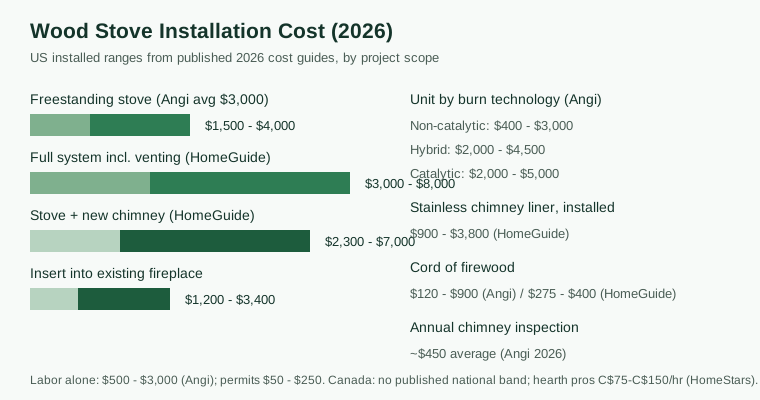
A wood stove installation costs $1,500 to $4,000 in the US in 2026, averaging $3,000 (Angi, updated July 2026), with labor alone at $500 to $3,000. HomeGuide puts a full stoveandventing project at $3,000 to $8,000, a stove plus new chimney at $2,300 to $7,000, and an insert into an existing fireplace at $1,200 to $3,400. This guide prices catalytic, noncatalytic, and hybrid stoves, cast iron vs steel, the size ladder, chimney liners ($900 to $3,800 installed), firewood and inspection running costs, Canada pricing, 2026 code and credit notes, and a 12point quote checklist.
Quick Checks
- 1Budget $3,000 as the US national average for a wood stove installation in 2026. Angi puts the working range at $1,500 to $4,000, with simple jobs near $325 and full chimney builds reaching $5,000.
- 2The venting decides the total more than the stove does. A liner into an existing flue runs $900 to $3,800 installed; a stove plus a new chimney totals $2,300 to $7,000 in HomeGuide's 2026 data.
- 3Buy the burn technology, not the look. Non-catalytic stoves run $400 to $3,000, hybrids $2,000 to $4,500, and catalytic units $2,000 to $5,000 (Angi). The catalyst buys longer, cleaner burns and its own replacement schedule.
- 4Size to the space, not the ambition. Angi's 2026 ladder runs about $900 for a small stove heating 400 to 950 sq ft up to $2,800+ for an extra-large unit covering 2,200 to 3,000 sq ft. Oversizing forces smoldering burns and creosote.
- 5Price the decade, not the invoice. A cord of firewood runs $120 to $900 depending on region (Angi) or $275 to $400 (HomeGuide), plan on two or more cords for primary heat, and budget about $450 a year for the chimney inspection.
Wood Stove Installation Cost 2026: What Installation Really Costs
By EnergyBS Editorial Team | October 12, 2026
The Short Answer
Short Answer: Installing a wood stove costs $1,500 to $4,000 in the US in 2026, averaging about $3,000, with labor alone at $500 to $3,000 (Angi, updated July 2026). HomeGuide frames a full project wider: $3,000 to $8,000 for a stove with venting, $2,300 to $7,000 for a stove plus a brand-new chimney, and $1,200 to $3,400 for a wood-stove insert dropped into an existing fireplace. The two ranges are not in conflict. Angi's band centers on freestanding stove projects; HomeGuide's captures the full system including chimney work. What you pay depends mostly on one question: does your house already have a flue this stove can use?
A wood stove is the rare heating upgrade where the equipment is the cheap half of the job. The unit sits in the middle of the quote; the chimney, liner, hearth pad, wall protection, and labor sit around it. Quotes that surprise people almost always surprise them on the venting side. This guide prices every line: the stove by burn technology and material, the size ladder, the venting (liner vs new chimney), the add-ons, the running costs, Canada pricing, the 2026 code and credit picture, and a 12-point quote checklist.
1. Price by Scope: The Venting Question Comes First
Every wood stove project is one of three scopes, and the scope explains most of the spread between $1,500 and $8,000.
Scope A: freestanding stove into an existing chimney or flue. The cheapest path. The installer sets the stove, connects the stove pipe to a suitable existing flue, and builds or upgrades the hearth pad. This is where Angi's $1,500 to $4,000 band lives, and where the low-end $325 jobs (a like-for-like swap with venting already in place) come from.
Scope B: insert into an existing masonry fireplace. HomeGuide prices this at $1,200 to $3,400 installed. The insert slides into the firebox, gets a stainless liner up the existing chimney, and converts an open fireplace into a sealed heating appliance. The fireplace becomes the venting, which is why this costs less than a freestanding job that needs new pipe.
Scope C: stove plus new chimney from scratch. HomeGuide's $2,300 to $7,000 band. No usable flue exists, so the project builds one: a Class A insulated chimney through the ceiling and roof, or up the exterior wall. On a two-story house with a complex roof, this is the budget line that moves quotes past Angi's $4,000 normal-range ceiling.
Before you collect quotes, know your scope. Walk outside, look at your roofline, and check whether a chimney or flue exists that is sized for a wood stove. The contractor will confirm it, but knowing the answer first keeps you from comparing a Scope A quote against a Scope C quote as if they were the same job.
2. The Unit: Catalytic, Non-Catalytic, and Hybrid
Angi's 2026 table prices the three burn technologies:
| Stove type | Unit cost, US (Angi 2026) | What it is |
|---|---|---|
| Non-catalytic | $400 to $3,000 | Secondary air tubes reburn smoke; no catalyst to replace |
| Hybrid | $2,000 to $4,500 | Secondary combustion plus a catalyst for the cleanest burn |
| Catalytic | $2,000 to $5,000 | A coated ceramic catalyst reburns gases at lower flue temperatures |
A catalytic stove can hold a low, slow overnight burn while staying clean, because the catalyst keeps combustion going at temperatures where a non-catalytic stove would smolder. The tradeoff is the catalyst itself: it degrades over years of use and needs periodic replacement, a real ownership line item the non-catalytic design avoids. If you heat with the stove as primary heat and want overnight burns, the catalytic or hybrid design earns its premium. If the stove is weekend ambiance plus supplemental heat, non-catalytic gives you the look and most of the heat for less money and fewer parts to maintain.
Material matters next. Cast iron stoves run $350 to $5,000 and steel stoves $700 to $3,200 (Angi 2026). Cast iron holds and radiates heat longer after the fire dies down and carries the classic stove look; it is also heavier and more expensive to move and install. Steel heats up faster and costs less. Neither is categorically better. The burn technology and the sizing decide performance; the material decides the price, the look, and how the heat feels after the fire goes out.
One note on the market: 65% of homeowners in Angi's data bought freestanding stoves and 23% bought fireplace inserts. Freestanding is the default for a reason: it radiates from all sides and can sit wherever the venting allows.
3. The Size Ladder: Buy BTUs, Not Ambition
Angi's 2026 size table prices stoves by the space they heat:
| Heating capacity | Square feet | BTUs | Typical unit cost |
|---|---|---|---|
| Small | 400 to 950 | 8,000 to 38,000 | ~$900 |
| Medium | 1,000 to 1,500 | 20,000 to 68,000 | ~$1,600 |
| Large | 1,600 to 2,200 | 32,000 to 88,000 | ~$2,400 |
| Extra large | 2,200 to 3,000 | 44,000 to 120,000 | ~$2,800+ |
The U.S. Department of Energy's rule of thumb, quoted in Angi's 2026 guide: a stove rated at 42,000 BTUs heats about 1,300 square feet, and a 60,000-BTU stove about 2,000 square feet. Treat that as a starting point, not a target. Cold climate, closed floor plan, and thin insulation all push the requirement up; an open main floor in a mild climate pushes it down.
The sizing mistake is oversizing. A stove that is too big for the room forces you to damp it down into a smoldering burn to stay comfortable, and smoldering is what loads the chimney with creosote. Creosote is the fuel for chimney fires. An installer who asks about your floor plan, ceiling height, insulation, and climate before recommending a size is doing the job right. One who recommends the biggest unit in the showroom is selling inventory.
4. The Venting Line: Liners, New Chimneys, and the Add-On Stack
This is the section that moves quotes. Price it separately from the stove.
Chimney liner. If you have a masonry chimney in usable shape, a stainless steel liner is the standard move: $900 to $3,800 installed (HomeGuide 2026). Materials run $20 to $90 per linear foot, with installation labor adding $500 to $1,500. Single-wall runs $35 to $70 per installed foot, double-wall $50 to $160. A stainless liner lasts 15 to 20 years with maintenance. The liner has to match the stove's flue diameter: too large and the draft weakens and creosote builds; the installer sizes it to the stove's outlet, not to whatever the old chimney happens to be.
New chimney. Where no flue exists, a Class A insulated chimney goes up through the house or along the exterior wall. HomeGuide's combined band of $2,300 to $7,000 for stove plus new chimney tells you the rough shape: on a single-story ranch with a straight vertical run, you land near the bottom; on a two-story with a steep roof and offsets, near the top. Every bend and every foot of height adds material and labor, and roof penetrations on steep or metal roofs cost more than on a simple asphalt slope.
The add-on stack. These lines appear on quotes individually and add up:
- Hearth pad: a non-combustible floor protector under and around the stove, sized to the stove's manual. Factory pads run a few hundred dollars installed; custom stone or tile more.
- Wall shields and clearances: an unlisted stove needs 36 inches to combustibles under NFPA 211; listed stoves follow the clearances printed on their label. Heat shields can reduce labeled clearances, which is what makes a stove possible in a tight room, but shields are specified hardware, not improvised sheet metal.
- Permits: $50 to $250 (Angi). Most jurisdictions require one. The contractor should pull it.
- Delivery and old-unit removal: stoves weigh 300 to 500+ pounds. Delivery, placement, and disposal of an old unit are separate lines on many quotes.
5. Running Costs: Firewood, Inspections, Repairs
The stove is a purchase; the wood is a subscription. Angi's 2026 figures: a cord of firewood costs $120 to $900 depending on region and wood type, and a household heating primarily with the stove needs at least two cords a winter. HomeGuide's firewood data centers tighter at $275 to $400 per cord, which is the number to use in milder markets. Two variables swing this more than any other line in the guide: hardwood vs softwood (hardwood burns longer and costs more) and whether you buy seasoned wood in summer or scramble in November.
Chimney inspection is the non-optional maintenance line: Angi puts the average at $450, ranging from $100 to $5,000 depending on chimney condition. That wide range is the point. A clean annual Level 1 inspection is the low end; an inspection that finds a damaged liner, a blocked flue, or a creosote glaze problem becomes a repair project. Burning only dry, seasoned wood (under 20% moisture) is what keeps you at the low end of that range year after year.
Repair bands from Angi's 2026 data: chimney obstruction $120 to $360, faulty door gasket $20 to $50, loose stove pipes $75 to $130. The gasket number is small and important: a leaking door gasket lets the stove burn too fast and too hot, which is both a safety issue and a fuel-waste issue. The gasket check takes a minute with a dollar bill in the door seal.
6. A Labeled 10-Year Ownership Example
The installed price is one number; the decade is the real one. The example below is a labeled hypothetical built from the cited bands, not a quote. Assumptions are stated so you can rerun it with your own: a 1,600 sq ft home, a medium non-catalytic stove bought at Angi's ~$1,600 unit price, professional installation at the $3,000 national average (existing flue with a new stainless liner at the midpoint), permits at $150, heating supplementally with 2.5 cords a year at $340 a cord (inside HomeGuide's $275 to $400 band), and one $450 chimney inspection a year.
| Line | 10-year cost |
|---|---|
| Installed (unit + install + liner + permit) | ~$3,000 + ~$2,350 + $150 = ~$5,500 |
| Firewood: 2.5 cords x $340 x 10 yrs | $8,500 |
| Inspections: $450 x 10 yrs | $4,500 |
| Gaskets, minor repairs (labeled estimate) | ~$500 |
| Illustrative 10-year total | ~$19,000 |
Two things to read off this table. First, the stove itself is about a third of the decade's money; fuel and maintenance are the other two-thirds, which is why the wood supply question (do you have cheap, dry hardwood nearby?) matters as much as the unit price. Second, this math only pays back if the stove displaces real furnace runtime. A stove in a house with cheap natural gas and a 95% furnace is ambiance with a fuel bill; the same stove in a house heating with oil, propane, or electric baseboards at high rates can displace enough purchased fuel to change the decade's arithmetic. Run the comparison with your own utility rates before buying, not after.
7. Canada: What Changes North of the Border
There is no published national CAD band for wood stove installations, so treat any single Canadian number with suspicion and work from the pieces. HomeStars' city cost pages put hearth and fireplace pros at C$75 to $150 per hour in major markets, and list pellet stove installs at C$500 to $2,000 as a labor-and-venting reference point. Installer-published figures for a wood stove put the unit around C$1,500 to C$3,500 with installation adding C$1,500 to C$3,000, in the same shape as the US bands after currency conversion.
Three Canada-specific items belong in the budget and the contractor search. First, look for WETT-certified installers (Wood Energy Technology Transfer), the national training and certification body Canadian insurers commonly ask for; a non-certified installation can complicate a claim after a chimney fire. Second, installation follows CSA B365, the Canadian installation code for solid-fuel-burning appliances and equipment, which your installer and your local permit office both work from. Third, wood is the cheap fuel in cottage country and the expensive fuel in the city: a rural Ontario or Quebec homeowner with their own woodlot faces a very different decade of running costs than a Vancouver homeowner buying delivered cords. Permits are municipal and universal; confirm yours before the stove is delivered, because the inspector checks clearances, not the salesperson's brochure.
8. The 2026 Code and Credit Picture
EPA certification is mandatory for new stoves. The EPA's 2020 New Source Performance Standards require new residential wood heaters sold in the US to be EPA-certified, with a 2.0 gram-per-hour particulate limit. Buy only certified units with the EPA label and hang tag; non-certified new stoves are not legal inventory. The practical upside: a certified stove burns a fraction of the smoke of a pre-1988 unit, which is the difference between heating your house and heating your neighborhood's air quality complaints. (Our fireplace efficiency guide covers what the old open fireplaces were doing to houses, and why a sealed insert changes the math.)
Clearances are a code issue, not a suggestion. NFPA 211 sets 36-inch clearance to combustibles for unlisted stoves; listed stoves carry their clearances on the certification label, and the label wins. Reducing clearances requires listed heat shields installed exactly to the manual. The inspection at permit sign-off checks this, which is one more reason the permit matters.
The federal credit is gone. The 30% residential credit that covered qualifying biomass stoves under Section 25C ended for property placed in service after December 31, 2025. In 2026 there is no federal installation credit for wood stoves. Do not let a quote subtract one. State and utility programs still exist in some places; verify any claimed rebate against the program's own current rules before signing.
9. Wood Stove vs the Alternatives
A wood stove competes with other ways to heat the same square feet. Installed-cost context from the cited 2026 sources:
| Option | Installed cost, US | The tradeoff |
|---|---|---|
| Wood stove | $1,500 to $4,000 (Angi); $3,000 to $8,000 full system (HomeGuide) | Cheapest fuel where wood is local; most labor; needs chimney |
| Pellet stove | $1,600 to $4,100 (HomeGuide) | Thermostat-like convenience, steady heat; needs electricity; pellets $300 to $400/ton |
| Ductless mini split, single zone | See our mini split cost guide | Cooling included; no fuel logistics; depends on electricity rates |
| Cold-climate heat pump | See our heat pump vs furnace comparison | Highest efficiency; whole-house; biggest installed cost |
| Outdoor wood boiler | $9,000 to $16,000 (HomeGuide) | Heats the whole house plus water; feeds a big wood appetite |
The wood stove's niche is clear from the table: it wins where firewood is cheap and the owner accepts the labor of feeding it. It loses on convenience to everything with a thermostat. As supplemental or backup heat it is nearly unmatched; during an ice storm, a wood stove is the heat source that works with the power out. Our standby generator cost guide prices the electric side of that same resilience question.
10. The 12-Point Quote Checklist
- Scope named: freestanding into existing flue, insert into fireplace, or new chimney, in the contractor's words.
- Stove specified: make, model, burn technology (catalytic/non-catalytic/hybrid), BTU rating, and EPA certification confirmed on the label.
- Sizing rationale: the square footage, ceiling height, insulation level, and climate the recommendation is based on, not just the showroom's biggest seller.
- Flue compatibility: stove outlet diameter matched to the liner or chimney, in writing.
- Liner specified: stainless grade, single vs double wall, insulated or not, and the installed per-foot price with total footage.
- New chimney detailed where applicable: Class A system, height above the roofline, number of offsets, roof flashing included.
- Hearth pad: dimensions, material, and the manual's clearance requirement it satisfies.
- Wall protection: shields specified as listed hardware with the reduced clearances they achieve.
- Permits and inspection: who pulls the permit, and the final inspection included before final payment.
- Delivery and old unit: delivery, placement, and disposal of any old stove named as included or excluded.
- Fuel guidance: the installer's seasoned-wood requirement (under 20% moisture) and any first-year burning-in instructions in writing.
- Warranty split: stove warranty from the manufacturer and workmanship warranty from the installer, separately stated with terms.
A quote missing lines 1, 4, 5, and 9 is not comparable to one that has them. The cheapest complete quote describing the same scope is the one to buy.
Frequently Asked Questions (FAQ)
How much does it cost to install a wood stove in 2026?
In the US, Angi's 2026 data puts the average at $3,000, with most projects between $1,500 and $4,000 and labor alone at $500 to $3,000. HomeGuide frames the full system at $3,000 to $8,000: a stove plus a new chimney runs $2,300 to $7,000, while a wood-stove insert into an existing fireplace costs $1,200 to $3,400. The venting scope explains most of the spread; the stove unit is the smaller half of most quotes.
Is it cheaper to install a wood stove or a pellet stove?
The equipment bands overlap: wood stoves $1,500 to $4,000 installed (Angi average $3,000) vs pellet stoves $1,600 to $4,100 installed (HomeGuide). The difference is operating. Pellets cost $300 to $400 a ton and need electricity to run the auger and fans; cordwood costs $120 to $900 a cord (Angi) or $275 to $400 (HomeGuide) and needs no power. Wood wins on fuel flexibility and outage resilience; pellets win on convenience and steady heat.
Can I install a wood stove without a chimney?
Yes, by building one. A Class A insulated stainless chimney can run through the ceiling and roof or up an exterior wall, which is what HomeGuide's $2,300 to $7,000 stove-plus-new-chimney band prices. There is no safe chimney-free option for a wood stove: direct-vent shortcuts and unlisted pipe are how houses burn. The chimney is the installation.
How much does a chimney liner cost for a wood stove?
A stainless steel liner costs $900 to $3,800 installed (HomeGuide 2026), with materials at $20 to $90 per linear foot and installation labor adding $500 to $1,500. Single-wall installs run $35 to $70 per foot, double-wall $50 to $160. A maintained stainless liner lasts 15 to 20 years. The liner diameter must match the stove's flue outlet.
What size wood stove do I need?
Start from the DOE rule of thumb in Angi's 2026 guide: about 42,000 BTUs heats 1,300 sq ft and 60,000 BTUs heats 2,000 sq ft, then adjust for climate, ceiling height, floor plan, and insulation. Angi's price ladder runs about $900 for a small stove (400 to 950 sq ft) through $1,600 medium, $2,400 large, and $2,800+ extra-large. Do not oversize: a damped-down stove smolders, and smoldering builds creosote.
How much does it cost to run a wood stove per year?
Firewood is the big line: $120 to $900 a cord (Angi, region-dependent) or $275 to $400 (HomeGuide), with two or more cords a winter for primary heating. Add about $450 a year for the chimney inspection (Angi average) plus small repair lines like door gaskets ($20 to $50). The labeled example in section 6 works a medium stove to roughly $13,000 to $14,500 in fuel and maintenance over ten years on top of the installed price.
Do I need a permit to install a wood stove?
Almost always yes. Permits average $50 to $250 (Angi) and the contractor should pull them. The inspection checks clearances to combustibles, the chimney connection, and the hearth pad against the stove's certification label and NFPA 211. Skipping the permit risks the insurance claim after a chimney fire, which is exactly when you discover the policy's fine print.
Is there a tax credit for wood stoves in 2026?
No federal one. The 30% credit for qualifying biomass stoves under Section 25C ended for property placed in service after December 31, 2025. Any 2026 quote that subtracts a federal credit is using expired math. Check state and utility programs directly against their current published rules before counting them.
What should I read next before deciding?
If you have a masonry fireplace and are choosing between an insert and a freestanding stove, our fireplace efficiency guide explains the physics that makes the sealed unit win. For the electric alternative, compare ductless mini split installation costs and the heat pump vs furnace true-cost comparison. For outage resilience, the standby generator cost guide prices the powered side.
Prices in this guide are planning ranges from the published 2026 sources cited above, not quotes for your house. Scope, flue condition, chimney height, roof complexity, stove choice, permits, and local labor decide the final figure. Size to the space, buy only EPA-certified stoves, burn dry seasoned wood, get the annual inspection, and make sure the cheapest quote is also a complete one.
What to Read Next
The Fireplace Fallacy: Why Your Hearth is a Energy ThiefUse this next to compare the cost, incentive, installation, or operating-risk angle before you make a home energy decision.Sources and Verification
- Angi How Much Does a WoodBurning Stove Installation Cost? [2026 Data], updated July 31, 2026 (installation $1,500 to $4,000, average $3,000, low end $325, high end $5,000; labor $500 to $3,000; catalytic $2,000 to $5,000, noncatalytic $400 to $3,000, hybrid $2,000 to $4,500; cast iron $350 to $5,000, steel $700 to $3,200; size ladder small $900 through extralarge $2,800+; DOE sizing rule 42,000 BTU for 1,300 sq ft; permits $50 to $250; cord of wood $120 to $900; annual chimney inspection average $450; repair bands gasket $20 to $50, obstruction $120 to $360, loose pipes $75 to $130)
- HomeGuide Pellet Stove vs. Wood Stove (2026) (wood stove installation $3,000 to $8,000; wood stove plus new chimney $2,300 to $7,000; woodstove insert into existing fireplace $1,200 to $3,400; installation labor $250 to $800; cord of firewood $275 to $400; pellet stove installation $1,600 to $4,100; pellets $300 to $400 per ton)
- HomeGuide How Much Does a Chimney Liner Cost to Install? (2026) (stainless steel liner $900 to $3,800 installed; materials $20 to $90 per linear foot; 15 to 20 year lifespan; installation labor $500 to $1,500; singlewall installed $35 to $70 per foot, doublewall $50 to $160 per foot)
- HomeStars Hearth and BBQ pro cost pages, Canada (fireplace and BBQ pros $75 to $150 per hour; pellet stove installation $500 to $2,000; fireplace installation $1,000 to $3,500 covering unit connection and venting)
- U.S. EPA Burn Wise (EPAcertified wood stoves and the 2020 new source performance standards for residential wood heaters)
- U.S. DOE Wood and Pellet Heating (BTU sizing guidance; wood stove efficiency context)
Editorial Review
EnergyBS Editorial Team
EnergyBS publishes practical homeowner guides. Important program, product, and cost claims should be checked against the linked source and local project documents before you commit to work.
Related Guides
View All ArticlesThe Fireplace Fallacy: Why Your Hearth is a Energy Thief
An open masonry fireplace has an efficiency of 10%. It sucks more heat out of your house than it adds. We explain the 'Stack Effect' and how to convert your chimney into a heater.
Ductless Mini Split Installation Cost 2026: What Installation Really Costs
A ductless mini split installation in the US in 2026 typically costs $2,500 to $15,000 or more in HomeGuide project data: singlezone systems run $2,500 to $6,000, twozone $4,500 to $8,000, threezone $6,500 to $11,000, and fivezone wholehome systems $10,000 to $15,000. HVAC labor alone runs $700 to $3,000 on multizone work and permits $250 to $400 in Angi data. This guide prices by zone count, BTU capacity and indoor unit style, explains what moves a quote inside each band, runs labeled operatingcost math, and covers Canada pricing.
Heat Pump vs Gas Furnace: The True Cost Comparison for 2026
The full 2026 cost comparison of a heat pump vs a gas furnace: verified Ontario installedcost ranges, Home Renovation Savings rebates up to $7,500, operating cost math using published electricity rates, maintenance, lifespan, and the four factors that actually flip the winner.