Gutter Installation Cost 2026: What New Gutters Really Cost
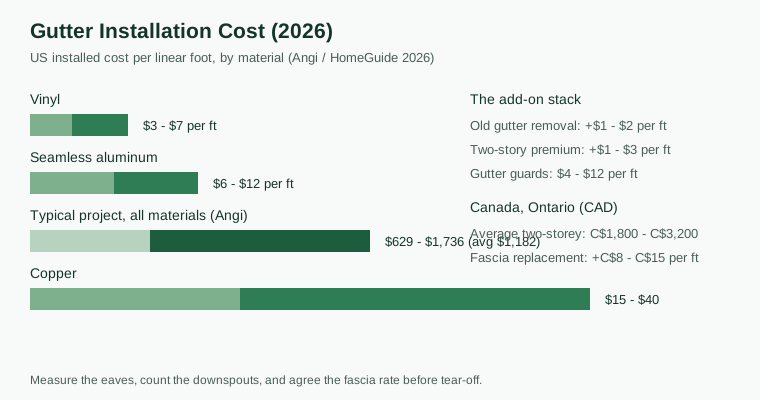
New gutters cost $5 to $15 per linear foot installed for most homes in 2026, or $750 to $2,300 for a onestory house with 150 linear feet (HomeGuide). Angi puts a typical project at $629 to $1,736, averaging about $1,182, with aluminum at $900 to $3,300 and an average near $2,400. This guide shows how to measure eaves footage, prices each material per foot and per year of service life, works a full 160foot replacement quote, separates the addons (removal, guards, fascia repair, downspouts), explains 5inch vs 6inch sizing, covers Ontario pricing in CAD, and ends with a 12point quote checklist.
Quick Checks
- 1Budget $5 to $15 per linear foot installed for most gutter materials in 2026 (HomeGuide). A one-story house with 150 linear feet of eaves runs $750 to $2,300. Angi's typical project is $629 to $1,736, averaging about $1,182.
- 2Measure eaves, not roof area and not floor area. Add the length of every roof edge that will carry a gutter, then count downspouts separately. Most homes carry 100 to 200 linear feet of gutter and 4 to 5 downspouts (HomeGuide).
- 3Seamless aluminum is the default buy for most houses: $6 to $12 per linear foot installed (HomeGuide), a 20 to 30 year service life, and no seams along a run to leak. Sectional aluminum at $4 to $8 per foot is cheaper and leaks at its joints sooner.
- 4Replacement costs more than first installation by design: old gutter removal adds $1 to $2 per linear foot (HomeGuide), and a two-story house adds another $1 to $3 per foot for ladder and safety work. A replacement quote priced like a new install has left something out.
- 5Gutter guards can cost as much as the gutters. At $4 to $12 per linear foot installed (HomeGuide), guards on 160 feet add $640 to $1,920. Price them as their own decision, on the runs under trees, not as a reflex add-on for the whole house.
Gutter Installation Cost 2026: What New Gutters Really Cost
By EnergyBS Editorial Team | October 14, 2026
The Short Answer
Short Answer: New gutters cost $5 to $15 per linear foot installed for most materials in 2026, or $750 to $2,300 for a one-story house with 150 linear feet of eaves (HomeGuide). Angi puts a typical project at $629 to $1,736, averaging about $1,182, and prices aluminum on its own at $900 to $3,300, averaging about $2,400, because aluminum jobs skew to larger, smooth systems. Material sets the band: vinyl at $3 to $7 per foot, aluminum at $4 to $12, galvanized steel at $5 to $20, and copper at $15 to $40 (Angi and HomeGuide, 2026 guides). Replacement adds $1 to $2 per foot for removing the old system, and guards, fascia repair, and extra downspouts are separate decisions with separate prices.
Gutters are the cheapest water-management system on the house and the one whose failure costs the most per dollar spent. A gutter has one job: catch roof water at the eave and deliver it to a downspout that discharges away from the foundation. When it sags, leaks at the seams, or overflows, that water lands against the basement wall, behind the siding, and under the roof edge instead. This site covers gutters for the same reason it covers basement waterproofing: the eavestrough and the foundation are two ends of the same pipe, and the eavestrough end is far cheaper to fix.
1. Measure the Eaves, Then Count the Downspouts
Gutters are priced by the linear foot of eave, and the measurement is one you can do from the ground with a tape, a phone photo of each elevation, and ten minutes.
- Walk the perimeter and mark which edges get gutters. Gutters hang on eaves, the horizontal lower edges of the roof. Rakes (the sloped edges on gable ends) do not carry gutters. Most houses gutter the front and back; houses with hip roofs gutter all four sides.
- Measure each run's length. Add dormer eaves and porch roofs that drain onto the main system or need their own downspout.
- Count corners. Every outside corner is a miter piece and labor. A rectangular ranch has four; a cut-up roofline can have a dozen, and corners are why two houses with the same footage get different quotes.
- Count and locate downspouts. Plan roughly one downspout per 30 to 40 feet of gutter run (HomeGuide). Most homes end up with 4 to 5. Note where each one discharges: a downspout that dumps at the foundation corner has moved the problem, not solved it.
- Note the stories. Measure the drop from eave to grade at each downspout. Height drives both downspout length and the labor premium in section 4.
Most homes land between 100 and 200 linear feet of gutter (HomeGuide). If your count comes in far outside that band, remeasure before you shop; a 300-foot count on a 1,600 square foot house usually means rake edges got included.
2. Cost by Material, Per Linear Foot
| Material | Installed per linear foot | Service life | Notes |
|---|---|---|---|
| Vinyl (PVC) | $3 to $7 (Angi); up to $17 in some HomeGuide tables | 10 to 20 years | Cheapest ticket, shortest life, brittle in deep cold |
| Aluminum, sectional | $4 to $8 (HomeGuide) | 20 to 30 years | Pre-cut lengths joined on site; seams are the weak point |
| Aluminum, smooth | $6 to $12 (HomeGuide); $7 to $13 (Angi) | 20 to 30 years | Formed on site to the exact run length; the standard pro install |
| Galvanized steel | $5 to $20 (Angi); $6 to $17 (HomeGuide) | 15 to 20 years | Strong, heavy, rusts once the coating fails |
| Galvalume steel | $8 to $25 (HomeGuide) | 20 to 40+ years | Aluminum-zinc coated steel, longer clock than galvanized |
| Zinc | $15 to $30 (Angi); $16 to $27 (HomeGuide) | 30 to 80 years | Premium metal, self-healing patina, specialist install |
| Copper | $15 to $40 (HomeGuide and Angi) | 50 to 100 years | The lifetime material; smooth copper runs $30 to $50 per foot |
| Wood | $20 to $32 (Angi) | Varies with upkeep | Historic-house specialty work, priced like it |
Two patterns in the table matter more than any single band. First, aluminum owns the middle for a reason: it does not rust, it is light enough for one crew to hang long smooth runs, it takes factory color, and its 20 to 30 year life matches a typical roof cycle. Second, the per-foot spread inside one material is mostly geometry and height, not brand. The same smooth aluminum run is $6 per foot on a one-story rectangle and $12 per foot on a two-story house with eight corners and a steep lot, because the crew, ladder work, and miter count differ.
Profile is the other choice hiding inside the band. K-style (the flat-back profile with a stepped face) is the default on houses built in the last 50 years, installs against flat fascia, and moves more water than a half-round of the same width. Half-round is the traditional profile some historic districts require; it hangs on brackets, costs more to install, and is the usual partner for copper and zinc. Fascia-style gutters, built into the eave as one piece, sit at the top of the custom range Angi publishes at $6 to $40 per foot.
3. A Worked Quote: 160 Feet of smooth Aluminum, Replacement
Per-foot bands stay abstract until they meet one house. Hypothetical example: a one-story house, 160 linear feet of eaves, five downspouts, old aluminum gutters coming off, sound fascia, no guards. Every rate below comes from the published bands in sections 2 and 4.
| Line | Basis | Low | High |
|---|---|---|---|
| smooth aluminum installed, 160 ft | $6 to $12 per ft (HomeGuide) | $960 | $1,920 |
| Old gutter removal and disposal | $1 to $2 per ft (HomeGuide replacement adder) | $160 | $320 |
| Downspout work if priced separately | $30 to $75 each x 5 (HomeGuide) | $150 | $375 |
| Replacement total, no guards, sound fascia | $1,270 | $2,615 |
Read the total against the published anchors. Angi's all-material typical range is $629 to $1,736 with an average near $1,182, and its aluminum-specific range is $900 to $3,300 with an average near $2,400. The worked quote sits between them, which is where a mid-size smooth aluminum replacement should sit: above the vinyl-heavy all-material average, inside the aluminum band. Angi also advises budgeting $700 to $1,700 for old gutter removal and gutter guards combined on an aluminum job, which brackets the removal line above plus a partial-guard decision.
Two quote structures hide in the table, and you need to know which one you are holding. HomeGuide's aluminum installed price includes gutters, downspouts, hangers, and labor, so on that structure the downspout line is already inside the per-foot rate and should not appear again. Other installers price downspouts per piece. Neither structure is wrong; a quote that charges both the inclusive per-foot rate and a per-piece downspout line is.
The swing lines are not in the base table. Guards at $4 to $12 per foot would add $640 to $1,920 to this house, nearly doubling the low end. Fascia rot found at tear-off, priced at $4 to $22 per foot for fascia or soffit replacement (HomeGuide), adds $80 to $440 for a typical 20-foot rotten stretch. Section 5 prices both decisions properly.
4. The Add-On Stack
- Removal and disposal. Replacement adds $1 to $2 per linear foot over first installation because the old system has to come down and go to disposal (HomeGuide). Priced flat, removal and disposal averages $150 to $300. Confirm the quote includes hauling; old gutters left in the driveway are a disposal fee transferred to you.
- Second-story premium. A two-story house adds $1 to $3 per linear foot for the extra ladder work, safety equipment, and longer downspouts (HomeGuide). On 160 feet that is $160 to $480, and it is legitimate. A two-story quote with no height premium has usually priced the footage and forgotten the building.
- Downspouts. $30 to $75 each installed, or $220 to $625 to replace 4 to 5 on a typical house; new downspouts in vinyl or aluminum run $2 to $4 per linear foot installed (HomeGuide). Copper and zinc downspouts run $10 to $34 per foot, which is why premium-metal quotes itemize them.
- Extensions and drainage. A downspout that ends at the foundation needs an extension or a buried drain. Burying a downspout line runs $150 to $350 each (HomeGuide). Splash blocks are the cheap partial answer; a buried line to daylight or a dry well is the real one, and it belongs in the same conversation as the sump pump and waterproofing system it feeds or relieves.
- Drip edge / gutter apron. $1.50 to $3.00 per linear foot installed (HomeGuide). This small flashing strip sends roof water into the gutter instead of behind it. On a re-roof it is part of the roofing scope; on a gutter-only job, ask whether the existing drip edge is sound.
- Fascia and soffit repair. $4 to $22 per linear foot for fascia or soffit replacement, $9 to $34 per foot to replace the full eave assembly (HomeGuide). Gutters hang from fascia; a gutter hung on rotten fascia is a gutter scheduled to sag. This is the most common legitimate change order in gutter work, and section 8 turns it into an agreed rate before tear-off instead of a surprise after it.
- Cleaning and repair, for comparison. Professional cleaning runs $100 to $250, and typical repairs run $100 to $450 (HomeGuide). Those numbers are the repair column of the section 6 decision; a system that needs a $450 repair every second year has already made the replacement argument.
Labor structure explains the rest of the spread between quotes. Angi puts a gutter pro at about $75 per hour and the professional share of a project at 10 to 50 percent of the total, which is a wide band because a smooth crew with a forming machine on the truck is selling a different hour than a handyman hanging sectional lengths. Angi also notes that only a small share of gutter jobs are urgent (storm damage, active leaks), and flexible scheduling avoids rush pricing; fall is the busy season for exactly the reason you are reading this in October.
5. Sizing: 5-Inch vs 6-Inch, and Where Guards Fit
Width. The standard residential gutter is 5-inch K-style. A 6-inch gutter carries a larger cross-section of water and pairs with larger downspouts (3x4 inch instead of 2x3 inch). Upsizing is the fix for a specific symptom: gutters that overflow in hard rain despite being clean and correctly pitched. Overflow with clean gutters means the system is undersized for the roof plane draining into it, which happens with large roof areas, steep pitches that deliver water fast, long runs between downspouts, and valleys that concentrate two planes into one corner. Houses in regions with frequent heavy rain can pay up to 50 percent more for these larger, heavier-duty systems (Angi). If the current gutters overflow only when clogged, cleaning and pitch correction are the fix, and a wider gutter just holds more leaves.
Pitch. A gutter is a very shallow flume. It must slope toward its downspout, gently enough to look level and steadily enough that water does not pond. Ponded water is weight, mosquito habitat, and seam corrosion, and it is an installation defect, not a maintenance issue. This is the single strongest argument for professional installation: setting a continuous fall over a 40-foot run, from a ladder, is the skill the labor rate buys.
Guards. Gutter guards cost $4 to $12 per linear foot installed, or $570 to $1,530 for 150 to 200 feet (HomeGuide); premium leaf-filter systems price higher. Guards reduce how often a gutter clogs; they do not eliminate cleaning, and no guard fixes overflow caused by undersizing or bad pitch. The rational pattern is partial: guard the runs directly under trees, leave open runs open and easy to clean. Guarding every foot of a treeless elevation buys nothing. One cold-climate caution, stated plainly because it is often sold backwards: guards do not prevent ice dams. Ice dams form at the eave when heat escaping from the attic melts roof snow that refreezes at the cold edge, and the fix is air sealing and insulation in the attic, covered in our ice dam prevention guide. A guard can hold its own layer of ice and debris at the edge; it cannot cool your roof.
6. Repair or Replace
Angi's lifespan framing sets the first test: gutters last roughly 20 to 50 years depending on material, with most lifetimes at the shorter end, and past about 20 years replacement usually beats repeated repair on cost. HomeGuide's material table sharpens it: vinyl 10 to 20 years, aluminum 20 to 30, galvanized steel 15 to 20. A 22-year-old galvanized system is not an asset with a leak; it is a finished product leaking on schedule.
Repair, at $100 to $450 for typical work (HomeGuide), fits when the damage is local and the system is young: one leaking corner miter, a short section bent by a ladder, a loose downspout, a single sagging run whose fascia is sound. Cleaning at $100 to $250 fits when the symptom is overflow and the troughs are full of debris.
Replace when the failures are systemic: seams leaking along every run on a sectional system, rust or cracks in multiple places, gutters pulling away because the fascia behind them is rotten, chronic overflow that sizing math says is a capacity problem, or peeling paint and water staining on the siding below the eaves, which means water has been going behind the system for a while. Sagging deserves its own sentence: a sagging gutter over damaged fascia is the classic repair-that-cannot-work, because new fasteners in rotten wood hold until the first full trough of water. Replace the fascia section and the gutter together.
Sequence a replacement with roof work when both are due. Gutters come off for a roof replacement anyway, the drip edge is part of the roof scope, and one mobilization is cheaper than two. A new gutter hung under a roof with five years left will be removed and rehung at the re-roof; price that into the order of operations.
7. Cost per Year: The Ranking That Matters
Divide each material's installed midpoint by the middle of its published service life, using only the Angi and HomeGuide figures from section 2. This is simple division for comparison, stated as such. It leaves out cleaning (similar across materials) and repairs (not similar: sectional seams and galvanized rust generate more of them, which would widen the gaps shown).
| Material | Installed midpoint per ft | Life used | Simple cost per ft per year |
|---|---|---|---|
| Aluminum, smooth | $9.00 ($6 to $12) | 25 years (band 20 to 30) | about $0.36 |
| Copper | $27.50 ($15 to $40) | 75 years (band 50 to 100) | about $0.37 |
| Vinyl | $5.00 ($3 to $7) | 15 years (band 10 to 20) | about $0.33 |
| Zinc | $21.50 ($16 to $27) | 55 years (band 30 to 80) | about $0.39 |
| Galvanized steel | $11.50 ($6 to $17) | 17.5 years (band 15 to 20) | about $0.66 |
The table kills two sales claims at once. Copper is not extravagant on a per-year basis; it roughly matches aluminum, and its real cost is writing one large check instead of three smaller ones over 75 years. Galvanized steel is the risk: mid-table ticket, shortest metal life, and the worst per-year figure by a wide margin. Vinyl wins the check written today and ties on per-year math, and its discount is paid in brittleness, sagging between hangers as it ages, and a second replacement inside the span where aluminum needs one.
For most houses the decision the table supports is the one the market already makes: smooth aluminum, sized to the roof, with the money that copper would have cost redirected to the fascia, downspout drainage, and discharge lines that decide whether any gutter system actually protects the foundation.
8. Canada Pricing (Ontario, CAD)
Canadian eavestrough pricing follows the same structure in Canadian dollars. Custom Contracting's Ontario 2026 guide prices professionally installed smooth aluminum K-style systems by house size:
| Home | Approx. footage | Replacement cost, installed (CAD) |
|---|---|---|
| Small bungalow or semi | 80 to 120 ft | C$1,200 to C$2,000 |
| Average two-storey | 120 to 180 ft | C$1,800 to C$3,200 |
| Larger home | 180 to 250 ft | C$2,800 to C$4,500 |
Fascia replacement, when the board behind the trough is rotten, adds C$8 to C$15 per linear foot on the same guide. Regional spread is real inside one province: the guide notes Greater Hamilton Area and Brantford pricing tends to run below the GTA, with Oakville and Burlington higher on labor. HomeStars, the Canadian contractor marketplace, lists common gutter work at $5 to $15 per linear foot for installation or replacement, small repairs at $150 to $400 per job, cleaning at $100 to $250, guards at $7 to $20 per linear foot, and downspout installation or replacement at $100 to $300 per downspout, which brackets the Ontario guide from the marketplace side.
Two Canada-specific points. First, the vocabulary: the same product is sold as eavestrough in most of Canada, and quotes, listings, and municipal pages use the two terms interchangeably. Second, freeze-thaw and ice loading punish seams and hangers harder than in most US markets, which pushes Canadian buyers toward smooth runs and hidden hangers with screws rather than spike-and-ferrule fastening, and makes the fall installation slot, before the troughs fill with ice, worth booking early.
9. DIY, Timing, and the Limits of Both
Sectional vinyl and aluminum are genuinely sold as DIY products, and a one-story run over a garage or a short porch eave is a reasonable weekend project for someone comfortable on a ladder. The full-house job is different in kind, not just in length. smooth gutters cannot be DIY at all: the forming machine lives on the installer's truck, and the long, joint-free runs are the entire point of the product. Pitch setting over long runs, miter cutting, and two-story ladder work are the other three places DIY systems fail, and all three fail silently, showing up as ponding, leaking corners, and overflow months later.
Angi's list of what a homeowner can usefully do around a pro install is the better division of labor: measure the runs in advance so quotes can be checked against your own count, clear patio furniture, grills, and overhanging branches from the work area, and haul the old gutters yourself if you have a vehicle, converting the $150 to $300 removal-and-disposal average into your own Saturday. Those contributions buy down real line items without putting you on the ladder for the skilled parts.
Timing is a modest lever. Gutter crews are busiest in fall, when leaves make every clog visible, and in the spring thaw. Off-season scheduling can soften price and shorten the wait, but a system that is overflowing against the foundation now is not a candidate for a three-month delay to save a small percentage; the water damage it prevents is the expensive line in this whole guide, and it accrues monthly.
10. The 12-Point Quote Checklist
Compare gutter quotes line by line. A complete quote names:
- The measured eaves footage, run by run, so the per-foot rate can be checked against your own count from section 1.
- Material and gauge or thickness, profile (K-style or half-round), and width (5-inch or 6-inch), by product line and color.
- smooth or sectional, stated plainly. On a smooth quote, the runs that will still have seams (corners, short returns) should be identified.
- Downspouts: count, size (2x3 or 3x4 inch), placement, and whether they are inside the per-foot price or charged per piece ($30 to $75 each, HomeGuide), never both.
- Discharge: where each downspout ends, extension length, or buried drain lines at $150 to $350 each, with the discharge point a real distance from the foundation.
- Removal: old gutters stripped and hauled, priced in ($1 to $2 per foot or the $150 to $300 flat average), not left as your problem.
- Fascia condition and the agreed per-foot repair rate ($4 to $22 per foot; C$8 to C$15 in Ontario) set before tear-off, so a rotten stretch is a rate, not a negotiation.
- Hangers: type (hidden hangers with screws preferred over spikes) and spacing, because hanger spacing is what keeps a full trough from sagging in year eight.
- Pitch and warranty against ponding: the installer stands behind the fall of the runs, in writing.
- Guards, if any: product, which runs are covered and which are deliberately left open, and the per-foot price ($4 to $12 typical) as a separable line you can decline without repricing the base job.
- Warranty split: material warranty from the manufacturer, workmanship warranty from the installer, and what each excludes.
- Payment schedule tied to completion, with the final payment after a hose test or the first rain shows every run draining to its downspout.
A quote missing lines 1, 4, 5, and 7 is not a cheaper version of a complete quote. It is an undefined drainage system, and undefined systems get defined at change-order prices.
Frequently Asked Questions (FAQ)
How much does it cost to install new gutters in 2026?
HomeGuide puts general installation at $5 to $15 per linear foot installed, or $750 to $2,300 for a one-story home with 150 linear feet. Angi's typical project runs $629 to $1,736, averaging about $1,182 across materials, with aluminum specifically at $900 to $3,300 and an average near $2,400. By material: vinyl $3 to $7 per foot, smooth aluminum $6 to $12, galvanized steel $5 to $20, copper $15 to $40. Replacement adds $1 to $2 per foot for removing the old system.
How many linear feet of gutters does a house need?
Most homes carry 100 to 200 linear feet (HomeGuide). Measure only the eave edges that will hold gutters, not the sloped gable edges, and add dormer and porch eaves. Plan on one downspout per 30 to 40 feet of run, which lands most houses at 4 to 5 downspouts. A count far outside the 100 to 200 foot band usually means rake edges were measured by mistake.
Are smooth gutters worth the extra cost?
On the HomeGuide bands, smooth aluminum at $6 to $12 per foot costs about $2 to $4 more per foot than sectional at $4 to $8. What the premium removes is every seam along a run, and seams are where gutters leak, catch debris, and start clogs. Over a 20 to 30 year aluminum life, the per-year cost of smooth (about $0.36 per foot per year at the midpoint) is close to vinyl's, without vinyl's brittleness. For a one-story outbuilding, sectional is a fair economy; for the house itself, smooth is the standard recommendation in this guide.
How much do gutter guards add?
Guards cost $4 to $12 per linear foot installed on HomeGuide's figures, $570 to $1,530 for 150 to 200 feet, with premium leaf-filter systems higher and HomeStars listing Canadian guard work at $7 to $20 per foot. On a 160-foot house, full guard coverage can nearly double the low end of the gutter quote. Guard only the runs under trees, keep cleaning on the calendar anyway, and do not buy guards as an ice dam fix; ice dams are an attic air-sealing and insulation problem.
Should I get 5-inch or 6-inch gutters?
Start with 5-inch K-style, the residential standard. Move to 6-inch with 3x4 downspouts when the existing 5-inch system overflows while clean and correctly pitched, which points to a large or steep roof plane, a long run, or a valley concentrating water. Angi notes heavy-rain regions can pay up to 50 percent more for these larger systems. If the overflow happens only when the troughs are full of leaves, the fix is cleaning or guards, not width.
How long do gutters last?
By material (HomeGuide): vinyl 10 to 20 years, aluminum 20 to 30, galvanized steel 15 to 20, galvalume 20 to 40 or more, zinc 30 to 80, and copper 50 to 100. Angi's general framing is 20 to 50 years with most systems at the shorter end. Life assumes the gutters are cleaned, the pitch holds, and the fascia behind them stays dry and sound; a premium material hung on rotten fascia will not reach its band.
How much does eavestrough replacement cost in Canada?
Custom Contracting's Ontario 2026 guide prices smooth aluminum K-style replacement in CAD at C$1,200 to C$2,000 for a small bungalow or semi (80 to 120 feet), C$1,800 to C$3,200 for an average two-storey home (120 to 180 feet), and C$2,800 to C$4,500 for a larger home (180 to 250 feet), with fascia replacement adding C$8 to C$15 per foot. HomeStars lists common Canadian gutter installation or replacement at $5 to $15 per linear foot. GTA labor runs above smaller Ontario markets on the same work.
Should I repair or replace my gutters?
Repair at $100 to $450 (HomeGuide) when the problem is local and the system is well inside its service life: one leaking miter, one bent section, one loose downspout. Replace when seams leak along multiple runs, rust or cracks appear in several places, the gutters are pulling away from rotten fascia, or the system is past its material's expected life (about 20 years for galvanized and vinyl at the top of their bands, 20 to 30 for aluminum). Repeated $450 repairs on a finished system cost more than the replacement they are postponing.
What should I read next before deciding?
Price the connected water work in the same pass: the roof replacement cost guide for the eave and drip edge your gutters hang under, the siding replacement cost guide for the wall that overflow water stains, the basement waterproofing cost guide for where downspout discharge has to go, and the ice dam prevention guide before anyone sells you a gutter product as an ice dam cure.
Prices in this guide are planning ranges from the published 2026 sources cited above, not quotes for your house. Footage, material, height, corners, fascia condition, and local labor decide the final figure. Measure your own eaves before the first quote arrives, agree the fascia rate before anything comes down, and make the last payment only after water has run through the new system and left through the downspouts, away from the foundation.
What to Read Next
Roof Replacement Cost 2026: What Installation Really CostsUse this next to compare the cost, incentive, installation, or operating-risk angle before you make a home energy decision.Sources and Verification
- Angi How Much Does Gutter Installation Cost? [2026 Data], updated July 9, 2026 (typical project $629 to $1,736, average about $1,182; $4 to $40 per linear foot across materials; material bands per linear foot: vinyl $3 to $7, aluminum $3 to $15, galvanized $5 to $20, copper $15 to $40, zinc $15 to $30, wood $20 to $32; custom gutters $6 to $40 per foot; pro labor about $75 per hour; pro share 10 to 50 percent of project cost; gutter lifespan roughly 20 to 50 years with most on the shorter end; heavyrain regions can pay up to 50 percent more for larger systems)
- Angi How Much Does It Cost to Install Aluminum Gutters? [2026 Data], updated October 9, 2026 (aluminum installation $900 to $3,300, average $2,400, at $7 to $13 per linear foot; length table at $7 to $12 per foot: 50 ft $350 to $600, 100 ft $700 to $1,200, 150 ft $1,050 to $1,800, 200 ft $1,400 to $2,400; budget $700 to $1,700 extra for old gutter removal and gutter guards combined)
- HomeGuide 2026 Aluminum Gutter Installation Costs (aluminum $4 to $12 per linear foot installed; average project $600 to $1,800, national average $1,200; sectional $4 to $8 per foot, smooth $6 to $12 per foot; length table: 100 ft $400 to $1,200, 150 ft $600 to $1,800, 200 ft $800 to $2,400, 300 ft $1,200 to $3,600; most homes have 100 to 200 linear feet; installed price includes gutters, downspouts, and labor)
- HomeGuide Gutter installation FAQ and cost data published across its 2026 gutter guides (general installation $5 to $15 per linear foot installed, $750 to $2,300 for a onestory home with 150 linear feet; replacement adds $1 to $2 per foot for old gutter removal; a twostory house adds $1 to $3 per foot; gutter guards $4 to $12 per foot installed or $570 to $1,530 for 150 to 200 feet; gutter cleaning $100 to $250; repairs $100 to $450; lifespans: vinyl 10 to 20 years, aluminum 20 to 30, galvanized steel 15 to 20, galvalume 20 to 40+, copper 50 to 100, zinc 30 to 80)
- HomeGuide 2026 Cost to Install Vinyl (PVC) Gutters and downspout cost guides (old gutter removal and disposal $150 to $300 on average; fascia or soffit replacement $4 to $22 per linear foot, full eave replacement $9 to $34 per foot; drip edge / gutter apron $1.50 to $3.00 per foot installed; downspouts $30 to $75 each installed, $220 to $625 to replace 4 to 5, new downspouts $2 to $4 per linear foot for vinyl and aluminum; most homes need 4 to 5 downspouts, about one every 30 to 40 feet of gutter)
- HomeGuide 2026 Copper Gutters Cost (copper $15 to $40 per linear foot installed, $2,200 to $6,000 on average; sectional copper $15 to $30 per foot, smooth copper $30 to $50 per foot; materials alone $12 to $30 per foot, labor $3 to $10 per foot)
- Custom Contracting (Ontario) When to Replace Your Eavestroughs, Ontario 2026 cost guide for professionally installed smooth aluminum Kstyle eavestroughs in CAD: small bungalow or semi, 80 to 120 ft, C$1,200 to C$2,000; average twostorey home, 120 to 180 ft, C$1,800 to C$3,200; larger home, 180 to 250 ft, C$2,800 to C$4,500; fascia replacement adds C$8 to C$15 per linear foot; Greater Hamilton Area and Brantford tend to price below the GTA, Oakville and Burlington above)
- HomeStars (Canada) Gutter and eavestrough contractor pricing (common gutter jobs: installation or replacement $5 to $15 per linear foot, small repairs $150 to $400 per job, cleaning $100 to $250, gutter guard or leaf protection $7 to $20 per linear foot, downspout installation or replacement $100 to $300 per downspout)
Editorial Review
EnergyBS Editorial Team
EnergyBS publishes practical homeowner guides. Important program, product, and cost claims should be checked against the linked source and local project documents before you commit to work.
Related Guides
View All ArticlesRoof Replacement Cost 2026: What Installation Really Costs
Replacing a roof in 2026 costs $9,609 on average in the US (Angi 2026 data), with asphalt shingles at $3 to $5 per square foot installed and standingseam metal at $9 to $16. This guide prices every common material by the square, separates tearoff and decking lines from the headline number, works through the asphaltvsmetal lifetime math, and covers the energy side: coolroof reflectance, attic ventilation, and Canada pricing.
Siding Replacement Cost 2026: What Installation Really Costs
Replacing house siding costs $5,554 to $17,721 for a typical US project in 2026, averaging about $11,588 (Angi, updated October 2026). Per square foot of wall, HomeGuide prices vinyl installed at $4 to $12, fiber cement at $6 to $15, engineered wood at $7 to $12, and stucco at $7 to $17. This guide shows how to measure wall area (not floor area), works a full quote for 1,800 square feet of wall, prices removal, labor, permits, and the insulation addon that only makes sense while the walls are open, compares cost per year of service life, covers Canada pricing in CAD, and ends with a 12point quote checklist.
Basement Waterproofing Cost 2026: What Installation Really Costs
Waterproofing a basement in 2026 averages $5,239 in the US (Angi, updated July 2026), with most homeowners paying $2,461 to $8,201. This guide prices every method: crack injection at $250 to $800+ per crack, interior drains at $4,000 to $17,000, exterior membranes at $100 to $300 per linear foot in Canada, and the fullsystem math that moves quotes past $15,000. Includes interiorvsexterior decision logic, Canada pricing, rebates, and a 13point quote checklist.