Siding Replacement Cost 2026: What Installation Really Costs
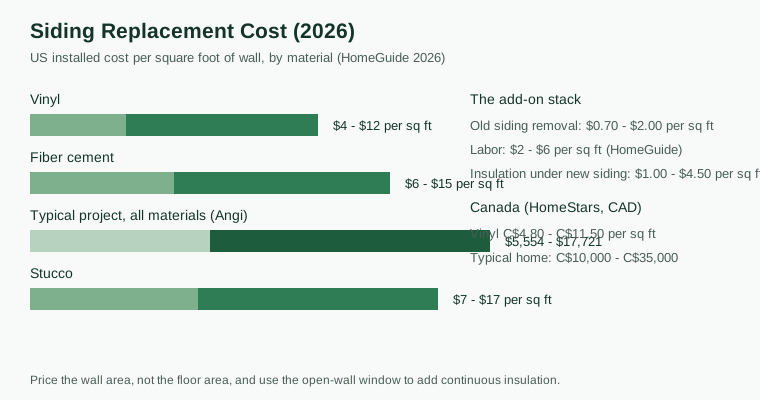
Replacing house siding costs $5,554 to $17,721 for a typical US project in 2026, averaging about $11,588 (Angi, updated October 2026). Per square foot of wall, HomeGuide prices vinyl installed at $4 to $12, fiber cement at $6 to $15, engineered wood at $7 to $12, and stucco at $7 to $17. This guide shows how to measure wall area (not floor area), works a full quote for 1,800 square feet of wall, prices removal, labor, permits, and the insulation addon that only makes sense while the walls are open, compares cost per year of service life, covers Canada pricing in CAD, and ends with a 12point quote checklist.
Quick Checks
- 1Budget about $11,588 as the US average for a siding replacement in 2026 (Angi). Most projects land between $5,554 and $17,721. Per square foot of wall, the all-in band across common materials is $4 to $13 (HomeGuide).
- 2Price wall area, not floor area. Siding covers the exterior walls minus windows and doors, and it is sold by the square, meaning 100 square feet of coverage. A 2,000 square foot house often carries 1,600 to 2,200 square feet of wall, and quotes built on floor area mislead in both directions.
- 3Removal is a separate line, not a rounding error: $0.70 to $2.00 per square foot to strip and dispose of the old siding (HomeGuide). On 1,800 square feet of wall that is $1,260 to $3,600. A quote with no removal line has either buried it in the unit price or plans to side over the old material.
- 4A re-side is the one cheap moment to add continuous insulation. The walls are open once in a generation. Insulation work under new siding runs $1.00 to $4.50 per square foot (HomeGuide), and insulated siding itself is recognized by the US Department of Energy and the EPA as continuous insulation that cuts thermal bridging through studs.
- 5Fiber cement costs more per foot and less per year. At HomeGuide midpoints, vinyl at $8 per square foot over a 35-year life runs about $0.23 per square foot per year; fiber cement at $10.50 over a 62-year mid-band life runs about $0.17. The cheap ticket and the cheap decade are different purchases.
Siding Replacement Cost 2026: What Installation Really Costs
By EnergyBS Editorial Team | October 14, 2026
The Short Answer
Short Answer: A siding replacement costs $5,554 to $17,721 for a typical US project in 2026, averaging about $11,588 for materials and installation (Angi, updated October 9, 2026). HomeGuide prices the same work per square foot of wall: $4 to $13 all-in across common materials, with vinyl installed at $4 to $12, fiber cement at $6 to $15, engineered wood at $7 to $12, cedar and wood at $5 to $16, and stucco at $7 to $17. Material is the biggest single choice, but the quote is built from wall area, removal, labor, trim, and one decision this site cares about more than most: what goes under the new siding while the wall is open.
Siding is the largest single surface on most houses and the layer that takes the weather so the structure does not have to. It is also, for energy purposes, a rare opening. The wall assembly behind it (sheathing, house wrap, flashing, and any exterior insulation) is reachable only during a re-side or a major repair. Homeowners who treat the project as a color change spend the money and keep the same drafts and cold stud lines. Homeowners who treat it as an envelope project spend a bit more per foot and fix problems that are otherwise locked inside the wall for 30 to 50 years. This guide prices both versions.
1. Measure the Wall, Not the Floor
Every siding number in this guide is per square foot of wall, and that unit causes more budgeting errors than any material choice. Floor area and wall area are different numbers. A 2,000 square foot two-story house has a small footprint and tall walls; a 2,000 square foot ranch spreads the same floor over a long, low perimeter. Their siding bills differ by thousands of dollars.
The measurement a contractor makes, and the one you can check with a tape and a ladder-free afternoon:
- Perimeter times height, per wall. Measure each exterior wall's length and its height from the base of the siding to the eaves. Multiply and add the walls together.
- Add the gables. A triangular gable is half its base times its height. Two gable ends on a simple house add a few hundred square feet that flat-wall math misses.
- Subtract the openings. Windows and doors come out. A standard door is about 21 square feet; windows vary, so measure the ones you have. Contractors often subtract only large openings and price the cutting and trim work around small ones into the unit rate, which is legitimate if it is stated.
- Convert to squares. Siding is sold and quoted by the square, one square being 100 square feet of coverage. 1,800 square feet of wall is 18 squares. A quote that arrives in squares and a quote that arrives per square foot are the same quote once you divide by 100.
Expect a waste and complexity allowance on top of net area. Corners, dormers, bay windows, and multiple short walls mean more cuts and more offcuts than one long rectangle. Simple boxes price at the bottom of each material band; cut-up elevations price at the top, and Angi makes the same point from the labor side: the home's shape, number of stories, and design details raise labor time because crews make more cuts.
2. Cost by Material
HomeGuide's 2026 table is the cleanest published breakdown because it separates the installed per-foot price from the whole-house total and the service life:
| Material | Installed per sq ft (HomeGuide 2026) | Total, 2,500 sq ft house (HomeGuide) | Lifespan |
|---|---|---|---|
| Vinyl | $4 to $12 | $10,000 to $30,000 | 30 to 40 years |
| Aluminum | $6 to $10 | $15,000 to $25,000 | 25 to 40 years |
| Fiber cement | $6 to $15 | $15,000 to $37,500 | 50 to 75 years |
| Engineered wood | $7 to $12 | $12,500 to $37,500 | 30 to 50 years |
| Cedar | $6 to $16 | $15,000 to $40,000 | 20 to 40 years |
| Wood and log | $5 to $15 | $12,500 to $37,500 | 20 to 40 years |
| Steel | $7 to $16 | $17,500 to $40,000 | 40 to 70 years |
| Stucco | $7 to $17 | $17,500 to $42,500 | 50 to 80 years |
| Brick | $8 to $18 | $20,000 to $45,000 | 100+ years for real brick |
Angi's per-foot bands run a touch lower for the two volume materials (vinyl at $3 to $12, fiber cement at $5 to $14), and its head-to-head comparison puts average total project costs at about $12,205 for vinyl and about $14,870 for fiber cement. The two sources agree on the structure of the market even where their bands differ by a dollar: vinyl is the low ticket, fiber cement is the mid ticket with the long clock, and masonry and stucco are premium projects with premium lifespans.
Three readings of the table matter more than the bands themselves. First, the totals assume 2,500 square feet of house, and your wall area from section 1 is the number to multiply, not the floor plan figure. Second, grade moves price inside a band as much as material moves it between bands: thicker, premium-grade panels can run up to twice the price of builder-grade panels in the same material, with better fade resistance and impact performance (HomeGuide). Third, stone at $10 to $45 per square foot is normally an accent material for part of one elevation, not a whole-house cladding, and quotes that price it wall-to-wall should be read as design statements, not defaults.
3. A Worked Quote: 1,800 Square Feet of Wall
Per-foot bands stay abstract until they are run against one house. Hypothetical example: a two-story house with 1,800 square feet of net wall area (18 squares) after openings are subtracted, old vinyl coming off, straightforward access, no rot found under the old siding. Every input below comes from the published bands in sections 2 and 4.
| Line | Basis | Low | High |
|---|---|---|---|
| Vinyl installed, 1,800 sq ft | $4 to $12 per sq ft (HomeGuide) | $7,200 | $21,600 |
| Same wall in fiber cement | $6 to $15 per sq ft (HomeGuide) | $10,800 | $27,000 |
| Old siding removal and disposal | $0.70 to $2.00 per sq ft (HomeGuide) | $1,260 | $3,600 |
| Permit | $30 to $200 (HomeGuide); $150 to $1,500 (Angi) | $30 | $1,500 |
| Insulation under the new siding (optional) | $1.00 to $4.50 per sq ft (HomeGuide) | $1,800 | $8,100 |
Read the build as a structure test. The vinyl job with removal and a mid-range permit lands roughly between $8,500 and $25,000 depending on grade and complexity, which brackets Angi's $5,554 to $17,721 typical range once you remember that Angi's range includes smaller and partial projects. The two judgment calls are the insulation line and the grade inside the vinyl band. A quote at $21,600 for vinyl alone needs to name what the top of the band buys: premium thickness, insulated panels, difficult elevations, or scaffolding on a three-story wall. A quote under the low end for the full scope has usually dropped removal, trim, or the permit, and section 10 prices what those omissions become later.
One number in the table deserves a second look. The insulation line, at $1,800 to $8,100 on this house, is the only line that pays anything back. Sections 5 and 8 separate what it can and cannot do.
4. The Cost Stack Under the Unit Price
HomeGuide splits a siding project into materials and supplies at $2 to $7 per square foot and labor at $2 to $6 per square foot, and puts the overall split at 50 to 55 percent materials and 45 to 50 percent labor. Angi's labor figures run lower, at $1 to $4 per square foot or $40 to $75 per hour, against HomeGuide's $40 to $80 per hour. Either way, labor is roughly half the job, which is why the cheapest-material strategy disappoints: halving the material price cuts the total by about a quarter, and the panels still have to be hung by the same crew at the same rate.
The lines that sit outside the unit price:
- Removal and disposal: $0.70 to $2.00 per square foot (HomeGuide). Angi bundles removal and permits at $150 to $1,500 for typical projects and advises confirming in writing that the estimate includes stripping the old siding and hauling the debris, because many contractors leave it out of the first number. Asbestos-containing siding on older houses is a different project entirely, with abatement rules that override every band in this guide; if the existing siding is a cement-asbestos product, stop and get a specialist assessment before anyone prices a tear-off.
- Permits: $30 to $200 on HomeGuide's figures, $150 to $1,500 on Angi's. The gap is geography, not error: permit schedules are municipal. The quote should say who pulls it.
- Repairs found under the old siding. Rotten sheathing, failed house wrap, and damaged trim are invisible until the tear-off. HomeGuide prices small-section siding repair at $2 to $14 per square foot or $200 to $1,100 on average, but sheathing replacement is carpentry priced on discovery. A contingency line in the budget is not pessimism on a 40-year-old wall; it is arithmetic.
- Trim, soffit, and fascia. Corners, J-channel, window and door trim, and soffit work are where vinyl quotes in particular go vague. They belong as named lines, because "siding" alone does not include them by default on every bid.
- Season. HomeGuide notes that contractors charge a premium in their busiest stretch, late spring to mid fall, and Angi points to off-season scheduling as a real, if modest, lever on price and timeline.
5. The Energy Section: The Open-Wall Window
New siding, by itself, barely insulates. A vinyl panel is a rain and wind screen a fraction of an inch thick, and swapping one screen for another changes the wall's heat loss very little. Anyone who sells a re-side as an insulation project on the panel alone is selling the wrong line item. The energy value of a re-side is access, and it comes in three forms, all priced in section 3.
Continuous insulation under the new siding. With the old cladding off, rigid foam or insulated panels can go over the sheathing as one unbroken layer. That continuity is the point. Cavity insulation sits between studs, and the studs themselves conduct heat straight through the wall, a path called thermal bridging. The US Department of Energy's Building Science Education site puts it plainly: both the DOE and the EPA recognize insulated siding as a way to improve a home's energy efficiency, because it reduces thermal bridging and provides continuous insulation. Insulated siding itself is vinyl siding with rigid foam, most commonly expanded polystyrene, laminated or permanently attached to the panel (DOE). The same job can be done with separate foam board under conventional siding, at the $1.00 to $4.50 per square foot insulation band HomeGuide publishes. Our exterior insulation and siding retrofit guide works through the building science of that assembly (drainage plane, flashing, cladding attachment, and how much exterior R-value a cold-climate wall needs) in the depth it requires.
House wrap and air sealing. The tear-off exposes every failed seam, unflashed window head, and cracked penetration in the existing weather barrier. Replacing or repairing the water-resistive barrier and sealing the penetrations while the wall is open costs a fraction of what the same work costs as a standalone project, because the scaffolding, labor, and access are already paid for by the siding job. Water management is the primary job here, not energy, but the air leaks sealed in the same pass are the ones no interior caulking ever reaches.
What not to expect. No source cited in this guide publishes a percentage energy saving for a re-side, and this guide will not invent one. The saving depends on the existing wall: a 1970s wall with empty or thin cavities and no exterior insulation gains far more from added continuous insulation than a recent wall that already has foam under its cladding. If a quote promises a fixed bill reduction, ask for the wall assembly math behind it. The defensible claim is narrower and still worth money: added continuous insulation reduces heat flow through the wall, the reduction is largest on the worst existing walls, and the installation cost is at its lowest during a re-side because the wall is already open.
Sequence the envelope work as a system. Siding pairs naturally with a window replacement (shared flashing and trim work, one scaffold rental), with a roof replacement at the eaves where the two systems meet, and with attic insulation as the other half of the wall-and-lid envelope. At grade, the same water that siding sheds has to leave the foundation, which is the basement waterproofing problem, not the siding crew's, but the two quotes should at least agree on where the water goes.
6. The Materials, One by One
Vinyl is the default because it is the cheapest installed panel that needs almost no upkeep: no painting, no sealing, and a 30 to 40 year service life (HomeGuide). Its failure modes are impact cracks in deep cold, fading on sun-beaten elevations, and warping when it is nailed too tight to move with temperature. Grade matters inside the material: thickness and formulation separate the $4 foot from the $12 foot more than brand does. Insulated vinyl, with its foam backing, adds rigidity and the continuous-insulation benefit from section 5 at the upper part of the band.
Fiber cement is the step up in durability and the step down in convenience. It resists fire, insects, and moisture, holds paint far longer than wood, and lasts 50 to 75 years (HomeGuide). Angi's comparison notes it resists fire and weather better than vinyl, while vinyl installs easier and asks for less maintenance. The costs hide in the handling: the boards are heavy, cutting them needs dust control, and the installed price reflects two-person crews. Plan on repainting over a long ownership even though the boards themselves outlast the paint by decades.
Engineered wood splits the difference: wood fiber formed into boards that look like cedar, at $7 to $12 installed and a 30 to 50 year life (HomeGuide). It is lighter than fiber cement and easier to cut, and its maintenance burden sits between vinyl and real wood.
Wood and cedar buy appearance with upkeep. At $5 to $16 installed depending on species and style, and a 20 to 40 year life, the real price includes repainting or restaining on a cycle and prompt repair of any failed coating, because wood siding that loses its finish takes on water. Cedar insulates a bit better than most cladding and resists decay naturally, but it is the most fire- and moisture-sensitive of the common choices (HomeGuide).
Aluminum and steel are the metal pair. Aluminum at $6 to $10 installed is light, insect-proof, and fire-resistant, but it dents, and HomeGuide notes it is not as energy efficient as vinyl or steel. Steel at $7 to $16 is the durable one, 40 to 70 years, with concealed-fastener standing seam panels at $10 to $16 giving the cleanest weather seal. Metal panels over foam are a legitimate cold-climate assembly; metal panels alone are a screen, same as vinyl.
Stucco, brick, and stone are masonry projects wearing a siding label. Stucco at $7 to $17 lasts 50 to 80 years and suits dry climates better than wet ones. Brick at $8 to $18 can pass 100 years, and may need a concrete brick ledge to carry it. These are the right answers for specific houses and regions, and the wrong frame for a like-for-like re-side budget.
7. Repair, Partial Replacement, or Full Replacement
Angi's framework sorts the decision on four tests, and it is a better starting point than age alone:
| Factor | Points to repair | Points to replace |
|---|---|---|
| Repair cost vs replacement cost | Repair under 50 percent of replacement | Repair over 50 percent of replacement |
| Siding age | Under 20 years | Over 20 years |
| Extent of damage | Localized | Widespread |
| Moisture intrusion | Isolated | Widespread |
HomeGuide's repair pricing gives the framework its numbers: a small damaged section runs $2 to $14 per square foot, or $200 to $1,100 on average, with the warning that matching the color of older, faded siding may not be possible. That matching problem is the quiet argument for replacement on visible elevations: a patched front wall reads as a patched front wall, and the per-foot saving buys a permanent two-tone house.
The signs that move a wall from the repair column to the replacement column are mostly water signs: rotting boards or sheathing, cracks and holes that let weather in, warped or buckled panels, bubbling or blistering surfaces, peeling paint that returns quickly (a moisture symptom on wood, not a paint failure), pest damage, and mold or water staining on interior walls (HomeGuide). One energy sign belongs on the list too: rising heating and cooling bills alongside exterior deterioration can mean the wall assembly, not just the cladding, is failing, which is a finding only the tear-off confirms.
Partial replacement, one or two elevations, is the middle option quotes rarely volunteer. The weather side of most houses ages years ahead of the sheltered sides. Replacing the failed elevations now and the sound ones later is a legitimate staging plan if the material and profile are still manufactured, so record the exact product line on the contract either way.
8. Cost per Year: The Ranking That Matters
Installed price ranks these materials by what leaves your account this year. Service life decides what the wall actually costs. Divide each material's installed midpoint by the middle of its published lifespan band, using only the HomeGuide figures from section 2, and the order changes. This is simple division for comparison, stated as such; it leaves out maintenance, which section 6 shows is not evenly distributed either.
| Material | Installed midpoint per sq ft | Lifespan used | Simple cost per sq ft per year |
|---|---|---|---|
| Vinyl | $8.00 ($4 to $12) | 35 years (band 30 to 40) | about $0.23 |
| Fiber cement | $10.50 ($6 to $15) | 62 years (band 50 to 75) | about $0.17 |
| Engineered wood | $9.50 ($7 to $12) | 40 years (band 30 to 50) | about $0.24 |
| Steel | $11.50 ($7 to $16) | 55 years (band 40 to 70) | about $0.21 |
| Stucco | $12.00 ($7 to $17) | 65 years (band 50 to 80) | about $0.18 |
Vinyl still wins the check written today, and for a house being prepared for sale or a tight budget that is the right test. Fiber cement and stucco win the per-year test, which is the right test for a house held for decades. Wood is absent from the table on purpose: its per-year figure looks competitive until the repainting cycle is priced in, and the repaint price varies too much by market to support a credible division here.
Resale sits between the two tests. HomeGuide puts the return on new siding at 75 to 85 percent of project cost on average, and Angi puts it as high as 80 percent. Treat those as ranges across markets, not a promise attached to your house; the recovery is strongest when the old siding was visibly failing and weakest when a sound wall was re-sided for color.
9. Canada Pricing
Canadian pricing follows the same structure in Canadian dollars, with a wider regional spread. HomeStars' national price guide puts replacement on a typical home at $10,000 to $35,000, at these per-square-foot rates:
| Material | Cost per sq ft, CAD (HomeStars) |
|---|---|
| Vinyl | C$4.80 to C$11.50 |
| Aluminum | C$7.20 to C$10.00 |
| CanExel (wood fibre) | C$7.20 to C$12.00 |
| Fiber cement | C$8.40 to C$15.00 |
| Acrylic and stucco | C$9.60 to C$15.00 |
| Engineered wood | C$12.00 to C$18.00 |
| Steel | C$25.20 to C$40.00 |
| Brick or stone | C$27.00 to C$45.00 |
Two Canada-specific notes. First, the insulation-behind-siding upgrade is a priced line in Canadian quotes, not an exotic ask: HomeStars' Toronto guidance puts insulation upgrades behind siding at about C$2 to C$5 per square foot, improving energy efficiency, which matters more per dollar in a heating-dominated climate than anywhere in the US table. Second, freeze-thaw cycles and wind-driven rain punish the layers behind the cladding (house wrap, flashing, and sheathing) harder than the panels themselves, so Canadian tear-off discoveries skew toward barrier and sheathing repairs. Budget the contingency from section 4 at the generous end.
As with any incentive claim in either country, verify program rules with the program itself before counting a rebate in the budget. Envelope measures are eligible under some Canadian retrofit programs in some years, and eligibility turns on audits and product lists that change; a quote that nets out an unnamed credit is a quote to re-read.
10. DIY, Timing, and the Limits of Both
Siding looks like the most DIY-friendly of the big exterior jobs because the panels are light and the tools are ordinary. The work that decides whether the wall survives is not the panel hanging. It is the flashing at every window head and penetration, the house wrap laps, the clearances at grade and at the roof line, and the expansion room vinyl needs to move without buckling. Errors there do not show on completion day; they show as rot inside the wall years later, discovered at the next tear-off.
Angi lists the parts a handy homeowner can take on without touching the weather seal: clearing landscaping and obstacles around the walls, removing old siding and debris ahead of the crew, and measuring walls and planning layouts. Those are real savings, because they buy down crew hours at the $40 to $80 per hour labor band rather than asking you to be the flashing detailer. Full DIY installation makes sense mainly for small, single-story, low-consequence walls (a detached garage, a shed) where a flashing miss costs a repair, not a structural rebuild.
Timing is the other modest lever. Siding is a late-spring-to-mid-fall premium trade in most markets (HomeGuide), and off-season crews are hungrier and sometimes faster. Balance that against material limits: some products and coatings have minimum installation temperatures, and a winter discount that voids a manufacturer's installation spec is not a discount.
11. The 12-Point Quote Checklist
Compare siding quotes line by line. A complete quote names:
- The measured wall area in square feet or squares, with the openings subtracted, so the unit price can be checked against the measurement from section 1.
- Material by product line: manufacturer, profile, thickness or grade, and color, not just "vinyl" or "fiber cement."
- Removal: old siding stripped and debris hauled, priced as its own line ($0.70 to $2.00 per square foot, HomeGuide), or stated as siding-over and why that is safe on this wall.
- The layer stack: house wrap or water-resistive barrier condition and replacement, flashing at windows, doors, and penetrations, each named.
- Insulation: none, insulated panels, or foam board, with the product and its added R-value stated, priced separately ($1.00 to $4.50 per square foot, HomeGuide).
- Trim scope: corners, J-channel, window and door trim, soffit, and fascia, included or excluded, piece by piece.
- Sheathing and rot allowance: the per-sheet or per-hour rate for repairs found at tear-off, agreed before the wall is open.
- Fastening and clearances: the manufacturer's installation spec followed, including vinyl expansion clearances and fiber cement dust control where relevant.
- Permit: who pulls it and its cost, as a line ($30 to $200 on HomeGuide's figures; $150 to $1,500 on Angi's).
- Warranty split: the manufacturer's material warranty (term, and what fades, cracks, or defects it covers) separate from the installer's workmanship warranty.
- Payment schedule tied to milestones (material delivered, tear-off complete, installation complete), never full payment in advance.
- Product record: the exact siding line and color code left with you in writing, so a future partial replacement or repair can match it.
A quote missing lines 1, 3, 4, and 7 is not a cheaper version of a complete quote. It is an undefined wall, and undefined walls get defined at tear-off prices.
Frequently Asked Questions (FAQ)
How much does it cost to replace siding in 2026?
Angi's 2026 data (updated October 9, 2026) puts a typical project at $5,554 to $17,721, averaging about $11,588 for materials and installation. HomeGuide prices the work at $4 to $13 per square foot of wall all-in: vinyl at $4 to $12, fiber cement at $6 to $15, engineered wood at $7 to $12, and stucco at $7 to $17. Removal ($0.70 to $2.00 per square foot), permits, trim, and any insulation work under the new siding sit on top of the bare unit price on many quotes.
How is siding measured and priced?
By wall area, not floor area. Measure each wall's length times its height to the eaves, add the gable triangles at half base times height, subtract windows and doors, and convert to squares, one square being 100 square feet. Every per-square-foot band in this guide multiplies against that wall figure. A 2,000 square foot house commonly carries 1,600 to 2,200 square feet of wall depending on its shape and number of stories.
What is the cheapest siding that is still worth installing?
Vinyl, at $4 to $12 per square foot installed (HomeGuide) with a 30 to 40 year service life and no painting cycle. Masonite-type composites price slightly lower in some tables and carry a maintenance and moisture record that erases the saving. The grade inside vinyl matters: thicker premium panels cost up to twice the builder-grade price and buy fade and impact resistance. On a per-year basis, fiber cement at about $0.17 per square foot per year (midpoint math, section 8) undercuts vinyl's $0.23 despite the higher ticket.
Does new siding lower energy bills?
The panel alone does very little; siding is a weather screen, not insulation. The saving comes from what a re-side lets you add while the wall is open: continuous insulation over the sheathing, which the US Department of Energy and the EPA recognize as a way to cut thermal bridging through studs, plus a renewed weather barrier and sealed penetrations. Insulation work under new siding runs $1.00 to $4.50 per square foot (HomeGuide). No source cited here publishes a fixed percentage saving, because the gain depends on how poor the existing wall is; treat any fixed-percentage promise as a sales figure, not a measurement.
Can new siding go over old siding?
Sometimes, and most reputable contractors will not do it as a default. HomeGuide's condition is strict: the old exterior must be flat, tightly fastened, and in good condition, and any sign of rot or damage can spread and cause structural decay behind the new layer. Siding over also forfeits the one open-wall chance to repair the weather barrier and add insulation, and it can bury window and door trim depths. The removal line it saves is $0.70 to $2.00 per square foot; price that saving against what it gives up.
How long does siding last?
By material (HomeGuide): vinyl 30 to 40 years, aluminum 25 to 40, engineered wood 30 to 50, fiber cement 50 to 75, steel 40 to 70, stucco 50 to 80, wood and cedar 20 to 40, and real brick 100 years or more. Lifespans assume sound installation and, for wood and fiber cement, a maintained paint or finish film. The lifespan bands are why the per-year ranking in section 8 differs from the per-foot ranking in section 2.
How much does siding cost in Canada?
HomeStars' national price guide puts a typical Canadian home at C$10,000 to C$35,000. Per square foot in CAD: vinyl C$4.80 to C$11.50, aluminum C$7.20 to C$10.00, fiber cement C$8.40 to C$15.00, engineered wood C$12.00 to C$18.00, and stucco C$9.60 to C$15.00. Adding insulation behind the siding runs about C$2 to C$5 per square foot in the Toronto market guidance, and freeze-thaw exposure makes barrier and sheathing repairs at tear-off more common than US averages suggest.
Should I repair or replace my siding?
Use the four tests in section 7 (Angi): repair fits when the repair costs under 50 percent of replacement, the siding is under 20 years old, the damage is localized, and moisture intrusion is isolated. Replace when those flip. HomeGuide prices small-section repair at $2 to $14 per square foot or $200 to $1,100 on average, with one structural warning: matching faded, older siding may be impossible, so a cheap repair on the front elevation can leave a permanent two-tone wall.
What should I read next before deciding?
Price the connected envelope work in the same pass: the exterior insulation and siding retrofit guide for the wall assembly under the cladding, the window replacement cost guide for the flashing and trim work that shares the scaffold, the roof replacement cost guide for the eave junction, and the basement waterproofing cost guide for where the water your siding sheds ends up.
Prices in this guide are planning ranges from the published 2026 sources cited above, not quotes for your house. Wall area, material grade, removal, the condition of the sheathing and weather barrier, trim scope, and local labor decide the final figure. Measure the wall yourself before the first quote arrives, and spend the open-wall moment on the layers you will not see again for 30 years.
What to Read Next
Roof Replacement Cost 2026: What Installation Really CostsUse this next to compare the cost, incentive, installation, or operating-risk angle before you make a home energy decision.Sources and Verification
- Angi How Much Does It Cost to Replace or Install Siding? [2026 Data], updated October 9, 2026 (typical project $5,554 to $17,721, average about $11,588; removal and permits $150 to $1,500 combined; labor $1 to $4 per square foot or $40 to $75 per hour; permits $150 to $1,500; persquarefoot bands: vinyl $3 to $12 with a 20 to 40 year lifespan, fiber cement $5 to $14 at 50 years, steel $4 to $16 at 50 years, brick $10 to $20 at 100+ years; repairvsreplace framework: repair under 50 percent of replacement cost, siding under 20 years old, localized damage; new siding ROI as high as 80 percent)
- HomeGuide How Much Does House Siding Cost to Install or Replace? (2026) (total installed $4 to $13 per square foot; materials and supplies $2 to $7, labor $2 to $6; materials 50 to 55 percent of project cost, labor 45 to 50 percent; labor $40 to $80 per hour; old siding removal and disposal $0.70 to $2.00 per square foot; permits $30 to $200; insulation replacement $1.00 to $4.50 per square foot; siding repair $2 to $14 per square foot or $200 to $1,100 on average; material table with installed persquarefoot prices, totals for a 2,500 square foot house, and lifespans: vinyl $4 to $12 / 30 to 40 years, aluminum $6 to $10 / 25 to 40, fiber cement $6 to $15 / 50 to 75, engineered wood $7 to $12 / 30 to 50, cedar $6 to $16 / 20 to 40, wood $5 to $15 / 20 to 40, steel $7 to $16 / 40 to 70, stucco $7 to $17 / 50 to 80, brick $8 to $18 / 100+ for real brick; new siding ROI 75 to 85 percent)
- Angi Fiber Cement vs Vinyl Siding: Which Is Better?, updated August 4, 2026 (vinyl $3 to $12 per square foot with total project costs averaging around $12,205; fiber cement $5 to $14 per square foot averaging around $14,870; fiber cement lasts up to 50 years and resists fire and weather better; vinyl is easier to install and lower maintenance)
- HomeStars How Much Does Siding Cost?, Canada price guide (per square foot in CAD: vinyl $4.80 to $11.50, fiber cement $8.40 to $15.00, engineered wood $12.00 to $18.00, aluminum $7.20 to $10.00, steel $25.20 to $40.00, CanExel wood fibre $7.20 to $12.00, acrylic and stucco $9.60 to $15.00, brick or stone $27.00 to $45.00; replacing siding on a typical Canadian home ranges from $10,000 to $35,000)
- US Department of Energy, Building Science Education (bsesc.energy.gov) House is Sided and Sealed: Insulated Siding Provides Continuous Insulation (both DOE and EPA recognize insulated siding as a way to improve a home's energy efficiency; insulated siding is vinyl siding with rigid foam plastic insulation, most commonly expanded polystyrene, laminated or otherwise permanently attached to the vinyl; it reduces thermal bridging through the studs and provides continuous insulation)
Editorial Review
EnergyBS Editorial Team
EnergyBS publishes practical homeowner guides. Important program, product, and cost claims should be checked against the linked source and local project documents before you commit to work.
Related Guides
View All ArticlesRoof Replacement Cost 2026: What Installation Really Costs
Replacing a roof in 2026 costs $9,609 on average in the US (Angi 2026 data), with asphalt shingles at $3 to $5 per square foot installed and standingseam metal at $9 to $16. This guide prices every common material by the square, separates tearoff and decking lines from the headline number, works through the asphaltvsmetal lifetime math, and covers the energy side: coolroof reflectance, attic ventilation, and Canada pricing.
Window Replacement Cost 2026: What Installation Really Costs
Replacing house windows in 2026 averages $517$800 per installed window in the US (C$600C$2,000 in Canada). This guide breaks down frame materials, insert vs. fullframe pricing, glass packages, overlooked costs, and a payback check with stated assumptions.
Exterior Continuous Insulation Retrofit 2026 Tool
Plan exterior continuous insulation as a complete siding retrofit with verified sheathing, drainage plane, window flashing, vapor control, cladding attachment, roof edges, utilities, and inspection details.