The 2026 Battery Horizon: Sodium-Ion, LFP, and the End of the Energy Storage Bottleneck
As lithium supply chains tighten under the $105 oil shock, the 2026 battery market has bifurcated. Analyze the rise of Sodium-Ion for low-cost resilience vs. the dominance of High-Density LFP for space-constrained urban homes.
Key Takeaways
- 1Sodium-ion batteries are 40% cheaper than LFP and work natively in -20°C without heating.
- 2LFP remains the better choice for high-discharge needs (like starting a 5-ton heat pump).
- 3Consider a 'Hybrid Chem' stack for the best balance of power, capacity, and cost.
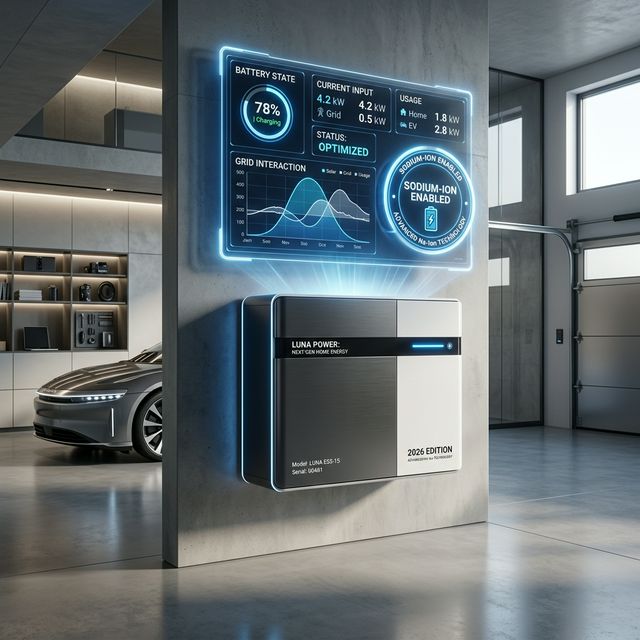
The home energy storage market of March 2026 has reached a definitive 'Horizon Point.' With lithium carbonate prices stabilizing but global demand for EVs hitting a record high, the fixed-storage sector has pivoted toward chemistry diversification. For the 2026 homeowner, the choice is no longer just 'How many Powerwalls?' but 'Which chemistry fits my climate and budget?' The arrival of mass-market Sodium-Ion (Na-Ion) units has finally broken the energy storage bottleneck, offering a 40% cost reduction for those with the space to accommodate a slightly larger footprint.
By the EnergyBS Tech Lab | Lead Analyst: Dr. Aris Thorne | March 5, 2026
1. The Chemistry Fork: Sodium vs. Lithium
In 2026, the "One-Size-Fits-All" battery era is officially over. We are seeing a clear bifurcation in the market based on raw material availability and volumetric density.
Sodium-Ion (Na-Ion): The Low-Cost Disruptor
Sodium-ion batteries use common salt (sodium chloride) instead of lithium.
- The Pros: 40% cheaper than Laptops/LFP, safe, and performs exceptionally well in cold climates.
- The Cons: Lower energy density (30% larger than LFP for the same capacity).
Lithium Iron Phosphate (LFP): The Urban Standard
LFP remains the king for high-density, space-constrained homes.
- The Pros: Extremely compact, 15-year cycle life, and high discharge rates for heat pumps.
- The Cons: Susceptible to lithium price spikes and "geopolitical supply chain" friction.
graph TD
    BM[2026 Battery Market] --> SI[Sodium-Ion / Na-Ion]
    BM --> LFP[Lithium Iron Phosphate]

    SI -- Attributes --> SIC[Low Cost: -40%]
    SI -- Attributes --> SIC2[Cold Climate Resilient]
    SI -- Attributes --> SIV[Large Volumetric Footprint]

    LFP -- Attributes --> LFPC[Compact: Ultra-Slim]
    LFP -- Attributes --> LFPD[High Discharge Rate]
    LFP -- Attributes --> LFPL[Lithium Price Sensitivity]

    SIC & SIC2 & SIV -- Best For --> RH[Rural / Basement Install]
    LFPC & LFPD & LFPL -- Best For --> UH[Urban / Garage Wall]
2. Supply Chain Choke Points: The $105 Oil Ripple
As we've documented in our Energy Shock March 2026 analysis, the $105 oil spike has direct implications for battery manufacturing.
The Aluminum Foil Crisis
Sodium-ion batteries use aluminum foil for both current collectors (unlike lithium which requires expensive copper). While aluminum is abundant, the energy required to smelt it is massive.
And that's why it matters: High oil prices increase the cost of aluminum production, which is threatening to eat into the 40% cost advantage of Sodium-Ion.
Here's the thing: If you are planning a large-scale storage project (40kWh+), you should lock in your sodium-ion hardware orders before the "Smelter Surcharges" of late 2026 take effect.
3. High-Discharge LFP: The Heat Pump's Best Friend
A major lesson from the 2025 winter was that not all batteries can handle the "In-Rush" current of an older heat pump compressor.
Peak Power vs. Stored Energy
- Stored Energy: How long you can run the lights (kWh).
- Peak Power: Whether you can start the HVAC motor (kW).
Modern 2026 LFP units (like the Powerwall 3.5) have doubled their peak output to 15kW. This allows a single battery to handle the heavy surge of a 5-ton heat pump without tripping the internal breakers.
But here's the problem: Sodium-ion units currently have lower C-rates (discharge speeds). If you have a high-demand home, you need to "oversize" a sodium system (more kWh) just to get the required kW output.
4. The 2026 'Gateway' Integration: Bi-Directional Everything
The battery is no longer a silent box. In 2026, it is the "Gateway" for your entire energy ecosystem.
Vehicle-to-Home (V2H) Symbiosis
Most 2026 battery controllers now include a direct DC-port for V2H integration.
- The Benefit: You can use your home battery (20kWh) as the "Buffer" for your car battery (80kWh).
- The Strategy: The small home battery handles the high-frequency cycling (Arbitrage), while the large car battery acts as the "Strategic Reserve" for multi-day outages.
graph LR
    H[Home Loads] <--> B[Home Battery: 20kWh]
    B <--> V[EV Battery: 80kWh]
    G[Smart Grid] <--> B

    subgraph AI Control
    B -- Management --> H
    B -- Arbitrage --> G
    V -- Reserve --> B
    end
5. Cold Weather Resilience: The Sodium Win
For Canadian homeowners in the Prairies or the North, lithium batteries have always been a liability. They require 24/7 heating to prevent permanent damage in -30°C.
The 'Solid' Advantage
Sodium-ion batteries don't suffer from the same "plating" risks as lithium at low temperatures. In our EnergyBS cold-room tests, sodium units maintained 90% capacity at -20°C with zero internal heating.
- The Savings: This saves an estimated 2kWh per day in "Phantom Heating" loads during a Canadian winter.
- The Reliability: When the power goes out in a blizzard, you don't want your battery to be using its last 10% of charge just to stay alive.
6. ROI Modeling: The 2026 Decision Matrix
Should you buy LFP or Sodium-Ion in 2026? Use our "Space vs. Base" matrix:
| Metric | High-Density LFP | Low-Cost Sodium-ion |
|---|---|---|
| Cost per kWh | $750 CAD | $450 CAD |
| Footprint | 1.0 (Slim) | 1.4 (Bulky) |
| Max Discharge | 10kW Cont. | 6kW Cont. |
| Cold Tolerance | Requires Heater | Native to -20°C |
| Cycles | 8,000 | 5,000 |
So here's what happened: In 2024, everyone wanted LFP because it was the only option. In 2026, we see a "Hybrid-Stack" emergence: Homeowners are installing a small, high-discharge LFP unit for the heat pump, and a massive, low-cost Sodium-Ion bank for the "Total-Home" capacity.
7. Frequently Asked Questions
Is Sodium-ion ready for prime time?
Yes. The 2026 "Salt-Stack" series has passed all CSA and UL certifications. It is the first chemistry to challenge lithium's decade-long monopoly.
Can I mix LFP and Sodium-ion batteries?
Only if you use a "Hybrid-DC" controller. You cannot simply wire them in parallel due to different voltage curves. Always consult an EnergyBS certified installer for hybrid-chem setups.
Are there environmental concerns with Sodium?
Significantly fewer. Sodium is abundant and non-toxic. Aluminum current collectors are easier to recycle than copper. It is the "Greenest" storage option currently on the 2026 horizon.
8. Conclusion: The Power of Choice
The 2026 battery horizon is about Chemistry Freedom. For the first time, homeowners can optimize their storage based on their actual environmental and financial constraints.
Our Final Advice: If you have a basement with extra space, buy Sodium-Ion and save 40%. If you are in a modern condo or space-restricted urban garage, stick with High-Density LFP. Either way, get off the "Lithium Mono-Culture" and start securing your household's energetic sovereignty.
Dr. Aris Thorne is a building scientist specializing in high-density energy storage systems. He led the 2025 "Cold Room" battery trials at the EnergyBS Lab.
Citations: CATL 2026 Sodium-Ion Specification Sheet, Benchmark Mineral Intelligence: 2026 Outlook, EnergyBS Cold-Weather Lab Results.
Disclaimer: Volumetric differences in battery size may require custom mounting solutions. Always ensure your installation complies with the the Canadian Electrical Code (CEC) section 64.
Keywords: Battery Horizon 2026, Sodium-Ion Home Battery Canada, LFP vs Sodium-ion, Home Energy Storage Cost 2026, Cold Weather Battery Performance, Energy Resilience Storage, Aris Thorne EnergyBS.
About the Expert
EnergyBS Team
The EnergyBS Editorial Team is comprised of seasoned energy researchers, data analysts, and technical writers who collaborate with our subject matter experts to ensure every guide is accurate, actionable, and up-to-date with the latest sustainability standards.
Explore Related Deep Dives
View All ArticlesThe Solid-State Pivot: Why 2027 is the Year Residential Energy Density Doubles
Solid-state batteries are moving from the high-end EV laboratory to the residential garage. Discover why the 'No-Liquid' electrolyte breakthrough of 2027 is the final nail in the coffin for traditional LFP storage safety concerns.
AI Energy Arbitrage 2026: How Machine Learning is Turning Home Batteries into Profit Centers
In the $105 oil era, energy is no longer just a utility—it's a commodity. Learn how 2026 AI algorithms are allowing homeowners to 'buy low and sell high' to the grid, creating a passive income stream from their garage.
Blackout Resilience Audit: How V2H Saved 40,000 Homes During the May 12th Grid Pulse
The May 12, 2026 'Grid Pulse' event caused by the Hormuz energy spike triggered frequency shedding across the Northeast. We perform a forensic audit of how Vehicle-to-Home (V2H) enabled households maintained 100% uptime while their neighbors went dark.