Hot Tub Installation Cost 2026: Tub, Wiring, Pad and Running Costs
A hot tub costs $3,000 to $10,000 on average before installation (HomeGuide), and a typical aboveground project lands at $4,000 to $15,000 once delivery, electrical wiring, a base, and permits are in. The tub is only part of the bill: a dedicated 240V circuit runs $800 to $1,600 (HomeGuide) or $1,900 to $4,200 on Angi's wider wiring scope, a concrete pad runs $500 to $2,500, and running the tub costs $20 to $100 a month in electricity (HomeStars, Canada) plus chemicals and upkeep. This guide prices each line, works the heatup and standby math from the portable spa energy standard, compares 120V plugandplay against 240V hardwired, and totals 10year ownership from the published bands.
Quick Checks
- 1Budget the project, not the tub. A $6,000 tub typically becomes a $9,000 to $11,000 project after the circuit ($800 to $1,600, HomeGuide), pad ($500 to $2,500), delivery ($200 to $500), and permit ($100 to $250) are added.
- 2Get the electrical quoted before you buy. HomeGuide prices a dedicated circuit at $800 to $1,600, while Angi's wider wiring scope runs $1,900 to $4,200. Distance from the panel and panel capacity explain most of the gap, and both are knowable before the tub is ordered.
- 3Standby heat loss is the running bill. Every watt a covered tub draws around the clock costs about 0.73 kWh a month. A tub holding temperature at 150 watts average costs about $18.60 a month at $0.17 per kWh; the same tub with a tired, waterlogged cover at 300 watts costs about $37.21.
- 4A filled 6 to 7-person tub weighs about 6,000 pounds (HomeGuide). Grass and an unreinforced deck are not bases. Price the pad or the deck reinforcement ($15 to $30 per sq ft) into the project from the start.
- 5Plug-and-play saves the electrician and pays in heat-up time. A 400-gallon tub needs about 46 kWh to go from 55F fill water to 102F: about 8.4 hours on a 5.5 kW 240V heater, about 30 hours on a 1.5 kW 120V heater, before losses.
Hot Tub Installation Cost 2026: Tub, Wiring, Pad and Running Costs
By EnergyBS Editorial Team | October 16, 2026
The Short Answer
Short Answer: A hot tub costs $3,000 to $10,000 on average for the tub alone (HomeGuide), and a typical above-ground project, tub plus delivery, electrical wiring, base, permits, and labor, lands at $4,000 to $15,000. The installation work by itself, wiring and setup without the tub, runs $300 to $1,600 (HomeGuide, national average $1,100). In-ground builds are a different class of project at $8,000 to $25,000 installed. After purchase, plan on $20 to $100 a month in electricity (HomeStars, Canada), plus $10 to $30 a month in water and chemicals and $500 to $1,000 a year in maintenance and repairs.
The sticker price misleads in a specific way: the tub is the only line most ads show, and it is often barely half the project. A mid-range tub at $6,000 needs a dedicated 240V circuit, a base that can carry roughly 4,000 to 6,000 pounds of filled tub, delivery that may need a crane, and a permit. Section 2 stacks those lines with published prices. Sections 5 and 6 then price the second purchase, the electricity: a hot tub is a 300 to 500-gallon tank of water held near 102F outdoors, all winter if you use it year-round, and the heater pays for every degree the weather takes away.
1. The Tub Itself: Price by Tier, Size, and Material
HomeGuide's quality tiers are the cleanest map of the market. The same features repeat as price climbs: thicker shells, full-foam insulation, stronger jets, built-in sanitizing, and longer warranties.
| Tier (HomeGuide) | Tub price | What defines it |
|---|---|---|
| Inflatable | $400 to $1,500 | 120V plug-in, lasts up to about 5 years, light jets and lights |
| Entry-level | $2,000 to $6,000 | Plastic or portable shell, many are 120V plug-and-play, short warranty |
| Value-priced | $4,000 to $8,000 | The most common tier: 2 to 5 people, acrylic or wood shell, more jets, built-in sanitizing, improved insulation |
| Premium | $8,000 to $11,000 | Acrylic shell, stronger adjustable jets, 4 to 6 people, better energy efficiency, longer warranty |
| Luxury | $11,000 to $18,000 | 7+ people, advanced controls and filtration, premium components, custom features |
Size moves price inside every tier. Angi's size bands: 2 to 3 people at $2,000 to $7,000, 4 to 5 people at $2,000 to $12,000, 6 to 7 people at $3,000 to $15,000, and 10 people at $5,000 to $20,000 and up. Material matters as much as seats. Angi prices inflatable vinyl at $400 to $1,500, rotomolded plastic at $2,000 to $6,000, wood at $3,000 to $10,000, vinyl-lined shells at $4,000 to $12,000, and acrylic, the standard hard-shell material, at $4,000 to $18,000.
Two buying notes follow from those tables. First, the tiers overlap so much that a large entry-level tub and a small premium tub meet in the middle; compare insulation and warranty at a given price, not tier names. Insulation is the feature that keeps paying, because it sets the standby draw in section 6 for the life of the tub. Second, dealer pricing includes delivery and setup in some quotes and excludes both in others. HomeGuide puts delivery at $200 to $500 on its own line, so a quote that looks $400 cheaper may simply have moved the truck off the page.
In-ground tubs sit outside this table entirely: $8,000 to $25,000 installed (HomeGuide), against an average above-ground tub of about $6,000 and an average in-ground tub of about $15,000 in Angi's figures. Section 8 covers that branch.
2. The Installation Stack: Wiring, Pad, Delivery, Permit
Four lines turn a tub into a project. Each has a published range, and each range is wide because site conditions, mostly distance and ground, do the deciding.
| Installation line | Published range | Source |
|---|---|---|
| Dedicated circuit, conduit, GFCI outlet or subpanel (up to 100 ft) | $800 to $1,600 | HomeGuide |
| Hot tub wiring, wider scope | $1,900 to $4,200 (average $2,300) | Angi |
| Connect to existing wiring (replacement tub) | $150 to $500 | HomeGuide |
| Electrical panel upgrade, if capacity runs out | $1,400 to $2,800 | HomeGuide |
| Concrete pad | $500 to $2,500 ($5 to $10 per sq ft) | HomeGuide |
| Gravel base / plastic pad / pavers / reinforced deck | $1 to $3 / $4 to $7 / $10 to $17 / $15 to $30 per sq ft | HomeGuide |
| Delivery and placement | $200 to $500 | HomeGuide |
| Crane lift, when access fails | $300 to $1,500 | HomeGuide |
| Permit and inspection | $100 to $250 | HomeGuide |
| Wiring and setup labor (basic install near the panel) | $300 to $1,600 | HomeGuide |
Electrical is the deciding line. A hardwired tub needs a dedicated 40 to 60-amp, 240V circuit with GFCI protection (Angi's requirements guide). HomeGuide prices that circuit, with underground conduit up to 100 feet and a GFCI outlet or subpanel near the tub, at $800 to $1,600. Angi's electrical cost guide prices hot tub wiring higher, at $1,900 to $4,200 with a $2,300 average, and says labor is about 75 percent of the total. The two are pricing different scopes: Angi's band absorbs longer runs, trenching, and subpanel work, and its materials list shows why distance costs money (a breaker at $90 to $150, hundreds of feet of heavy #6 wire at $480 to $600, conduit at $50 to $120, a subpanel at $100 to $350). Both sources agree on the drivers: how far the tub sits from the panel, and whether the panel has capacity left. A 100 or 150-amp service with no spare breaker space turns the circuit into a panel project at $1,400 to $2,800 (HomeGuide); our panel upgrade cost guide prices that work line by line. The disconnect also has placement rules: HomeGuide notes the spa panel sits at least 5 feet from the tub, a code-driven safety distance your electrician will set.
The pad is a structural purchase. Section 4 covers the weights. For pricing, concrete is the default at $5 to $10 per square foot. A 64 sq ft pad (8 by 8 feet) at those rates is $320 to $640 in slab terms, inside HomeGuide's $500 to $2,500 per-tub band once grading, forms, and a small-job minimum are in. Cheaper bases exist (gravel at $1 to $3 per sq ft, plastic spa pads at $4 to $7) and dearer ones too (pavers at $10 to $17, a reinforced deck at $15 to $30). What is not on the menu is bare ground or grass: HomeGuide is explicit that a tub on grass sinks and goes out of level over time.
Delivery is a logistics line, not a flat fee. Standard delivery and placement runs $200 to $500. Five to ten percent of deliveries need a crane (HomeGuide), at $300 to $1,500 depending on reach, and tight side yards can add a fence-section removal at $100 to $200. Measure the route from curb to pad, gate widths, overhead wires, and corners, before the truck is booked. The electrician then needs 6 to 8 hours to complete the hookup once the tub is placed (HomeGuide), and the full above-ground project, ordering through permits and inspections to first fill, typically runs 2 to 6 weeks.
A worked stack. Take a value-priced tub at a $6,499 sticker. Circuit at a 60-foot run: $1,450. Concrete pad: $1,800. Delivery: $400. Permit: $200. Cover lifter: $275. Steps: $180. Total project: $10,804, against the $6,499 the ad showed. Every add-on here sits inside its published range above (cover lifter $150 to $400, steps $60 to $400, HomeGuide). This is a hypothetical example assembled from those ranges, and your stack will differ, but the shape will not: installation adds roughly half to two-thirds on top of a mid-range tub's price.
3. 120V Plug-and-Play vs 240V Hardwired
The cheapest installation decision is made at purchase, in the electrical spec.
Plug-and-play (120V). Entry-level and inflatable tubs plug into a standard outlet with GFCI protection (Angi). No electrician, no permit in most places, and hookup to existing wiring runs $150 to $500 where a dedicated outlet is needed (HomeGuide). The trade is heater size. A 120V circuit can feed a heater of roughly 1.5 kW, against the 5.5 kW class heaters common on 240V tubs, and on many 120V models the heater cannot run at full output while the jets are on high, because the circuit has no headroom left.
Hardwired (240V). A dedicated 40 to 60-amp GFCI circuit, the $800 to $1,600 HomeGuide job or the wider Angi scope above. In exchange: a heater three to four times the size, jets and heat at the same time, and faster recovery after a soak.
The heat-up math in section 5 puts numbers on the trade: about 46 kWh takes a 400-gallon tub from 55F fill water to 102F. That is about 8.4 hours of heater time at 5.5 kW and about 30 hours at 1.5 kW, before counting heat lost during the wait. In practice a 120V tub is filled, heated over a day or more, and then held at temperature, which works fine for planned weekend use. It works badly for draining, refilling, and soaking the same evening, and in cold weather a small heater can struggle to hold temperature with the cover off and jets running, because the loss rate during a soak can approach what 1.5 kW replaces.
Rule of thumb from the numbers: if the tub will live outdoors year-round in a cold climate, or get heavy use, the 240V circuit is part of the purchase price, not an upgrade. If it is a mild-climate, seasonal, or first tub bought to test whether your household uses one at all, plug-and-play keeps the exit cheap, and many models convert to 240V later if the habit sticks (check the specific model's conversion support before counting on it).
4. Weight and the Base: 3,000 to 6,000 Pounds, Sitting Still
Water weighs 8.34 pounds a gallon, and a hot tub is mostly water once filled. HomeGuide's weight table:
| Size | Empty | Filled |
|---|---|---|
| 2 to 3 person | 500 lb | 3,000 lb |
| 4 to 5 person | 750 lb | 4,000 lb |
| 6 to 7 person | 900 lb | 6,000 lb |
Add bathers on top. Six adults at an assumed 180 lb each add another 1,080 lb to the large tub's 6,000, for a working load near 7,000 lb on an 8 by 8 foot footprint, roughly 110 lb per square foot. A standard residential deck is not built for that without reinforcement, which is why HomeGuide prices a reinforced deck base at $15 to $30 per square foot, the dearest foundation in its table, and why deck installs belong in the quote as engineering, not carpentry optimism.
The base also has to stay level. A tub that settles out of level strains the shell, misaligns the cover seal (which costs heat, section 6), and can void warranty coverage. Existing patios are sloped to drain away from the house, and HomeGuide lists concrete leveling at $4 to $9 per square foot where a sloped slab needs correcting. Indoors multiplies everything: floor reinforcement for the load, ventilation at $300 to $1,200 to move the moisture out, plumbing at $450 to $1,800, and water-resistant finishes, because a 400-gallon indoor spill or a slow leak is a building problem, not a yard problem. Our whole-house dehumidifier cost guide covers the moisture-control side of indoor water generally.
5. Worked Example: What Heating 400 Gallons Actually Costs
Monthly running-cost bands (section 6) describe other people's tubs. This example prices one defined heating job with the arithmetic shown, so you can rerun it with your own electricity rate. It is a hypothetical example; every assumption is stated.
The tub and the job. 400 gallons, filled with 55F water, heated to 102F, a 47F rise.
The physics. One gallon of water weighs about 8.34 pounds, and one BTU raises one pound of water one degree F.
- Water weight: 400 gal x 8.34 lb/gal = 3,336 lb
- Heat needed: 3,336 lb x 47F = 156,792 BTU into the water
- In electricity: 156,792 / 3,412 BTU per kWh = 45.9 kWh at the heater
- At an assumed $0.17 per kWh: 45.9 x $0.17 = $7.81 per fill-and-heat
Heat-up time, same example: at 5.5 kW (240V), 45.9 / 5.5 = about 8.4 hours. At 1.5 kW (120V plug-and-play), 45.9 / 1.5 = about 30.6 hours. Both ignore heat lost during the heat-up itself, which stretches the 120V figure more, because the tub spends a full day leaking heat through the cover while it warms.
Recovery after a soak. Assume the water drops 4F during an hour-long winter soak with the cover off (stated assumption; wind and air temperature move this a lot). Replacing that heat takes 3,336 x 4 = 13,344 BTU = 3.9 kWh = about $0.66, and about 43 minutes of heater time at 5.5 kW against about 2.6 hours at 1.5 kW. This is why 120V owners learn to keep the cover on between soaks: the recovery, not the soak, is what their heater cannot hurry.
Refill frequency. Water is changed a few times a year on a maintained tub. Four full heat-ups a year at $7.81 is about $31, a rounding error next to the standby bill in section 6. Filling is not the cost. Holding temperature is the cost, which is the same conclusion the water heater fuel cost comparison reaches indoors: standby and distribution losses, not the headline heating event, dominate a year of hot water.
6. Running Costs: Standby Is the Bill
A hot tub's heater does most of its work when nobody is in the tub, replacing heat that escapes through the cover, shell, and base, 24 hours a day. That standby draw is the running cost, and it is measurable before you buy, because portable electric spas carry a regulated energy figure.
The standard. California's Title 20 appliance rules, mirrored in the ANSI/APSP/ICC-14 spa standard, cap a portable spa's normalized standby power at 5 x V^(2/3) watts, where V is fill volume in gallons. Run the formula:
| Fill volume | Standby cap (normalized) |
|---|---|
| 300 gal | 5 x 44.8 = 224 W |
| 400 gal | 5 x 54.3 = 271 W |
| 500 gal | 5 x 63.0 = 315 W |
Normalized standby is a test-condition figure for comparing models, not a meter reading, and the CEC's own reporting shows wide spread under the cap: some spas use about half the standby power of others at the same volume. That spread is the single biggest running-cost variable you control at purchase, bigger than jet count or heater size. Ask for the model's tested standby watts (it is on the California appliance database listing and the spa's energy label) and compare models on it.
Turning watts into dollars. One watt drawn around the clock uses 24 x 30.4 / 1,000 = 0.73 kWh a month. So, as a stated-assumption illustration at $0.17 per kWh:
| Average standby draw | Electricity per month | Cost per month | Cost per year |
|---|---|---|---|
| 100 W (tight shell, good cover, mild weather) | 73 kWh | $12.41 | $149 |
| 150 W | 109 kWh | $18.60 | $223 |
| 200 W | 146 kWh | $24.82 | $298 |
| 300 W (thin insulation or a waterlogged cover, cold weather) | 219 kWh | $37.21 | $447 |
Jet pumps, filtration cycles, and soak recovery add on top, and winter raises the loss rate as the gap between 102F water and outdoor air widens. Cross-check against the published ownership bands: HomeStars (Canada) puts hot tub electricity at $20 to $100 a month, HomeGuide notes in-ground tubs can cost up to $100 a month to operate, and Hydropool, a Canadian manufacturer, puts total ongoing cost (power plus cleaning) at about $60 a month in Canada for 2026. The standby table lands inside those bands for mid-range assumptions, which is what a cross-check is for. A quote or review promising $10 a month year-round in a cold climate is describing the 100 W row in July, not January.
The cover is the insulation that wears out. Covers waterlog: the foam cores absorb water over years, gain weight, and lose insulating value, and the tub quietly moves down the table above from the 150 W row toward the 300 W row. At the stated rate that slide costs about $18.61 a month, about $223 a year, which repays a replacement cover (HomeGuide: $50 to $700, plus a lifter at $150 to $400 that makes the cover easy enough to actually use) in one to three years. A cover that takes two people straining to move is a cover that stays off, and an uncovered tub in winter loses heat at soak rates all night.
Chemicals and upkeep. HomeStars prices water and chemicals at $10 to $30 a month, filters at $15 to $120 every one to two years, and annual maintenance and repairs at $500 to $1,000. HomeGuide lists the salt-system branch at $500 to $1,700 installed for above-ground tubs, which trades chemical purchases for a generator cell and longer intervals between drainings (up to 12 months, against a few months on standard care), with two cautions from the same source: some manufacturers limit warranty coverage with aftermarket salt systems, and salt is hard on internal metal parts and nearby decking if splash-out is not rinsed. Price the system your tub was built for, not the conversion an accessory catalog prefers.
7. Ten-Year Ownership, From the Published Bands
Installed price plus running cost, using the midpoint of each published band. Hypothetical illustration: midpoints are arithmetic means of the cited ranges, the running band is the same for all three rows (HomeStars: electricity $60 a month at midpoint, chemicals $20 a month, maintenance and repairs $750 a year, totaling $1,710 a year), and no repairs beyond that band, rate changes, or financing are included. Premium tubs often draw less standby power and entry tubs more, so treat the running column as a shared planning figure, not a per-tier measurement.
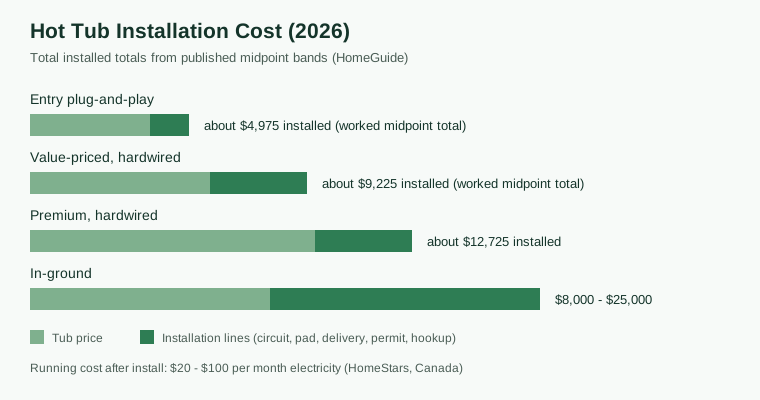
| Path | Tub (midpoint) | Install lines (midpoints) | Installed total | 10-year running | 10-year total |
|---|---|---|---|---|---|
| Entry plug-and-play | $4,000 | Hookup $325 + base $300 + delivery $350 | $4,975 | $17,100 | $22,075 |
| Value-priced, hardwired | $6,000 | Circuit $1,200 + pad $1,500 + delivery $350 + permit $175 | $9,225 | $17,100 | $26,325 |
| Premium, hardwired | $9,500 | Circuit $1,200 + pad $1,500 + delivery $350 + permit $175 | $12,725 | $17,100 | $29,825 |
Two adjustments matter. First, lifespan: HomeGuide gives hot tubs 5 to 20 years depending on quality and care, so an entry tub replaced in year 7 breaks the table's single-purchase assumption and pulls the plug-and-play row up by a second tub. The premium row's longer warranty and build are partly a bet against that replacement. Second, energy efficiency is priced and paid back in the open: HomeStars notes energy-efficient models run 10 to 20 percent more upfront with energy savings up to 30 percent. On the $720-a-year midpoint electricity figure, 30 percent is about $216 a year, which repays a 15 percent premium on a $6,000 tub ($900) in a little over four years, faster at the cold-climate end of the electricity band and slower at the warm end. Run that division with your own rate and climate before paying for the efficiency badge or skipping it.
The pattern matches the pool heater guide published this morning: in heated-water equipment, the purchase is the smaller half of ownership. For a hot tub the effect is stronger, because the water is held hot every day of the year, not for a swim season.
8. In-Ground Tubs and Adding a Spa to a Pool
An in-ground hot tub is construction, not delivery: excavation, a shell or poured structure, plumbing, electrical, and surround work. HomeGuide prices a standalone in-ground install at $8,000 to $25,000, building one alongside a new inground pool at $6,000 to $15,000 (the excavation and trades are already on site), and adding one to an existing pool at $12,000 to $25,000, because the existing structure needs opening, tying in, and resurfacing ($6 to $10 per square foot for the pool resurfacing itself). Angi's averages frame the same gap: about $6,000 for an average above-ground tub against about $15,000 in-ground.
The shared-equipment question decides value here. A spa built with a pool usually shares the pool's heater, pump, and controls, so its running cost folds into the pool's, and the pool heater cost guide sizing and fuel math applies to the combined system. A standalone in-ground tub carries its own equipment and its own standby bill, with HomeGuide's up-to-$100-a-month operating figure as the planning band. Permits are the norm for in-ground work ($100 to $250 for the permit itself, HomeGuide), where many above-ground installs need only the electrical permit and inspection. Get the permit list from the local building department before the design is final, not from the sales brochure: setback, fencing, and locking-cover rules for spas vary by municipality and can move the tub's location.
9. Canada: Prices in Canadian Dollars, Winter in the Math
HomeStars publishes the Canadian version of the same stack, in Canadian dollars. Models: entry-level $2,000 to $5,000, mid-range $5,000 to $8,000, premium $8,000 to $35,000. Complete backyard setups: basic $5,000 to $10,000, mid-range $10,000 to $15,000, luxury $15,000 to $35,000. The trades price higher than the US table on the heavy lines: electrical work C$600 to $2,200, a concrete pad or decking C$2,000 to $5,000, plumbing adjustments C$350 to $2,000. Removal of an old tub runs C$300 to $1,000. Portable tubs span $500 to $8,000, and swim spas, a different product with a current to swim against, run $10,000 to $30,000.
Running costs, HomeStars (CAD): electricity $20 to $100 a month, water and chemicals $10 to $30 a month, annual maintenance and repairs $500 to $1,000. Hydropool's Canadian average for total ongoing cost, about $60 a month including power and cleaning, sits inside that stack.
The Canadian variable is winter, and it cuts both ways. A tub used through a Canadian winter is the best argument for the 240V circuit, full-foam insulation, and a healthy cover: the standby table in section 6 stretches toward its bottom rows for five months, and a 120V heater has the least reserve exactly when recovery is slowest. It is also the case for buying in spring over autumn sales pressure: a tub installed in May gets its pad poured in workable weather, its electrical inspected without a snow load on the trench, and its first season at the cheap end of the standby table. Freeze protection is a standing chore, not an option: a power outage in January needs a plan (keep the cover closed, call your dealer, and know the drain procedure) because a frozen pump or split line converts an electricity problem into a replacement-tub problem. Winterizing a tub you will not use is a defined procedure with the dealer or manual; a tub left full, hot, and unused all winter is the worst cell in every table in this guide.
10. The Quote Checklist
Compare hot tub quotes line by line. A complete quote names:
- The tub make, model, gallons, heater size in kW, and the model's tested standby watts, checked against the section 6 standard for its volume.
- Whether the price is 120V plug-and-play or 240V hardwired, and, if hardwired, the circuit size in amps (40 to 60A is the standard band, Angi).
- The electrical as its own line: feet of run, conduit and trenching, GFCI breaker or subpanel, and the price, against the section 2 bands. Panel work, if needed, priced separately ($1,400 to $2,800, HomeGuide).
- The base: material, thickness, and price per square foot, against the section 2 foundation table, with leveling included if the site slopes.
- Delivery: standard placement or crane, the access route walked and measured, and fence or railing work priced if needed ($200 to $500 standard, $300 to $1,500 crane, HomeGuide).
- Permits: which permits and inspections the job needs, the fee ($100 to $250, HomeGuide), and who pulls them.
- The cover: model, thickness, and price ($50 to $700), plus the lifter ($150 to $400), quoted with the tub.
- Steps and access: steps ($60 to $400), any deck reinforcement at a stated per-square-foot price, and railing or gate work local rules require.
- Startup: filling, water balancing, control setup, and a walkthrough of the drain-and-refill and freeze procedures, included or priced.
- Removal of the old tub, if this is a replacement ($150 to $350 US, HomeGuide; $300 to $1,000 Canada, HomeStars), stated rather than assumed.
- Warranty split: shell, equipment, and labor warranties as separate terms, and whether a salt system or third-party accessory affects equipment coverage.
- The running-cost estimate the seller is claiming, in kWh or dollars per month, with the climate and temperature it assumes, checked against sections 5 and 6.
A quote that shows a tub price and a single installation number is hiding lines 3, 4, and 5, which are the lines that vary by thousands between houses.
Frequently Asked Questions (FAQ)
How much does it cost to install a hot tub in 2026?
For an above-ground tub, $4,000 to $15,000 covers the tub, delivery, wiring, base, permits, and labor (HomeGuide). The tub alone averages $3,000 to $10,000, installation work alone $300 to $1,600, and a full electrical job is the widest line: $800 to $1,600 for a dedicated circuit (HomeGuide) up to $1,900 to $4,200 on Angi's wider wiring scope. In-ground installs run $8,000 to $25,000.
How much does it cost to run a hot tub per month?
Electricity is the main line: $20 to $100 a month in HomeStars' Canadian figures, with in-ground tubs up to $100 a month in HomeGuide's. The physics sets the floor: holding temperature costs about 0.73 kWh per month for every watt of average standby draw, so a tub averaging 150 W uses about 109 kWh a month before jets and soaks. Add $10 to $30 a month for water and chemicals and $500 to $1,000 a year for maintenance and repairs (HomeStars).
Is a plug-and-play hot tub cheaper to own?
Cheaper to install, similar to run, slower to heat. It skips the $800 to $1,600 circuit (hookup to existing wiring is $150 to $500, HomeGuide), but its roughly 1.5 kW heater needs about 30 hours to heat a 400-gallon fill against about 8.4 hours at 5.5 kW on 240V, and recovery after a winter soak takes hours. Standby cost depends on insulation and cover, not voltage. For a mild climate or a first tub, the saving is real. For year-round cold-climate use, 240V is the practical spec.
Does a hot tub need a concrete pad?
It needs a level, stable base rated for 3,000 to 6,000 lb filled (HomeGuide). Concrete at $5 to $10 per square foot ($500 to $2,500 per tub) is the default. Gravel ($1 to $3 per sq ft), plastic spa pads ($4 to $7), pavers ($10 to $17), and reinforced decks ($15 to $30) are the published alternatives. Grass and bare ground are not: the tub sinks and goes out of level. An existing patio works if it is level or leveled ($4 to $9 per sq ft).
Do I need a permit for a hot tub?
Usually an electrical permit and inspection for a hardwired tub, and a building permit for in-ground or custom work; HomeGuide puts the permit itself at $100 to $250 and notes most cities do not require a building permit for a standard above-ground tub. Local rules on setbacks, fencing, and locking covers vary by municipality, so confirm with the building department before the pad is poured.
How long does a hot tub last?
Five to 20 years (HomeGuide), with quality, water care, and cover condition deciding where a tub lands. Inflatables sit at the short end at up to about 5 years. The ownership math in section 7 assumes one tub across 10 years; a tub replaced at year 7 changes that table more than any price negotiation does.
Can I install a hot tub myself?
Placement and pad work are within reach of an experienced homeowner, and a 120V plug-and-play tub needs no wiring at all. The 240V circuit is licensed electrical work in most jurisdictions, and it is the line where errors are dangerous: a dedicated 40 to 60-amp GFCI circuit next to water. HomeGuide also notes DIY installation can void the warranty. The $300 to $1,600 basic installation band buys the permit record and the inspection as well as the labor.
What should I read next before deciding?
Price the circuit's worst case in the panel upgrade cost guide, because a full panel turns a hot tub project into two projects. If a pool is part of the plan, the pool heater cost guide prices the shared heating equipment and the fuel choice behind it. For the fuel-math method used in section 5, the water heater fuel cost comparison converts gas, propane, electric, and heat pump heating to cost per unit of delivered heat. An indoor install should also read the whole-house dehumidifier cost guide for the moisture side.
Prices in this guide are planning ranges from the published 2026 sources cited above, not quotes for your yard. Distance from the panel, ground conditions, local permit and fencing rules, and your electricity rate decide the final figures. Get the tub, the circuit, the base, and the delivery priced as separate lines, and rerun the section 5 and 6 math with the rate on your own bill before you sign.
What to Read Next
Pool Heater Installation Cost 2026: Gas vs Heat Pump vs Solar PricesUse this next to compare the cost, incentive, installation, or operating-risk angle before you make a home energy decision.Sources and Verification
- HomeGuide How Much Does It Cost to Install a Hot Tub? (2026), updated November 21, 2025 (aboveground total $4,000 to $15,000 including materials, delivery, wiring, base, permits and labor; wiring and installation labor alone $300 to $1,600, national average $1,100; tub alone $3,000 to $10,000; quality tiers: inflatable $400 to $1,500, entrylevel $2,000 to $6,000, valuepriced $4,000 to $8,000, premium $8,000 to $11,000, luxury $11,000 to $18,000; electrical $800 to $1,600 for a dedicated circuit with conduit up to 100 ft and a 220V GFCI outlet or subpanel, $150 to $500 to connect to existing wiring, panel upgrade $1,400 to $2,800; pad $5 to $10 per sq ft concrete, $500 to $2,500 per tub, gravel $1 to $3, plastic pad $4 to $7, pavers $10 to $17, reinforced deck $15 to $30 per sq ft; delivery $200 to $500, crane $300 to $1,500; permit $100 to $250; inground $8,000 to $25,000 installed, $6,000 to $15,000 with a new pool, $12,000 to $25,000 added to an existing pool; filled weights 3,000 lb (23 person) to 6,000 lb (67 person); cover $50 to $700, cover lifter $150 to $400, steps $60 to $400, salt system $500 to $1,700; removal $150 to $350; lifespan 5 to 20 years; aboveground project timeline 2 to 6 weeks; electrician hookup 6 to 8 hours)
- Angi How Much Does a Hot Tub Cost? [2026 Data] (prices by size: 23 people $2,000 to $7,000, 45 people $2,000 to $12,000, 67 people $3,000 to $15,000, 10 people $5,000 to $20,000+; by material: inflatable $400 to $1,500, rotomolded plastic $2,000 to $6,000, wooden $3,000 to $10,000, vinyllined $4,000 to $12,000, acrylic $4,000 to $18,000; aboveground units $400 to $18,000, inground $8,000 to $25,000, with average aboveground tub about $6,000 against about $15,000 inground)
- Angi 2026 Hot Tub Electrical Installation Cost Guide, updated October 13, 2026 (hot tub wiring $1,900 to $4,200, national average $2,300, labor about 75 percent of the project; materials detail: breaker $90 to $150, 400 ft of 6 wire $480 to $600, 100 ft of 1inch PVC conduit $50 to $120, subpanel $100 to $350; cost driven by panel amperage, distance from breaker to tub, subpanel and trenching needs)
- Angi Hot Tub Electrical Requirements: What You Need to Know, updated July 9, 2026 (traditional tubs hardwire to a dedicated 40 to 60amp circuit with GFCI protection at 220/240 volts; plugandplay tubs use a 120volt GFCI outlet; professional electrical installation $600 to $2,200, GFCI outlet installation $130 to $300)
- HomeStars How Much Does a Hot Tub Cost in Canada? (2026), prices in Canadian dollars (entrylevel models $2,000 to $5,000, midrange $5,000 to $8,000, premium $8,000 to $35,000; typical backyard setups: basic $5,000 to $10,000, midrange $10,000 to $15,000, luxury $15,000 to $35,000; electrical work $600 to $2,200, plumbing adjustments $350 to $2,000, concrete pad or decking $2,000 to $5,000; running costs: electricity $20 to $100 per month, water and chemicals $10 to $30 per month, annual maintenance and repairs $500 to $1,000, filter replacement $15 to $120 every 1 to 2 years; removal $300 to $1,000; energyefficient models priced 10 to 20 percent higher with energy savings up to 30 percent)
- California Energy Commission Title 20 portable electric spa standard, as documented in the CEC CASE report on pools and spas and ANSI/APSP/ICC14 (normalized standby power for portable electric spas manufactured on or after January 1, 2006 capped at 5 x V^(2/3) watts, where V is fill volume in gallons; the standard is a testcondition comparison metric reported to the CEC, and tested models vary widely under the cap, with some using about half the standby power of others at the same volume)
- Hydropool Hot Tubs (Canadian manufacturer) How Much Does it Really Cost Each Month to Run a Hot Tub in Canada? (2026 figure: about $60 a month in ongoing costs in Canada, covering power and cleaning, presented as an average across its models and Canadian conditions)
Editorial Review
EnergyBS Editorial Team
EnergyBS publishes practical homeowner guides. Important program, product, and cost claims should be checked against the linked source and local project documents before you commit to work.
Related Guides
View All ArticlesPool Heater Installation Cost 2026: Gas vs Heat Pump vs Solar Prices
A pool heater costs $1,600 to $5,200 installed on average in 2026 (HomeGuide, national average $3,300), and Angi puts the typical project at $1,864 to $4,351 with an average near $3,100 across 1,019 projects. Type sets both halves of the bill: gas installs for $1,500 to $4,500 but runs $200 to $500 a month, a heat pump installs for $2,000 to $6,000 and runs $50 to $150 a month, and solar installs for $2,500 to $6,500 and runs $10 to $25 a month. This guide prices each type, the gasline and electrical hookups that decide real quotes, BTU sizing by pool size, a worked 10degree heating example with the math shown, 10year ownership totals, and a quote checklist.
Electrical Panel Upgrade Cost 2026: What a 100 to 200 Amp Upgrade Runs
Upgrading an electrical panel from 100 to 200 amps costs $1,300$4,200 installed in the US in 2026 depending on market and scope, and C$2,500$4,500 in Ontario. This guide breaks down cost by upgrade path, what a legitimate quote includes, when 200 amps is genuinely needed, and when load management avoids the upgrade entirely.
Gas vs Electric Water Heater Operating Cost Comparison
Compare gas, electric resistance, propane, tankless, and heat pump water heater operating costs with a worked example priced from EIA residential energy data, plus the installation tradeoffs that change the result.