Electrical Panel Upgrade Cost 2026: What a 100 to 200 Amp Upgrade Runs
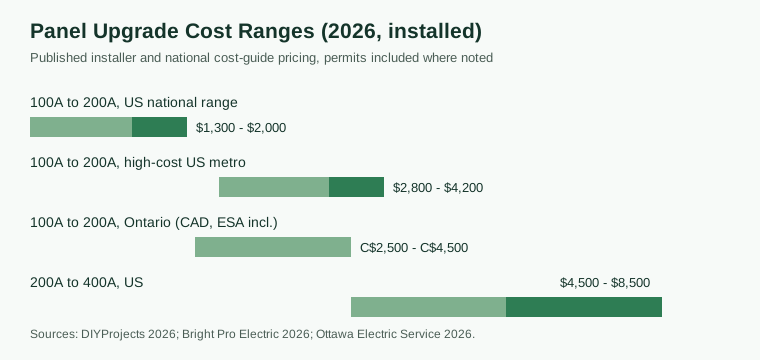
Upgrading an electrical panel from 100 to 200 amps costs $1,300$4,200 installed in the US in 2026 depending on market and scope, and C$2,500$4,500 in Ontario. This guide breaks down cost by upgrade path, what a legitimate quote includes, when 200 amps is genuinely needed, and when load management avoids the upgrade entirely.
Quick Checks
- 1The most common upgrade, 100 to 200 amps, runs $1,300-$2,000 at national-average pricing and $2,800-$4,200 in high-cost metros; Ontario homeowners pay C$2,500-$4,500 including the ESA permit.
- 2A legitimate quote itemizes the panel, meter socket, grounding, AFCI/GFCI breakers, surge protection, permit, utility coordination and inspection. A quote that omits the permit is offering future insurance and resale problems.
- 3Do not size the panel by guess: an NEC Article 220 load calculation decides whether you need 200 amps, a sub-panel, or just load management on your existing service.
- 4Bundling pays: adding a Level 2 EV charger during a panel upgrade adds about $400-$600 versus $850-$1,800 as a standalone job, and Ontario electricians report C$300-$600 saved by bundling.
- 5Expect one day of work with the power off for 4 to 8 hours, inside a 1 to 3 week project window dominated by permit and utility scheduling.
Electrical Panel Upgrade Cost 2026: What a 100 to 200 Amp Upgrade Runs
By EnergyBS Editorial Team | October 2, 2026
The Short Answer: What a Panel Upgrade Costs
Short Answer: Upgrading a home electrical panel from 100 to 200 amps - the most common panel job - costs $1,300 to $4,200 installed in the United States in 2026, depending on your market and what the job uncovers. DIYProjects' national cost guide puts the standard 100-to-200-amp upgrade at $1,300 to $2,000, with high-cost metropolitan areas and difficult-access homes quoted at $4,500 or more. Bright Pro Electric's published San Diego pricing, which includes permits and utility coordination, runs $2,800 to $4,200 for the same upgrade. In Ontario, Ottawa Electric Service lists C$2,500 to C$4,500 for a 100-to-200-amp upgrade including panel, labor, ESA permit and inspection.
Where you land in the range depends on three things: your local labor market, how far the new service has to run, and what the electrician finds when the old panel comes off the wall. Labor is 40% to 60% of the total bill according to DIYProjects, which is why the identical job prices so differently between a low-cost state and a coastal metro. This guide breaks down the cost by upgrade path, shows what a legitimate quote includes line by line, covers Ontario pricing, and then works through the question that decides whether you should spend the money at all: do you actually need 200 amps? If you are adding loads - an EV charger, a heat pump, a tankless water heater - start with our panel capacity guide, which explains how electricians total up what your current service can carry.
1. Cost by Upgrade Path (US)
Bright Pro Electric publishes installed pricing by amperage for the San Diego market, permits and utility coordination included:
| Panel upgrade | Installed cost (2026) | Typical use case |
|---|---|---|
| 60A to 100A | $1,800 - $2,800 | Very old homes, small cottages |
| 100A to 150A | $2,200 - $3,400 | Homes without major new loads |
| 100A to 200A | $2,800 - $4,200 | Most common residential upgrade |
| 150A to 200A | $2,200 - $3,500 | Mid-size homes adding EV or heat pump |
| 200A to 400A | $4,500 - $8,500 | Large homes, ADUs, EV plus pool plus heat pump |
| New sub-panel (60-100A) | $1,400 - $2,800 | Detached garage, ADU, pool equipment |
Treat those as high-cost-metro numbers. DIYProjects' national compilation tells the other half of the story: the 2026 national average for a panel upgrade sits around $1,600, most standard upgrades fall between $1,200 and $2,000, and its state cost tiers put a 100-to-200-amp upgrade at $1,200 to $1,500 in low-cost states, $1,500 to $2,000 in average-cost states, $1,800 to $3,200 in high-cost states and $2,200 to $4,500 or more in premium markets such as California, New York and the Pacific Northwest. A basic 100-amp panel swap without a service increase can run as low as $800 to $1,500 installed.
The practical takeaway: get your number locally, but use the structure to judge it. If a premium-market quote for a straight 100-to-200-amp swap lands above $4,500, the quote should be able to point at the reason - distance, underground service, a meter base replacement - in writing.
2. Canada: Ontario Pricing
Ottawa Electric Service publishes Ontario pricing with the ESA permit and inspection included, which makes it a useful benchmark for Canadian homeowners:
| Upgrade type (Ontario) | Cost range (CAD) | What is included |
|---|---|---|
| 60A to 100A | C$2,000 - C$3,500 | New panel, breakers, service entrance cable, ESA |
| 100A to 200A | C$2,500 - C$4,500 | New 200A panel, 40+ breaker spaces, service upgrade |
| 60A to 200A | C$3,500 - C$5,500 | Complete rewire from meter to panel, new service entrance |
| Fuse box to breaker panel | C$2,000 - C$4,000 | Replace fuse panel with modern breaker panel plus ESA |
| Sub-panel installation | C$1,000 - C$2,500 | Additional panel for garage, basement or addition |
| Panel relocation | C$2,500 - C$5,000+ | Moving panel to a new location plus all reconnections |
Regional spread for the standard 100-to-200-amp job: Ottawa and Eastern Ontario run C$2,500 to C$4,000, Toronto and the GTA C$3,000 to C$5,000, Hamilton and Niagara C$2,500 to C$4,500, London and Southwestern Ontario C$2,500 to C$4,000, and Northern Ontario C$2,800 to C$4,500. The GTA typically prices 10% to 20% above Ottawa for the same scope. Overall Ontario panel work spans C$1,800 to C$5,000 and up, with 60-amp services at the expensive end because they need a new service entrance and meter base, not just a bigger box.
3. Where the Money Goes
A panel upgrade quote is mostly labor and logistics wrapped around a few hundred dollars of hardware. DIYProjects puts the 200-amp panel hardware itself at $250 to $350, with licensed electricians charging $50 to $150 per hour and labor accounting for 40% to 60% of the bill. Ottawa Electric Service itemizes the Canadian version of the same job:
| Component (Ontario) | Typical cost (CAD) |
|---|---|
| New panel and breakers | C$300 - C$800 |
| Service entrance cable | C$200 - C$600 |
| Meter base replacement | C$200 - C$500 |
| Grounding and bonding | C$100 - C$300 |
| Installation labor | C$1,000 - C$2,500 |
| ESA permit and inspection | C$100 - C$250 |
| Utility disconnect and reconnect | C$0 - C$500 |
On the US side, Bright Pro Electric lists what a complete San Diego job includes: a new main breaker panel, a meter socket rated for the new amperage, a grounding electrode system bonded to the water service, AFCI and GFCI breakers where current code requires them, a whole-home surge protection device, the city or county permit at $150 to $400, utility coordination for the disconnect and reconnect, and the inspection sign-off. That list is the standard your own quote should be measured against, whatever your market. If a line is missing, ask whether it is included, excluded, or genuinely not required for your home - the answer changes what you are actually buying.
Two hardware notes. Whole-home surge protection runs $300 to $600 as an add-on according to DIYProjects and is increasingly standard on new panels; it protects the electronics a modern house is full of. And smart panels - which add load monitoring and circuit-level control - cost $2,000 to $5,000 more than standard hardware. They can occasionally defer a service upgrade entirely by managing loads actively; we cover that option in our smart electric panel deep dive.
4. What Pushes a Quote Up
The panel size sets the base price. These six variables move it:
- Meter-to-panel distance. Bright Pro Electric: if the meter sits at the front of the house and the panel is in a back garage, running service entrance cable through the structure adds $300 to $800.
- Underground service. Replacing a weatherhead is simple; corroded underground conduit is not. Expect $400 to $1,200 for underground complications on the US side. In Ontario, replacing the service entrance cable adds C$200 to C$600 in materials plus two to four hours of labor.
- Meter base compatibility. Older meter bases rated at 100 amps or less must be replaced for 200-amp service (Ontario: C$200 to C$500), and the utility has to coordinate the changeover.
- Existing wiring condition. Knob-and-tube, aluminum branch wiring or deteriorating connections can require circuit-level corrections before an inspector signs off - C$500 to C$3,000 or more in Ontario depending on extent.
- Location and access. A panel in a tight crawl space or behind finished walls, or one that must move for code or renovation reasons, costs more. Ontario relocation alone runs C$2,500 to C$5,000 and up.
- Code deficiencies found on opening. Double-tapped breakers, missing grounds and improper bonding must be fixed to pass inspection in both countries. A thorough electrician flags them in the quote; a cheap one discovers them on your invoice.
One more Ontario-specific point: some utilities must also upgrade the service drop - the wire from the pole to your home. Ottawa Electric Service notes Hydro Ottawa typically handles that at no charge but scheduling can add two to six weeks, while underground service upgrades may carry a fee. Ask who pays for the drop before you assume your quote is the whole project.
5. Do You Actually Need 200 Amps?
Not every electrical problem is a panel problem, and not every new appliance requires a service upgrade. The decision runs on a load calculation, not a guess.
Most single-family homes built from the 1960s through the 1980s have 100-amp service, which handles a typical load profile: HVAC, kitchen appliances, washer and dryer, lighting. What it cannot cleanly absorb is combination load. Bright Pro Electric's figures for the two most common additions: a Level 2 EV charger pulls 32 to 48 amps continuously, and a high-efficiency heat pump draws 15 to 30 amps depending on size. Pairing a new heat pump with an EV charger on a 100-amp panel is, in their assessment, almost always an upgrade scenario. Our Level 1 vs Level 2 EV charging comparison works through how much charging speed a household actually needs, which is the other half of that decision.
Electricians settle the question with a load calculation under NEC Article 220 in the US, or the equivalent Canadian Electrical Code calculation in Ontario - not by counting breakers. The outcomes are usually one of four:
- Your existing service passes. Sometimes a 100-amp service has enough calculated headroom, particularly with a smaller charger or managed charging. Bright Pro Electric notes this happens, but not often.
- Load management. A load-management device or smart panel pauses big loads when the house peaks, letting a 100-amp service support an EV charger legally. This is the cheapest path when the calculation only just fails.
- A sub-panel. If the main panel has capacity but no breaker spaces, or a detached garage or ADU needs its own distribution, a 60-to-100-amp sub-panel runs $1,400 to $2,800 in the US and C$1,000 to C$2,500 in Ontario - materially less than a service upgrade.
- The full 200-amp upgrade. Right when the calculated load, present plus planned, exceeds the service. For most single-family homes adding one EV charger and a heat pump, Bright Pro Electric's position is that 200-amp service is sufficient.
Resist the upsell past 200. A 200-to-400-amp upgrade runs $4,500 to $8,500, and Bright Pro Electric is blunt about oversizing: upsizing to 400 amps when 200 handles the math is a $2,000 to $4,000 unnecessary expenditure. Four hundred amps is for homes over roughly 3,500 square feet with a heat pump, multiple EV chargers, pool and hot tub loads running together, or an ADU with its own sub-panel.
There are also triggers that have nothing to do with capacity. Federal Pacific Stab-Lok, Zinsco/Sylvania and Challenger panels have documented failure modes that some insurance carriers watch. Finding one is a reason to have it inspected - Bright Pro Electric is explicit that the brand name alone is not a replacement verdict - while Ottawa Electric Service takes the harder line for Ontario homes and advises replacing those panels regardless of amperage, noting insurers increasingly refuse coverage. Either way, the step is an inspection and your insurer's position, not a sales pitch. Pre-sale inspection findings and frequently tripping breakers under normal load round out the legitimate trigger list - after you have ruled out a single overloaded circuit.
6. A Worked Load Example (Hypothetical)
The numbers below are an illustrative example, stated so you can see the arithmetic an electrician is paid to do with your real figures - they are not a quote or a code calculation for your home.
Suppose a load calculation for a 100-amp home comes back at 68 amps of existing calculated demand - a normal result for a house with electric cooking, a dryer and central air. Now add the two planned loads from Section 5:
- A Level 2 EV charger set to 48 amps continuous: plus 48 amps.
- A heat pump drawing 25 amps: plus 25 amps.
The total is 141 amps against a 100-amp service. It fails, and no breaker arrangement fixes arithmetic. The household's real options are the four from Section 5: pay for the 200-amp upgrade (US $2,800 to $4,200 at San Diego pricing, or $1,300 to $2,000 at national-average pricing), install load management so the charger yields when the heat pump runs, set the charger to a lower rate if the reduced calculation then passes, or phase the projects. What the household should not do is accept a verdict - in either direction - from anyone who has not run the calculation. Get the calculated load in writing; it is the document that justifies or kills a four-figure job.
7. Permits, Utility Coordination and Timeline
The permit is not optional in either country, and both of our US sources and our Ontario source say so in almost the same words. Bright Pro Electric: permits run $150 to $400 depending on the city, and an unpermitted panel is uninspected work that can complicate a homeowner insurance claim if a fire is ever traced to the panel. DIYProjects puts mandatory electrical permits at $50 to $300 nationally. In Ontario, the ESA notification and inspection runs C$100 to C$250, is filed by your electrician, and skipping it can void home insurance.
What the process looks like:
- Assessment. The electrician inspects the panel, runs the load calculation and writes the quote.
- Permitting and scheduling. The permit is pulled and the utility disconnect is booked - this scheduling, not the work, is what stretches the calendar.
- Install day. One day of work in most cases. Bright Pro Electric's San Diego timeline has power off for 4 to 6 hours, utility disconnect in the morning, new panel and grounding through midday, reconnect and inspection in the afternoon. Ontario timing is similar with power off 4 to 8 hours; DIYProjects gives 4 to 8 hours for the installation itself.
- Inspection. If the inspector cannot attend the same day, power is restored after the work and the inspection follows within a day or two. DIYProjects puts final approval at one to three business days depending on local backlogs.
Total project length: DIYProjects says one to two weeks including permitting and utility coordination; Ottawa Electric Service says one to three weeks, with most of the wait in utility scheduling. Tell the electrician at booking about medical equipment, a critical home office or temperature-sensitive animals - some can hold specific circuits on a portable generator during the outage window.
And no, this is not a DIY job in either country. DIYProjects describes panel work as pro-only: the service conductors are live and cannot be switched off by a breaker in the house, and DIY work voids insurance. Ottawa Electric Service is equally direct for Ontario - panel work must be done by a licensed electrician and inspected by the ESA.
8. Bundling With an EV Charger or Heat Pump
The cheapest panel upgrade is the one you schedule alongside the work that forced it. Shared utility coordination, one permit cycle and one mobilization mean combination jobs cost less than the sum of their parts.
Bright Pro Electric prices the clearest example: a Level 2 EV charger added during a panel upgrade visit runs about $400 to $600 on top, versus $850 to $1,800 as a standalone job. DIYProjects lists a Level 2 EV charger circuit at $600 to $1,500 as an add-on service - consistent with the bundled figure once the panel is already open. The same logic covers generator interlocks ($400 to $800 per DIYProjects), sub-panels and surge protection. In Canada, Ottawa Electric Service reports that bundling a panel upgrade with an EV charger, solar install or renovation saves C$300 to C$600 against doing the jobs separately.
Two more line items worth deciding while the panel is open: a whole-home surge protector at $300 to $600 (DIYProjects), increasingly expected on new panels, and spare breaker capacity for the heat pump or charger you plan next year rather than this one. Sizing for the next load now is almost always cheaper than a second service visit later. If the panel upgrade is groundwork for a heat pump, our heat pump vs gas furnace true cost comparison covers the installed-cost side of that project, and the tankless water heater installation cost guide covers the water-heating case, including the panel add-on whole-home electric units often trigger.
9. Quote Checklist and Red Flags
Three written quotes from licensed electricians, each itemized, will do more for your final price than any negotiation tactic. Check each quote for:
- Panel make and model, and the meter socket rated for the new amperage.
- The load calculation result, in writing - the number that justifies the upgrade size.
- Grounding electrode system and bonding included.
- AFCI/GFCI breakers where code requires them.
- Whole-home surge protection: included, priced as an add-on, or absent.
- Permit fee and who pulls it; inspection sign-off included.
- Utility disconnect and reconnect coordination: who schedules it, who pays any utility fee.
- Service entrance and meter base: inspected and confirmed sufficient, or priced for replacement.
- Day-of expectations: power-off window, generator provision if you need one.
- Workmanship warranty and hardware warranty terms.
Red flags: a discount for skipping the permit - Bright Pro Electric's warning is that this buys future insurance and resale problems, because uninspected work surfaces at home-sale inspections and after any electrical fire; a 400-amp recommendation with no load calculation behind it; and a quote that cannot say whether the service drop and meter base are included. Finding a Federal Pacific or Zinsco panel in your home is a reason to get it inspected and ask your insurer what they require - not a verdict, from a brand name, that you must sign today.
On value: Ottawa Electric Service argues the upgrade typically costs less than the value it protects, noting a 60-amp fuse box can reduce a home's sale price by C$5,000 to C$15,000 or deter buyers outright, and that home inspectors flag outdated panels routinely. DIYProjects adds that modern buyers actively look for EV-ready electrical. We would frame it conservatively: a permitted 200-amp upgrade removes an objection, satisfies insurers who refuse certain panels, and makes the next electrification project cheaper. That is worth having, whether or not it shows up dollar-for-dollar at resale.
Frequently Asked Questions (FAQ)
How much does it cost to upgrade an electrical panel from 100 to 200 amps in 2026?
DIYProjects puts the standard US upgrade at $1,300 to $2,000 installed, with the 2026 national average panel upgrade around $1,600 and high-cost metros quoted at $4,500 or more. Bright Pro Electric's San Diego pricing, permits and utility coordination included, runs $2,800 to $4,200. In Ontario, Ottawa Electric Service lists C$2,500 to C$4,500 including the ESA permit and inspection, with the GTA at C$3,000 to C$5,000. Your position in the range is set by labor market, meter-to-panel distance, and whether the service entrance and meter base need replacement.
How long does a panel upgrade take?
The installation itself is one day: Bright Pro Electric schedules 4 to 6 hours of power-off time, Ottawa Electric Service 4 to 8 hours, and DIYProjects 4 to 8 hours for a 200-amp upgrade. The full project runs longer - DIYProjects says one to two weeks including permitting and utility coordination, Ottawa Electric Service one to three weeks with most of the wait in utility scheduling, which in Ontario can add two to six weeks if the utility must upgrade its service drop.
Do I need a permit for a panel upgrade?
Yes, everywhere. Bright Pro Electric puts US electrical panel permits at $150 to $400 depending on the city, DIYProjects at $50 to $300 nationally, and Ottawa Electric Service lists the mandatory Ontario ESA notification and inspection at C$100 to C$250, filed by your electrician. A quote offering a no-permit discount is offering you uninspected work: it can complicate an insurance claim after any electrical fire, and it surfaces when home inspectors review the panel at sale.
Is a 200-amp panel enough for an EV charger and a heat pump?
For most homes, yes. Bright Pro Electric's assessment is that a 200-amp panel handles an EV charger and a heat pump in most San Diego homes with standard loads, and Ottawa Electric Service says a 200-amp panel comfortably supports central AC, an electric dryer and range, an EV charger and standard household loads. A Level 2 charger draws 32 to 48 amps continuously and a heat pump 15 to 30 amps, so the combination is exactly what pushes a 100-amp service over - and exactly what 200 amps is sized to absorb. Your electrician confirms with a load calculation before recommending a size.
Can I upgrade my electrical panel myself?
No. DIYProjects describes the job as pro-only in the US: the utility service conductors remain live during the work, DIY attempts carry arc-flash and fire risk, and the result voids homeowner insurance. Ottawa Electric Service is equally direct for Ontario: all panel work must be performed by a licensed electrician and inspected by the ESA, and DIY panel work is illegal there. There is no version of this project where the savings justify the risk.
Does a panel upgrade increase home value?
Both of our installer sources say yes, with different mechanisms. Ottawa Electric Service notes that updated electrical is a positive line item on pre-purchase inspections and that an outdated 60-amp fuse box can reduce a home's sale price by C$5,000 to C$15,000 or scare off buyers entirely; homes with Federal Pacific or Zinsco panels can face forced price reductions or non-negotiable repair credits at closing. DIYProjects adds that modern buyers seek EV-ready homes and that replacing an outdated panel can reduce insurance premiums by lowering fire risk. The conservative reading: the upgrade removes objections and insurer problems rather than adding a line item buyers pay extra for.
Should I get 400-amp service instead of 200?
Only if the load calculation says so. Bright Pro Electric prices a 200-to-400-amp upgrade at $4,500 to $8,500 and warns that upsizing to 400 amps when 200 handles the math is a $2,000 to $4,000 unnecessary expenditure. Four-hundred-amp service fits homes over about 3,500 square feet running a heat pump, multiple EV chargers and pool or hot tub loads simultaneously, properties adding an ADU with its own sub-panel, or multi-EV households - and the recommendation should always arrive with a written NEC Article 220 load calculation behind it.
What to Read Next
- Electrical Panel Capacity for Electrification - how to total your existing loads before anyone quotes you an upgrade
- Level 1 vs Level 2 EV Charging at Home - how much charger your driving actually needs
- Tankless Water Heater Installation Cost 2026 - the other job that most often lands on a panel quote
- Heat Pump vs Gas Furnace: True Cost Comparison 2026 - installed costs and payback for the heating half of an electrification plan
Sources and Verification
- Bright Pro Electric Electrical Panel Upgrade Cost Guide 2026, San Diego (installed pricing by amperage, permits, inclusions)
- DIYProjects Electrical Panel Upgrade Cost Guide 2026 (national averages, hourly rates, cost tiers)
- Ottawa Electric Service Electrical Panel Upgrade Cost Ontario 2026 (100A to 200A pricing, ESA permits, regional costs)
Editorial Review
EnergyBS Editorial Team
EnergyBS publishes practical homeowner guides. Important program, product, and cost claims should be checked against the linked source and local project documents before you commit to work.
Related Guides
View All ArticlesElectrical Panel Capacity for Home Electrification
A decision guide for homeowners adding heat pumps, EV charging, induction, water heating, solar, or batteries: service ratings, load calculations, demand data, panel space, load management, project sequencing, and quote review.
Level 1 vs. Level 2 EV Charging 2026 Tool (Guide & Data)
Choose Level 1 or Level 2 home EV charging from daily miles, dwell time, winter conditioning, vehicle acceptance, circuit capacity, installation, tariffs, and a measured recoveryday test.
Tankless Water Heater Installation Cost 2026: Prices, AddOns and Payback
A tankless water heater costs $1,400$5,600 installed in the US in 2026, and C$2,800$6,500 for a typical Canadian gas install. This guide breaks down unit, labor, venting, gasline and panel addons, sizes the unit, and runs honest 20year payback math against a new tank.