Heat Pump Dryer vs Vented Dryer 2026 Tool (Guide & Data)
A householdspecific comparison of heatpump, vented electric, and gas dryers using model energy data, laundry volume, utility rates, cycle time, drainage, room conditions, vent cost, maintenance, and clothing care.
The Short Answer
Short Answer: Choose a heat-pump dryer when electricity use, ventless installation, lower fabric temperature, or avoiding conditioned-air exhaust matters more than the fastest cycle. Choose a conventional vented dryer when purchase price, large-load speed, simple familiar service, or an already short and compliant vent dominates. Compare exact models using annual kWh, drum capacity, normal-cycle time, voltage, drainage, room-temperature limits, filter and heat-exchanger maintenance, warranty, and your loads per week - not technology labels alone.
ENERGY STAR explains that a heat-pump dryer recirculates warm air through an evaporator that removes moisture rather than exhausting that warm, humid air outdoors. That closed loop can substantially reduce energy use, but the machine must collect or drain condensed water and may dry differently from a high-powered vented dryer.
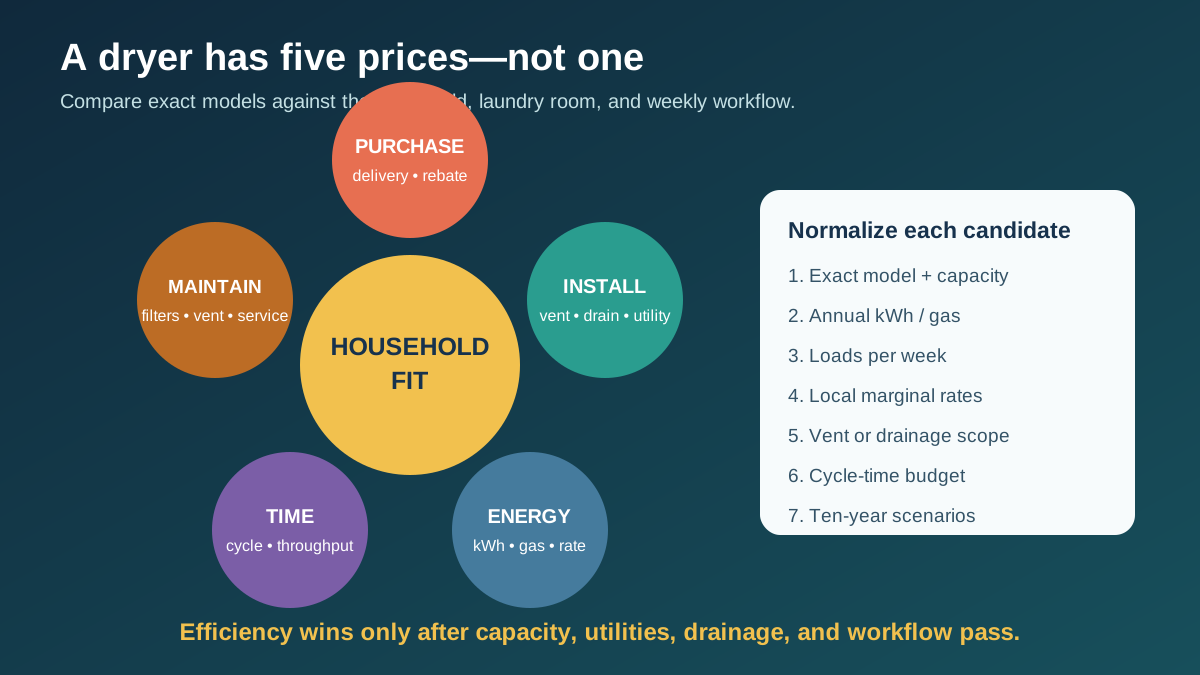
This guide builds a five-cost ledger: purchase, installation, energy, time, and maintenance. A model wins only when it fits the household and laundry room across all five.
The Three Dryer Architectures
Heat-pump dryer
A refrigerant circuit moves heat into a closed drying-air loop, then an evaporator condenses moisture from that air. Heat is reused rather than continuously created and exhausted. Most models are ventless. Water goes to a removable tank or an approved drain connection.
Conventional vented electric dryer
Electric resistance elements heat room air. The dryer moves that air through wet laundry and exhausts warm, humid air outdoors. It usually needs a dedicated high-voltage circuit in North American homes, plus a compliant metal exhaust path.
Vented gas dryer
A gas burner supplies most process heat while electricity powers the motor and controls. The dryer needs the correct fuel connection, combustion setup, electricity, and exterior exhaust. Installed cost and operating economics depend heavily on the existing utility and local fuel price.
A fourth category - non-heat-pump ventless condensing dryers - also exists. It condenses moisture without an exterior vent but generally does not reuse heat through the same refrigeration cycle. Do not equate “ventless” with “heat pump.” Verify the exact product type.
The Five-Cost Ledger
| Cost layer | Heat pump | Vented electric | Vented gas |
|---|---|---|---|
| Purchase | Often higher | Often lower | Midrange varies |
| Installation | No exhaust; needs drainage plan and correct circuit | Exterior vent and typically high-voltage circuit | Exterior vent, gas, electricity, combustion requirements |
| Energy | Usually lowest electric use | Higher electricity use | Depends on gas and electric prices |
| Time | May use longer, lower-temperature cycles | Often faster | Often fast |
| Maintenance | Lint filters plus model-specific condenser/heat-exchanger care | Lint filter, vent, and cabinet | Lint filter, vent, cabinet, and combustion service |
Do not fill this table with national averages. Put exact model and local project numbers into it.
Compare Model Energy, Not Marketing Percentages
ENERGY STAR's Product Finder provides model-level fields such as estimated annual energy use and Combined Energy Factor. CEF expresses pounds of test load dried per kilowatt-hour; a higher value means greater tested efficiency. It helps compare products tested within the applicable program, but it is not your utility bill.
For each candidate, record:
- exact model number;
- dryer type and fuel;
- drum capacity;
- estimated annual kWh from an authoritative model listing;
- Combined Energy Factor;
- test-cycle time or published normal-cycle information;
- standby/network use where disclosed;
- voltage and circuit requirements;
- whether energy figures assume a particular washer/load/cycle.
Then calculate with one consistent method.
Estimated annual dryer electricity cost = model annual kWh × local all-in marginal electricity price
Use the price for added consumption, including relevant delivery riders and time period - not only the headline supply rate. If time-of-use rates apply, assign dryer cycles to realistic periods. The time-of-use rate guide shows how to model schedule rather than averaging every kWh.
For gas, calculate both gas and electricity. Convert the gas use disclosed for the model or an authoritative test source into the units on your bill, then apply the marginal rate. Avoid comparing a heat-pump dryer's total electricity with a gas dryer's motor electricity while omitting fuel.
Worked Energy Example
Consider a hypothetical household comparing two exact models:
- heat-pump dryer listing: 210 kWh/year;
- vented electric dryer listing: 610 kWh/year;
- electricity: $0.22/kWh all-in marginal price;
- heat-pump purchase premium: $650;
- no rebate;
- both use the existing electrical setup;
- the vented dryer also needs $300 of vent correction, while the heat-pump dryer needs a $90 drain kit and installation.
Annual electricity:
- heat pump: 210 × $0.22 = $46.20;
- vented: 610 × $0.22 = $134.20;
- modeled difference: $88/year.
Net initial premium:
- purchase premium: $650;
- heat-pump drain scope: +$90;
- avoided vent correction: −$300;
- net premium: $440.
Simple energy payback: $440 ÷ $88 = 5 years.
This is not a universal payback. If the household dries half as often as the test assumption, electricity is cheaper, the vent is already excellent, or repair cost differs, payback lengthens. If usage and rates are higher or a new vent is difficult, it shortens.
Rebuild Cost From Loads Per Week
Annual model figures are convenient, but household use varies. Create a two-week laundry log:
| Load | Washer size/fill | Fabric mix | Washer final spin | Dryer cycle | Minutes | Redry needed? |
|---|---|---|---|---|---|---|
| Towels | ||||||
| Bedding | ||||||
| Clothing |
Count annual loads as weekly loads × 52, then ask manufacturers or testing data for comparable per-cycle energy where available. Do not divide annual kWh by a guessed cycle count and present it as measured truth without labeling the assumption.
A plug-in electricity monitor is not appropriate for many high-voltage dryers. Use utility interval data, a properly installed whole-home/branch monitor, or a qualified measurement method. Do not improvise adapters.
Washer Extraction Controls Dryer Energy
The dryer removes water that the washer leaves behind. ENERGY STAR recommends pairing heat-pump dryers with efficient front-load washers because strong final spin removes more moisture before drying.
Compare washer capacity and extraction with dryer capacity. A compact heat-pump dryer paired with a large washer can force split loads, making the workflow and energy different from the label. Conversely, moving to a high-spin washer can reduce dry time for any dryer type.
Before blaming the dryer, record whether clothing emerges unusually wet, the washer balances and reaches full spin, and bulky items risk water. The slow-drying diagnostic guide separates washer, load, airflow, heat, sensor, and room causes.
Capacity Is More Than Cubic Feet
Ask whether one normal washer load can tumble freely in the exact dryer. ENERGY STAR notes that overlarge loads take longer because air cannot circulate, while very small loads can also perform poorly or waste a cycle.
Evaluate:
- rated drum volume;
- matching washer capacity;
- king bedding and bulky-item instructions;
- minimum useful sensor load;
- household peak, such as weekend family laundry;
- need to split loads;
- cycle availability for wool, delicates, outdoor gear, and sanitizing;
- reversing action or strategies for sheets that ball up.
A smaller efficient dryer can be an excellent fit for frequent moderate loads and frustrating for one weekly oversized load. Model the actual routine.
Drying Time: Measure Door-to-Door Workflow
Heat-pump drying often uses lower temperatures and can take longer, though model design and load matter. Compare:
- published normal-cycle time under a stated test;
- time to the dryness level you use;
- second-load turnaround;
- whether the cycle can run unattended under instructions;
- filter and tank-emptying time;
- ability to schedule during off-peak rates;
- whether gentle heat reduces ironing or garment replacement.
Do not compare a heat-pump eco cycle with a vented dryer's maximum-heat timed cycle without considering load dryness and fabric wear. Also do not select “extra dry” by habit; moisture sensors can stop at a useful dryness while avoiding overdrying.
Create a weekly time budget. If four loads can overlap with cooking, work, or sleep, an extra twenty minutes per cycle may have little cost. If eight loads must finish between sports practices, throughput may dominate.
The Laundry Room Heat and Air Balance
A conventional vented dryer exhausts indoor air. Replacement air must enter the house through planned openings or leaks. In a conditioned home, that air may need reheating, cooling, or dehumidifying. The appliance's energy listing may not capture every site-specific building load.
Heat-pump dryers do not intentionally exhaust the same volume outdoors, which can be valuable in tight or extreme-climate homes. They still release some heat to the room and require manufacturer-specified ambient conditions and clearances.
Check:
- minimum and maximum ambient temperature;
- closet volume or ventilation opening requirements;
- room heat during back-to-back cycles;
- condensation risk on cold surfaces;
- floor drain or water-damage consequences;
- proximity to bedrooms and offices;
- lint and cleaning access;
- door and appliance clearance;
- stacking approval.
A cold garage, sealed closet, or hot unconditioned room can affect performance or violate instructions. “Ventless” does not mean “install anywhere.”
Drainage Is a Permanent Utility
ENERGY STAR describes common heat-pump dryer water options: emptying a tank, using an approved drain hose, or using a compatible device to share a washer drain.
For a tank, estimate how often it fills and whether every household member can access it. Ask what happens when the tank is full.
For a drain, verify the exact manufacturer's:
- hose and connection method;
- allowed height and route;
- standpipe, sink, or shared-drain configuration;
- backflow or siphon requirements;
- freeze exposure;
- leak protection;
- cleaning and service access.
Do not insert an unapproved hose into plumbing and assume it is secure. Include the drain in the purchase quote and final leak test.
Electrical and Gas Retrofit Questions
Record exact nameplate and installation requirements. Some heat-pump dryers use standard-voltage receptacles; others require different circuits. Conventional electric dryers commonly use higher-voltage dedicated circuits. Gas dryers still require electricity and a compliant fuel connection.
Ask a qualified person to evaluate:
- circuit voltage, amperage, grounding, receptacle, and conductor condition;
- cord supplied or separately required;
- local permits;
- gas connector, shutoff, pressure, and fuel conversion where applicable;
- combustion air and exhaust;
- removal/capping of abandoned gas service;
- whether load management is relevant.
Do not choose based on voltage folklore. Use the exact model instructions and existing electrical/gas conditions.
Vent Cost Can Reverse the Purchase Comparison
A heat-pump dryer generally avoids an exterior dryer exhaust. That can be valuable in an apartment, interior laundry closet, addition, historic wall, or long-route home.
If comparing with a vented model, price:
- rigid or approved transition metal duct;
- shortest compliant route;
- elbows and developed length;
- exterior termination;
- fire or rated-assembly penetrations;
- air/water/pest sealing;
- access for cleaning;
- makeup-air or pressure concerns;
- removal of plastic, foil, crushed, or disconnected duct;
- roof or finish work.
CPSC warns that lint can block airflow and contribute to excessive heat and fire risk, and recommends rigid or corrugated semi-rigid metal rather than plastic or foil accordion material. The dryer vent routing guide provides a manufacturer-specific planning worksheet.
Do not count an abandoned vent as zero work. Decide whether it is removed, capped, air-sealed, weather-sealed, and documented without trapping moisture or pests.
Maintenance: Read the Exact Routine
All dryers require lint management. Heat-pump designs may have multiple filters and model-specific condenser or heat-exchanger cleaning. Some components are owner-accessible; others are not.
Before buying, download the manual and price the routine:
- lint filter cleaning frequency;
- secondary filter or plinth filter;
- condenser/heat-exchanger access and permitted cleaning;
- water tank and drain maintenance;
- sensor cleaning;
- vent and cabinet service for vented models;
- replacement-filter availability and cost;
- access to parts and trained service;
- warranty exclusions tied to cleaning.
Do not spray or brush a delicate heat exchanger unless the manual permits that method. Bent fins, forced debris, or water in electronics can turn maintenance into damage.
Clothing Care Has an Economic Value
Lower-temperature drying can reduce heat stress on elastic, prints, and some fibers. ENERGY STAR highlights gentler low-temperature operation as a heat-pump advantage. Translate that into household behavior:
- Are expensive technical garments dried?
- Does the household routinely overdry clothing?
- Would sensor termination replace timed high heat?
- Are delicates already air-dried?
- Does longer drying increase tangling or wrinkling for the model?
Do not invent a universal clothing-savings dollar amount. Track replacement patterns if clothing care is a major reason to buy.
A Weighted Choice Worksheet
Score each exact model 0 to 5 and multiply by your weight.
| Criterion | Weight | Heat pump | Vented electric | Vented gas |
|---|---|---|---|---|
| Fits normal washer load | 20 | |||
| Ten-year installed + energy cost | 20 | |||
| Weekly throughput | 15 | |||
| Site utilities and route | 15 | |||
| Maintenance/service | 10 | |||
| Room heat/noise | 10 | |||
| Fabric-care priorities | 5 | |||
| Warranty/parts | 5 |
Capacity, electrical/gas compliance, drainage, exhaust safety, and installation instructions are pass/fail gates, not score categories.
Three Household Scenarios
Apartment or interior condominium laundry
The laundry closet has no legal exterior exhaust route. The household washes four moderate loads per week in a front-load washer, electricity is expensive, and cycle timing is flexible. A compact heat-pump dryer may avoid costly or prohibited wall work, but the buyer still must confirm condominium rules, closet openings, circuit, stacking kit, drain connection, delivery dimensions, room heat, noise, and service access.
The correct comparison is not heat pump versus a vented dryer sitting on the same floor. It is heat pump versus the full feasible vented project, if one exists. If the only vent route crosses common property or exceeds the selected dryer's permitted design, the conventional machine may not be a valid option.
Large family with an existing short vent
The home has a large washer, eight to ten weekly loads, a straight accessible exterior duct, and low off-peak electricity. Laundry must finish in a narrow weekend window. A full-size vented electric or gas model may win on throughput and initial cost. A large-capacity heat-pump model could still compete, but compare one-washer-load capacity and back-to-back cycle time rather than assuming the efficiency percentage decides.
The household might find a hybrid workflow: line-dry delicates, use sensor cycles, increase washer spin where fabric permits, and schedule the dryer off-peak. Those low-cost changes can reduce energy without forcing early replacement.
Cold-climate basement retrofit
The vent is long, leaky, and pulls conditioned air from a recently air-sealed home. A heat-pump dryer avoids exhaust loss, but the basement approaches the candidate model's minimum ambient condition in winter. The buyer should measure seasonal room temperature, confirm the exact operating range, and include any effect of the dryer on the room. Replacing the vented dryer without addressing an abandoned exterior opening also leaves an air and pest path.
In this case, the best project may include a heat-pump dryer, approved drain, capped and weather-sealed old vent, and a plan to keep the room within allowed conditions. Or a corrected short vent route may be more dependable. The site facts decide.
Ten-Year Cost Model
Use a present-value calculation if the purchase decision is large, but a transparent undiscounted ledger is better than a precise-looking model built on weak assumptions.
For each option record:
- delivered purchase price;
- stacking or pedestal hardware;
- electrical, gas, drain, vent, carpentry, and permit work;
- removal and disposal;
- annual electricity and gas use;
- rate scenarios rather than one escalator;
- filters and planned maintenance;
- warranty term and likely uncovered service;
- expected years of ownership;
- residual value only if defensible.
Ten-year modeled cost = initial installed cost + ten years of energy + planned maintenance + scenario repair cost
Run at least three rate cases: current marginal rate, a lower case, and a higher case. Do not promise energy-price escalation. Run a low-use and high-use case around the household log. If the choice changes with a small assumption, call it a close decision and prioritize capacity, service, and installation quality.
Avoid double-counting. If model annual kWh already represents a standard usage pattern, do not add a separate per-cycle energy estimate for the same loads. If you scale model data to household cycles, label the linear assumption and acknowledge that load size and program selection may not scale perfectly.
Delivery and Installation Day Checklist
- Verify model and serial numbers before the old dryer leaves.
- Inspect drum, door, filters, heat exchanger access, cord, hose, and stacking parts.
- Confirm the circuit or gas work and permits are complete.
- Confirm the dryer is level and clearances match its instructions.
- Test the approved condensate drain or tank-full response.
- For vented equipment, inspect transition duct and exterior airflow.
- Run a specified startup or test cycle.
- Confirm the moisture-sensor program and dryness adjustment.
- Demonstrate every owner-cleanable filter and surface.
- Record required cleaning intervals without inventing extras.
- Register applicable warranties and keep the receipt.
- Photograph connections before the machine is pushed into place.
Measure doors, stairs, turns, closet width, and stacked height before delivery. A model that fits the alcove dimensions may still lack space for hoses, cord, door swing, controls, or service. Include safe anti-tip or stacking hardware when required by the manufacturer.
First-Month Verification Log
Efficiency should survive contact with the household. For the first ten representative loads, record:
| Date | Load type | Washer spin | Dryer cycle | Start/end time | Redry | Tank/filter action | Notes |
|---|
Look for patterns rather than one unusual blanket. If cycles are unexpectedly long, check load size, washer extraction, selected dryness, filters, room temperature, drainage warning, and model guidance before assuming a refrigeration failure. If a new vented dryer is slow, stop treating a new appliance as proof the old vent is sound.
Use an independent room thermometer when ambient conditions may matter. Compare utility interval data only when other major loads are understood. A dryer cycle can be obscured by water heating, cooking, EV charging, or HVAC.
If performance remains outside the product's instructions or seller representations, preserve the log, photos, error codes, and service reports. Clear evidence is more useful than repeated setting changes.
Questions to Ask Before Ordering
- What is the exact model's annual kWh and CEF?
- Which source and test basis provide those numbers?
- Can it dry one normal load from my washer without splitting?
- What normal-cycle time applies to a comparable load?
- What room-temperature and closet-opening limits apply?
- How is condensed water collected or drained?
- Which filters and heat-exchange surfaces need owner care?
- What circuit, receptacle, gas, or vent work is required?
- Is stacking approved with my washer and kit?
- Who services the refrigerant circuit and stocks parts?
- What labor, parts, sealed-system, and compressor warranties apply?
- What installation, delivery, haul-away, and finish work is excluded?
Sources and Verification
- ENERGY STAR's heat-pump dryer guide supports the ventless heat-recovery technology description and consumer comparison context.
- ENERGY STAR's clothes-dryer guidance and certified product finder provide model-level efficiency and certification evidence.
- DOE's laundry guidance supports evaluating washer extraction, load practice, and dryer energy together.
- CPSC's dryer fire-safety publication supports lint, exhaust, installation, and maintenance safety boundaries for vented equipment.
Cycle time, room limits, drainage, circuit, capacity, filters, stacking, and warranty are model-specific. Verify the current installation and use manuals for the exact appliance.
Frequently Asked Questions
Do heat-pump dryers really use less electricity?
Yes, as a technology class they can use less electricity than conventional resistance dryers, but savings vary by exact model, load, cycle, washer extraction, maintenance, room condition, and use. Compare the model in ENERGY STAR's certified product finder and calculate with your rate.
Do heat-pump dryers take twice as long?
Not universally. Many use longer lower-temperature cycles, but model, capacity, load, washer spin, settings, and desired dryness matter. Compare published test-cycle information and owner routine for exact models.
Does a heat-pump dryer need a vent?
Most residential heat-pump dryers are ventless and do not use a conventional exterior exhaust; ENERGY STAR's technology guide explains the closed-loop heat-recovery process. They still need model-specified room conditions, clearance, electricity, and condensate handling.
Can a heat-pump dryer go in a closet?
Only if the exact installation instructions allow the enclosure and its clearances, openings, ambient conditions, door, drainage, and service access. Ventless is not the same as zero ventilation or zero heat release.
Is a 120-volt heat-pump dryer better than 240 volts?
Voltage alone does not decide efficiency, capacity, speed, or fit. Compare exact nameplate, circuit, model energy, test time, drum, and household workflow.
What happens to the water?
Condensed water goes to a removable reservoir or an approved drain hose configuration. Verify routing, height, connection, leak behavior, and maintenance under the model instructions.
Should I replace a working vented dryer for energy savings?
Calculate the remaining life, model energy difference, utility rate, annual loads, vent condition, resale/reuse options, and avoided installation cost. Early replacement may not pay back for a low-use household with a sound short vent.
What to Read Next
If the current machine has become slow, diagnose it with Why Your Dryer Takes Two Cycles before buying a replacement. If a vented model remains in the comparison, scope the route with the dryer vent length and routing guide. Use the time-of-use electricity guide to price scheduled loads with interval rates.
Sources and Verification
Editorial Review
EnergyBS Editorial Team
EnergyBS publishes practical homeowner guides. Important program, product, and cost claims should be checked against the linked source and local project documents before you commit to work.
Related Guides
View All ArticlesWhy Your Dryer Takes Two Cycles 2026 Tool (Guide & Data)
A symptomfirst homeowner guide to slow drying that separates wet washer output, load and cycle errors, lintscreen problems, crushed or blocked exhaust, room conditions, sensors, heat, and appliance faults.
Dryer Vent Routing and Length 2026 Tool (Guide & Data)
A modelspecific homeowner worksheet for dryer exhaust route length, elbows, materials, transition duct, exterior termination, cleaning access, penetrations, makeup air, contractor scope, and postinstallation verification.
Are TimeofUse Rates Worth It? Model Your Bill From
Use a year of interval data and current tariff rules to compare flat and timeofuse electricity plans. Includes a bill model, loadshift inventory, demandcharge check, and trial scorecard.