Refrigerator Repair vs. Replace 2026 Tool (Guide & Data)
A diagnosisfirst refrigerator repairversusreplace worksheet that compares the full installed decision, EnergyGuide operating cost, foodloss risk, warranties, fit, serviceability, and responsible disposal.
The Short Answer
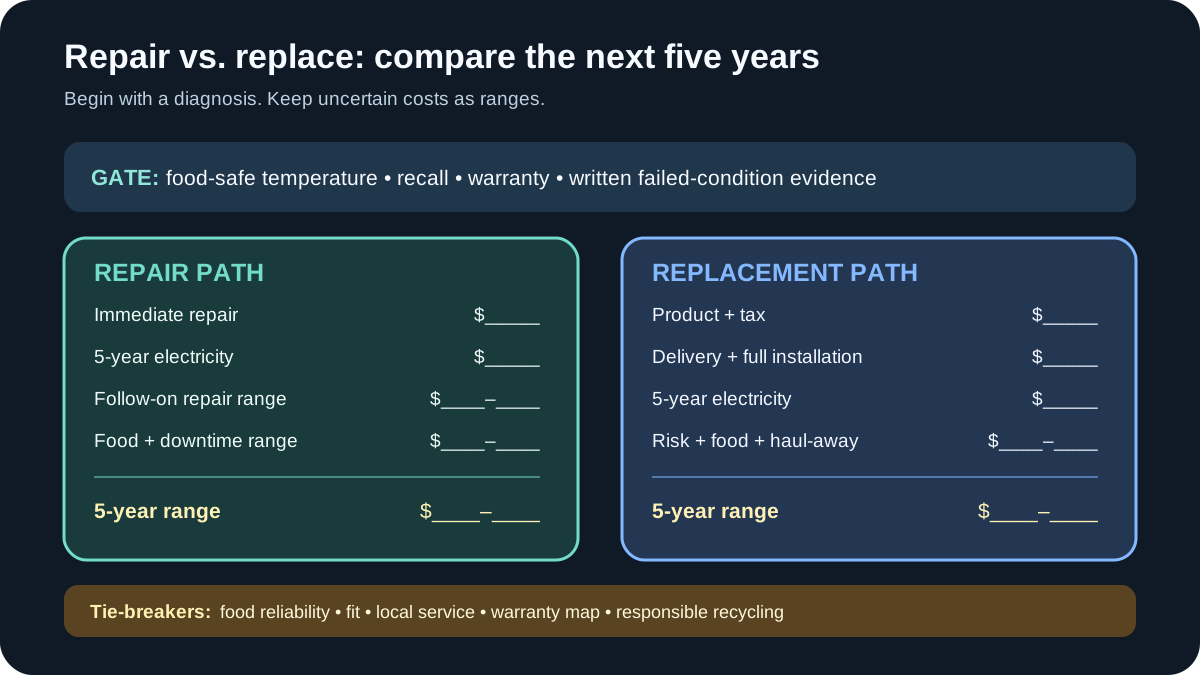
Short Answer: Do not replace a refrigerator from age or a repair-price percentage alone. First obtain a model-specific diagnosis, check recall and warranty coverage, and confirm the cabinet can still hold safe temperatures. Then compare five-year forward cost: repair now plus likely follow-on work and operating energy versus purchase, delivery, installation, modifications, protection, haul-away, and operating energy for a specific replacement. Add food-loss exposure, downtime, fit, serviceability, and warranty in separate columns so a low sticker price does not hide the risk.
Stop using an appliance with smoke, burning odor, repeated trips, damaged wiring, an unsafe active leak, or an official stop-use recall. Move perishables to verified cold storage when the refrigerator cannot hold 40°F (4°C) or below.
Why the Familiar “50% Rule” Is Too Crude
A common shortcut says to replace an appliance when repair costs exceed half the price of a new one. That ratio ignores most of the decision:
- the repair may carry a long parts warranty or none;
- the replacement price may exclude delivery, installation, water line, electrical work, cabinetry, doors, stairs, permits, tax, and haul-away;
- a cheap replacement may not fit or may sacrifice capacity and features the household uses;
- the current failure may be isolated or may signal several aging systems;
- a sealed-system part may have coverage beyond the general warranty;
- food loss and downtime can dominate a repeat failure;
- actual annual energy difference may be small or material;
- the existing refrigerator may be under recall or extended service program;
- replacement lead time and local repair capability vary.
The better question is: Which option has the lower risk-adjusted five-year cost while reliably meeting food safety, fit, and household needs?
The Five-Year Decision Ledger
Use one row per cost instead of one guessed total:
| Five-year item | Repair current unit | Replace with exact model |
|---|---|---|
| Diagnosis already paid | ||
| Immediate parts and labour | ||
| Delivery and installation | ||
| Water/electrical/cabinet/door work | ||
| Floor and finish protection | ||
| Haul-away/recycling | ||
| Five-year electricity | ||
| Expected follow-on repair allowance | ||
| Expected food-loss/downtime allowance | ||
| Extended coverage chosen | ||
| Rebates/bounties, verified | ||
| Resale or salvage value, realistic | ||
| Five-year total |
Keep uncertain numbers as ranges. A $700–$1,100 sealed-system quote should not be entered as $700 simply because that produces the desired answer.
Gate 1: Protect Food and Confirm the Failure
The FDA recommends refrigerator temperatures at or below 40°F (4°C) and freezer temperature at 0°F (-18°C), verified with appliance thermometers. If the refrigerator is warm, protect food before price shopping.
Use the warm-refrigerator/cold-freezer diagnostic to document both zones. For recurring ice, use the freezer frost location guide. These guides help distinguish owner-correctable conditions from internal failures; they do not replace qualified service.
Before authorizing a repair or disposal, obtain:
- exact model and serial;
- independent temperature log;
- error code and symptom timeline;
- written failed-condition diagnosis;
- parts, labour, refrigerant, and taxes itemized;
- required companion parts;
- post-repair verification method;
- parts and labour warranty;
- whether the fee is credited if repair proceeds;
- parts availability and expected downtime.
A quote that says only “compressor” or “control board” lacks the evidence needed for an economic decision. Ask what test isolated that component and whether any root condition could damage the new part.
Gate 2: Check Recall, Warranty, and Service Programs
Search the manufacturer's official support site and the CPSC refrigerator recall category with the complete model and serial. Also review:
- base appliance warranty;
- sealed-system warranty and what components it names;
- compressor-only coverage versus labour/refrigerant coverage;
- retailer or credit-card benefits;
- extended protection terms and exclusions;
- known service campaign or warranty extension;
- transferable coverage if the home/appliance changed owners;
- required authorized servicer or preauthorization.
A ten-year compressor-parts warranty does not necessarily pay diagnosis, labour, evaporator, condenser, filter-drier, refrigerant, shipping, or incidental food loss. Get written coverage before using a “free compressor” as the repair-side value.
An official recall remedy can change the decision entirely. Follow the notice; do not pay an independent shop to perform work that makes the product ineligible without first clarifying the program.
Classify the Repair by Scope, Not Just Part Name
Narrow, accessible repair
Examples may include an owner-inaccessible but straightforward fan, sensor, switch, damper, relay, gasket, hinge, valve, or ice-maker issue after correct diagnosis. A bounded repair with available parts, stable temperatures after verification, and meaningful warranty often favours repair.
Multi-system or concealed repair
Water migration, damaged wiring, foamed-in components, recurring drain ice, corroded connectors, door wiring, cabinet deformation, or several previous repairs can expand labour and uncertainty. Ask what is visible only after disassembly and who bears cost if the initial diagnosis changes.
Sealed-system repair
Compressor, evaporator, condenser, refrigerant line, filter-drier, and related work requires refrigerant-specific expertise, correct recovery practices, leak diagnosis, evacuation, charging, and post-repair verification. Some newer refrigerators use flammable refrigerants. Do not cut, heat, recharge, or open the circuit yourself.
For a sealed-system quote, ask:
- what evidence proves loss of capacity or refrigerant condition;
- whether the leak location is known;
- whether a restricted component or contamination is involved;
- all parts to be replaced;
- refrigerant type and technician qualification;
- whether refrigerant recovery, evacuation, recharge, and leak testing are included;
- whether tubing is accessible or embedded;
- coverage on the complete repaired circuit;
- expected cabinet temperature verification and return visit.
Replacing a compressor without addressing a leak, restriction, contamination, control, or airflow cause is not the same as restoring the system.
Calculate the Repair Side
Use:
Five-year repair path = immediate repair + current-unit energy + expected follow-on repairs + expected food/downtime loss − covered benefits
Immediate repair
Include diagnosis, parts, labour, tax, refrigerant, transport, removal/reinstallation of built-in panels, water reconnection, and return visit. Do not omit the already-paid diagnosis from household cash flow, but when comparing options from this moment, treat any non-refundable sunk fee consistently.
Follow-on repair allowance
Do not invent a universal failure probability. Build low/base/high cases from evidence:
- age and condition of door seals, fans, controls, ice/water system, hinges, and wiring;
- previous repair history;
- technician's documented observations;
- part availability;
- whether the fault damaged other components;
- warranty length on the proposed repair;
- household tolerance for another outage.
Example planning range - not a prediction:
| Repair scenario | Immediate | Follow-on allowance | Food/downtime allowance | Five-year energy | Total |
|---|---|---|---|---|---|
| Low | $420 | $0 | $50 | $300 | $770 |
| Base | $520 | $250 | $150 | $300 | $1,220 |
| High | $700 | $700 | $350 | $300 | $2,050 |
Replace those figures with local quotes and household evidence.
Worked Case 1: Bounded Airflow Repair
Suppose a seven-year-old top-freezer refrigerator holds 0°F in the freezer but the fresh-food section warms. A technician documents a failed evaporator fan, confirms the defrost and sealed systems operate, and quotes $430 installed with one-year parts and labour coverage. The cabinet, doors, wiring, and water-free design are in good condition.
A comparable replacement costs $1,050, plus $110 delivery/haul-away and $65 tax. Its EnergyGuide is 70 kWh per year lower. At $0.18/kWh, five years of energy difference is only $63.
Illustrative comparison:
| Item | Repair | Replace |
|---|---|---|
| Immediate installed cost | $430 | $1,225 |
| Five-year energy difference | $63 more | Baseline |
| Follow-on risk allowance | $200–$500 | $100–$350 |
| Food/downtime allowance | $75–$200 | $25–$100 |
| Five-year planning range | $768–$1,193 | $1,350–$1,675 |
Repair has the stronger evidence in this example. The result depends on the complete diagnosis and warranty, not the refrigerator's age. If inspection also found cabinet corrosion, intermittent control errors, and unavailable fan stock, the ranges would change.
Worked Case 2: Recurrent Sealed-System and Food Risk
Now suppose a twelve-year-old French-door model has lost cooling twice, spoiled food once, and needs an out-of-warranty sealed-system repair quoted at $1,100–$1,500. The leak location is uncertain, the water system has a separate intermittent fault, and local parts lead time is three weeks. A fitting replacement is $1,850 plus $250 for delivery, water-line commissioning, haul-away, and tax. It uses 190 fewer kWh per year.
At $0.24/kWh, the candidate's five-year energy advantage is:
190 kWh × $0.24 × 5 = $228
That energy difference alone does not decide the case. Replacement becomes stronger because repair uncertainty, repeat food loss, water-system work, and downtime are all evidenced. The household should still verify the replacement route, door swing, service network, warranty map, and disposal plan before ordering.
These cases are frameworks, not price forecasts. Local labour, taxes, electricity, configuration, diagnosis, and risk tolerance must replace every example number.
Calculate the Full Replacement Side
The retail price is only the first line. Ask for an installed, operating, protected, old-unit-removed price that includes:
- exact model and finish;
- sales tax;
- delivery zone, stairs, elevator, long carry, and appointment fees;
- old-unit disconnect and haul-away;
- door removal/reinstallation to enter the home;
- water line, shutoff, filter, fitting, leak protection, and commissioning;
- dedicated receptacle or electrical correction if actually required;
- cabinetry, trim, counter, floor, or wall changes;
- anti-tip or built-in hardware;
- panels/handles sold separately;
- temporary food storage;
- extended coverage if deliberately selected;
- recycling or disposal fee;
- verified rebate or recycling bounty.
Confirm who is responsible if the appliance does not fit, doors cannot open fully, a water connection leaks, or flooring is damaged. Photograph the route and floor before delivery.
Measure Fit Like an Installer
“36-inch refrigerator” is a sales class, not a guaranteed fit. Record:
| Measurement | Existing | Opening/route | Candidate requirement |
|---|---|---|---|
| Cabinet width at top/middle/bottom | |||
| Height at left/centre/right | |||
| Depth to wall/baseboard | |||
| Plug and water-valve projection | |||
| Door depth and handle | |||
| Hinge/top clearance | |||
| Door swing to wall/island | |||
| Drawer pull-out clearance | |||
| Narrowest delivery doorway | |||
| Stair/turn/elevator limit |
Use the candidate installation manual, including required ventilation clearances and door-open angle - not only retailer dimensions. Check whether doors can be removed for delivery without violating the procedure and whether the unit can be levelled in the opening.
Counter-depth can reduce projection while also reducing usable volume. A large nominal capacity with inaccessible deep shelves may be less useful than a smaller layout. Buy the household's storage and access pattern, not the largest badge.
Compare Electricity With Actual kWh
The FTC explains that the yellow EnergyGuide label shows estimated annual energy use and lets shoppers compare similar models. The displayed annual cost uses an assumed electricity price; your cost depends on local price and use.
Use the label's annual kWh, not its printed dollar estimate:
Annual electricity cost = annual kWh × your marginal all-in electricity price per kWh
If the current refrigerator's annual kWh is known from its label or DOE's refrigerator/freezer rating database, compare it with the candidate. Suitable multi-day plug-in measurement may be better for the existing unit if safely performed and representative.
Example:
- existing unit: 610 kWh/year;
- candidate: 380 kWh/year;
- difference: 230 kWh/year;
- local marginal price: $0.18/kWh;
- annual difference: 230 × $0.18 = $41.40;
- five-year undiscounted difference: $207.
That $207 matters, but it does not justify a $2,000 replacement by itself. At a higher electricity price, wider consumption gap, or longer horizon, it matters more. Use low/base/high rate scenarios if rates are tiered or uncertain.
Do not compare unlike labels carelessly
EnergyGuide ranges compare similar product classes. Door count, freezer location, size, through-door ice, and configuration influence consumption. ENERGY STAR notes that appropriately sized refrigerators, fewer doors, and top-freezer designs tend to use less energy. A feature-rich 29-cubic-foot French-door model can be certified yet use more energy than a simpler smaller refrigerator.
ENERGY STAR certification is a useful filter, not a guarantee of reliability, silence, food layout, repair access, or lowest lifetime cost.
Give Food Loss and Downtime Their Own Line
A refrigerator protects an inventory. Estimate exposure from receipts or a realistic household list:
- meat, dairy, prepared meals, medicines requiring controlled storage, and specialty food;
- coolers, ice, dry ice, or temporary appliance rental;
- meals purchased because the kitchen is disrupted;
- work time for service windows and deliveries;
- cleaning after leakage or spoiled food;
- risk during repeat failures or long parts delays.
Do not keep food merely to protect the repair decision. FDA temperature guidance and FoodSafety.gov item charts control. Some medicines have separate storage instructions; contact the pharmacist or manufacturer rather than applying food rules.
A household with a second verified refrigerator has lower downtime cost than a household with medical storage needs and no backup. This is a household-specific risk, not a reason to inflate every replacement case.
Score Reliability and Serviceability Separately
Brand averages do not diagnose an exact model. Before buying, investigate:
- local authorized-service coverage;
- ordinary parts availability and shipping time;
- sealed-system and labour warranty terms;
- access to filters and consumables;
- whether ice/water components can be isolated;
- error-code and service documentation availability;
- door and drawer repairability;
- whether controls require network/app access for core operation;
- retailer return/exchange conditions;
- recall and complaint patterns for the exact model family, interpreted cautiously.
Ask two local servicers whether they work on the model and refrigerant. A technically excellent appliance with no qualified local service may carry higher downtime risk.
Decide Which Features Are Worth Another Failure Path
List needs, preferences, and avoidable complexity.
| Feature | Must have | Useful | Avoid | Service/energy question |
|---|---|---|---|---|
| Through-door ice/water | Flap, heater, chute, leak access | |||
| In-door ice maker | Capacity and warm-air path | |||
| Dual evaporators | Humidity control and service scope | |||
| Convertible zone | Temperature range and controls | |||
| Wi-Fi/app | Core function without account/cloud | |||
| Auto-fill pitcher | Leak sensing and cleaning | |||
| Internal water | Filter and valve access | |||
| Multiple drawers/doors | Gaskets, hinges, air leakage |
Fewer features can mean fewer components and lower energy, but configuration must still meet accessibility, capacity, and food-organization needs.
Compare Warranties as Coverage Maps
Create columns for:
- complete appliance parts;
- labour;
- sealed-system components by name;
- compressor part;
- refrigerant and consumables;
- travel/diagnosis;
- food-loss allowance;
- cosmetic and door coverage;
- water damage exclusions;
- authorized-service requirement;
- registration deadline;
- term start and transferability.
“Ten-year warranty” in large print may refer to one part only. Price the uncovered labour and supporting work before assigning it value.
When Repair Usually Has the Stronger Case
Repair tends to score better when:
- food-safe temperature can be restored with a bounded diagnosed repair;
- total installed repair cost is low relative to a truly comparable installed replacement;
- the cabinet, doors, wiring, water system, and sealed system are otherwise sound;
- the part is available promptly;
- meaningful parts/labour coverage applies;
- the unit fits an unusual opening that would be expensive to alter;
- measured energy use is reasonable;
- there is no stop-use recall or repeated failure pattern;
- a qualified local technician will verify performance.
Age alone does not overturn these facts.
When Replacement Usually Has the Stronger Case
Replacement tends to score better when:
- a stop-use recall remedy or unsafe condition directs it;
- the cabinet or embedded refrigerant circuit cannot be repaired economically;
- several major systems are degraded or repairs recur;
- parts are unavailable or downtime is unacceptable;
- the repair has weak warranty and high diagnostic uncertainty;
- food loss or leakage has repeated;
- the unit no longer fits household access/capacity needs;
- measured consumption is high enough to materially change the ledger;
- full installed replacement cost is verified and manageable;
- local service and parts for the selected model are stronger.
Do not manufacture urgency because a sale ends tonight. A cooler and safe food plan may buy time for a second diagnosis and correct measurement.
Responsible Removal and Recycling
The EPA says not to tamper with a refrigerant-containing appliance before disposal, including cutting refrigerant lines or removing the compressor. The knowing release of most refrigerants during disposal is prohibited, and proper programs recover refrigerant and other materials.
Arrange removal through a retailer, local public-works program, utility/recycling bounty, qualified appliance recycler, or other compliant route. Ask:
- who takes custody;
- whether refrigerant will be recovered properly;
- whether the unit is permanently retired or resold;
- what happens to oil, mercury-containing parts where present, electronics, metal, and foam;
- whether doors must be secured/removed under local rules before pickup;
- whether proof of recycling is available;
- whether a rebate requires a working, plugged-in, or primary/secondary appliance.
Do not leave a refrigerator accessible to children. Follow local safety and collection instructions.
The Final Decision Sheet
| Decision factor | Repair score (1–5) | Replace score (1–5) | Evidence |
|---|---|---|---|
| Five-year cost range | |||
| Food-safe reliability | |||
| Diagnostic certainty | |||
| Parts/service availability | |||
| Warranty coverage | |||
| Energy consumption | |||
| Kitchen/delivery fit | |||
| Accessibility and storage | |||
| Water/leak risk | |||
| Downtime | |||
| End-of-life handling |
Weight food safety, reliable operation, and fit more heavily than finish or novelty features. Keep the source beside every dollar and score.
Frequently Asked Questions
Is a ten-year-old refrigerator automatically worth replacing?
No. Diagnose the fault and compare forward costs, energy, condition, fit, coverage, and downtime. Calendar age alone does not reveal repair scope or replacement value.
Should I repair if the quote is under half the replacement price?
Not from that ratio alone. Compare full installed replacement cost and five-year repair risk, including energy and food loss. Warranty and diagnostic certainty can change the result.
How do I compare EnergyGuide labels?
Use annual kWh among genuinely similar models, then multiply by your marginal local electricity price. The printed annual cost uses an assumed rate and your result will differ.
Does ENERGY STAR mean the refrigerator will be reliable?
It certifies energy performance against program criteria. It does not certify repair history, local service, food layout, sound, or every feature's durability.
Is a compressor warranty the same as a sealed-system warranty?
Not necessarily. Read the named components and whether labour, refrigerant, diagnosis, and travel are covered.
Can I sell or scrap the old refrigerator myself?
Do not cut lines or remove the compressor. Use a compliant reuse or recycling route that handles refrigerant and safety requirements correctly; EPA explains refrigerant recovery and recycler responsibilities in its appliance-disposal guidance.
Should I buy an extended warranty?
Compare price, exclusions, term overlap, service network, deductible, food-loss benefit, and claim limits with the manufacturer's coverage and your ability to self-insure. It is a contract decision, not an automatic yes or no.
What to Read Next
If the refrigerator is warm, start with the two-zone cooling diagnostic. If ice keeps returning, map it with the freezer frost location ledger. To understand long inverter-compressor runtime before treating it as a fault, read the inverter refrigerator guide.
Sources and Verification
Energy comparisons use the FTC EnergyGuide explanation, ENERGY STAR refrigerator guidance, and the DOE refrigerator energy-rating search tool. Disposal and refrigerant claims use the EPA homeowner FAQ and appliance-disposal page. Food-temperature decisions use the FDA refrigerator thermometer guide, while recall status must be confirmed through CPSC and the manufacturer. Exact quotes, warranty terms, local rates, model fit, and qualified diagnosis control the household decision.
Sources and Verification
- FTC: How to Use the EnergyGuide Label
- ENERGY STAR: Refrigerator Buying Guidance and Saving Tips
- DOE: Refrigerator and Freezer Energy Rating Search Tool
- EPA: Homeowner Questions About Appliance Disposal
- EPA: Appliance Disposal
- FDA: Refrigerator Thermometers Cold Facts About Food Safety
- CPSC: Refrigerator Recalls
Editorial Review
EnergyBS Editorial Team
EnergyBS publishes practical homeowner guides. Important program, product, and cost claims should be checked against the linked source and local project documents before you commit to work.
Related Guides
View All ArticlesRefrigerator Warm but Freezer Cold? A FoodSafe
A thermometerled guide to a warm refrigerator and cold freezer that protects food first, then separates setting, loading, airflow, doorseal, frost, fan, damper, and sealedsystem evidence.
Freezer Frost and Ice Buildup 2026 Tool (Guide & Data)
A locationbased freezer frost diagnostic that separates normal foodsurface crystals from humidair leaks, door problems, blocked vents, drain or icemaker leaks, fan icing, and defrost faults.
Why Your Inverter Refrigerator Rarely Turns Off
Does an inverter refrigerator automatically turn off? Why the compressor slows down instead of stopping, how that keeps cabinet temperatures steadier, what it does to energy use, and when constant running means a service call.