Electrical Panel Capacity for Home Electrification
A decision guide for homeowners adding heat pumps, EV charging, induction, water heating, solar, or batteries: service ratings, load calculations, demand data, panel space, load management, project sequencing, and quote review.
Electrical Capacity: The Short Answer
Short Answer: Do not approve a service upgrade solely because the panel says 100 A or has no empty breaker spaces. First define the actual appliances, obtain a code-compliant dwelling load calculation from a qualified electrician, check whether measured demand is an accepted path, and separate ampacity from physical panel space and equipment condition. Efficient appliances, lower-power charging, circuit sharing, load management, a subpanel, or phased installation may solve different constraints. Upgrade the service when verified load, condition, code, insurance, utility, or project requirements make it necessary.
Home electrification is not one appliance. A household might add a heat pump, heat-pump water heater, induction range, clothes dryer, EV charger, solar inverter, battery, and resistance backup over several years. Planning them together prevents the first contractor from consuming capacity the later projects need.
This is a decision guide, not a wiring tutorial. Service calculations and installations belong with licensed professionals and the local authority having jurisdiction. The homeowner's job is to define the roadmap, request evidence, and compare complete scopes.
Five Constraints Often Called “The Panel Problem”
A quote may say “you need a 200-amp panel,” but that phrase can hide several different constraints:
- Service ampacity: The service conductors and main overcurrent protection may not have enough calculated capacity for planned loads.
- Bus or equipment rating: The panelboard and its components have stated ratings and permitted configurations.
- Breaker space: There may be insufficient physical positions for new circuits even when calculated electrical capacity remains.
- Condition or compliance: Damage, corrosion, obsolete equipment, improper modifications, or local requirements can justify replacement independent of load.
- Utility-side capacity: The meter, service drop or lateral, transformer, or utility approval process may constrain the project.
Each has a different remedy. A subpanel can add circuit spaces but does not create service ampacity. A smart load-management device may control coincident demand but does not repair a damaged panel. A complete service upgrade may solve several issues, but paying for it before diagnosis can consume money that would deliver more comfort or efficiency elsewhere.
Read the Existing System Before Designing the Future One
Ask the electrician to document:
- main service rating;
- panelboard manufacturer, model, bus rating, and condition;
- main-breaker rating;
- service conductor information where observable and applicable;
- meter and utility service configuration;
- number and type of available breaker positions;
- permitted use of tandem or quad breakers for that specific panel;
- existing large loads and their nameplate ratings;
- heating and water-heating fuels;
- air-conditioning and resistance-heat loads;
- solar, battery, generator, or transfer equipment;
- known code defects or unsafe modifications;
- utility interval-demand data if available;
- every planned electric load, including later phases.
Photograph the directory, main rating, full interior deadfront area only when safely exposed by a professional, equipment labels, meter, and planned appliance locations. Homeowners should not remove a panel cover. Energized equipment can remain dangerous even when branch breakers are off.
Amps, Kilowatts, and Energy Are Not Interchangeable
Capacity discussions become confusing when power and energy are mixed.
- Ampere (A): electric current.
- Kilowatt (kW): instantaneous power.
- Kilowatt-hour (kWh): energy used over time.
For a simplified 240-volt single-phase load, power is approximately voltage multiplied by current. A 7.2 kW EV charger draws about 30 A at 240 V before applying the code rules relevant to continuous loads and circuit sizing. This arithmetic is only orientation; the electrician must use nameplates, code methods, load classifications, and local rules.
A monthly bill showing 900 kWh does not reveal the household's highest coincident demand. The same energy could be spread evenly or concentrated into a few high-power hours. Interval data or an accepted demand-history method may give better information than monthly totals.
Nameplate Arithmetic Is Not the Load Calculation
Adding every breaker handle or appliance maximum produces an alarming number but is not generally how dwelling services are evaluated. Breaker ratings protect circuits; they do not mean every circuit draws that amount simultaneously.
Electrical codes provide methods that apply demand factors and rules to dwelling loads. DOE's Home Electrification and Electric Panel Upgrades factsheet describes methods based on calculated appliances and, in an applicable existing dwelling, utility demand records. Which path is accepted depends on the adopted code edition and local authority.
A useful report should state:
- calculation method and governing code basis;
- existing calculated or measured demand;
- each proposed new load and how it was treated;
- service and feeder ratings used;
- required continuous-load treatment;
- remaining capacity under the chosen method;
- assumptions about noncoincident or managed loads;
- whether local inspection and utility approval are required.
Do not rely on an online calculator as permit documentation. It can help prepare questions, but the professional of record owns the calculation.
Build an Electrification Load Inventory
Start with a table before requesting prices. Use exact proposed equipment when known; use planning ranges only to compare strategies.
| Planned end use | Capacity question | Lower-demand design options |
|---|---|---|
| Space heating | Compressor input and separate auxiliary resistance stages | Right-sized cold-climate heat pump, envelope improvements, controlled backup |
| Water heating | Compressor mode, resistance elements, recovery needs | Heat-pump water heater, larger tank with lower element demand where suitable |
| EV charging | Actual daily miles and parking duration | Level 1, lower-amperage Level 2, scheduled charging, managed charging |
| Cooking | Range or cooktop and oven nameplates | Induction cooktop plus appropriately sized oven, appliance-specific circuit planning |
| Clothes drying | Dryer nameplate and household schedule | Heat-pump dryer or other lower-demand model |
| Cooling | Compressor input and startup characteristics | Variable-capacity, properly sized equipment |
| Sauna, hot tub, pool | Large discretionary or seasonal loads | Scheduling, dedicated management, or project deferral |
| Battery and solar | Charging, export, interconnection, backup topology | Controls designed as an integrated system |
The point is not to minimize every appliance. It is to buy the service the household needs without defaulting to maximum power.
A Worked Planning Example
Consider a hypothetical home with a 100 A service, gas furnace, gas water heater, electric range, electric dryer, and central air conditioner. The owners want a heat pump, heat-pump water heater, EV charging, and induction cooking.
Three proposals could emerge:
Proposal 1: Upgrade first
Replace the service and panel with a 200 A system, then add appliances without active load coordination. This can be appropriate when the existing equipment is obsolete or damaged, the utility scope is straightforward, future high loads are likely, and the full cost is acceptable.
Proposal 2: Reduce and sequence loads
Complete air sealing and insulation, size a variable heat pump to the lower post-retrofit load, select a heat-pump water heater and heat-pump dryer, charge the EV at a lower current overnight, and phase the range later. A compliant calculation may show that the original service remains adequate.
Proposal 3: Manage coincidence
Install a listed control that pauses or reduces a flexible load when higher-priority loads operate. EV charging is often flexible because a car can receive the required energy over many parked hours. This may avoid a service upgrade where accepted by the local authority and compatible with the equipment.
No proposal is automatically best. Compare total installed cost, utility work, disruption, future flexibility, control failure behavior, warranties, and operating experience. The calculation decides whether each is viable; household priorities decide which viable path is preferable.
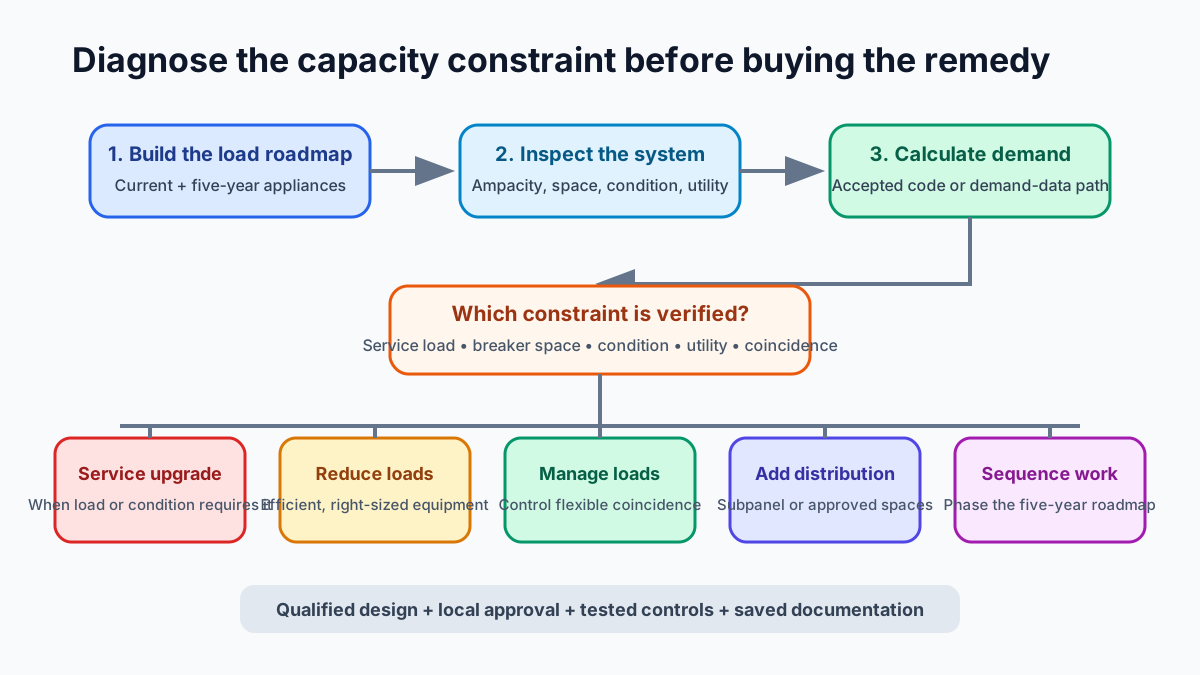
The Capacity Decision Path
Use this order:
- Inventory current and future loads. Include the five-year roadmap, not just today's appliance.
- Inspect equipment and utility context. Identify condition, ratings, space, and utility constraints.
- Reduce avoidable demand. Right-size HVAC and consider efficient appliances before calculating the final design.
- Perform the accepted load calculation. Use measured demand when the code and authority permit it.
- Identify the actual constraint. Ampacity, spaces, condition, utility, or a combination.
- Compare compliant remedies. Upgrade, subpanel, circuit sharing, managed load, appliance change, or project sequence.
- Coordinate permits and utility work. Confirm ownership and schedule before deposits.
- Commission controls and update documents. Test priorities, labels, monitoring, and failure behavior.
Skipping the inventory is how a new EV circuit can make a later heat-pump project unnecessarily difficult.
Efficiency Is a Capacity Strategy
Envelope improvements do more than lower bills. They can reduce the design heating and cooling load, which can reduce compressor size, backup resistance capacity, duct requirements, and peak electrical demand.
The sequence is especially important for heat pumps:
- diagnose air leakage and insulation;
- define improvements that will be completed;
- calculate the post-improvement room loads;
- select equipment from performance data;
- enter the actual compressor and backup loads in the electrical plan.
A rule-of-thumb four-ton heat pump with large strip heat can create a very different electrical scope from a right-sized variable system with staged backup. Read the heat-pump sizing guide before treating an HVAC sales quote as a load input.
Efficient water heaters and dryers can also change the plan. Evaluate recovery time, household schedule, climate, noise, space, and condensate - not just nameplate power. For laundry, use the heat-pump dryer versus vented dryer worksheet to compare the exact circuit with capacity, cycle time, drainage, room conditions, and avoided exhaust work.
EV Charging: Size for the Driving Need
Many households do not need the highest available charging rate. Start from daily energy:
- estimate average and high-day driving distance;
- use a conservative vehicle efficiency;
- calculate energy that must be replaced;
- identify hours the vehicle is parked;
- add a reasonable charging-loss allowance;
- select the lowest practical charging power with enough recovery margin.
If a vehicle needs 15 kWh restored over ten overnight hours, the energy requirement does not by itself justify an 11.5 kW charger. Lower-power Level 2 or even Level 1 may meet the actual schedule, depending on vehicle, climate, commute, and off-peak window.
Managed charging can reduce or pause charging when household load is high. Confirm that the proposed device is listed for its purpose, accepted locally, compatible with the charger and service, and configured with a clear priority order.
The Level 1 versus Level 2 guide helps translate driving needs into a charging plan.
Load Management, Circuit Sharing, and Smart Panels
DOE identifies smart panels, load management, and digital circuit controls as tools that can help coordinate home loads and, in some cases, avoid costly upgrades. NREL research also evaluates low-power appliances, load shedding, circuit-sharing devices, batteries, and energy-management systems as alternatives under service constraints. The 100-amp smart-panel and load-management guide compares those architectures, failure modes, and commissioning evidence.
These options are not interchangeable.
Dedicated load-management controller
A controller monitors service or circuit demand and disables or reduces a flexible load when a threshold is reached. It may be a focused solution for EV charging, water heating, or another controllable appliance.
Circuit-sharing controller
A listed device can allow two loads to use one suitable circuit under controlled noncoincident operation. A common concept is sharing where one appliance receives priority and the second operates only when the first is idle. Exact applications and permissions depend on products and local rules.
Smart panel or smart breakers
These can provide circuit monitoring, remote control, prioritized shedding, solar-and-battery coordination, or backup-load selection. They may offer valuable resilience and visibility, but a premium panel is not required for every capacity problem.
Appliance-integrated controls
Some chargers, water heaters, batteries, and HVAC systems can respond to schedules or signals. Confirm whether the feature is fail-safe and accepted as part of the formal capacity solution rather than merely a convenience setting a user can override.
For each option ask:
- Is it listed and approved for this exact application?
- Which loads are controlled, and in what order?
- What happens after internet, sensor, or controller failure?
- Can occupants override it, and does that affect compliance?
- Is monitoring local or cloud-dependent?
- Are subscriptions required?
- Who supports firmware and replacement parts?
- Will the authority and utility accept it?
- Does it preserve future solar, battery, or generator plans?
The existing smart-panel and load-shedding guide covers the technology tradeoffs. This article focuses on when it belongs in the capacity decision.
Panel Space Is Not Service Capacity
A panel can have adequate calculated load capacity but no approved breaker positions. Possible remedies may include:
- a subpanel fed from an appropriately sized breaker;
- approved tandem or quad breakers where the specific panel permits them;
- consolidation during removal of obsolete circuits;
- replacement with a larger panelboard while retaining the existing service rating;
- a broader service upgrade.
Only the last option necessarily increases service ampacity, and even it may require utility-side changes. The electrician should explain which limitation is being solved.
Similarly, an apparently empty space is not proof that capacity exists. The service calculation, bus and breaker rules, conductor ratings, panel labeling, and equipment condition still apply.
When a Full Service Upgrade Makes Sense
A service upgrade may be the clearest choice when:
- the accepted calculation shows insufficient capacity after reasonable design optimization;
- the existing panel is damaged, corroded, obsolete, or improperly modified;
- the planned household loads are genuinely large and concurrent;
- local rules, the utility, insurer, or project conditions require replacement;
- the meter or service equipment must move during a major renovation;
- a large addition materially changes the dwelling;
- available management options are incompatible, unsupported, or poor for the household;
- future flexibility is worth the additional cost and disruption.
The scope can extend beyond the panelboard. It may include service entrance conductors, meter equipment, grounding and bonding, mast or trench work, utility disconnect and reconnect, transformer review, wall repair, permits, inspections, surge protection, and labeling.
Ask which items are firm, allowances, exclusions, or utility charges.
When an Upgrade May Be Avoidable
An upgrade may be avoidable when the problem is only breaker space, accepted demand data shows sufficient headroom, planned loads can be reduced, flexible loads can be managed, or projects can be sequenced.
NREL's work on equitable electrification is important because service upgrades can be a major barrier. Its research does not mean every 100 A home can electrify unchanged. It supports a more careful conclusion: many homes deserve analysis of efficiency and management options before an upgrade is assumed.
Avoidance is not the only measure of success. A simple, durable service upgrade may be preferable to stacking several controls in a household that wants maximum simultaneous use and minimal operational complexity. Compare lifecycle support and usability, not just first cost.
Solar, Batteries, and Backup Change the Architecture
Solar and batteries introduce generation, charging, export, islanding, and backup-load decisions. A battery can sometimes support demand management, but it is not free service capacity, and its ability to reduce peaks depends on power rating, state of charge, controls, and approved design.
Before electrical work, define:
- grid-connected solar now or later;
- whole-home versus selected-load backup;
- critical-load panel requirements;
- EV bidirectional charging plans;
- generator interlock or transfer equipment;
- battery charging power;
- utility export and interconnection rules;
- panel locations and conductor pathways.
Retrofitting these after a rushed panel replacement can duplicate labor. Conversely, do not buy an expensive “future-ready” architecture without a credible project roadmap.
Canada, the United States, and Europe
The decision framework travels; the code calculation does not.
In the United States, the locally adopted National Electrical Code edition, amendments, utility rules, and authority having jurisdiction govern. DOE materials describe common U.S. calculation pathways, but local acceptance must be confirmed.
In Canada, the Canadian Electrical Code, provincial or territorial adoption, local inspection authority, and utility requirements apply. Service terminology may look similar while demand rules and approval processes differ.
Across Europe and the United Kingdom, service arrangements, phase configuration, voltage, main fuses, distribution boards, diversity calculations, network-operator processes, and EV or heat-pump notification rules vary by country. Do not translate a U.S. 100 A versus 200 A discussion directly.
For any jurisdiction, request the calculation and rule citation used for the actual address.
Quote Comparison Table
| Scope item | Quote A | Quote B | Why it matters |
|---|---|---|---|
| Existing service and panel condition documented | Separates capacity from replacement need | ||
| Calculation method attached | Makes conclusion reviewable | ||
| Five-year load roadmap included | Prevents rework | ||
| Exact appliance loads used | Avoids generic allowances | ||
| Efficiency or lower-power alternatives evaluated | May reduce capacity and cost | ||
| Management sequence and failure mode | Determines usability and compliance | ||
| Utility work and fees | Can dominate schedule and price | ||
| Permit and inspection | Clarifies responsibility | ||
| Grounding, bonding, and surge scope | Avoids incomplete proposals | ||
| Solar, battery, and generator coordination | Preserves future architecture | ||
| Wall, trench, or finish repair | Reveals exclusions | ||
| Labels, commissioning, and owner training | Makes controls maintainable |
Compare a complete managed-load proposal with a complete service-upgrade proposal. Comparing one device price against an entire electrical project produces a false bargain.
Project Sequencing Checklist
Before appliance selection
- Create current and five-year load inventories.
- Collect twelve months of bills and available interval-demand data.
- Document panel, service, meter, and large-appliance labels.
- Decide which gas or oil equipment will remain as backup.
- Define solar, battery, EV, and generator intentions.
- Complete envelope diagnostics that could change HVAC size.
Before signing electrical work
- Obtain the accepted load calculation.
- Separate service ampacity, breaker space, condition, and utility constraints.
- Confirm exact appliance nameplates and backup heat.
- Compare upgrade and management alternatives.
- Confirm permits, inspection, utility scheduling, and fees.
- Confirm listed equipment and local acceptance.
- Document control priorities and failure behavior.
At completion
- Label every new circuit and managed load.
- Test load-control behavior under simulated priority conditions.
- Save permits, inspection records, calculations, manuals, and photos.
- Update the panel directory.
- Record monitoring access without placing credentials in shared documents.
- Revisit the roadmap before adding the next major load.
Common Sales Shortcuts
“Every electric home needs 200 amps”
Service need depends on calculated or accepted measured demand, appliance choices, management, and local rules. Some homes need more; some do not.
“There are no spaces, so capacity is gone”
Breaker space and service ampacity are separate. Diagnose both.
“A smart panel gives unlimited capacity”
Controls coordinate loads within ratings and rules. They do not create energy or repair inadequate equipment.
“Just add the breaker sizes”
Breaker handles are not a dwelling demand calculation. Request the recognized method.
“Your monthly kWh proves the service is fine”
Monthly energy does not show peak demand. Use accepted interval-demand evidence or a code calculation.
“The battery will cover it”
A battery's power, energy, controls, state of charge, and approved operating mode determine what it can do. Treat it as engineered equipment, not a blanket capacity credit.
Frequently Asked Questions
Can a 100 A service support a heat pump and EV charger?
Sometimes. The answer depends on existing loads, heat-pump compressor and backup ratings, charging power, accepted calculation method, and management options. Obtain a whole-dwelling calculation using exact equipment.
Does a subpanel increase available power?
No. A subpanel creates circuit-distribution space within the capacity of its feeder and the overall service. It can solve a space or location problem but does not increase service ampacity.
Can utility data replace a traditional load calculation?
In some existing-dwelling situations, an adopted code and local authority may accept a demand-history method. Data interval, duration, adjustments, and added-load treatment matter. The electrician must confirm local acceptance.
Is a smart panel required for load management?
No. Dedicated listed controllers and circuit-sharing products may address specific loads. A smart panel can offer broader monitoring and control but should be justified by the project.
Should I upgrade before installing solar?
Coordinate them before choosing. Solar interconnection, bus ratings, equipment locations, batteries, and future backup topology can influence panel design. The best sequence is site-specific.
What if the HVAC contractor and electrician use different load assumptions?
Pause and reconcile them. The HVAC contractor should provide exact equipment and auxiliary-heat electrical data. The electrician should use those values in the dwelling calculation. A placeholder “future heat pump” can materially distort the result.
Is load management inconvenient?
It depends on which loads are controlled. Pausing EV charging for short periods may be invisible when the car is parked overnight. Interrupting cooking, comfort, or medical equipment would be a poor priority. Design around household needs and test the sequence.
How do I plan if I will electrify over several years?
Create a one-page load roadmap with likely equipment, timing, power, location, and flexibility. Update the calculation as exact products are chosen. Install pathways and space where cost-effective, but avoid buying speculative equipment without a defined need.
What to Read Next
Use the home electrification blueprint to sequence end uses, then take exact HVAC loads from the heat-pump sizing guide. If cooking is part of the plan, scope the exact model with the induction range installation guide. Compare dedicated controls with the smart electric-panel guide, and right-size vehicle charging with the Level 1 versus Level 2 guide.
Sources and Method
This guide synthesizes DOE homeowner and training material with NREL research on service constraints, efficient appliances, and load-management alternatives. It intentionally avoids a universal service-size recommendation. Electrical codes, adopted editions, utility processes, product listings, incentives, and professional licensing vary by jurisdiction and can change; verify every project at the address before purchase.
Sources and Verification
Editorial Review
EnergyBS Editorial Team
EnergyBS publishes practical homeowner guides. Important program, product, and cost claims should be checked against the linked source and local project documents before you commit to work.
Related Guides
View All ArticlesElectrical Panel Upgrade Cost 2026: What a 100 to 200 Amp Upgrade Runs
Upgrading an electrical panel from 100 to 200 amps costs $1,300$4,200 installed in the US in 2026 depending on market and scope, and C$2,500$4,500 in Ontario. This guide breaks down cost by upgrade path, what a legitimate quote includes, when 200 amps is genuinely needed, and when load management avoids the upgrade entirely.
Smart Panel or Load Management? Electrifying a 100Amp
Compare a service upgrade, lowerpower appliances, managed EV charging, circuit sharing, targeted load controls, and a smart panel for a 100amp electrification plan.
Tankless Water Heater Installation Cost 2026: Prices, AddOns and Payback
A tankless water heater costs $1,400$5,600 installed in the US in 2026, and C$2,800$6,500 for a typical Canadian gas install. This guide breaks down unit, labor, venting, gasline and panel addons, sizes the unit, and runs 20year payback math with stated assumptions against a new tank.