Tankless Water Heater Installation Cost 2026: Prices, AddOns and Payback
A tankless water heater costs $1,400$5,600 installed in the US in 2026, and C$2,800$6,500 for a typical Canadian gas install. This guide breaks down unit, labor, venting, gasline and panel addons, sizes the unit, and runs honest 20year payback math against a new tank.
Quick Checks
- 1Budget $1,400-$5,600 installed in the US for a whole-home tankless water heater in 2026; gas runs $2,100-$5,600 and electric $1,400-$3,000.
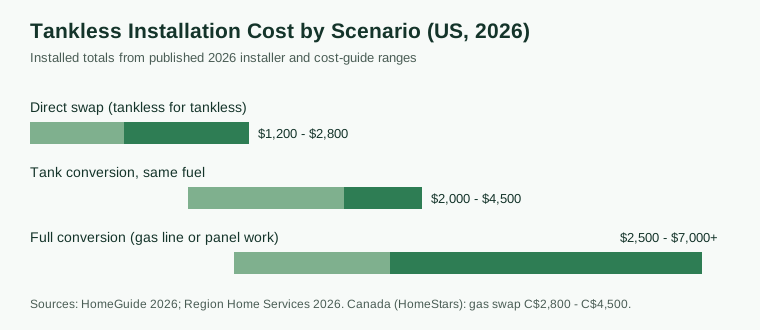
- 2The install scenario drives the bill more than the brand: a direct swap can be $1,200-$2,800, while a full conversion with gas-line or panel work reaches $2,500-$7,000 or more.
- 3In Canada, a gas tankless replacing a gas tank with compatible venting typically runs C$2,800-$4,500 installed; a condensing model with new venting is C$4,000-$6,500.
- 4The federal 25C credit no longer applies to tankless units installed in 2026, so any quote that shows a 30% federal offset is working from outdated rules.
- 5Buy tankless for endless hot water, space and a 15-20 year lifespan, not for a fast energy payback - for average-use homes the energy math against a new tank is close to a wash.
Tankless Water Heater Installation Cost 2026: Prices, Add-Ons and Payback
By EnergyBS Editorial Team | October 2, 2026
The Short Answer: What a Tankless Water Heater Costs Installed
Short Answer: In 2026, a whole-home tankless water heater costs $1,400 to $5,600 installed in the United States, according to HomeGuide's 2026 cost data. Gas models run $2,100 to $5,600 installed, electric models $1,400 to $3,000, and propane $1,600 to $4,500. In Canada, HomeStars puts a straightforward gas-for-gas replacement at C$2,800 to C$4,500 installed, rising to C$4,000 to C$6,500 for a condensing model with new venting, and C$5,000 to C$10,000 when the gas line also needs upgrading.
The spread is wide because the water heater itself is only part of the invoice. HomeGuide estimates the unit at roughly 40% to 45% of the total project cost, with installation labor, supplies and permits adding another $800 to $3,000. Region Home Services, an installer that publishes its 2026 pricing, lands in the same place: $1,200 to $5,500 total, with most homeowners paying $2,400 to $5,400 for a complete job. What your house already has - gas line size, vent path, panel capacity - matters more than the badge on the box.
This guide breaks the price down line by line, covers the three install scenarios that explain most quote differences, sizes the unit for cold-climate flow rates, and runs the 20-year ownership math against simply buying another tank. For the technology comparison itself - flow, recovery, and how each type behaves in daily use - see our tankless vs tank water heater comparison.
1. Tankless Installation Cost at a Glance
HomeGuide's 2026 US figures, by fuel type:
| Fuel type | Unit price | Total installed cost |
|---|---|---|
| Electric | $600 - $1,000 | $1,400 - $3,000 |
| Propane | $1,000 - $2,000 | $1,600 - $4,500 |
| Natural gas | $1,500 - $2,600 | $2,100 - $5,600 |
A few reference points that keep quotes honest:
- A whole-house unit costs $600 to $2,600 before installation. A single-point unit for one faucet costs $150 to $250.
- Installation labor runs $600 to $2,500 for 3 to 10 hours of work, and the unit itself is only about 40% to 45% of the total job price.
- Plumbers and HVAC technicians charge $75 to $150 per hour on average in the US; electricians charge $50 to $130 per hour, plus a service call fee.
- Non-condensing units cost about 25% less to install than condensing units, because condensing models need PVC venting and a condensate drain while non-condensing models vent hotter exhaust through metal.
Where does your quote sit? A basic electric unit replacing an old electric tank, with the panel already able to carry it, belongs near the bottom of the range. A condensing gas unit with a long vent run, a gas-line upsize and a permit belongs near the top. Neither number is wrong - they are different jobs.
2. What the Installed Price Actually Covers
A complete tankless quote has seven or eight cost lines. The lowest bid in a stack is usually the one missing several of them. Region Home Services itemizes a typical 2026 job like this:
| Line item | Typical 2026 range | Notes |
|---|---|---|
| The unit | $500 - $2,800 | Electric at the bottom, condensing gas at the top |
| Labor | $800 - $2,500 | Tankless takes 6 to 10 hours against 2 to 4 for a tank swap |
| Gas line upsizing | $400 - $2,000 | Depends on run length and distance back to the meter |
| Venting | $300 - $800 | Stainless or PVC depending on whether the unit condenses |
| Permit and inspection | $50 - $400 | Required in most jurisdictions for gas and water heater work |
| Old tank removal and disposal | $50 - $500 | Confirm it is included rather than assumed |
| Condensate drain or pump | $100 - $300 | Condensing units produce acidic condensate that needs routing |
| Expansion tank | $50 - $350 | Often required by code on closed systems |
HomeGuide's numbers tell the same story from a different angle: unit $600 to $2,600, labor $600 to $2,500, additional supplies $150 to $300, permits $50 to $200. The two sources disagree at the edges because they sample different markets, but the structure is identical - labor and infrastructure work together are half or more of a typical bill. HomeStars says the same for Canada: labor and venting together typically account for more than half the total cost.
Two add-ons are worth requesting even when code does not force them. Isolation valves with flush ports add a modest amount at install and turn annual descaling into a routine task instead of a plumbing call. A condensate neutralizer protects drain lines from the acidic discharge of a condensing unit. Both are cheaper on day one than as retrofits.
3. The Three Install Scenarios That Set the Price
Region Home Services groups nearly every residential tankless project into three scenarios, and identifying yours narrows the estimate more than any other question:
| Scenario | Typical installed cost | What is involved |
|---|---|---|
| Direct swap: tankless replacing tankless, same fuel and location | $1,200 - $2,800 | Existing gas line, venting and mounting are reused after inspection |
| Conversion from a storage tank, same fuel type | $2,000 - $4,500 | Wall mounting, new venting, gas line sizing check, condensate routing, tank removal |
| Full conversion: fuel change, gas line upsizing, or electrical panel work | $2,500 - $7,000+ | Everything above plus new gas piping, a rerouted vent path, or a service upgrade |
Ask any contractor which scenario they are quoting before you compare numbers. Two bids that differ by $3,000 are often pricing two different jobs, and the cheaper one is frequently the one that has not yet discovered the gas line is undersized.
The single most common surprise is gas capacity. A storage tank might run happily on a half-inch line at 40,000 BTU, while a whole-home tankless unit can demand 150,000 to 199,000 BTU and need three-quarter-inch pipe back to the meter. HomeGuide puts gas line work at $350 to $2,000, and notes that the old tank's exhaust vent cannot be reused for a tankless unit - replacing the vent adds $100 to $600. If a quote is silent on venting and gas sizing, it is not a complete quote.
4. Gas vs Electric: Installed Cost and Running Cost
Electric tankless units cost less to buy and are routinely described as the simpler installation. That holds for point-of-use models and breaks down for whole-home ones.
A point-of-use electric unit serving a single sink or a remote bathroom is genuinely straightforward: a dedicated circuit, no venting, hours rather than a full day. A whole-home electric unit is a different proposition. Units in that class commonly draw 24 to 36 kW and require multiple double-pole breakers, heavy-gauge wiring and, in many homes, a 200-amp service. HomeGuide prices a dedicated electrical circuit at $250 to $900 and a full panel replacement at $850 to $1,700 when the existing panel cannot support the heater. Region Home Services puts a service upgrade triggered by an electric tankless install at $500 to $2,000 or more - which erases the equipment savings and then some. If your home needs that work anyway, our electrical panel upgrade cost guide breaks down 2026 pricing, and the panel capacity guide explains how to tell what your current service can carry.
Gas units cost more upfront but carry higher flow rates, which matters in a house running two showers and a dishwasher at once, and they usually cost less to run where natural gas is cheaper per delivered BTU than electricity. HomeGuide's annual energy cost estimates:
| System | Annual energy cost |
|---|---|
| Gas tankless | $220 - $480 |
| Electric tankless | $340 - $540 |
| Gas tank | $250 - $420 |
| Electric tank | $530 - $600 |
The practical rule: if your home already has gas service and a reasonable vent path, gas is usually the lower total cost over the life of the equipment. If it does not, price the electrical work before assuming electric is the cheaper route. Our gas vs electric water heater operating cost comparison runs the same comparison for tank models if you are deciding on fuel before deciding on format.
5. Condensing vs Non-Condensing
Both types heat water on demand. The difference is what happens to the exhaust.
Condensing units add a secondary heat exchanger that captures heat from the exhaust gases before they leave. That makes them the most efficient gas option, and it is why they need PVC venting and a condensate drain - the exhaust is cool enough for plastic pipe but produces acidic water that has to go somewhere. Non-condensing units skip the second exchanger, vent hot exhaust directly, and cost about 25% less to install according to HomeGuide, at the price of higher fuel use every year the unit runs.
In Canada, HomeStars notes that choosing a condensing model typically pays back its higher upfront cost through lower gas bills within a few years in households with high daily hot water use, while a low-use household may never recover the premium. That matches the general shape of the decision: the more hot water you move, the more the efficient unit earns its keep.
6. Canada Pricing
HomeStars publishes Canadian installed ranges by scenario:
| Installation scenario (Canada) | Typical installed cost |
|---|---|
| Gas tankless replacing an existing gas tank, compatible venting | C$2,800 - C$4,500 |
| Gas tankless, condensing model with new PVC venting | C$4,000 - C$6,500 |
| Gas tankless with gas line upgrade required | C$5,000 - C$10,000 |
| Electric tankless, no panel upgrade required | C$800 - C$2,500 |
| Electric tankless with panel upgrade required | C$2,500 - C$4,500 |
| Propane tankless | C$3,500 - C$7,000 |
Canadian specifics worth knowing before you book:
- Switching from a storage tank in a home without a dedicated high-capacity gas supply line adds C$500 to C$1,500 to the project.
- Electric models often trigger a panel upgrade, adding C$500 to C$2,000.
- Plumber labor runs C$80 to C$150 per hour, and permits budget C$100 to C$500 depending on the municipality.
- Several provincial governments and natural gas utilities offer rebates for high-efficiency tankless units, and most require a pre-approval application before installation starts. Confirm what applies in your area before booking - eligibility confirmed after the fact rarely qualifies.
- Gas appliance installation in Canada requires a licensed gas technician, and most municipalities require a permit and inspection. This is not a DIY project in either country once gas or panel work is involved.
7. Sizing: Flow Rate and Temperature Rise
Tankless units do not run out of hot water, but they can be outrun. Sizing has two halves: how much hot water you draw at once (gallons per minute, GPM), and how far the unit has to lift the temperature of your incoming water.
HomeGuide's simultaneous-use guidance:
- 1 to 2 fixtures (shower plus sink): 3.5 GPM minimum
- 2 to 3 fixtures (shower, sink, dishwasher): 5 GPM recommended
- 3 to 4 fixtures (multiple showers plus laundry): 7 GPM or higher
Temperature rise matters as much as the nameplate rating. A unit rated at 9 GPM at a 35-degree rise delivers far less at the 65-to-70-degree rise a cold-climate winter demands. HomeStars, sizing for Canadian groundwater, suggests a one- or two-person household typically needs a unit rated at 6 to 8 GPM, and a household of four or more should look at 9 to 12 GPM - precisely because Canadian incoming water runs colder in winter. Electric units are hit hardest by this: HomeGuide lists limited cold-weather performance and limited flow capacity among the electric drawbacks, which is why gas carries the practical edge for large northern households running multiple fixtures at once.
Undersizing is the most common tankless complaint, and it is a quoting failure, not an equipment failure. Have the installer state the assumed flow rate and temperature rise in writing.
8. Tankless vs a New Tank: The 20-Year Math
Here is the honest version of the payback question. A new tank costs $600 to $3,100 installed according to HomeGuide, against $1,400 to $5,600 for tankless. Tankless also carries maintenance a tank mostly skips: an annual descaling flush runs $100 to $250 in the US according to Region Home Services, and C$150 to C$300 in Canada according to HomeStars. Against that, tankless units last 15 to 20 years against 8 to 12 for a tank, so one tankless unit covers the period in which you would buy two tanks.
Worked example - hypothetical, using figures inside the published ranges above. A US home with gas service loses its 50-gallon tank and gets two quotes: a replacement tank at $1,700 installed, or a condensing gas tankless at $4,300 installed. Both are mid-range quotes from the tables in this guide. Assume the tank costs $390 a year in gas and the tankless $310 a year, both inside HomeGuide's published annual ranges:
- Tank path over 20 years: two tanks (the second bought around year 10) at $1,700 each is $3,400, plus 20 years of energy at $390 is $7,800. Total: $11,200.
- Tankless path over 20 years: $4,300 installed, plus 20 years of energy at $310 is $6,200, plus descaling. With a professional flush every year at $150, maintenance adds $3,000, for a total of $13,500. With the flush done by the homeowner using a pump and descaling solution - the valves requested in Section 2 make this a routine task - maintenance drops to a few hundred dollars over the period, and the total lands near $11,000.
The conclusion is not that tankless never pays. Region Home Services puts break-even against a storage tank between year eight and year ten, which is what the numbers above reproduce when maintenance stays cheap and hot water use is high. The conclusion is that the payback is conditional: high simultaneous demand, infrastructure already in place, a long stay in the home, and maintenance handled inexpensively. Buy tankless for endless hot water, the freed-up floor space, and a 15-to-20-year service life. If a salesperson pitches it as a money machine for an average-use household, ask to see their arithmetic. A straight tank replacement is the better call if you are selling within five years or the conversion quote lands at the top of the range because of gas or electrical work - paying $6,000 to save $200 a year does not pencil out on a house you are leaving.
9. Rebates and the End of the Federal Credit in 2026
One line to check on every 2026 quote: the federal tax credit is gone. The Energy Efficient Home Improvement Credit under Section 25C, which covered part of a qualifying tankless installation, was terminated for property placed in service after December 31, 2025. Region Home Services flags the same point from the installer side: a great deal of published guidance still promises 30% back, and a contractor proposal that shows a federal credit as an offset on a 2026 installation is working from outdated rules. Our 25C vs 25D explainer covers what ended and what can still be claimed for 2025 projects.
What remains: state energy office rebates, typically $200 to $1,000 on qualifying high-efficiency equipment with rules that vary by state, and local utility incentives, often $100 to $500 for ENERGY STAR certified units. In Canada, HomeStars notes Ontario, British Columbia and several natural gas utilities run incentives that usually require ENERGY STAR certification and a pre-approval application before installation. These programs change more often than federal ones and are rarely well advertised, so check your state or provincial energy office and your utility directly before assuming nothing is available.
10. How to Compare Tankless Quotes
A quote worth comparing names the exact model, states which install scenario it assumes, and itemizes the work. Ask for these lines explicitly:
- Unit model and its flow rating at your winter temperature rise, not the headline GPM.
- Labor, stated separately from the unit price.
- Venting: material, route, and whether the old flue is being abandoned or removed.
- Gas line: current size, required size, and the cost if upsizing is needed.
- Electrical: dedicated circuit or panel work for electric units, priced separately.
- Condensate routing and neutralizer for condensing units.
- Permit and inspection: who pulls it, and whether the fee is included.
- Old tank removal and disposal.
- Isolation valves with flush ports, and the descaling plan for year one.
- Labor warranty length, separate from the manufacturer's warranty on the unit.
A quote that shows a single number labeled "installation included" cannot be compared against anything, because you cannot see which of those items it covers. Three itemized quotes, from installers who sized the unit against your winter groundwater temperature, will tell you more than any advertised starting price. Installation itself is quick once the scope is right: HomeStars puts a straightforward gas-for-gas swap at three to five hours, with venting, gas-line or panel work stretching the job to a full day or more.
Frequently Asked Questions (FAQ)
How much does it cost to install a tankless water heater in 2026?
HomeGuide puts the US total at $1,400 to $5,600 installed: gas $2,100 to $5,600, electric $1,400 to $3,000, propane $1,600 to $4,500. Region Home Services reports $1,200 to $5,500, with most homeowners paying $2,400 to $5,400. In Canada, HomeStars lists C$2,800 to C$4,500 for a gas unit replacing a gas tank with compatible venting, and C$4,000 to C$6,500 for a condensing model with new venting. Your position in the range is set mostly by the install scenario: direct swap, tank conversion, or full conversion with gas-line or panel work.
Is a tankless water heater worth the higher upfront cost?
It depends on hot water demand, infrastructure and how long you stay. Tankless units last 15 to 20 years against 8 to 12 for a tank, and HomeStars notes gas condensing models can reduce water heating bills by 20 to 30 percent annually. But the worked example in this guide shows the 20-year cost is close to a wash for an average-use household once descaling is paid for. Tankless earns its premium in high-demand households, homes whose gas line and venting already suit it, and anywhere the tank's floor space is worth reclaiming.
How long does a tankless water heater last?
HomeGuide rates tankless lifespan at 15 to 20 years with proper maintenance, against 8 to 12 years for a traditional tank. Maintenance is the condition: HomeStars warns that without a scale filter at installation, mineral buildup can shorten the unit's lifespan by several years and reduce efficiency noticeably, notably in hard-water regions such as much of Alberta, Saskatchewan, Manitoba and parts of Ontario. An inline scale filter costs C$200 to C$700 at installation.
Can I install a tankless water heater myself?
For gas units, no. HomeStars states that gas appliance installation in Canada requires a licensed gas technician, with a permit and inspection in most municipalities; improper installation creates carbon monoxide risks and can void the manufacturer warranty. Electric tankless installs involving panel work similarly require a licensed electrician. Swapping like-for-like electric units is the only scenario that sometimes falls to experienced DIY, and local permit rules still apply.
Does an electric tankless water heater need a panel upgrade?
Often, yes. Whole-home electric tankless units commonly draw 24 to 36 kW across multiple double-pole breakers, and many homes need a 200-amp service to carry one. HomeGuide prices a dedicated circuit at $250 to $900 and a full panel replacement at $850 to $1,700; Region Home Services puts a triggered service upgrade at $500 to $2,000 or more. HomeStars gives the Canadian version of the same line: C$800 to C$2,500 installed without panel work, C$2,500 to C$4,500 with it. Price the electrical work before assuming electric is the cheaper route.
How long does a tankless installation take?
HomeStars: a straightforward gas-for-gas swap with compatible venting and gas supply typically takes three to five hours. Installs requiring new venting routes, a gas line upgrade or panel work can take a full day or more. Region Home Services notes the labor difference against a tank swap: 6 to 10 hours for tankless against 2 to 4 for a like-for-like tank replacement.
What maintenance does a tankless water heater need?
Descaling is the recurring task. Mineral buildup inside the heat exchanger reduces efficiency and output, and HomeStars puts professional descaling at C$150 to C$300 a year, with an annual general inspection recommended to maintain the warranty. Region Home Services gives $100 to $250 for the yearly flush in the US and notes that in hard water areas, skipping it shortens heat-exchanger life considerably. Isolation valves with flush ports, requested at install time, make the flush a routine job rather than a service call.
What to Read Next
- Tankless vs. Tank Water Heaters - the technology comparison: peak flow, first-hour rating, venting and distribution delay
- Gas vs Electric Water Heater Operating Cost - running costs by fuel before you pick a format
- Electrical Panel Upgrade Cost 2026 - what a 100 to 200 amp upgrade runs when an electric unit needs more service
- Electrical Panel Capacity for Electrification - how to tell what your current panel can actually carry
Sources and Verification
- HomeGuide Tankless Water Heater Installation Cost (2026 US unit, labor and installed ranges)
- Region Home Services Cost of Tankless Water Heater Installation in 2026 (install scenarios, line items, 25C status)
- HomeStars Tankless Water Heater Cost in Canada 2026 (installed scenarios, labor, maintenance)
Editorial Review
EnergyBS Editorial Team
EnergyBS publishes practical homeowner guides. Important program, product, and cost claims should be checked against the linked source and local project documents before you commit to work.
Related Guides
View All ArticlesTankless vs. Tank Water Heaters 2026 Tool (Guide & Data)
Compare tankless and storage water heaters using peak flow, inletwater temperature, firsthour rating, fuel and electrical capacity, venting, distribution delay, maintenance, and installed cost.
Gas vs Electric Water Heater Operating Cost Comparison
Compare gas, electric resistance, propane, and heat pump water heater operating costs using 2026 energyprice assumptions and practical installation tradeoffs.
Electrical Panel Upgrade Cost 2026: What a 100 to 200 Amp Upgrade Runs
Upgrading an electrical panel from 100 to 200 amps costs $1,300$4,200 installed in the US in 2026 depending on market and scope, and C$2,500$4,500 in Ontario. This guide breaks down cost by upgrade path, what a legitimate quote includes, when 200 amps is genuinely needed, and when load management avoids the upgrade entirely.