Insulation Types Compared (2026 Guide & Data)
Compare fiberglass, cellulose, mineral wool, spray foam, and rigid insulation by tested Rvalue, installed quality, air and moisture role, fire and health constraints, assembly location, serviceability, and verified project cost.
Direct Answer
Compare fiberglass, cellulose, mineral wool, spray foam, and rigid insulation by tested Rvalue, installed quality, air and moisture role, fire and health constraints, assembly location, serviceability, and verified project cost.
Choose the Assembly First, Then the Material
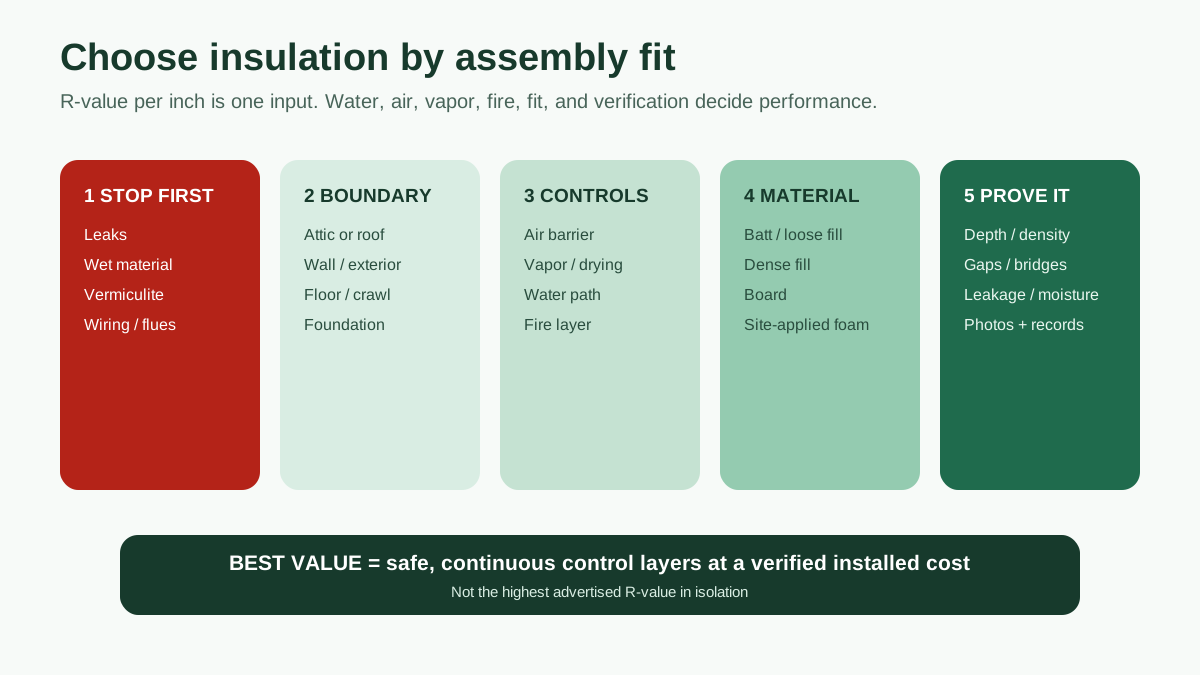
Short answer: There is no best insulation material for every house. First locate the intended air, thermal, water, and vapor-control layers. Then compare products that can be installed safely and continuously in that assembly. R-value per inch matters when space is tight, but coverage, gaps, compression, air leakage, moisture tolerance, fire protection, substrate condition, pest access, future service, climate, and total installed cost can matter more. Use the exact product's tested label and instructions rather than a generic material number.
The Physics of Heat Transfer
Here's the practical issue: Before you spend a single dollar on an HVAC upgrade, you must understand how your house loses energy. Heat always moves from warm areas to cold areas. In the winter, your expensive heated air tries to escape outside. In the summer, the blazing exterior heat tries to force its way into your air-conditioned living room.
Insulation works by trapping small pockets of air (or specific gases) to slow down this conductive heat flow.
What is R-Value?
R-value is the metric of thermal resistance. The "R" literally stands for Resistance. The higher the R-value, the better the material is at resisting heat transfer.
But R-value is not a linear metric; it operates on the law of diminishing returns. Upgrading an uninsulated attic from R-0 to R-11 will save you a massive amount of energy. Upgrading that same attic from R-38 to R-49 will yield much smaller incremental savings.
The Four Major Insulation Families
If you are planning a home energy retrofit in 2026, you are generally choosing between four primary categories of insulation. Each has specific use cases, costs, and R-values.
1. Fiberglass (Batts and Blown-in)
- R-Value: R-2.2 to R-2.9 per inch (Batts); R-2.2 to R-2.7 per inch (Blown)
- Best For: Unfinished walls, floors, and ceilings (new construction or open stud cavities).
Fiberglass is the pink fluffy stuff you see in most American homes. It is made from spun glass fibers.
The strengths: It is widely available in several forms and can perform well when fitted without gaps or compression. The limits: Compression, voids, wind washing, and poor fitting reduce assembly performance. Fibrous insulation is not the primary air barrier unless a tested system explicitly provides that function.
2. Cellulose (Blown-in)
- R-Value: R-3.1 to R-3.8 per inch
- Best For: Retrofitting existing enclosed walls, filling irregular attic spaces.
Cellulose is made from recycled paper products (mostly newsprint) treated with borate for fire and pest resistance.
The Pros: It is dense. When blown into an attic, it settles into every nook and cranny, providing a much better blanket than fiberglass batts. It is also highly eco-friendly due to its recycled content. The limits: Installation density and settled thickness matter. Do not install it over an unresolved leak or in an assembly that cannot manage moisture; product and assembly guidance control the location.
3. Spray Foam (Open-Cell and Closed-Cell)
- R-Value: R-3.7 per inch (Open-Cell); R-6.0 to R-7.0 per inch (Closed-Cell)
- Best For: Roof decks (unvented attics), rim joists, crawlspace walls, and maximizing R-value in shallow stud bays.
Spray polyurethane foam (SPF) is mixed on-site and sprayed into cavities where it expands and cures.
The strengths: Some tested spray-foam systems can provide insulation and air control at a specified thickness when correctly applied to suitable substrates. The limits: Product chemistry, substrate moisture and temperature, lift thickness, ratio, cure, worker and occupant protection, fire protection, future hot work, roof drying, inspection, and removal all matter. EPA documents isocyanate and other exposure concerns during installation (EPA SPF guidance).
4. Rigid Foam Board (EPS, XPS, Polyiso)
- R-Value: R-3.8 (EPS), R-5.0 (XPS), R-6.0 to R-6.5 (Polyisocyanurate) per inch
- Best For: Continuous exterior insulation, basement walls, slab foundations.
Rigid foam comes in solid sheets.
The Pros: It is structurally strong and provides continuous insulation (CI) over the outside of the framing, which breaks the "thermal bridge" (where heat escapes directly through the wooden studs). The Cons: It must be cut precisely to fit, and joints must be meticulously taped to provide an air barrier. Polyiso, while boasting the highest R-value, can actually lose performance in extreme cold.
Climate and Local Requirements
Use the adopted energy/building code and an assembly design for the jurisdiction. ENERGY STAR publishes U.S. retrofit recommendations by climate zone and existing condition, including different attic, floor, wall, basement, and crawlspace values (current table). Those recommendations are not automatically Canadian, European, or local code requirements.
Climate changes more than target R-value. It affects vapor drive, drying, rain and ground moisture, termite inspection, frost depth, wildfire and fire details, wind washing, and whether exterior insulation keeps sheathing warm enough. Get a wall, roof, or foundation section - not just an R-value line item.
The Air Sealing Prerequisite
Here is the most important takeaway of 2026 building science: Insulation without air sealing is like wearing a thick wool sweater on a windy day.
The wind will blow right through the wool, stealing your body heat. You need a windbreaker over the sweater.
Before adding attic insulation, inspect and air-seal priority bypasses using materials compatible with each opening and required fire/electrical clearances. This is not always a DIY foam-can job. ENERGY STAR says attic air sealing should precede added insulation and calls for combustion-safety testing after air sealing when fuel-burning equipment is in the attic (ENERGY STAR).
Compare Materials by Function, Not Marketing Name
| Material/form | Common retrofit role | Air-control role | Moisture question | Installation evidence |
|---|---|---|---|---|
| Fiberglass batt | open cavities, floors, ceilings | separate air barrier normally needed | keep dry; control wind washing | fit without gaps or compression |
| Blown fiberglass | open attic or dense-fill system | system-specific | settled depth and airflow | bag count, depth grid, density |
| Cellulose | attic or dense-packed cavity | can reduce airflow but isn't automatically the air barrier | water source and drying | installed density and depth |
| Mineral wool | cavities or some exterior boards | separate sealed layer normally needed | assembly-specific drying | fit, support, joint continuity |
| Open-cell SPF | site-specific cavity or roofline | may qualify at tested thickness | vapor and roof drying | substrate, thickness, cure, protection |
| Closed-cell SPF | tight spaces, rim, roof, foundation details | may combine air/vapor functions | drying direction and hidden leaks | lifts, thickness, adhesion, fire layer |
| EPS, XPS, or polyiso board | continuous exterior/interior details | sealed system may be air layer | facer, joints, temperature, ground contact | product data, fasteners, flashing |
DOE Building Science Education stresses a whole-house approach: insulation interacts with the air barrier, moisture control, and other building components (DOE).
Diagnose the Existing Assembly
Before requesting bids, record:
- wall, attic, roof, floor, rim, basement, or crawlspace location;
- intended conditioned-space boundary;
- framing depth and accessible area;
- existing material, thickness, gaps, compression, staining, and odor;
- roof, plumbing, foundation, or condensation moisture;
- air-leak paths and pressure-test evidence;
- ducts, wiring, flues, recessed lights, and service clearances;
- pest and fire-separation details;
- exterior water-control layers and planned siding or roof work;
- target R-value or code basis and dimensional limits.
Do not disturb unknown vermiculite. EPA advises homeowners to assume vermiculite insulation may contain asbestos and leave it undisturbed unless handled under appropriate assessment and abatement procedures (EPA).
Compare Whole-Assembly R-Value
A stud wall is not all insulation. Wood or metal framing, plates, headers, rim areas, windows, and fasteners create parallel heat-flow paths. Adding higher-R cavity material does not remove those bridges. Continuous exterior insulation can reduce framing heat flow, but it must integrate with windows, doors, cladding attachment, flashing, fire, and insect details.
Ask for:
- cavity R-value and installed quality;
- continuous-insulation R-value;
- framing fraction used in the whole-wall calculation;
- major thermal bridges;
- air-film and finish assumptions, if included;
- temperature-dependent material data where relevant;
- final assembly U-factor or effective R-value.
Do not add advertised R-values from layers that are discontinuous or compressed. And don't count reflective foil as if it provides a system value without the required adjacent air space. DOE notes that reflective systems need an air space to affect radiant transfer (DOE).
Select by Location
Open vented attic floor
Air-seal first, preserve soffit baffles, repair exhaust ducts, and keep fire/electrical clearances. Loose fill can cover irregular joists when installed to verified settled depth. Batts can work where access allows careful fitting. Use a depth grid and bag count rather than one photo near the hatch.
Enclosed wall retrofit
Probe for blocking, existing insulation, wiring, fire stops, moisture, and connected cavities. Dense-fill products require specified density and verification. Exterior continuous insulation may make more sense when siding is already being removed. Patch every installation hole with a complete water and air-control detail.
Basement or crawlspace
Fix bulk water, drainage, capillary sources, and humidity first. PNNL's basement guidance calls for moisture assessment before insulation and describes sealed rigid-insulation approaches for interior walls (PNNL). Local fire, termite, radon, flood, and ignition-barrier requirements matter.
Roofline or compact roof
Determine vented versus unvented design, roof condition, drying direction, vapor control, and any required above- and below-deck ratios. Spray foam is not an automatic roof repair. Document how future leaks will be detected and how the assembly complies with fire and roofing requirements.
Rim joist
Air leakage, cold surfaces, wood moisture, sill and foundation capillary paths, wiring, and termite inspection all meet here. Use the rim-joist guide to choose a detail rather than stuffing a generic batt into each bay.
Compare Quotes on the Same Boundary
| Quote field | Contractor A | Contractor B |
|---|---|---|
| Exact areas and exclusions | ||
| Existing material and moisture findings | ||
| Air, water, and vapor-boundary drawing | ||
| Product name, form, and tested R-value | ||
| Installed thickness or density and final R | ||
| Surface preparation and removals | ||
| Fire, electrical, and combustion clearances | ||
| Ventilation, baffle, flashing, and drainage details | ||
| Worker/occupant protection and re-entry | ||
| Inspection and performance test | ||
| Warranty and exclusions | ||
| Complete installed price |
Reject a quote that substitutes a brand nickname for product data or says “R-60” without final thickness and coverage. For spray foam, require batch and product information, substrate conditions, lift and thickness records, ventilation and re-entry instructions, plus the required thermal or ignition protection.
Calculate Improvement Without Invented Savings
For the same area and temperature difference, steady conductive heat flow is proportional to area × temperature difference ÷ R-value. Moving from R-10 to R-20 roughly halves that modeled component. Moving from R-40 to R-50 reduces it by a much smaller fraction.
The whole home's bill will not fall by those percentages. Windows, air leakage, ventilation, ducts, equipment, internal gains, weather, and fixed charges remain. Use local weather and utility rates in a transparent model. ENERGY STAR's national methodology estimates typical-house savings under specific air-sealing and insulation assumptions, not a guarantee for one project (methodology).
Keep low, base, and high cases. Compare the affected heating and cooling load with the complete installed price using the insulation payback guide.
Commission the Installation
Before finishes hide the work:
- Verify exact product labels and lot or bag counts.
- Measure depth or thickness at a defined grid.
- Confirm density where the system depends on it.
- Photograph gaps, penetrations, baffles, rim areas, and transitions.
- Confirm fire blocking, ignition or thermal barriers, and clearances.
- Test air leakage when it is part of the scope.
- Record sheathing or wood moisture at specified locations.
- Inspect exterior flashing and cladding details.
- Confirm ventilation and combustion safety after tightening.
- Store warranties, safety data, product sheets, and before/after results.
Use an Area and Thickness Ledger
Insulation quotes often use one total square-foot number even when the work contains several assemblies. Split the project:
| Area ID | Location | Gross area | Openings/exclusions | Net area | Product | Design thickness | Final R-value | Verification |
|---|---|---|---|---|---|---|---|---|
| A1 | main attic field | depth grid | ||||||
| A2 | eaves/top plates | photos/baffles | ||||||
| W1 | north wall | density/thermal scan | ||||||
| R1 | rim joists | thickness/probe | ||||||
| B1 | basement wall | seams/moisture |
This catches missing work around hatches, kneewalls, porch roofs, additions, and low eaves. It also prevents a contractor from averaging deep, easy attic areas with shallow eaves and calling the whole attic R-60.
For loose fill, record the manufacturer's minimum settled thickness, minimum bags for the covered area, and installed depth markers. For batts, record product width/thickness and photograph fitting around wiring, pipes, bracing, and boxes. For board, record layers, staggered joints, fastener/washer pattern, taped or sealed seams, and transitions at openings. For foam, record thickness at a defined sampling grid rather than relying on the thickest visible spot.
Audit the Air, Water, and Vapor Layers at Transitions
Most failures happen at edges:
- wall-to-roof and wall-to-foundation transitions;
- rim joist to above-grade wall;
- windows, doors, and service penetrations;
- attic hatches and kneewalls;
- roof valleys, dormers, and porch interfaces;
- slab edges and basement stairs;
- party walls, fire separations, and attached garages.
Mark each transition on a section drawing and assign the material that carries the air, water, thermal, and vapor function across it. “Foam the gaps” is not a transition detail. Sealants need compatible substrates, joint dimensions, backing where required, movement capacity, temperature range, and fire classification.
A blower-door result can show whole-building leakage change, but it does not prove every insulation cavity is full. Thermal imaging can reveal patterns under suitable temperature and pressure conditions, but it is not an R-value meter. Use each test for the question it can answer.
Plan for Future Work and End of Service
Insulation can make future roofing, wiring, plumbing, pest treatment, and structural inspection easier or harder. Ask:
- Can a roof leak be found before decay spreads?
- Can electricians access junctions without cutting unknown foam?
- Can termite inspection lines remain visible where required?
- Can damaged or wet material be removed locally?
- Are product and batch records available for later repair?
- Will re-roofing expose or destroy the insulation layer?
- Can the assembly dry after an unusual wetting event?
These questions can justify a slightly lower R-value-per-inch material that is easier to inspect, replace, or integrate. Life-cycle value includes serviceability and moisture consequence, not only modeled heat flow.
Worked Comparison: Two Attic Quotes
Quote A offers loose-fill insulation to a stated R-value but excludes air sealing, baffles, bath-fan repair, and depth markers. Quote B costs more and includes the ceiling bypass map, fire-safe sealing, outdoor bath-fan termination, baffles with wind dams, a material bag count, a depth grid, and seasonal moisture follow-up.
The correct comparison is not price per square foot of insulation. Normalize both to the same completed assembly. Add the missing scope to Quote A or remove it from Quote B, then compare. If attic frost already exists, Quote A may conceal the source and increase risk even though it has the cheaper nominal R-value.
The ledger should show separate prices for water repair, hazardous-material handling, air sealing, ventilation/exhaust correction, insulation, access platforms, testing, and finish repair. This lets the homeowner see which cost changes when the material changes.
Keep the pre-work utility baseline, indoor temperature settings, blower-door result, and comfort complaint map. Recheck them after the same season returns. A lower bill during milder weather is not proof of savings, and a warmer floor can be valuable even when whole-house kWh changes only modestly. Record any occupancy or equipment changes so the comparison does not credit insulation for an unrelated load reduction.
Frequently Asked Questions
Which insulation has the highest R-value per inch?
Some closed-cell spray-foam and rigid-foam products provide high labeled R-value per inch, but values vary by exact product and conditions. DOE lists multiple insulation families and stresses interaction with air and moisture control (DOE). Highest per inch is not automatically the best assembly.
Is spray foam always an air and vapor barrier?
No. Those properties depend on product, thickness, installation, and tested assembly. It also brings worker and occupant exposure plus fire-protection requirements; review EPA SPF safety guidance and exact manufacturer documents.
Can I add insulation over old insulation?
Often, if the existing material is dry, clean, compatible, and not blocking air sealing or safety work. Use the attic keep-or-remove guide and never disturb suspect vermiculite (EPA).
Does insulation stop air leakage?
Not automatically. ENERGY STAR recommends air sealing before attic insulation (ENERGY STAR). Some tested foam or sealed-board systems can serve as air barriers when installed to their requirements.
What attic R-value should I use?
Use the adopted local code and existing-condition assessment. ENERGY STAR's U.S. retrofit table varies by climate zone and current insulation; it is guidance, not a universal international requirement.
Is the highest-R quote the best value?
Not if it omits air sealing, coverage, moisture repair, fire safety, or installation verification. Compare the complete assembly, affected load, total installed cost, and measured acceptance.
What to Read Next
Before choosing by R-value per inch, use the insulation payback by climate guide to compare existing condition, affected load, air-sealing scope, and diminishing returns. Once the envelope scope is defined, read the heat-pump sizing guide so equipment selection reflects the post-retrofit home. For broader housing-market context, see BubbleWatch.ca without assuming a guaranteed resale premium.
Sources and Verification
Material-family, heat-flow, air-space, and assembly claims use DOE Building Science Education. U.S. retrofit targets and attic sequencing use ENERGY STAR's R-value table, attic guidance, and air-seal-first guidance. Vermiculite and spray-foam health cautions use EPA vermiculite guidance and EPA SPF safety guidance. Basement moisture sequencing uses PNNL. Exact product labels, assembly design, climate, code, and field condition govern.
About the Editorial Team EnergyBS reviews public program rules, product specifications, utility rates, and reader-facing cost assumptions. Treat savings figures as estimates until you verify local prices, permits, rebates, and contractor quotes.
Sources and Verification
- U.S. DOE Building Science Education: Types of Insulation
- ENERGY STAR: Recommended Home Insulation RValues
- ENERGY STAR: WellInsulated and Sealed Attic
- ENERGY STAR: Assess the Level of Opportunity
- U.S. EPA: Vermiculite Insulation Guidance
- U.S. EPA: Spray Polyurethane Foam Safety
- PNNL Building America: Basement Blanket Insulation
Editorial Review
EnergyBS Editorial Team
EnergyBS publishes practical homeowner guides. Important program, product, and cost claims should be checked against the linked source and local project documents before you commit to work.
Related Guides
View All ArticlesInsulation Payback by Climate: A Homeowner's Savings and Quote Worksheet
A climateaware method for estimating attic and envelope insulation payback without applying a generic savings percentage to the entire utility bill.
How Much Insulation Is Enough? RValue, Heat Loss, and
Choose an insulation target from climate guidance, existing wholeassembly performance, air leakage, moisture risk, installation access, and the marginal cost of each added Rvalue.
Should You Remove Old Attic Insulation or Add More on
Keep dry, clean insulation when it can remain part of a safe assembly; remove only what blocks air sealing or is wet, contaminated, damaged, or incompatible. Includes a quote and depthgrid worksheet.