WholeHouse Rewiring Cost 2026: Per Square Foot, by Access and by Room
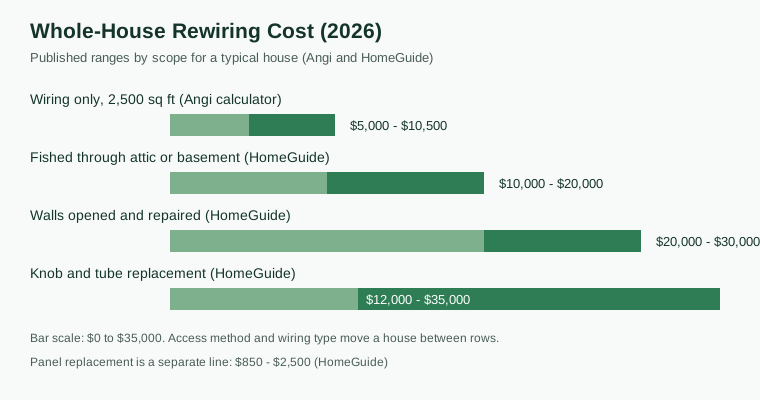
Rewiring a whole house costs $2 to $4 per square foot in Angi's 2026 calculator ($5,000 to $10,500 for 2,500 sq ft, before permits and wall repair) and $5 to $17 per square foot in HomeGuide's data (a $10,000 to $30,000 average project), and the gap is scope, not error: HomeGuide prices oldhouse work done through finished walls, with access method alone splitting the job into $10,000 to $20,000 fished through an attic or basement versus $20,000 to $30,000 or more with walls opened. This guide reconciles the two sources line by line, prices the panel, outlets, permits, and wall repair separately, covers knob and tube replacement ($12,000 to $35,000, HomeGuide), what Ontario's Electrical Safety Authority actually says about old wiring, and Canada pricing from BC electricians.
Quick Checks
- 1Two honest budgets exist for the same house. Angi's 2026 calculator prices a full rewire at $2 to $4 per sq ft ($5,000 to $10,500 for 2,500 sq ft). HomeGuide prices old-house rewiring at $5 to $17 per sq ft ($10,000 to $30,000 average). HomeGuide is pricing finished-wall access, wall repair, and code upgrades in old houses; Angi's calculator is the wiring job itself. Quote against the scope your house actually needs.
- 2Access is the biggest single lever. HomeGuide: $10,000 to $20,000 when wire can be fished through an attic, basement, or floor joists, against $20,000 to $30,000 or more when walls are opened. An unfinished basement and an accessible attic are worth thousands on this one project.
- 3Knob and tube is its own price band: $12,000 to $35,000 to replace (HomeGuide), $8,000 to $15,000 on one BC electrician's Canadian average. Ontario's ESA does not order intact knob and tube removed, but insurers, buyers, and any plan to bury it in new insulation can force the question anyway.
- 4The panel is usually a separate decision. Panel replacement runs $850 to $2,500 (HomeGuide) or $900 to $2,000 for 100-amp and $1,500 to $2,500 for 200-amp (Angi). Price it as its own line, and read our panel upgrade guide before combining the two jobs into one lump sum.
- 5Do not count a tax credit. Rewiring is safety and capacity work, not an energy measure with a published federal credit for a 2026 project in the sources used here. Its energy value is indirect: it is the wiring that a heat pump, an EV charger, and an induction range will stand on.
Whole-House Rewiring Cost 2026: Per Square Foot, by Access and by Room
By EnergyBS Editorial Team | October 16, 2026
The Short Answer
Short Answer: A full-house rewire costs $2 to $4 per square foot in Angi's 2026 calculator, which works out to $5,000 to $10,500 for a 2,500 sq ft house, plus a permit at $75 to $150 and an inspection at $100 to $125. HomeGuide prices the same job at $5 to $17 per square foot, a $10,000 to $30,000 average project. Both sources are usable once you see what each is counting. Angi's calculator is the wiring work: labor and materials to pull new cable and connect it. HomeGuide is pricing old-house reality on top of that: fishing wire through finished walls or opening them, patching drywall or plaster, bringing outlets and circuits up to current code, and replacing knob and tube where it exists ($12,000 to $35,000 as its own band). Access decides which source describes your house. HomeGuide splits it directly: $10,000 to $20,000 when the wire can run through an attic, basement, or floor joists, and $20,000 to $30,000 or more when walls have to open.
One warning about the headline number you will see quoted most. Angi reports a national average rewiring project of $1,567, with most projects between $603 and $2,596, across 9,551 verified projects. Read that as the average rewiring project its members hired, which in practice is usually a partial job, a circuit, a room, or a problem section, because Angi's own calculator prices a full 2,500 sq ft house at $5,000 to $10,500 before the add-ons. A quote near $1,567 for a whole house is not a bargain version of this project. It is a smaller project wearing the same name, and section 1 shows how to tell the two apart on paper.
1. Why the Two Price Systems Disagree, and How to Use Both
Rewiring is quoted per square foot, but square feet are not what the electrician is really charging for. The charge is for hours spent getting cable from the panel to each outlet, switch, and fixture, and those hours depend on what stands between the panel and the outlet: open joists, or a finished wall with plaster, fire blocking, and a bathroom above it.
| Scope being priced | Per sq ft | 2,500 sq ft house | Source |
|---|---|---|---|
| Wiring labor and materials (calculator scope) | $2 to $4 | $5,000 to $10,500 | Angi 2026 |
| Old-house rewire, all-in average | $5 to $17 | $12,500 to $42,500 | HomeGuide 2026 |
| Fished through attic, basement, or joists (total) | about $4 to $8 implied | $10,000 to $20,000 | HomeGuide 2026 |
| Walls opened, rewired, drywall replaced (total) | about $8 to $12 implied | $20,000 to $30,000+ | HomeGuide 2026 |
| Knob and tube replacement | $8 to $17 | $12,000 to $35,000 (project band) | HomeGuide 2026 |
The implied per-square-foot rows are arithmetic from HomeGuide's totals for a typical house, not separate published rates, and they make the reconciliation plain: the wire, boxes, and devices are the smaller half of an old-house rewire. The larger half is access and restoration. That is also why new construction wiring, done while walls are open by definition, costs $6,000 to $22,500 at $4 to $9 per sq ft (HomeGuide), below the old-house band for the same finished floor area. Nobody is paying to open and close a wall that does not exist yet.
Use the sources in sequence. Start with Angi's $2 to $4 per sq ft to check the electrical scope of a quote: a bid far above it should name the extra work (access, panel, wall repair, knob and tube) in lines you can price from sections 4 and 5. Then budget the whole project from HomeGuide's access split. A quote inside Angi's band that also claims to include opening walls, patching plaster, a new panel, and knob and tube removal is missing something, and the missing thing tends to reappear as a change order in week one.
2. Cost by House Size
Both sources publish a size ladder. Put side by side, they describe the same ladder at two different scopes:
| House size | Angi 2026 (wiring scope) | HomeGuide 2026 (old-house scope) |
|---|---|---|
| 1,000 sq ft | $2,000 to $4,000 | $5,000 to $17,000 |
| 1,500 sq ft | $3,000 to $6,000 | $7,500 to $25,500 |
| 2,000 sq ft | $4,000 to $8,000 | $10,000 to $34,000 |
| 2,500 sq ft | $5,000 to $10,000 | $12,500 to $42,500 |
| 3,000 sq ft | $6,000 to $12,000 | $15,000 to $51,000 |
Three patterns matter more than any single cell. First, cost scales with size in both systems, but not with size alone: a 1,500 sq ft house with plaster walls, no basement, and knob and tube can cost more than a 2,500 sq ft house with drywall, an unfinished basement, and an open attic. When you compare a quote to these tables, match on access and wiring type before you match on square feet.
Second, some electricians price per opening instead: $100 to $300 or more per outlet, switch, or fixture (HomeGuide). Eighty openings at $200 is a $16,000 wiring scope before the panel, which is why counting openings on the walk-through, room by room, belongs in the written quote (section 12).
Third, labor is priced by the hour underneath these tables: $50 to $100 per hour (Angi) or $50 to $130 per hour (HomeGuide), usually with a two-person crew when wire is fished through closed walls, and a rule of thumb of at least one hour per 100 sq ft for the installation itself (HomeGuide). A local shortage of electricians puts a house at the top of both bands, and no national table overrides that.
3. Cost by Room: Kitchens and Bathrooms Cost More per Foot
HomeGuide's room table is the most useful way to price a partial rewire, and it shows why partial work is the right scope for many houses:
| Room | Typical size | Average cost to rewire (HomeGuide) |
|---|---|---|
| Bathroom | 40 to 150 sq ft | $200 to $2,600 |
| Bedroom | 130 to 230 sq ft | $650 to $3,900 |
| Kitchen | 100 to 200 sq ft | $500 to $3,400 |
| Living room | 200 to 450 sq ft | $1,000 to $1,700 |
| Garage | 240 to 700 sq ft | $1,200 to $11,900 |
| Basement | 500 to 1,500 sq ft | $2,500 to $25,500 |
The kitchen is small and expensive per foot for a code reason, not a materials reason. Kitchens and bathrooms are wet locations: they need dedicated circuits and GFCI-protected outlets, and the National Electrical Code spacing rule HomeGuide cites, at least one outlet every 12 feet of wall, sets a floor under the opening count in every room. A kitchen rewire done during a renovation, while cabinets and drywall are already open, is the cheapest version of that room you will ever be offered, which is why electricians push to fold wiring scope into remodels rather than sell it separately afterward.
The basement row is widest because an unfinished basement is the access route that makes the rest of the house cheaper (section 5), while a finished basement is another set of closed walls. If a basement finish is planned, rewire first. One caution on staging partial work: it splits the bill and lets you stay in the house, but room-by-room work usually costs more in total than one whole-house job, because each stage repeats setup, permitting, and minimum charges (HomeGuide). Stage because only part of the wiring is old, not as a discount strategy.
4. The Add-On Stack: Panel, Outlets, Permits, and Wall Repair
The rewire itself is the middle of the invoice. These are the lines that surround it on real quotes, each with a published range:
| Add-on line | Published range | Source |
|---|---|---|
| Electrical permit | $75 to $150 (standard) / $250 to $900 | Angi / HomeGuide |
| Post-rewiring inspection | $100 to $125 / $100 to $200 | Angi / HomeGuide |
| New outlet or switch (added during the job) | $100 to $185 each | Angi |
| Replace all outlets in the house | $1,200 to $2,600 | HomeGuide |
| GFCI outlet replacement | $90 to $200 each | HomeGuide |
| Ground an existing outlet | $100 to $300 each | HomeGuide |
| Dedicated circuit (large appliance) | $250 to $900 | HomeGuide |
| Panel replacement | $850 to $2,500 | HomeGuide |
| Panel, 100-amp / 200-amp install | $900 to $2,000 / $1,500 to $2,500 | Angi |
| Opening and repairing walls | $4 to $8 per sq ft | Angi |
| Drywall repair | $300 to $1,500+ per patch | HomeGuide |
| Worksite cleanup | up to $500 | Angi |
The panel decision comes first. Many houses that need rewiring also carry a 60-amp fuse box or an early breaker panel. HomeGuide prices panel replacement at $850 to $2,500, with 150 or 200-amp service the practical target for most homes today; Angi prices 100-amp at $900 to $2,000 and 200-amp at $1,500 to $2,500. Our panel upgrade cost guide prices that work line by line. The short version here: one contract, two lines. A lump sum for "rewire plus panel" cannot be compared against anything.
Outlets are where scope quietly grows. Code spacing, GFCI protection in wet locations, grounding, and tamper-resistant receptacles all add openings at $100 to $300 or more each (HomeGuide), and replacing every outlet runs $1,200 to $2,600 on its own. That is not upselling by itself, an ungrounded two-prong outlet on a new grounded circuit is a job half done, but the walk-through count belongs in the written quote, not a verbal estimate.
Wall repair is the line most often left vague. Angi prices opening and repairing walls at $4 to $8 per sq ft of wall; HomeGuide prices drywall repair at $300 to $1,500 or more per patch. Older houses add two mid-job findings: asbestos-containing material ($5 to $15 per sq ft to remove inside the home, HomeGuide) and lead paint ($8 to $15 per sq ft). Ask who patches, who paints, and whether patching is priced per patch or per square foot, before the first hole is cut. Painting is frequently excluded even when patching is included.
Permits and inspection are not optional extras. The two sources bracket the permit at $75 to $150 for a standard job (Angi) up to $250 to $900 (HomeGuide), with inspections at roughly $100 to $200. Angi also flags that permits tied to safety-code compliance work can run $200 to $900 on their own. The permit record is part of what you are buying: it is the paper a future buyer, insurer, or ESA or municipal inspector will ask for, and unpermitted rewiring discovered at sale time costs more than the permit saved.
5. Access Decides the Price: Fishing Wire vs Opening Walls
HomeGuide's access table is the single most instructive set of numbers in either source:
| Cost element | Fished through attic, basement, or joists | Walls opened and drywall replaced |
|---|---|---|
| Materials | $4,000 to $8,000 | $8,000 to $12,000 |
| Labor | $6,000 to $12,000 | $12,000 to $18,000 |
| Total | $10,000 to $20,000 | $20,000 to $30,000+ |
Labor doubles when walls open, and materials rise too, because opened walls usually mean more cable is replaced rather than reused in route, more boxes are reset, and the job absorbs demolition and disposal. Opening walls completely adds about 25 to 30 percent to the project on HomeGuide's figures for the drywall work alone, on top of the slower electrical pace.
Read your own house against that table before you collect quotes. An unfinished basement below the first floor, an accessible attic above the top floor, and a crawlspace are the three routes that keep a house in the left column. A slab-on-grade house with a finished second floor and a low, insulated attic is in the right column almost regardless of who bids it. Two-storey houses sit between: the first floor is fished from the basement, the second floor from the attic, and the wall cavities between them are the slow part.
Plaster changes the restoration math, not the electrical math: patches cost more ($50 to $125 per sq ft for lath and plaster ceilings, against $50 to $100 for drywall, HomeGuide), and Angi names plaster walls, brick construction, and multi-level ceiling lighting as access culprits directly. If you intend to keep original plaster, price plaster repair, not drywall compound, in writing. And time the work with any renovation that already opens walls: while a kitchen or bathroom is gutted, that part of the house drops from the right column toward the left, the largest legitimate saving in this guide.
6. Knob and Tube, Aluminum-Era Wiring, and What the Authority Actually Says
Most whole-house rewires are really verdicts on one of two older wiring systems.
Knob and tube is the pre-1950 system: separate hot and neutral conductors run on porcelain knobs and through porcelain tubes, with no ground wire. Its published replacement band is $12,000 to $35,000 (HomeGuide), or $8 to $17 per sq ft, and Angi prices the removal itself at about $5,000, plus removal permits at $200 to $500, with standard rewiring at $2 to $4 per sq ft after the old system is out. One Canadian electrician puts the Canadian average to replace it at $8,000 to $15,000 (Pacific Star Electric, BC), varying with size, complexity, and local labor.
The safety picture is more specific than the sales version, and Ontario's Electrical Safety Authority states it plainly in its May 2025 Flash Notice 25-05-FL: knob and tube conductors in good condition that have not been inappropriately altered will not present undue hazards, the Ontario Electrical Safety Code is not retroactive, and the claims that all knob and tube is unsafe or must all be disconnected and replaced are listed by the ESA as myths. What makes a given installation dangerous is condition and history: brittle rubber and fibre insulation that has broken down with age, splices added outside approved boxes, circuits buried under later insulation they were never meant to touch, and the classic abuse the BC source describes, fitting a larger fuse to stop a 15-amp circuit blowing, which lets the wire carry more current than it was built for and cooks its insulation from the inside.
So why is replacement recommended so often? Four practical reasons. First, few century-old systems are still intact and unaltered; the ESA condition is doing real work in that sentence. Second, with no ground wire the system cannot properly serve grounded outlets, and modern protections (GFCI near sinks and outdoors, AFCI on receptacle circuits, tamper-resistant receptacles, splices in approved boxes, dedicated circuits) are exactly the list the ESA gives as the benefits of new wiring. Third, insurers and buyers apply their own rules regardless of the code position. Fourth, electrification loads (section 8) assume circuits and capacity the old system was never built to provide. Get an inspection verdict on condition first, from a licensed electrician or the ESA in Ontario, and let that document, not a sales call, decide between retention, partial replacement, and a full rewire.
Aluminum branch wiring from the 1960s and 1970s is the second system that triggers this conversation. The sources used here treat it as a remediation line rather than a full-rewire band: CSK Electric lists aluminum wiring remediation among the additional costs on a Canadian rewire, priced as part of the assessed scope, and HomeGuide lists a house having aluminum wiring among the signs an inspection is due. If an inspection finds it, get the remediation method and its price as a named line, the same discipline as every other line in section 4.
The background risk is real without being a reason to panic. NFPA's home structure fire research (2019 to 2023 annual averages) puts electrical distribution and lighting equipment as the leading cause of home fire property damage, at 31,650 fires a year, 430 deaths, 1,300 injuries, and $1.6 billion in direct property damage, with wiring and related equipment at 3 percent of all home fires and 5 percent of home fire deaths. Those figures cover all electrical distribution, new and old. They are a reason to pay for a condition inspection, not a claim that any specific old house is about to catch fire.
7. Rewire, Partially Rewire, or Protect What You Have
A full rewire is one of three defensible answers. The inspection decides which.
Full rewire fits when the old system runs through most of the house, when knob and tube or damaged wiring is widespread, when a renovation or an electrification plan will load the system hard, or when insurance or a sale requires it. Budget from HomeGuide's old-house band and section 5's access column for your house.
Partial rewire fits when the old wiring is concentrated: one wing, one floor, the kitchen and bathrooms, or the circuits an inspection flags. HomeGuide's room table (section 3) prices it. Rewiring at least in part every 25 to 30 years is the maintenance rhythm its experts recommend, with correctly installed wiring under ideal conditions lasting 50 to 70 years.
Protect and monitor fits the narrow ESA case: knob and tube verified intact and unaltered, in a house with modest loads. The interim protection with a published basis is GFCI protection at the first device on each circuit (Pacific Star Electric), at the GFCI outlet band of $90 to $200 (HomeGuide), or grounding individual outlets at $100 to $300 each. HomeGuide makes the same point: GFCI outlets can protect people for less than a rewire, and an inspection decides whether that is sufficient in your house.
Signs that move a house out of the monitor column, from both sources: frequent breaker trips or blown fuses, flickering lights, discolored or warm outlets and switches, a burning smell at a device (turn that circuit off and have it investigated), two-prong outlets throughout, and any house 30 years or older whose wiring has never been assessed. None of these signs prices a job. All of them price an inspection.
8. Rewiring Is the Platform Electrification Stands On
Rewiring does not, by itself, cut an energy bill in any figure the sources used here publish, and this guide will not invent one for it. Treat any quote that promises a payback period for rewiring as a sales document, not an engineering one. The energy case is capacity and circuits, and it is concrete:
- A heat pump needs dedicated circuits and panel capacity sized to the system and its backup heat. Our panel capacity guide for electrification works through the load calculation, and the home electrification blueprint totals the full sequence.
- An EV charger is a large continuous load on its own circuit. The EV charger installation cost breakdown prices that circuit and shows where panel room becomes the constraint.
- An induction range, a heat pump water heater, and a heat pump dryer each want their own dedicated circuit (HomeGuide: $250 to $900 per dedicated circuit where one has to be added).
- A standby generator ties in through a transfer switch, priced separately in our transfer switch cost guide, and the wiring it feeds has to be worth backing up.
Doing the rewire once, with future circuits planned and labeled while routes are open, is materially cheaper than reopening finished work for each appliance in turn. That planning conversation belongs in the first walk-through (checklist item 2, section 12).
9. Timeline, Disruption, and Living Through It
Both sources put a full rewire at 3 to 10 days (Angi; HomeGuide says 3 to 10 or more). Older houses sit at the long end: Angi's duration guide notes houses over 40 years old commonly need at least seven days. Crew size, access, and whether walls open set the real figure, and plaster, asbestos findings, or a panel and service change can stretch it further.
Plan on the house being a worksite. Power goes off circuit by circuit. Furniture needs moving or covering, and HomeGuide prices a storage unit at $40 to $150 or more per month where a household chooses one. Staying in the house is possible and common, and it costs time: HomeGuide is explicit that rewiring an occupied home takes longer and costs more, because the crew cleans up daily and restores power each evening. Cleanup itself can be billed at up to $500 (Angi), so settle whether it is in the contract. Keep the permit and inspection records with the house documents: at sale or insurance renewal, they are the proof that the work behind the walls is what you say it is.
10. Canada: BC Pricing and Ontario Rules
Canadian pricing in the sources used here comes from electricians rather than national cost databases, so read it as practitioner ranges, in Canadian dollars. CSK Electric (Langley, BC) puts a full rewire of a typical house at $8,000 to $20,000, including labor, materials, and necessary panel or breaker upgrades, with small-house or partial work from about $4,000 and larger or more complex full rewires exceeding $50,000; wall repair, aluminum remediation, and added outlets are extra, the same stack as section 4. Pacific Star Electric (Maple Ridge, BC) puts knob and tube replacement at $8,000 to $15,000 on average in Canada. Both sit inside HomeGuide's US band once currency and scope are accounted for.
Ontario work runs under its own rules, and the ESA Flash Notice in section 6 is the practical summary: modifications should be done by a Licensed Electrical Contractor with an ESA inspection arranged, and new work follows current Ontario Electrical Safety Code requirements (GFCI in bathrooms, outdoors, and near sinks, AFCI on receptacle circuits, tamper-resistant receptacles, grounded and bonded devices). The code is not retroactive, but an insurer can still set its own conditions on top of it. In every province, ask for the permit and inspection paper by name in the contract, the same as in the US.
11. A Worked Example: 1,800 Sq Ft, Drywall, Unfinished Basement
This is a hypothetical example built only from the published ranges above, to show how a budget assembles. Change every assumption to your own house before using it.
The house. 1,800 sq ft, two storeys, built in the 1960s, drywall walls, unfinished basement, accessible attic, no knob and tube, panel already 200-amp and staying.
The wiring scope, two ways. Angi's calculator scope: 1,800 sq ft at $2 to $4 per sq ft is $3,600 to $7,200. HomeGuide's old-house scope: 1,800 sq ft at $5 to $17 per sq ft is $9,000 to $30,600, with its access table putting this house at the fished end. A sensible planning budget is therefore $9,000 to $16,000, the lower-middle of the fished-access band, not the Angi figure, because the Angi figure excludes the code and access work this house needs.
The surrounding lines. Permit $250 (inside both sources' ranges). Inspection $150. Twelve added or relocated outlets at $150 each (inside Angi's $100 to $185): $1,800. Two new dedicated circuits (heat pump water heater, workshop) at $500 each (inside HomeGuide's $250 to $900): $1,000. Drywall patching, fished method, four patches at $600 (inside HomeGuide's $300 to $1,500 or more): $2,400. No panel line, because this house keeps its panel; add $1,500 to $2,500 if yours does not.
The planning total. $9,000 to $16,000 plus $5,600 of surrounding lines is $14,600 to $21,600. Move the same house to slab-on-grade with finished ceilings and no attic access, and the wiring scope moves toward HomeGuide's opened-wall band, adding roughly $8,000 to $12,000 to the same example. The house did not change. The access did. That is the whole economics of this project in one example.
12. The 12-Point Quote Checklist
Compare rewiring quotes line by line. A complete quote names:
- Scope in words: full house, partial (which rooms and circuits), or knob and tube replacement, with the wiring type found in the house stated from an inspection, not assumed.
- The future-load plan: panel size kept or changed, and which planned loads (heat pump, EV charger, induction, water heater) the new circuits and routes anticipate.
- Price basis: per square foot, per opening (with the opening count from a walk-through), or hourly (with the rate, $50 to $130 per hour in the published bands), stated so quotes can be compared.
- Access method per floor: fished through basement, attic, or joists, or walls opened, and who patches (drywall or plaster named), at what price per patch or per square foot.
- Panel work as its own line: replacement or upgrade priced separately ($850 to $2,500, HomeGuide), never buried in the lump sum.
- Outlets and devices: counts for new, replaced, GFCI, and grounded outlets, with unit prices ($90 to $300 per device in the published bands).
- Dedicated circuits listed by appliance, priced each ($250 to $900, HomeGuide).
- Knob and tube or aluminum wiring: removal or remediation method and price as a named line, including removal permits where they apply ($200 to $500, Angi).
- Permits and inspections: which ones, the fees, who pulls them, and that the final inspection records are handed to you at the end.
- Hazard allowance: what happens to the price if asbestos, lead paint, or damaged structure is found in opened walls, and the per-unit rate that applies.
- Occupancy plan: whether the price assumes you vacate, the daily cleanup and power-restore routine if you stay, and the cleanup charge if any (up to $500, Angi).
- Warranty and paper: workmanship warranty term, device warranties, the final invoice itemized to these lines, and the permit and inspection documents.
A quote that shows one number for a whole house is asking you to skip lines 3, 4, 5, and 8, which are the lines that vary by thousands between houses.
Frequently Asked Questions (FAQ)
How much does it cost to rewire a whole house in 2026?
Angi's 2026 calculator prices the wiring work at $2 to $4 per sq ft ($5,000 to $10,500 for 2,500 sq ft, plus $75 to $150 for a permit and $100 to $125 for inspection). HomeGuide prices a complete old-house rewire at $10,000 to $30,000 on average, or $5 to $17 per sq ft, including the access and code work old houses need. Access splits HomeGuide's total: $10,000 to $20,000 fished through an attic or basement, $20,000 to $30,000 or more with walls opened. Knob and tube replacement is $12,000 to $35,000 (HomeGuide).
Why is Angi's average rewiring cost only $1,567?
Because it averages every rewiring project reported by its members, 9,551 of them, and most of those projects are partial: a circuit, a room, or a problem section, at $603 to $2,596 for most jobs. Angi's own calculator for a full 2,500 sq ft house is $5,000 to $10,500 for labor and materials alone. Use the average for small jobs and the calculator, or HomeGuide's band, for a whole house.
How much does it cost to replace knob and tube wiring?
HomeGuide puts knob and tube replacement at $12,000 to $35,000, or $8 to $17 per sq ft. Angi prices the removal itself at about $5,000 plus $200 to $500 in removal permits, with standard rewiring on top. In Canada, one BC electrician puts the average at $8,000 to $15,000 (Pacific Star Electric). Ontario's ESA does not require intact, unaltered knob and tube to be removed, so get an inspection verdict on condition before assuming the full band applies to your house.
Does rewiring a house lower the energy bill?
No published figure in the sources used here credits rewiring with a bill saving, and this guide does not claim one. The value is safety (grounding, GFCI and AFCI protection, splices in boxes), capacity (more circuits, a modern panel), and readiness: a heat pump, an EV charger, an induction range, and a heat pump water heater all need dedicated circuits and panel room that old wiring often cannot offer. Price rewiring as infrastructure, not as an efficiency measure with a payback.
Can a house be rewired without opening the walls?
In most houses, largely yes. Electricians fish new cable through attics, basements, and crawlspaces and cut only small holes, which HomeGuide prices at $10,000 to $20,000 all-in against $20,000 to $30,000 or more for opened walls. It takes longer per run than open-wall work, and houses without attic, basement, or crawlspace access may have no route to fish, which is when walls open. Plaster walls can be fished too, at higher patching cost.
How long does a whole-house rewire take?
Three to 10 days in both sources (HomeGuide: 3 to 10 or more), with older houses commonly at seven days and up (Angi). You can usually stay in the house, but the work takes longer and can cost more if you do, because the crew cleans up and restores power daily. Power is off circuit by circuit as the work proceeds.
Do I need a new electrical panel as part of a rewire?
Not always, but often. Houses with 60-amp fuse boxes or early breaker panels usually cannot serve modern loads plus new dedicated circuits. Panel replacement is $850 to $2,500 (HomeGuide); Angi prices a 100-amp panel at $900 to $2,000 and a 200-amp at $1,500 to $2,500. Have it quoted as a separate line, and use our panel upgrade cost guide to check the scope.
What should I read next before deciding?
Start with the panel upgrade cost guide, because the panel decision changes the rewire quote. Then the panel capacity guide for electrification for the load calculation behind heat pumps and EV chargers, and the home electrification blueprint if the rewire is step one of a larger plan. If a charger is the trigger, the EV charger installation cost breakdown prices that circuit on its own.
Prices in this guide are planning ranges from the published 2026 sources cited above, not quotes for your house. Access routes, wall material, wiring type and condition, panel capacity, and local labor decide the final figure. Get the scope, access method, panel, and wall repair priced as separate lines, get the inspection verdict on any old wiring in writing, and keep the permit and inspection records with the house.
What to Read Next
Electrical Panel Upgrade Cost 2026: What a 100 to 200 Amp Upgrade RunsUse this next to compare the cost, incentive, installation, or operating-risk angle before you make a home energy decision.Sources and Verification
- Angi Cost To Rewire A House [2026 Data], updated October 13, 2026 (national average rewiring project $1,567, most projects $603 to $2,596, based on 9,551 verified projects; rewiring calculator for a full 2,500 sq ft house: labor and materials $5,000 to $10,500 at $2 to $4 per sq ft, permit $75 to $150, postrewiring inspection $100 to $125, optional new outlet $100 to $185; size table 1,000 sq ft $2,000 to $4,000, 1,500 sq ft $3,000 to $6,000, 2,000 sq ft $4,000 to $8,000, 3,000 sq ft $6,000 to $12,000; electricians $50 to $100 per hour; opening and repairing walls $4 to $8 per sq ft; circuit breaker box upgrade $700 to $4,220; 100amp panel $900 to $2,000, 200amp panel $1,500 to $2,500; knob and tube removal about $5,000 plus removal permits $200 to $500; cleanup up to $500; rewiring takes 3 to 10 days)
- HomeGuide How Much Does It Cost to Rewire a House? (2026) (average $10,000 to $30,000 or $5 to $17 per sq ft; size table 1,000 sq ft $5,000 to $17,000, 1,500 sq ft $7,500 to $25,500, 2,000 sq ft $10,000 to $34,000, 2,500 sq ft $12,500 to $42,500, 3,000 sq ft $15,000 to $51,000; by access: through attic, basement, or floor joists materials $4,000 to $8,000 and labor $6,000 to $12,000, total $10,000 to $20,000, versus opening walls materials $8,000 to $12,000 and labor $12,000 to $18,000, total $20,000 to $30,000 or more; permits $250 to $900, inspection $100 to $200, drywall repair $300 to $1,500 or more per patch; electricians $50 to $130 per hour or $100 to $300 or more per opening; panel replacement $850 to $2,500, dedicated circuit $250 to $900, outlet replacement $80 to $200, GFCI outlet $90 to $200, grounding an outlet $100 to $300, all outlets $1,200 to $2,600; knob and tube replacement $12,000 to $35,000; newconstruction wiring $6,000 to $22,500; rewiring takes 3 to 10 or more days; partial rewiring every 25 to 30 years recommended)
- HomeGuide How Much Does Electrical Wiring Cost? (2026) (rewiring an old house $5 to $17 per sq ft; replacing knob and tube wiring $12,000 to $35,000 or $8 to $17 per sq ft; wire material $0.10 to $4.00 per linear foot, nonmetallic sheathed NM cable $0.50 to $3.00 per linear foot, conduit $0.70 to $8.00 per linear foot; homes without basement, attic, or crawlspace access may require opening walls completely)
- Electrical Safety Authority (Ontario) Flash Notice 2505FL, May 2025, on knob and tube wiring (knob and tube conductors in good condition that have not been inappropriately altered will not present undue hazards; the Ontario Electrical Safety Code is not retroactive and does not require all knob and tube to be disconnected and replaced; modern installations add larger capacity and more circuits, splices in approved boxes, dedicated circuits, grounded and bonded receptacles, switches and fixtures, tamperresistant receptacles, GFCI protection in bathrooms, outdoors, and near sinks, and AFCI protection on receptacle circuits; modifications should be done by a Licensed Electrical Contractor with an ESA inspection arranged)
- NFPA Research Home Structure Fires, 2019 to 2023 annual averages (electrical distribution and lighting equipment was the leading cause of home fire property damage: an average of 31,650 fires a year causing 430 deaths, 1,300 injuries, and $1.6 billion in direct property damage annually; wiring and related equipment accounted for 3 percent of all home fires and 5 percent of home fire deaths)
- CSK Electric (Langley, BC) How Much Does It Cost to Rewire a House? (full rewire of a typical house $8,000 to $20,000 including labor, materials, and any necessary panel or breaker upgrades; smallhouse or partial rewiring from about $4,000; larger or more complex full rewires can exceed $50,000; wall and ceiling repair, aluminum wiring remediation, and added outlets or smart systems are extra)
- Pacific Star Electric (Maple Ridge, BC) Knob and Tube Wiring (average cost to replace knob and tube wiring in Canada $8,000 to $15,000, varying with house size, system complexity, and local labor; knob and tube has no ground wire, its rubber and fibre insulation breaks down with age, and oversizing a fuse to stop it blowing overheats the wire; interim option: GFCI protection at the first device on each circuit)
Editorial Review
EnergyBS Editorial Team
EnergyBS publishes practical homeowner guides. Important program, product, and cost claims should be checked against the linked source and local project documents before you commit to work.
Related Guides
View All ArticlesElectrical Panel Upgrade Cost 2026: What a 100 to 200 Amp Upgrade Runs
Upgrading an electrical panel from 100 to 200 amps costs $1,300$4,200 installed in the US in 2026 depending on market and scope, and C$2,500$4,500 in Ontario. This guide breaks down cost by upgrade path, what a legitimate quote includes, when 200 amps is genuinely needed, and when load management avoids the upgrade entirely.
Electrical Panel Capacity for Home Electrification
A decision guide for homeowners adding heat pumps, EV charging, induction, water heating, solar, or batteries: service ratings, load calculations, demand data, panel space, load management, project sequencing, and quote review.
The 2026 Home Electrification Blueprint 2026 Tool
As utility rates soar in 2026, home electrification has transitioned from a sustainability goal to a financial imperative. This master guide breaks down the technology, ROI, and installation strategies for the modern energyindependent home.