Duct Cleaning Cost 2026: What It Costs, and When the EPA Says It Is Worth Doing
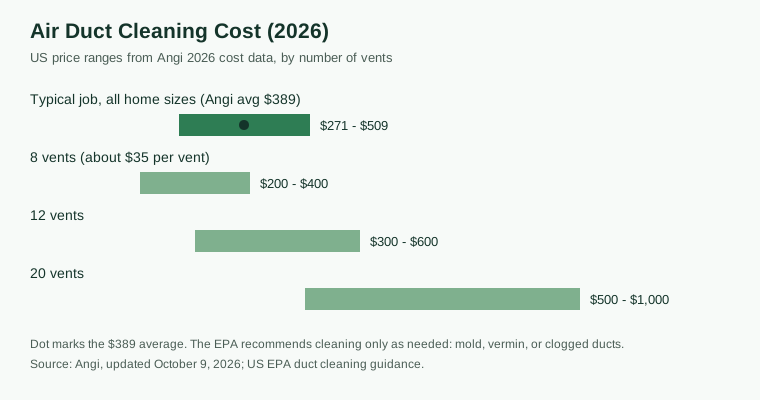
Professional air duct cleaning costs $389 on average in the US in 2026, with most homeowners paying $271 to $509 (Angi, 21,664 verified projects). Cleaners price by the vent, about $35 each ($25 to $50), or by the square foot, $0.15 to $0.30. The price is the easy part. The US Environmental Protection Agency does not recommend routine duct cleaning at all: it recommends cleaning only as needed, when there is substantial visible mold, a vermin infestation, or ducts clogged with so much dust and debris that particles blow into the home, and it states plainly that duct cleaning has never been shown to prevent health problems. This guide prices the service by vent count and home size, lists the three EPA triggers that make it worth buying, explains what a complete cleaning includes, and shows how to spot the coupon deal that turns into a fourfigure invoice.
Quick Checks
- 1Budget $389 as the US average for professional duct cleaning in 2026 (Angi). Most jobs land between $271 and $509; pricing runs about $35 per vent ($25 to $50) or $0.15 to $0.30 per square foot.
- 2The EPA does not recommend routine duct cleaning. It recommends cleaning only as needed: substantial visible mold, a vermin infestation, or ducts clogged with enough debris that particles blow out of the registers.
- 3Duct cleaning has never been shown to prevent health problems, and there is no evidence that a light layer of dust in ducts is a health risk (EPA). Any company promising health benefits, or claiming to be EPA certified, is telling you something the EPA itself contradicts. EPA does not certify duct cleaners.
- 4A complete job covers supply ducts, return ducts, registers, and the air handler area under negative pressure, and takes 3 to 8 hours (Angi). A whole-house coupon price that finishes in under an hour is not the same service.
- 5Price the add-ons before you agree to them: video inspection $70 to $130, furnace cleaning $60 to $150, duct repairs $200 to $800 (Angi). Skip chemical biocides and sealants as routine upsells; the EPA notes no biocide is registered for use in internally insulated ducts.
Duct Cleaning Cost 2026: What It Costs, and When the EPA Says It Is Worth Doing
By EnergyBS Editorial Team | October 21, 2026
The Short Answer
Short Answer: Professional air duct cleaning costs $389 on average in the US in 2026, with most homeowners paying between $271 and $509 (Angi, from 21,664 verified projects). Pricing runs about $35 per vent (typical range $25 to $50), so a 12-vent home estimates out at 12 x $35 = $420, inside Angi's 12-vent band of $300 to $600. Whether you should buy it at all is a separate question, and the US Environmental Protection Agency's answer is narrower than the industry's: the EPA does not recommend routine duct cleaning, only cleaning as needed, and it names three triggers, substantial visible mold, vermin in the ducts, or ducts clogged with so much debris that particles are released into the home. The EPA also states that duct cleaning has never been shown to actually prevent health problems. This guide prices the service honestly, then applies the EPA's test before it helps you hire anyone.
The job in six steps:
- Test your home against the EPA's three triggers before you shop for quotes.
- If a trigger is present, find and fix the cause first (moisture, pest entry, a failed filter seal), or the problem returns.
- Count your supply and return vents; that count is your price estimate at about $35 per vent.
- Get quotes that state the full scope in writing: supply and return ducts, registers, trunk lines, and the air handler.
- Decline add-ons you did not ask for, especially chemical treatments sold as routine.
- Verify the work: before and after photos or a walkthrough, and a check that registers and the area around the furnace are clean afterward.
Duct cleaning sits in our HVAC library next to two jobs it is often confused with: ductwork replacement, which is construction, and duct sealing, which is the duct job with an actual energy payoff. Cleaning is neither, and pricing it well starts with knowing what it can and cannot do.
1. Start With the EPA's Test, Not With a Coupon
The EPA's consumer guidance on duct cleaning is unusually direct for a government document, and every homeowner considering this service should hear its main points before seeing a price:
- "Duct cleaning has never been shown to actually prevent health problems." Studies do not conclusively show that particle levels in homes rise because of dirty ducts or fall after cleaning, because much of the dirt in ducts sticks to duct surfaces and does not enter the living space.
- There is no evidence that a light amount of household dust in air ducts poses any risk to health. Dirty ducts are only one of many particle sources in a home, and cooking, cleaning, and outdoor air usually matter more.
- EPA does not recommend routine cleaning, only as-needed cleaning, because of the continuing uncertainty about benefits under most circumstances.
- EPA does not certify duct cleaners. The agency neither establishes duct cleaning standards nor certifies, endorses, or approves duct cleaning companies. A technician who claims EPA certification is claiming a credential that does not exist.
- The efficiency claim is weak for ducts alone. Some research suggests cleaning dirty cooling coils, fans, and heat exchangers can improve system efficiency, but little evidence indicates that simply cleaning the duct system increases it. The coil and blower cleaning that helps efficiency happens during normal HVAC service, not during a duct cleaning visit.
Then the EPA names the situations where cleaning does make sense. You may want to consider duct cleaning when:
- There is substantial visible mold growth inside hard surface ducts or on other HVAC components. (If insulated ducts get wet or moldy, they cannot be cleaned effectively; the EPA's remedy there is removing and replacing the insulation, and fixing the water source.)
- Ducts are infested with vermin, rodents or insects.
- Ducts are clogged with excessive amounts of dust and debris, and particles are actually released into the home from the supply registers.
Renovation dust is the common fourth case in practice: after a remodel that cut drywall, sanded floors, or opened walls near returns, construction debris in the ducts is real debris, not a light layer of household dust. NerdWallet's 2026 summary of the same guidance lists post-renovation cleanup alongside mold and pest contamination as a specific reason that can justify the service.
If none of these describes your home, the EPA's position is that you are buying a service with unproven benefit. Put the $389 toward the filter, coil, and blower maintenance that the evidence does support, and toward sealing duct leaks, which is where ducts actually lose energy.
2. What Duct Cleaning Costs in 2026
Angi prices duct cleaning two ways, and both appear in quotes, so learn both.
By the vent. About $35 per vent, with a typical range of $25 to $50 per vent.
| Number of vents | Average cost in 2026 (Angi) |
|---|---|
| 8 | $200 to $400 |
| 12 | $300 to $600 |
| 16 | $400 to $800 |
| 20 | $500 to $1,000 |
By the square foot. $0.15 to $0.30 per square foot of home.
| Home size | Average cost in 2026 (Angi) |
|---|---|
| 1,000 sq ft | $140 to $250 |
| 1,500 sq ft | $225 to $450 |
| 2,000 sq ft | $300 to $600 |
| 3,000 sq ft | $450 to $900 |
The totals. The national average is $389 and most homeowners pay $271 to $509; totals can reach $800 once repairs or a separate inspection are added (Angi). Labor runs $90 to $125 per hour and most jobs take 3 to 8 hours, which is the sanity check on any quote: a price that implies one hour of work is not buying a whole-system cleaning. The EPA's own guidance gives a consistent picture for a complete cleaning of an entire heating and cooling system in an average home, in the $450 to $1,000 range per system depending on size, accessibility, and contamination level. Homes with two HVAC systems should expect the per-system logic to apply twice.
Duct type matters. Rigid metal ducts clean up with a vacuum, air hose, or power brush and price at the easy end. Flex duct needs more care and special equipment and pushes quotes up (Angi). Internally lined or insulated ducts are the special case from the EPA guidance: they cannot take aggressive brushing, and if they are moldy, replacement, not cleaning, is the remedy.
3. What a Complete Cleaning Includes
A real duct cleaning is a defined process, and the definition is your protection against the 45-minute version:
- The system is placed under negative pressure with a powerful vacuum, so loosened debris travels to the vacuum, not into your rooms.
- Each supply and return run is agitated with brushes or compressed-air tools to free adhered dust, working from the registers back toward the trunk.
- Registers and grilles are removed and cleaned, not wiped in place.
- The trunk lines and the air handler area, including the blower compartment, are cleaned. This is also the part adjacent to the components (coils, fans) whose cleaning the EPA associates with efficiency.
- Access holes, if any were cut, are sealed and insulated afterward.
Ask any company to confirm this scope in writing, and ask whether both supply and return ducts and the air handler are included. A quote that counts only supply vents, or that prices the trunk lines and air handler as surprise extras discovered mid-job, is the classic structure of the coupon deal: a low advertised whole-house price that grows once the crew is in your hallway. The EPA's advice to consumers is to take the same precautions you would with any service provider, and to be wary of anyone making sweeping health claims for the service.
4. Add-Ons, Priced and Judged
Angi's 2026 add-on prices, with the judgment the EPA guidance supports:
| Add-on (Angi 2026) | Price | Verdict |
|---|---|---|
| Video inspection | $70 to $130 | Worth it before and after, if you want proof |
| Furnace cleaning | $60 to $150 | Reasonable; overlaps with a normal HVAC service visit |
| Dryer vent cleaning, bundled | $100 | A different duct with a real fire-safety case; fair bundled |
| Dryer vent cleaning, standalone | $100 to $170 | Same; note it is not HVAC duct cleaning |
| Air duct coating | $180 to $630 | Skip as routine; the EPA notes sealant use in ducts is not demonstrated as effective for routine application |
| Air duct repairs | $200 to $800 | Legitimate when there is actual damage; ask to see it |
| Pest removal in ducts | $200 to $1,200 | Necessary when the EPA's vermin trigger is the reason for the job; fix entry points too |
| Mold and mildew remediation | $1,100 to $3,400 | A remediation job, not a cleaning add-on; the moisture source must be fixed or it returns |
| Asbestos removal | $5 to $20 per sq ft | Work stops if asbestos is found; licensed removal before anything else proceeds |
Chemical biocides deserve their own sentence: companies may propose spraying them inside ducts to kill mold and bacteria, and the EPA's position is that you should fully understand the pros and cons first, because research has not demonstrated their effectiveness in duct cleaning or their potential adverse health effects, and no chemical biocide is currently registered by the EPA for use in internally insulated air duct systems. Mold on hard surfaces is handled by removing the growth and fixing the moisture, not by fogging the ductwork.
5. Worked Examples
Example A: the 12-vent ranch with a dog. No mold, no pests, dust visible on register covers. Against the EPA's test: no trigger. The dust on the covers is room dust settling on a grille, not debris blowing out of the registers. Decision: skip the cleaning, vacuum the registers, replace the filter, and book the regular HVAC service that cleans the coil and blower. Cost of the duct cleaning not bought: $0 of the $300 to $600 Angi band for 12 vents.
Example B: the post-renovation two-story. Sixteen vents, a kitchen remodel that filled the returns with drywall dust, and visible debris at several registers. Against the EPA's test: clogged ducts releasing particles is a reasonable reading, and renovation debris is the recognized extra case. Estimate: 16 vents at about $35 = $560, inside Angi's 16-vent band of $400 to $800. Add a video inspection at $70 to $130 if you want before-and-after proof. Planning total: about $630 to $690 with the inspection, quoted against the full-scope definition in Section 3.
Example C: the mold finding. A cleaner or inspector reports mold inside the ducts. Now the job forks: mold on hard metal surfaces is a cleaning-and-source-fix job; mold in internally insulated duct is a removal-and-replacement job for that duct section, per the EPA. Angi prices mold and mildew remediation at $1,100 to $3,400. Before paying remediation prices, get the moisture story explained in writing: a sweating duct, a failed condensate drain, or a humidifier problem caused it, and an unfixed source regrows it. Our AC condensate drain guide covers the most common moisture source in cooling season.
6. Prevention: What the EPA Recommends Instead
The EPA's guidance ends where the sales pitches never start: "whether or not you decide to have your air ducts cleaned, preventing water and dirt from entering the system is the most effective way to prevent contamination." Its prevention list is unglamorous and cheap, and it is the actual maintenance program for ductwork:
- Filters, changed on schedule. Use the highest-efficiency filter your HVAC manufacturer recommends for the system, and change it regularly. A clogged or ill-fitting filter is how ordinary dust gets past the one barrier the system has, and a filter that has been left to load up and leak at the edges feeds the ducts a steady diet of the dust homeowners later pay to remove.
- Coils and drain pans, kept clean. The EPA pairs duct questions with the rest of the system: cooling coils and condensate drain pans are the wet parts, and wet parts are where mold actually grows in an HVAC system. Having them checked and cleaned during regular service addresses the component-level contamination that duct cleaning cannot reach, and it is also the cleaning the EPA associates with efficiency gains.
- Renovation discipline. Seal off supply and return registers during dusty work, and do not run the system until the dust has been removed from the work area. One drywall project with the furnace running can load ducts with more debris than a decade of normal use, and it is preventable with plastic, tape, and patience.
- Moisture control. Fix leaks, drain condensate properly, and keep ductwork in damp spaces insulated so its surface stays above the dew point. Mold in ducts is a water problem wearing a mold costume; every durable fix starts with the water.
- Ordinary housekeeping. Regular vacuuming with a well-sealed machine, and dust control at the sources (entry mats, shoe habits, pet grooming) reduce what the return air carries in the first place. The EPA's point stands: ducts are one particle source among many, and usually not the largest.
None of this has a coupon. All of it is why a well-kept system can run for decades without ever meeting one of the EPA's three cleaning triggers.
7. Hiring Checklist
- The company states, in writing, which EPA trigger or specific condition justifies the cleaning in your home.
- The quote counts your actual supply and return vents and lands near $25 to $50 per vent, or quotes by square footage near $0.15 to $0.30.
- Scope in writing: supply and return ducts, trunk lines, registers, and the air handler, under negative pressure.
- Time estimate of 3 to 8 hours for a full home (Angi). A one-hour promise is a different, smaller service.
- No health claims and no claim of EPA certification, because the EPA makes neither.
- Add-ons itemized in advance, with biocides, coatings, and sealants optional and declined by default.
- Before-and-after evidence offered: photos, video inspection, or a walkthrough of the air handler.
- Any mold finding comes with a moisture-source explanation and a fix, not just a remediation price.
- Access panels cut during the job are sealed and insulated before the crew leaves.
- The company is insured, and the final price is the quoted price unless you approve added work in writing.
Frequently Asked Questions
How much does duct cleaning cost in 2026?
The national average is $389, and most homeowners pay $271 to $509 (Angi, 2026). Pricing runs about $35 per vent ($25 to $50) or $0.15 to $0.30 per square foot. A complete cleaning of a whole system can run $450 to $1,000 per the EPA's guidance framing, and totals reach about $800 in Angi's data once inspections or repairs are added.
Is duct cleaning worth it?
Only in specific cases. The EPA recommends it as needed, not routinely, and names three: substantial visible mold, vermin infestation, or ducts clogged with enough debris that particles blow into the home. Post-renovation construction dust is the practical fourth case. For ordinary household dust, the EPA finds no proven health benefit.
How often should ducts be cleaned?
There is no EPA schedule. You will see every 3 to 5 years quoted across the industry, but that interval is a sales convention, not an EPA recommendation. Clean when a trigger condition appears, and spend the in-between money on filters and regular HVAC service.
Does duct cleaning improve air quality or health?
The EPA states that duct cleaning has never been shown to actually prevent health problems, and that there is no evidence a light amount of dust in ducts poses a health risk. Most dirt in ducts adheres to surfaces and does not enter the living space. Removing a genuine contaminant, a nest or mold growth, is a different matter from routine cleaning.
Will duct cleaning lower my energy bills?
There is little evidence that cleaning the ducts alone increases system efficiency (EPA). The cleaning that can help efficiency is of the cooling coils, fans, and heat exchangers, which happens during HVAC service. For duct-related energy losses, sealing leaks is the effective job, not cleaning.
What should a proper duct cleaning include?
Negative pressure on the whole system, agitation of every supply and return run, removal and cleaning of registers, cleaning of trunk lines and the air handler area including the blower compartment, and sealing of any access holes. Angi puts a proper job at 3 to 8 hours.
Are chemical treatments or sanitizers necessary?
Not routinely. The EPA has not seen research demonstrating the effectiveness of chemical biocides in duct cleaning, and no biocide is registered by the EPA for use in internally insulated duct systems. Treat a biocide or sealant upsell as a claim to be proven, not a standard step.
A company says it is EPA certified. Is that real?
No. The EPA neither establishes duct cleaning standards nor certifies, endorses, or approves duct cleaning companies. The claim itself is a reason to choose a different company. Look instead for a defined scope, references, and insurance.
Is dryer vent cleaning the same service?
No. Dryer vent cleaning clears lint from the dryer's exhaust duct, a fire-safety maintenance item priced at $100 to $170 standalone or about $100 bundled (Angi). It is often sold alongside duct cleaning because the crews and tools overlap, but it solves a different problem, and unlike HVAC duct cleaning it is worth doing on a regular cycle.
The Bottom Line
Duct cleaning is a $389 average service with a narrow set of good reasons to buy it: visible mold, vermin, clogged ducts blowing debris, or a renovation's worth of construction dust. The EPA's guidance is the filter for every quote: no routine schedule, no health promises, no EPA certification, and no chemical upsells by default. When a trigger is real, buy the complete job, negative pressure, both duct directions, trunk lines, and air handler, at about $35 per vent with the scope in writing. When it is not, the same money does more work as a proper HVAC service visit and duct sealing. For the duct decisions with lasting payoffs, see our ductwork replacement cost guide and the duct replacement vs sealing guide before you sign anything.
What to Read Next
Heat Pump Blowing Cold Air? A Diagnostic Guide: What Is Normal, What You Can Fix, and When to Call a TechnicianUse this next to compare the cost, incentive, installation, or operating-risk angle before you make a home energy decision.Sources and Verification
- US Environmental Protection Agency Should You Have the Air Ducts in Your Home Cleaned? (EPA consumer guidance booklet: EPA does not recommend that air ducts be cleaned routinely, but only as needed; duct cleaning has never been shown to actually prevent health problems; there is no evidence that a light amount of household dust or other particulate matter in air ducts poses any risk to health; consider cleaning when there is substantial visible mold growth inside hard surface ducts, ducts are infested with vermin such as rodents or insects, or ducts are clogged with excessive amounts of dust and debris and particles are released into the home from supply registers; no chemical biocides are currently registered by EPA for use in internally insulated air duct systems; EPA neither establishes duct cleaning standards nor certifies, endorses, or approves duct cleaning companies; some research suggests cleaning dirty cooling coils, fans and heat exchangers can improve system efficiency, but little evidence exists that simply cleaning the duct system will increase efficiency; the guidance prices a complete system cleaning for an average home in the hundreds of dollars per system, with the EPA figure commonly cited at $450 to $1,000 depending on system size, accessibility, and contamination)
- Angi How Much Does Air Duct Cleaning Cost? [2026 Data], updated October 9, 2026 (national average $389 from 21,664 verified projects, most homeowners pay $271 to $509, totals can reach $800 with repairs or inspection; about $35 per vent, typical range $25 to $50 per vent; cost by vents: 8 vents $200 to $400, 12 vents $300 to $600, 16 vents $400 to $800, 20 vents $500 to $1,000; cost by square footage at $0.15 to $0.30 per square foot: 1,000 sq ft $140 to $250, 1,500 sq ft $225 to $450, 2,000 sq ft $300 to $600, 3,000 sq ft $450 to $900; labor $90 to $125 per hour, most jobs 3 to 8 hours; addons: video inspection $70 to $130, furnace cleaning $60 to $150, dryer vent cleaning $100 bundled or $100 to $170 standalone, air duct coating $180 to $630, air duct repairs $200 to $800; contamination work: pest removal $200 to $1,200, mold and mildew remediation $1,100 to $3,400, asbestos removal $5 to $20 per square foot)
- NerdWallet Air Duct Cleaning Cost: Is It Worth It?, updated April 22, 2026 (air duct cleaning typically costs about $270 to $500 with an average of $389, based on 2026 Angi data; duct cleaning is generally not recommended as a routine service according to the EPA, but might be worth it for a specific reason such as removing mold growth, rodent or insect contaminants, or clearing the system after extensive renovations)
Editorial Review
EnergyBS Editorial Team
EnergyBS publishes practical homeowner guides. Important program, product, and cost claims should be checked against the linked source and local project documents before you commit to work.
Related Guides
View All ArticlesHeat Pump Blowing Cold Air? A Diagnostic Guide: What Is Normal, What You Can Fix, and When to Call a Technician
A heat pump blowing air that feels cold is usually not broken. Heat pump supply air runs about 85 to 100 degrees F, well below the 120 to 140 degrees of a gas furnace and right around skin temperature, so it feels cool on your hand while heating the house correctly. The second normal cause is the defrost cycle: Carrier's manual describes the system briefly reversing to melt frost off the outdoor coil, a cycle of about 5 to 10 minutes (up to 10 by design) during which vents can blow cool air and steam rises off the outdoor unit. This guide runs the diagnosis in order: time the episode, measure the vent air against room temperature, check the thermostat traps (fan ON, a multidegree setback recovery, emergency heat), check the filter and the outdoor unit, and only then decide it is a fault. The real faults (low refrigerant, a stuck reversing valve, a failed defrost control, a dead outdoor fan) are named with the symptom that separates each from the normal causes, plus Carrier's rule of thumb: if the house sits consistently more than 2 to 3 degrees below the thermostat setting, have the system checked.
Ductwork Replacement Cost 2026: What Installation Really Costs
Replacing home ductwork in 2026 typically costs $1,400 to $5,600 in the US, or $25 to $55 per linear foot, with a national average near $3,500. This guide breaks down cost by house size, duct location and material, the repair and sealing options that cost far less than replacement, and the addons that move a quote.
Replace, Repair, or Seal HVAC Ducts? A Scope and Quote
Choose between duct sealing, section repair, redesign, and full replacement using leakage, airflow, static pressure, room loads, material condition, contamination, accessibility, insulation, safety, commissioning, and comparable quote evidence.