Ductwork Replacement Cost 2026: What Installation Really Costs
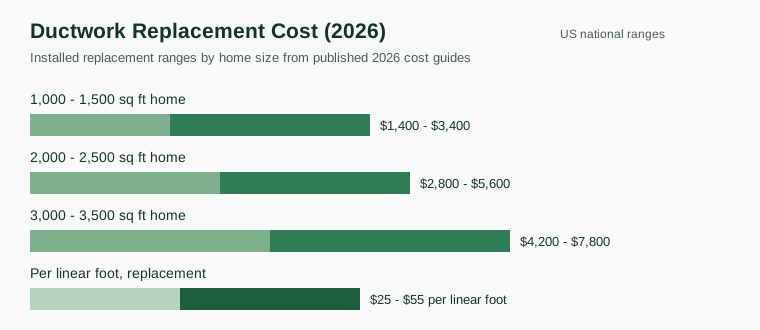
Replacing home ductwork in 2026 typically costs $1,400 to $5,600 in the US, or $25 to $55 per linear foot, with a national average near $3,500. This guide breaks down cost by house size, duct location and material, the repair and sealing options that cost far less than replacement, and the addons that move a quote.
Quick Checks
- 1Budget $1,400 to $5,600 installed to replace ductwork in a typical US home in 2026, or $25 to $55 per linear foot. The published national average is near $3,500.
- 2Location is the biggest price lever after size: basement ductwork runs $1,800 to $3,100, attic ductwork $2,200 to $5,600, and crawl space ductwork $3,000 to $7,300 for the same job.
- 3Replacement is not the first answer to leaky ducts. Manual sealing runs $400 to $1,900 and aerosol sealing $1,300 to $2,700, against a $1,400 to $5,600 replacement. Test the ducts before you price new ones.
- 4ENERGY STAR puts typical duct leakage at 20 to 30 percent of the air moving through the system. Sealing or replacing leaky ducts is where the published 10 to 40 percent energy saving comes from.
- 5Get the linear footage and the duct count in writing. At $25 to $55 per linear foot and $270 to $500 per duct, a quote that will not state either number cannot be compared to anything.
Ductwork Replacement Cost 2026: What Installation Really Costs
By EnergyBS Editorial Team | October 5, 2026
The Short Answer: What Ductwork Replacement Costs
Short Answer: In 2026, replacing the ductwork in a US home typically costs $1,400 to $5,600 installed, according to HomeGuide's 2026 ductwork cost guide, with a national average near $3,500 across 399 project costs reported by HomeGuide members. The same work prices at $25 to $55 per linear foot, or $270 to $500 per duct, for ducts in a crawl space, attic, or basement. Installing brand-new ductwork in a house that has never had ducts costs more: $2,400 to $6,600 on average, at $40 to $65 per linear foot.
Those three numbers describe three different jobs, and confusing them is how homeowners end up comparing a $900 quote against a $5,000 quote for what sounds like the same work. A per-duct price usually means swapping accessible runs. A per-linear-foot price means a measured system. A whole-house total means removal, new trunk and branch runs, registers, and disposal. This guide separates the jobs, prices each one from the same published 2026 data, and then covers the part most cost guides skip: the repair and sealing options that solve the same problem for a third of the money when the ducts themselves are still sound.
One framing note before the tables. Ductwork is the delivery system, not the heating or cooling equipment. A new furnace or heat pump connected to leaking, undersized, or crushed ducts delivers its rated efficiency into the attic or the crawl space instead of the rooms. That is why duct pricing belongs in the same conversation as equipment pricing, and why section 10 prices the bundle both ways.
1. Three Jobs That All Get Called Ductwork Replacement
Job one: like-for-like replacement. The old ducts come out and new ducts go in on the same routes, serving the same registers. This is the $1,400 to $5,600 band, and it is the right job when the existing material has failed: rusted or torn sheet metal, delaminated or pest-damaged flex duct, fiberboard that has taken on moisture, or runs so poorly fitted that sealing them costs more labor than replacing them.
Job two: new duct installation in a house without ducts. Homes heated by boilers, baseboards, or stoves that are adding central air or a ducted heat pump need a duct system designed from nothing: a plenum at the air handler, trunk runs, branch runs, air-distribution boxes, dampers, and insulated register boots cut into floors, walls, or ceilings. HomeGuide prices this retrofit at $2,400 to $6,600, at $40 to $65 per linear foot. The premium over replacement is design labor and the carpentry of cutting registers into a finished house.
Job three: repair, sealing, and cleaning. Minor repairs run $200 to $700. Manual sealing with mastic or metal tape runs $400 to $1,900. Aerosol sealing from inside the ducts runs $1,300 to $2,700. Cleaning runs $300 to $700. None of these is replacement, and for a large share of the homes that get quoted for replacement, one of them is the correct purchase. Our duct sealing vs replacement guide works through the test results that decide between the three, and this guide prices all of them so the comparison is in dollars, not adjectives.
The rest of this guide assumes job one unless it says otherwise, because that is the quote most readers are holding.
2. What the Installed Price Actually Covers
A complete replacement quote in the published data bundles removal of the old ducts, the new duct material, the labor to hang, connect, and seal it, and disposal. HomeGuide puts a typical replacement at 1 to 2 days of work, stretching to 4 days for larger homes or complex projects, and puts the duct inspection that produces the quote at $40 to $100.
What a complete quote usually includes:
- Old duct removal and disposal
- New trunk and branch ducts, fitted and supported
- Connections at the plenum and at each register boot, sealed
- Dampers where the design calls for balancing
- Insulated register boots on new or moved registers
What it usually does not include unless a line says so: duct insulation as a separate scope ($800 to $2,000 in the same data), drywall or ceiling repair where ducts hide behind finished surfaces ($300 to $1,500 or more), asbestos testing or removal in pre-1980 duct insulation, mold remediation, and the permit in jurisdictions that price it separately ($50 to $250 for ductwork alone). Section 8 prices each of these, because they are where a low quote quietly becomes an average quote plus surprises.
The single most useful number to demand on any quote is the measured linear footage. HomeGuide notes that the average home has about 100 linear feet of ductwork. At $25 to $55 per linear foot, 100 feet is $2,500 to $5,500 of work, which is exactly the published whole-house band. A quote that states footage, duct count, and material can be checked against the tables below in about a minute. A quote that states only a total cannot be checked at all.
3. Cost by House Size
Size is the cleanest pricing ladder because ductwork scales with the house it serves. HomeGuide's 2026 replacement table is:
| Home size | Average cost to replace ductwork |
|---|---|
| 1,000 to 1,500 sq ft | $1,400 to $3,400 |
| 1,500 to 2,000 sq ft | $2,100 to $4,500 |
| 2,000 to 2,500 sq ft | $2,800 to $5,600 |
| 2,500 to 3,000 sq ft | $3,500 to $6,700 |
| 3,000 to 3,500 sq ft | $4,200 to $7,800 |
| 3,500 to 4,000 sq ft | $4,900 to $9,000 |
Read the ladder as roughly $700 of added cost per added 500 square feet, which is the shape you would expect from a per-linear-foot price applied to a growing duct system. Two cautions keep the table honest. First, a two-story house of 2,000 square feet usually needs more ductwork, and harder ductwork, than a single-story house of the same area, because every second-floor register is a vertical run through a wall or a chase. Second, the table assumes one system. A house with two HVAC units has two plenums and two duct systems, and prices closer to two smaller jobs than to one large one.
For context at the edges of the same dataset: the published minimum is $1,000 and the maximum is $8,000, so a quote outside $1,400 to $5,600 for a typical single-system home should come with a specific explanation - unusual access, unusual material, or a scope item from section 8 riding along.
4. Cost by Where the Ducts Live
After size, location is the strongest price lever, because it decides how the crew works: standing up, on their backs, or in attic heat.
| Duct location | Average installed cost |
|---|---|
| Basement | $1,800 to $3,100 |
| Attic | $2,200 to $5,600 |
| Crawl space | $3,000 to $7,300 |
| Mobile home (underfloor) | $1,000 to $3,300 |
HomeGuide's 2026 location table, materials and labor included.
Basement ductwork is the cheapest to replace because it is the easiest to reach: open access, room to work, and no insulation gymnastics around the runs. Attic ductwork costs more because the work happens over ceiling joists, often in extreme heat, and because attic ducts in an unconditioned space need insulation to perform. Crawl space ductwork is the most expensive of the three standard locations, and it carries a sequencing warning the same source states plainly: contractors recommend cleaning, repairing, or encapsulating the crawl space before new ducts go in, and those projects price separately at $500 to $4,000 for cleaning and $3,000 to $15,000 for encapsulation. New ducts installed over a wet, pest-active crawl space inherit the conditions that damaged the old ones.
The mobile home band is lower because the systems are smaller, not because the work is easier. Underfloor ducts sit inside the belly insulation, which makes access awkward in the opposite direction: less material, more contortion.
If your quote lands above the band for your location, the two questions that resolve most of the gap are how many linear feet the quote counts, and whether insulation, disposal, or one of the section 8 items is bundled in. Both are fair things to bundle. Neither should be invisible.
5. Cost by Duct Material
Material prices below are material-only, per linear foot, before installation labor and contractor markup, from HomeGuide's 2026 material table. They explain the spread inside the $25 to $55 installed band: the duct itself is a minority of the installed price, and labor, fittings, sealing, and access make up the rest.
| Duct type | Material cost per linear foot | What it means for a replacement quote |
|---|---|---|
| Flexible, non-insulated | $1 to $3 | Cheapest material; for conditioned spaces only; shortest service life of the group |
| Flexible, insulated | $2 to $4 | The standard branch-run material for attics and crawl spaces |
| Fiberglass / fiberboard | $4 to $6 | Often used for trunk runs; does not tolerate moisture; needs no added insulation |
| Sheet metal | $7 to $13 | The durable option for trunk lines and exposed runs; longest service life; usually needs external insulation in unconditioned space |
Two material judgments matter more than the per-foot difference. The first is where flex duct belongs. Flex is a branch-run material: short, straight, fully supported runs from trunk to register. ENERGY STAR's duct guidance lists tangled or kinked flexible ducts as a sign of a poorly performing system, and kinked flex is the single most common defect found in attic duct systems. A replacement quote that runs long, sagging flex everywhere because it is cheap is selling you the defect you already have, in newer material. The second judgment is trunk material. Sheet metal and fiberboard trunks hold their shape, seal well at the joints, and outlast flex, which is why they cost more per foot and less per decade.
Exposed ductwork, the kind left visible in basements and open ceilings, prices at $10 to $33 per linear foot installed in the same data: easier access than concealed work, partly offset by finish expectations. If your ducts are exposed and accessible, your replacement should price toward the low end of every band in this guide, and a quote that prices your basement like a crawl space deserves a direct question.
6. Pricing Your Own House: The Linear-Foot Estimate
You can bracket your own job before the first quote arrives, using only the published figures. The method: estimate your duct footage, multiply by the band for your job type, then adjust for location using section 4.
Most single-system homes land near the published average of about 100 linear feet of ductwork. Homes with long runs to distant rooms, two stories on one system, or a furnace at one end of a long house run higher; compact homes with a central air handler run lower. Count registers as a cross-check: at $270 to $500 per duct, ten supply ducts price at $2,700 to $5,000, which should roughly agree with your footage math. If the two methods disagree wildly, your footage estimate is wrong, and that is worth knowing before a contractor's number anchors the conversation.
A labeled hypothetical, with the assumptions stated. Take a 1,800 square foot single-story home with attic ducts and one system. Say the measured system is 110 linear feet: a sheet-metal trunk with insulated flex branches. As a like-for-like replacement at $25 to $55 per linear foot, the duct work itself prices at $2,750 to $6,050. The house-size table says $2,100 to $4,500 for this square footage, and the attic location table says $2,200 to $5,600. Three published methods bracket the job between roughly $2,100 and $6,050, centered near the $3,500 national average. A $3,800 quote for this house is unremarkable. A $1,900 quote is missing scope, and a $7,500 quote needs an itemized reason. Those judgments are only possible because the quote stated its footage, which is the point of section 13.
Relocating ducts prices at the same $25 to $55 per linear foot in the published data, because relocation is removal plus new installation on a different route. Adding a single vent to an existing system runs $250 to $500, with the installers' caution attached in the same source: adding vents to a system that was not sized for them lowers overall efficiency rather than raising comfort. A room that is short of air is usually a duct problem, a damper problem, or a sizing problem before it is a missing-vent problem.
7. When You Do Not Need Replacement: Repair, Sealing, and Testing
This is the section that saves readers the most money, so it gets the most care.
HomeGuide's 2026 repair and sealing prices:
| Service | Average cost |
|---|---|
| Minor duct repairs | $200 to $700 |
| Manual sealing (mastic or metal tape) | $400 to $1,900 |
| Aerosol sealing from inside the ducts | $1,300 to $2,700 |
| Air duct cleaning | $300 to $700 |
| Duct insulation (whole system) | $800 to $2,000 |
Set those against the $1,400 to $5,600 replacement band. Manual sealing at its most expensive overlaps replacement at its cheapest, and for sound ducts with leaky joints, sealing is the rational purchase. Aerosol sealing costs more because it seals the system from inside, including joints a crew cannot physically reach, which makes it the standard answer for ducts buried behind drywall.
The physics underneath the choice, from ENERGY STAR's duct guidance: in a typical house, about 20 to 30 percent of the air that moves through the duct system is lost to leaks, holes, and poorly connected ducts, and the results are higher utility bills and rooms that never reach temperature. HomeGuide's published estimate for fixing that leakage, by sealing or by replacing the ducts that leak, is a 10 to 40 percent energy saving. ENERGY STAR lists the symptoms to check before spending anything: high summer and winter bills, rooms that are difficult to heat and cool, stuffy rooms, ducts running through an attic, crawl space, or garage, and tangled or kinked flex ducts.
The honest decision rule:
- Repair or seal when the duct material is intact: joints separated, seals failed, insulation fallen, a branch crushed or kinked. The test is a duct leakage or pressure test, not an opinion. Our duct leakage testing and sealing guide covers how that testing works and what the numbers mean.
- Replace sections when damage is localized: one pest-damaged run, one rusted trunk section, one moisture-damaged fiberboard length.
- Replace the system when the material has failed broadly, when the layout cannot deliver air to the rooms no matter how well it is sealed (undersized trunk, missing returns, registers in the wrong places), or when replacement is happening anyway as part of an equipment change in section 10.
Our duct sealing vs replacement decision guide walks the same decision from the test results outward. Read it before signing a replacement quote, because the contractor who profits from replacement is not the neutral party to ask whether you need it.
One material warning belongs here. In homes built in or before the 1970s, duct insulation can contain asbestos. Disturbing it is a health and legal problem, not a weekend project. The published cost stack is $250 to $850 for inspection and testing and $10 to $25 per square foot for removal of asbestos-containing duct material by licensed contractors, priced in section 8. If a replacement quote for an older home has no asbestos line and no testing step, ask where that step went.
8. The Add-Ons That Reprice a Quote
The base bands above assume a clean job: ducts come out, ducts go in, nothing else is wrong. Real houses add lines. HomeGuide's 2026 cost-factor table prices the common ones:
| Add-on | Published 2026 cost |
|---|---|
| Home energy audit | $200 to $500 |
| Duct insulation | $800 to $2,000 |
| Adding a vent to existing ductwork | $250 to $500 |
| Asbestos inspection and testing | $250 to $700 |
| Asbestos removal | $700 to $2,200 |
| Mold inspection and testing | $200 to $650 |
| Mold remediation | $450 to $6,000 |
| Building permit (ductwork only) | $50 to $250 |
| Drywall repair | $300 to $1,500 or more |
Three of these deserve a sentence each. Duct insulation at $1 to $8 per square foot installed is not optional decoration for ducts in unconditioned attics and crawl spaces: uninsulated ducts in a hot attic deliver cooled air that has already warmed on its way to the register, and adding attic insulation alongside attic duct work runs a further $800 to $1,500 in the same dataset. Mold remediation has the widest band in the table because it prices everything from a single contaminated section to a system-wide problem, and it sequences before new ducts for the same reason crawl space work does. Drywall repair is the line that separates concealed-duct quotes: a replacement behind finished ceilings is two trades, not one, and the $300 to $1,500 repair band is the second trade.
None of these lines makes a quote dishonest. All of them make a quote incomparable until each quote lists them the same way, which is what section 13 enforces.
9. How Long Ductwork Lasts, and the Signs It Is Done
Published service life for residential ductwork is 10 to 20 years in HomeGuide's 2026 data, with the spread explained by material and location more than by age. Sheet metal in a dry basement sits at the long end and beyond. Flex duct in a hot attic or a damp crawl space sits at the short end. Age alone is a weak reason to replace; condition and performance are the real triggers.
The replacement signs from the same published source: unbalanced heating or cooling that persists after sealing, rising energy bills, reduced airflow at registers, a noisy system with vibrating ducts, a consistently dusty home, mold, odors, or moisture damage in the ducts, pest infestation in the ductwork, and collapsed, loosened, torn, or rusted sections. Most duct systems get attention when the equipment they serve is replaced at 15 years or older, or when a larger or higher-efficiency system needs ducts sized for it, which leads directly to the bundling question.
A practical screening order, cheapest information first: look at the accessible ducts yourself for separation, kinks, fallen insulation, and rust; check that each register blows with roughly equal conviction; then pay for a leakage test if the symptoms persist. The symptoms list and the test together cost very little next to $3,500, and they convert a sales conversation into a measurement.
10. Replacing Ducts With the Equipment: The Bundled Job
Ductwork is most often replaced in the same week as the furnace, air conditioner, or heat pump it serves, and the bundled numbers in HomeGuide's 2026 data are:
| Equipment | Equipment installed | Equipment plus ductwork |
|---|---|---|
| Central air conditioner | $3,300 to $5,900 | $4,700 to $11,500 |
| Furnace | $2,000 to $5,400 | $3,400 to $11,000 |
| Heat pump | $3,800 to $8,200 | $5,200 to $13,800 |
The same source prices a full HVAC installation with ductwork in an existing home at $7,000 to $16,000, against $5,000 to $11,000 for equipment installed on existing ducts. Read the equipment-plus-ductwork column the way a contractor builds it: the duct premium over equipment alone runs roughly $1,400 to $5,600, which is the standalone replacement band appearing inside the bundle. Bundling does not make ductwork free; it makes it cheaper than doing it twice, because the air handler, plenum, and registers are already open.
The judgment call is whether the existing ducts deserve to serve the new equipment. Our furnace replacement cost guide, central AC replacement cost guide, and ductless mini-split installation cost guide price the equipment sides line by line. The case for new ducts with new equipment: correct sizing for the new airflow, sealed joints from day one, insulation where the code and the climate want it. The case against: the ducts test tight and measure adequate, in which case sealing at $400 to $1,900 buys most of the benefit and the replacement money stays unspent. Either way, the decision should be made from a test, in a quote that prices ductwork as its own line, so you can see what the bundle is charging you for it.
For homes abandoning ducts entirely, the mini-split column of the equipment table is the comparison that matters: a ductless system spends its money on refrigerant lines instead of duct runs, which is why the duct condition of the house often decides between the two architectures before equipment preference does.
11. Canada: Same Ducts, Thinner Published Pricing
Canadian readers should know the figures above are US pricing in US dollars from a US cost guide, and Canadian installed pricing for ductwork is not published in a comparable national guide the way furnace and boiler pricing sometimes is. The physical side travels without conversion: house size, linear footage, duct location, and material drive the job in the same order, and the repair-vs-replace logic is identical. The labor market, permit practice, and disposal rules are local, so a US band multiplied by an exchange rate is a guess wearing a costume.
The practical move is to get two or three itemized Canadian-dollar quotes using the checklist in section 13, and to judge them against each other rather than against the US tables. In much of Canada the ductwork question arrives with a furnace or heat pump quote attached, because ducted systems dominate the existing housing stock, and the same bundling logic from section 10 applies: ask for the duct scope as its own line, in writing, with footage.
12. Incentives in 2026: Budget as if None Are Coming
Price this job on its own economics. Ductwork replacement by itself is rarely a headline rebate item, and no federal tax credit should be assumed in 2026 budgeting for a standalone duct job; the federal home energy credits that once touched duct-adjacent work changed after 2025, and readers should verify current IRS rules before counting on any of them. What can exist locally:
- Utility efficiency programs in some service territories support duct sealing, and occasionally duct replacement, when it is tested and verified. Sealing is the more commonly supported scope, which is one more reason to test before replacing.
- Equipment-linked incentives attach to the furnace, air conditioner, or heat pump in a bundled job, not to the ducts. When a bundled quote claims an incentive, ask which line it applies to.
The documentation habit is the same as everywhere in this cost library: itemized invoice with footage and material, test results before and after where sealing or leakage is the claim, and the permit record. Programs that pay for duct work pay for measured duct work.
13. Quote Checklist: How to Compare Three Quotes Fairly
Get three written, itemized quotes for the same scope. Duct quotes diverge on footage, material, and the invisible lines, so each quote should state:
- Measured linear footage and duct count (registers served), stated as numbers
- Material by section: what the trunk is made of, what the branches are made of, and insulation included or separate
- Location scope: attic, basement, or crawl space runs priced as the job actually is
- Removal and disposal of the old ducts, included and stated
- Sealing method at joints and connections (mastic or metal tape, not cloth duct tape)
- Duct insulation: included, excluded, or priced per square foot, stated explicitly
- Leakage or pressure test before the quote, and retest after if sealing is part of the claim
- Add-ons priced separately: drywall repair, asbestos testing where the home's age calls for it, mold findings protocol, permit
- Warranty on labor and materials stated separately, and payment schedule tied to completion
- For bundled equipment quotes: the duct scope as its own priced line, so the bundle can be unbundled
Red flags: a total with no footage, flex duct specified for every run including long ones, no mention of sealing at the connections, an asbestos-free assumption on a pre-1980 home with no testing step, and a replacement recommendation with no leakage test behind it. The cheapest quote that states its footage and seals its joints is usually the cheapest quote that works.
Frequently Asked Questions
How much does it cost to replace ductwork in 2026?
Replacing ductwork in a US home typically costs $1,400 to $5,600 installed in 2026, with a national average near $3,500, according to HomeGuide's 2026 cost guide based on 399 reported projects. The same work prices at $25 to $55 per linear foot, or $270 to $500 per duct. Brand-new ductwork in a house without ducts costs $2,400 to $6,600.
How much ductwork does an average home have?
About 100 linear feet, per HomeGuide's 2026 data. At $25 to $55 per linear foot, that average system prices at $2,500 to $5,500 in materials and labor, which is why the published whole-house replacement band and the per-foot band agree with each other.
Is it cheaper to seal ducts than to replace them?
Yes, when the duct material is still sound. Manual sealing runs $400 to $1,900 and aerosol sealing $1,300 to $2,700, against $1,400 to $5,600 for replacement. ENERGY STAR estimates that a typical house loses 20 to 30 percent of its ducted air to leaks and poor connections, and fixing that leakage is published at a 10 to 40 percent energy saving. A leakage test tells you which purchase your house needs.
How long does ductwork last?
Published service life is 10 to 20 years, depending heavily on material and location. Sheet metal in a dry, accessible basement lasts longest; flex duct in a hot attic or damp crawl space sits at the short end. Age alone is a weak reason to replace. Condition, leakage, and whether the layout can deliver air to the rooms are the real triggers.
How long does ductwork replacement take?
One to 2 days for a typical home, and up to 4 days for larger homes or complex projects, per HomeGuide's 2026 data. Attic and crawl space jobs run longer than basement jobs at the same footage, and concealed ducts behind drywall add repair time on top of the duct work itself.
Does replacing ductwork lower energy bills?
It can, when the old system leaks. HomeGuide publishes a 10 to 40 percent energy saving for homeowners who replace leaky ducts, and the mechanism is the leakage ENERGY STAR quantifies at 20 to 30 percent of air moved in a typical house. Ducts in unconditioned attics, crawl spaces, and garages benefit most, especially when the new system is sealed and insulated. Sound, tight ducts replaced for age alone save little.
Should I replace ductwork when I replace my furnace or AC?
Only if the ducts fail the same tests you would apply on their own: leakage, sizing for the new equipment's airflow, material condition, and layout. Bundled pricing in 2026 puts a furnace plus ductwork at $3,400 to $11,000 and a heat pump plus ductwork at $5,200 to $13,800, so the duct decision is worth thousands inside the bundle. Ask for the duct scope as its own priced line, and seal instead when the test says sealing is enough.
What is the cheapest duct material, and should I use it?
Flexible non-insulated duct is the cheapest material at $1 to $3 per linear foot before labor, against $7 to $13 for sheet metal, but material is a minority of the installed price and flex has the shortest service life. Flex belongs in short, straight, supported branch runs. Trunk lines are better in sheet metal or fiberboard, and a quote that prices every run in flex is saving money on the part of the system that decides airflow.
What to Read Next
- Duct Sealing vs Replacement: Which Does Your Home Need? - the test results that decide between a $400 sealing job and a full replacement
- Furnace Replacement Cost 2026 - equipment pricing for the most common bundled job
- Central AC Replacement Cost 2026 - what adding or replacing cooling costs on new or existing ducts
- Ductless Mini-Split Installation Cost 2026 - the alternative that skips ductwork entirely
Sources and Verification
- HomeGuide How Much Does It Cost to Install or Replace Ductwork? (2026 replacement ranges by house size, perlinearfoot and perduct prices, location and material tables, repair and sealing costs, based on 399 project costs reported by HomeGuide members)
- ENERGY STAR Duct Sealing (in a typical house, about 20 to 30 percent of the air that moves through the duct system is lost due to leaks, holes, and poorly connected ducts)
Editorial Review
EnergyBS Editorial Team
EnergyBS publishes practical homeowner guides. Important program, product, and cost claims should be checked against the linked source and local project documents before you commit to work.
Related Guides
View All ArticlesFurnace Replacement Cost 2026: What Installation Really Costs
Replacing a gas furnace in 2026 typically costs $3,800$12,000 installed in the US ($4,000$7,500 in Canada). This guide breaks down equipment vs. labor, efficiency tiers, sizing, the 80%to90% conversion risk, and repairvsreplace math.
Central AC Replacement Cost 2026: What Installation Really Costs
Replacing a central air conditioner in 2026 typically costs $3,900$8,100 installed in the US (C$4,000C$7,000 in Canada). This guide breaks down equipment vs. labor, tonnage and SEER2 pricing, the refrigerant change, and repairvsreplace math.
Replace, Repair, or Seal HVAC Ducts? A Scope and Quote
Choose between duct sealing, section repair, redesign, and full replacement using leakage, airflow, static pressure, room loads, material condition, contamination, accessibility, insulation, safety, commissioning, and comparable quote evidence.