Furnace Repair Cost 2026: What Repairs Really Cost, by Part
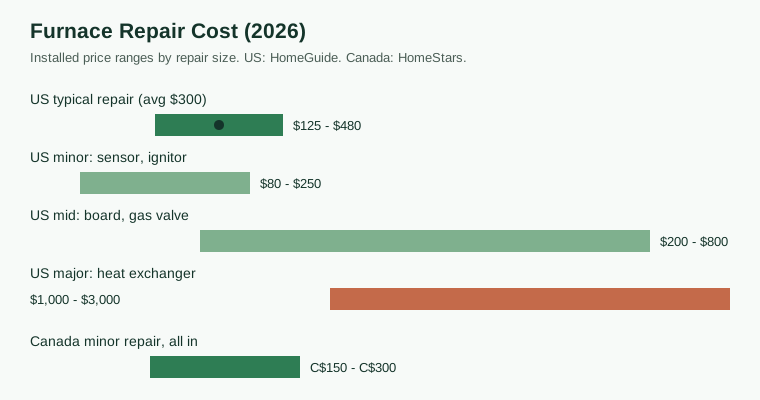
A furnace repair costs $300 on average in the US in 2026, with most jobs between $125 and $480 (HomeGuide). The failed part decides the bill: a flame sensor runs $80 to $250 installed, an ignitor $100 to $250, a control board $300 to $650, a blower motor $500 to $2,300, and a heat exchanger $1,000 to $3,000. In Canada, a diagnostic visit runs C$80 to C$150, a minor repair C$150 to C$300 all in, and a blower motor or control board C$400 to C$900 (HomeStars). This guide prices repairs by part for both countries, separates the diagnostic fee, part, and labour inside a quote, covers the cracked heat exchanger case where repair stops being the right answer, and works the repairorreplace math on three labelled examples.
Quick Checks
- 1Budget $300 as the US average furnace repair in 2026, with most jobs between $125 and $480 (HomeGuide). Angi puts the average in the same place, around $300 to $315.
- 2The part sets the price: flame sensor $80 to $250 and ignitor $100 to $250 installed in the US; control board $300 to $650; blower motor $500 to $2,300; heat exchanger $1,000 to $3,000 (HomeGuide).
- 3In Canada, expect a C$80 to C$150 diagnostic fee (often credited if you proceed), C$150 to C$300 all in for a minor repair, and C$400 to C$900 for a blower motor or control board (HomeStars). Labour runs C$80 to C$150 per hour.
- 4A cracked heat exchanger is the exception to every repair rule: it is a carbon monoxide risk, the furnace should not run, and on a furnace over 10 years old replacement usually beats a $1,000 to $3,000 exchanger job.
- 5Use the age test before a big quote: under 10 years old, repair a single failed part; at 10 to 15 years, price a replacement if the repair passes half the cost of a new furnace; past 15 years, lower that threshold (HomeStars).
Furnace Repair Cost 2026: What Repairs Really Cost, by Part
By EnergyBS Editorial Team | October 22, 2026
The Short Answer
Short Answer: A furnace repair costs $300 on average in the US in 2026, and most jobs land between $125 and $480 (HomeGuide, from project costs reported by its members). Angi lands in the same place, at an average around $300 to $315, with simple fixes from about $65 and complex ones past $1,400. The spread is the failed part, not the company logo on the truck: a flame sensor is $80 to $250 installed, an ignitor $100 to $250, a control board $300 to $650, a blower motor $500 to $2,300, and a heat exchanger $1,000 to $3,000. In Canada, a diagnostic visit runs C$80 to C$150, a minor repair C$150 to C$300 all in, and a blower motor or control board C$400 to C$900, at labour rates of C$80 to C$150 per hour (HomeStars). This guide prices the common repairs by part for both countries, shows the three lines inside every quote, and works the one decision that matters more than the price: repair this furnace, or put the money toward a new one. Our companion guide prices the other side of that decision, furnace replacement cost.
The repair in six steps:
- Rule out the free causes first: a clogged filter, a thermostat setting, a tripped breaker, a blocked vent.
- Book a diagnostic visit and confirm the fee, and whether it is credited toward the repair, before the truck rolls.
- Get the failed part named in writing, with the part price and the labour shown as separate lines.
- Check the quote against the by-part ranges in Section 2 (US) or Section 3 (Canada).
- Run the age test in Section 6 before approving anything over $500: furnace age plus repair size decides repair versus replace.
- Keep the invoice, the old part if you can, and the warranty terms for the repair itself.
1. What a Repair Bill Is Made Of
Every furnace repair quote is three lines wearing one number. Knowing the lines tells you where a high quote is actually high.
The diagnostic fee. In the US, a furnace service call runs $75 to $150 per hour before parts (HomeGuide). In Canada, the diagnostic or service call is typically C$80 to C$150 flat, and it is often credited toward the repair bill if you go ahead with the same company (HomeStars). Ask about the credit when you book, not when you pay. A company that credits the fee and a company that stacks it on top can differ by the full fee on the identical repair.
The part. Parts are the line with the widest range, because the same job can use a universal part or an original manufacturer (OEM) part, and HomeGuide notes OEM parts cost more. Two examples from the Canadian data show the split clearly: a flame sensor or ignitor part costs C$20 to C$100, with labour adding C$80 to C$150, so the bill is mostly the visit; a control board part runs C$200 to C$600 before labour is added, so the bill is mostly the board (HomeStars). Ask which part is being priced, and whether your furnace is still inside its parts warranty. Most furnace warranties cover parts for 5 to 10 years and do not cover labour (HomeGuide), which means a warranted board on a 7-year-old furnace is a labour-only bill, a very different number from the full replacement price.
The labour and the clock. US service labour runs $75 to $150 per hour in regular hours and $140 to $210 per hour for emergency, after-hours, weekend, or holiday work (HomeGuide). Canadian labour runs C$80 to C$150 per hour in regular hours, higher in Toronto and Vancouver, and an after-hours call typically adds C$100 to C$200 or more to the base bill (HomeStars). Most straightforward repairs take one to two hours. The timing decision is real money: a furnace that stops on a cold night but shows no safety problem (no gas smell, no carbon monoxide alarm, no scorch marks) can usually wait for a morning slot, and waiting is the single cheapest line item you control. A furnace with a safety problem cannot wait, and Section 5 covers that case.
One more line appears on some Canadian quotes: a permit. Most repairs need none, but gas line work, heat exchanger changes, or combustion system changes can require a permit or inspection in some municipalities, at C$75 to C$200 when they apply (HomeStars). If a permit line appears on a simple ignitor quote, ask what triggers it.
2. Furnace Repair Cost by Part (US)
HomeGuide's 2026 US prices, installed, part and labour included. These are national figures from reported project costs; your city and your furnace model move the number inside the range, and two-stage or variable-speed equipment sits toward the top of it.
| Repair | Installed cost (US, HomeGuide) | Part alone, where published |
|---|---|---|
| Flame sensor replacement | $80 to $250 | - |
| Ignitor replacement | $100 to $250 | $20 to $50 |
| Thermocouple replacement | $100 to $300 | $10 to $20 |
| Transformer replacement | $100 to $250 | $10 to $45 |
| Limit switch replacement | $100 to $375 | - |
| Relay switch replacement | $100 to $300 | - |
| Short-cycling repair | $100 to $400 | depends on the cause |
| Thermostat replacement | $190 to $480 | - |
| Gas valve replacement | $200 to $800 | $75 to $300 generic, up to $600 OEM |
| Combustion chamber replacement | $200 to $600 | $50 to $200 |
| Control board replacement | $300 to $650 | $50 to $300 |
| Draft inducer motor replacement | $400 to $1,100 | - |
| Flue pipe replacement | $400 to $800 | - |
| Blower motor replacement | $500 to $2,300 | $200 to $400 |
| Coil replacement (furnace plus AC combos) | $650 to $2,400 | - |
| Heat exchanger replacement | $1,000 to $3,000 | - |
Read the table by tier, because the tiers drive different decisions:
The $80 to $300 tier is wear items. Flame sensors, ignitors, thermocouples, transformers, and switches are small electrical and ignition parts that age out on a schedule. An ignitor is a $20 to $50 part; you are paying for the diagnosis and the visit. These repairs are worth doing at almost any furnace age, because the alternative is a cold house, and because a sensor or ignitor failure says little about the rest of the furnace. The exception is frequency: the second or third wear-item call in one winter on an old furnace is a pattern, not bad luck, and Section 6 prices that pattern.
The $300 to $800 tier is motors, valves, and boards. A control board at $300 to $650, a gas valve at $200 to $800, a draft inducer at $400 to $1,100. These are the quotes worth a second phone call before you approve, and the quotes where the OEM-versus-universal part question and the parts-warranty question change the total by hundreds. Add $90 to $200 to a board job if rewiring is needed (HomeGuide).
The $1,000-plus tier is a replacement conversation. A blower motor can reach $2,300 on a variable-speed system, and a heat exchanger runs $1,000 to $3,000. HomeGuide's summary table caps a typical repair at $1,100; jobs above that are no longer typical repairs, and they should be priced against a new furnace before anyone orders parts. Section 5 explains why the heat exchanger sits in its own category entirely.
By fuel type, HomeGuide puts the average repair for gas and propane furnaces and for oil furnaces at $100 to $480, and for electric furnaces at $100 to $380. The electric specialty repair is the heating element, at $125 to $400 per coil, with most electric furnaces carrying 2 to 5 coils. Gas and propane service visits run $100 to $550, oil service $120 to $600, and an electric furnace fix $100 to $400, all from the same HomeGuide data.
3. Furnace Repair Cost in Canada
HomeStars publishes the Canadian guide, in Canadian dollars, and the structure differs from the US in one useful way: the diagnostic fee is a named flat line, C$80 to C$150, and it is often credited toward the repair.
Gas furnace repairs (Canada, HomeStars):
| Repair | Typical cost (Canada) |
|---|---|
| Diagnostic or service call | C$80 to C$150 |
| Flame sensor replacement | C$75 to C$200 |
| Ignitor replacement | C$150 to C$300 |
| Blower motor replacement | C$300 to C$650 |
| Gas valve replacement | C$300 to C$700 |
| Control board replacement | C$400 to C$900 |
| Heat exchanger repair or replacement | C$500 to C$1,500 or more |
Electric furnace repairs (Canada, HomeStars): heating element C$150 to C$400, sequencer C$150 to C$350, limit switch C$100 to C$250, capacitor C$100 to C$250, blower motor C$300 to C$650, control board C$400 to C$900. Electric furnaces are the common system in many condos, in parts of BC, and in much of Quebec, and their element and sequencer repairs tend to land under C$300, while board repairs reach the same C$400 to C$900 band as gas.
Summarized by size: a minor repair such as a flame sensor or ignitor runs C$150 to C$300 all in; a mid-size repair such as a blower motor or control board runs C$400 to C$900; and major component work such as a draft inducer motor or gas valve can bring the total to C$700 to C$1,500 or more. Labour is C$80 to C$150 per hour in regular hours, and the Toronto or Vancouver version of a mid-size repair can carry C$100 to C$200 more labour than the same job in a mid-sized market. Most provinces require gas furnace work to be done by a licensed technician, and unlicensed gas work can void insurance and create problems at resale (HomeStars). Replacement context for the repair-or-replace math: our furnace replacement guide puts a high-efficiency gas furnace installed in Canada at C$4,000 to C$7,500 for most homeowners.
4. Symptoms, Likely Parts, and What Each Costs
A quote makes more sense when you can map the symptom to the short list of parts that cause it. These are the common pairings behind the prices above, and they match the failure patterns in our furnace short-cycling diagnostic guide:
- Furnace starts, runs a minute, shuts off, repeats. Short cycling. Causes include a dirty or failed flame sensor, a clogged filter overheating the furnace, a faulty limit switch, or a thermostat problem. HomeGuide prices short-cycling repair at $100 to $400, because the common fixes are the cheap parts. Check the filter yourself before you book: a severely clogged filter can shut a furnace down on its high-limit switch and mimic a failed component (HomeStars).
- Burners light, but the rooms stay cold and little air moves. Blower trouble: the motor, its capacitor, or the relay that controls it. That is the $500 to $2,300 US blower band, or $100 to $300 if the relay is the whole story. The diagnosis matters more than the symptom here.
- No ignition at all, furnace tries and gives up. Ignitor, flame sensor, gas valve, or the control board sequencing them. The first two are the cheap tier; the board is the mid tier. This is the case where an itemized quote earns its keep, because the same symptom spans $100 to $800 depending on which part failed.
- Furnace runs, air is warm, bills jump. Not always a repair: a furnace working harder than it should can point to duct leaks, a failing blower, or a heat exchanger problem (HomeStars lists rising heating bills among the warning signs). Our duct cleaning cost guide covers the duct side, including the point that cleaning is rarely the fix and sealing is the duct job with an energy payoff.
- Strange noises: banging, rattling, squealing. Loose components, a worn belt or bearing, or ignition trouble (HomeStars). Noise plus a yellow or flickering burner flame, instead of a steady blue one, moves the call from routine to urgent, because a yellow flame can signal incomplete combustion.
Error codes help. If the furnace shows a fault code on the control board, write it down before you call; manufacturers publish fault code guides, and giving the code to the technician before the visit helps them arrive with the right parts (HomeStars).
5. The Heat Exchanger Exception
One repair breaks the normal rules, and it is the most expensive one on the table. The heat exchanger is the metal wall between the combustion gases and your household air. When it cracks, combustion gases, including carbon monoxide, can enter the air the furnace circulates.
The facts, stated plainly:
- A heat exchanger replacement costs $1,000 to $3,000 in the US (HomeGuide). In Canada the part alone runs C$500 to C$1,200, and the combined repair on a furnace over 10 years old typically approaches or exceeds the price of a new furnace (HomeStars).
- Technicians replace heat exchangers rather than repair them, because of the carbon monoxide risk (HomeGuide). Most Canadian pros recommend full furnace replacement when a cracked exchanger is identified (HomeStars).
- A furnace with a confirmed crack may be red-tagged: shut down as unsafe until the problem is resolved. Angi describes a red tag as a designation for serious safety hazards such as carbon monoxide leaks or a cracked heat exchanger, and advises a second opinion before committing to repairs or replacement.
So the procedure for a cracked-exchanger diagnosis is: do not run the furnace, get the finding in writing with photos if the technician can show you the crack, and get a second diagnosis if the first one arrived with a same-day replacement pitch attached. The safety call is not negotiable, but the replacement quote is, and a second opinion on a $1,000 to $3,000 repair or a full replacement is the standard advice from both Angi and HomeStars. If the furnace is under 10 years old and the exchanger is under a parts warranty, replacement of the exchanger itself can still make sense; past that age, the money usually belongs in a new furnace.
6. Repair or Replace: The Math
HomeGuide frames the broad picture: most heating system repairs cost $100 to $600, while a new furnace costs $3,500 to $7,500 or more on its figures, and our replacement guide puts a gas furnace installed at $3,800 to $12,000 in the US. A furnace lasts 15 to 30 years (HomeGuide). Inside that frame, HomeStars gives the decision rule Canadian pros use, and it transfers directly to US prices:
- Under 10 years old: repair a single failed component, almost always. The furnace has most of its service life left, and parts may still be under warranty.
- 10 to 15 years old: apply the 50 percent rule. If the repair costs more than half the price of a comparable new furnace, price the replacement seriously before approving the repair.
- Over 15 years old: lower the threshold. An aging furnace that has already needed one significant repair in the past two seasons is a different calculation from one that has run clean, and parts for models past 15 years can be scarce or discontinued, which adds a return visit and a wait to the bill.
Three labelled examples, using hypothetical quotes set inside the published ranges above:
Example A: the 8-year-old gas furnace with a dead ignitor (US, hypothetical). Weekday call, diagnostic quoted at $100 and credited toward the repair, total quote $210 for the ignitor, inside HomeGuide's $100 to $250 installed band. Age test: under 10, single wear item, repair is about 3 percent of a $6,500 replacement quote. Decision: repair, no second quote needed at this size. Total paid in the example: $210.
Example B: the 17-year-old furnace with a cracked heat exchanger (US, hypothetical). Exchanger quote $2,400, inside HomeGuide's $1,000 to $3,000 band. Replacement quote $5,800, inside the replacement guide's $3,800 to $12,000 band. The repair is 41 percent of replacement on a furnace past the 15-year line, and the failed part is the safety part. Decision: replace, and spend the shopping effort on competing replacement quotes instead of a cheaper exchanger quote. This is also the case our replacement guide was written for, including the 80 percent to 90 percent AFUE conversion costs that change the installed price.
Example C: the 12-year-old furnace in Toronto with a failed control board (Canada, hypothetical). First quote C$780, inside HomeStars' C$400 to C$900 board band, with the board part at C$480 of it. HomeStars advises a second opinion before authorizing anything over C$300, so a second company quotes C$640 for the same board. Age test: 12 years puts the furnace in the 50 percent band, and C$640 is about 11 percent of a C$5,800 replacement quote, well under half. Decision: repair at the second quote, saving C$140, and note the furnace's age for the next failure, which is when the 50 percent rule may flip the answer. Heat pump owners face the same structure with different parts; our heat pump maintenance and repair cost guide prices that version.
Two cost notes that belong in every version of this math. First, standard home insurance does not cover furnace repairs caused by mechanical breakdown or normal wear; coverage applies to sudden damage from an insured event such as a fire, unless you carry an equipment breakdown endorsement (HomeStars). Second, a repair comes with its own warranty, typically 90 days to one year on parts and 30 to 90 days on labour in Canada (HomeStars); get both numbers in writing, because a part that fails again inside its warranty should not generate a second service call fee.
7. Before You Call, and What Not to Touch
Four checks cost nothing and close a surprising share of no-heat calls:
- The filter. Pull it. If it is grey, matted, or you cannot remember changing it, replace it and give the furnace a cycle. A restricted filter overheats the furnace and trips the limit switch (HomeStars), and it is the check every technician wishes the caller had done first.
- The thermostat. Confirm it is set to heat, the set point is above room temperature, and the batteries are alive if it uses them. If the thermostat itself has failed, replacement runs $190 to $480 in the US (HomeGuide), and a smart thermostat is a separate decision priced in our smart thermostat installation cost guide.
- The breaker and the furnace switch. A tripped breaker or a service switch bumped off at the furnace is a two-minute find.
- The vents and the exhaust. Blocked supply registers, a blocked intake or exhaust pipe outside, and a full condensate drain on a high-efficiency furnace all stop a furnace that has nothing wrong with it.
The boundary after those checks is firm. Gas lines, the heat exchanger, gas valves, and internal electrical work belong to a licensed technician; in most Canadian provinces gas work must be done by a licensed gas fitter (HomeStars), and the same licensing logic applies across US states. Cleaning a flame sensor is the one internal task some homeowners take on, with the power off and the manufacturer's instructions in hand; everything past that is a service call, and a service call at the prices in this guide is cheaper than a mistake inside a combustion appliance.
Prevention prices well here. A US tune-up runs $70 to $200 and an annual maintenance plan $150 to $450 (HomeGuide); a Canadian tune-up runs C$100 to C$200 and includes checking the ignitor, flame sensor, and heat exchanger (HomeStars). The arithmetic HomeStars gives is the cleanest version: finding a worn ignitor during a maintenance visit costs the price of the part, while finding it at 11 pm in January costs the part plus the emergency surcharge.
8. Quote Checklist
- The diagnostic fee is stated before the visit, and whether it is credited toward the repair is confirmed in writing.
- The failed part is named, not described as a heating problem in general terms.
- Part and labour are separate lines, and the part is identified as OEM or universal.
- The quote is checked against the by-part range for your country before you sign.
- Warranty status is checked first: a furnace inside its 5 to 10 year parts warranty should not be quoted a full part price.
- Anything over $300 in Canada, or $500 in the US, gets a second quote unless the house has no heat and no safety issue allows waiting. HomeStars sets its second-opinion line at C$300; the principle is the same on both sides of the border.
- The after-hours premium is a named number, so you can decide whether the repair can wait for morning.
- A cracked heat exchanger claim comes with evidence: photos, a combustion test result, or a second technician's confirmation.
- The repair warranty is on the invoice: parts term and labour term, in writing.
- The invoice records the furnace model and serial number, the part number installed, and the fault code the furnace showed, so the next technician starts from facts.
Frequently Asked Questions
How much does furnace repair cost in 2026?
The US average is $300, and most repairs land between $125 and $480 (HomeGuide). Angi's average is in the same range, around $300 to $315, with simple fixes from about $65 and complex jobs past $1,400. In Canada, a minor repair runs C$150 to C$300 all in, a mid-size repair C$400 to C$900, and major component work C$700 to C$1,500 or more (HomeStars).
What is the most expensive furnace repair?
The heat exchanger, at $1,000 to $3,000 installed in the US (HomeGuide), followed by blower motors on variable-speed systems at up to $2,300 and coils on combined furnace and AC systems at $650 to $2,400. A cracked heat exchanger is also a safety problem, and replacement of the furnace is usually recommended instead, especially past 10 years of age.
How much is a furnace service call?
In the US, $75 to $150 per hour before parts, and $140 to $210 per hour for emergency or after-hours work (HomeGuide). In Canada, the diagnostic fee is typically C$80 to C$150 and is often credited toward the repair if you proceed with the same company (HomeStars). Confirm the credit policy when you book.
Is it worth repairing a 15-year-old furnace?
For a cheap wear item, yes: a $150 ignitor that restores heat is rational at almost any age. For a major part, usually no. Past 15 years, lower the replacement threshold: a blower motor, board, or exchanger bill on a furnace that has already needed a significant repair in the past two seasons is money toward a new furnace, which our replacement guide prices at $3,800 to $12,000 installed in the US and C$4,000 to C$7,500 in Canada.
How long does a furnace repair take?
Straightforward repairs such as an ignitor, flame sensor, or capacitor typically take one to two hours. A blower motor or control board can take two to four hours depending on the model and access. If the part has to be ordered, expect a return visit and a delay of one to five business days (HomeStars).
Does insurance or a warranty cover furnace repair?
Standard home insurance does not cover mechanical breakdown or normal wear; it covers sudden damage from an insured event, and some policies offer an equipment breakdown endorsement as an add-on (HomeStars). The manufacturer's warranty is separate: most furnace warranties cover parts for 5 to 10 years and do not cover labour (HomeGuide). A repair itself usually carries 90 days to one year on parts and 30 to 90 days on labour.
Can I repair a furnace myself?
The checks in Section 7, yes: filter, thermostat, breaker, vents. A clogged filter alone can shut a furnace down. Gas lines, the heat exchanger, gas valves, and internal electrical components belong to a licensed technician; in most Canadian provinces gas work must be performed by a licensed gas fitter (HomeStars).
Why did my furnace repair quote come in higher than these ranges?
The usual reasons are a variable-speed or two-stage furnace, an OEM part on a discontinued model, rewiring on a board replacement (an extra $90 to $200, HomeGuide), after-hours timing, or a metropolitan labour rate. Ask for the part and labour lines separately and check them against Section 2 or 3; a quote that cannot be itemized is the one to replace with a second quote.
Making the Call
A furnace repair is a $300 average job with a long tail, and the tail is where the money is lost: a $2,400 heat exchanger approved on a 17-year-old furnace, a board replaced at the first quote when the second was C$140 lower, an emergency premium paid for a problem that would have waited for morning. The defences are all in this guide and none of them cost anything: name the part, split the quote into diagnostic, part, and labour, check the range for your country, and run the age test before anything over $500 is approved. Under 10 years, repair it. In the teens, do the 50 percent math. With a cracked heat exchanger, stop the furnace and shop for a replacement, not a repair. For that next step, the furnace replacement cost guide prices the new system, and the HVAC library holds the related guides on heat pump repair, ductwork, and thermostats.
What to Read Next
Furnace Replacement Cost 2026: What Installation Really CostsUse this next to compare the cost, incentive, installation, or operating-risk angle before you make a home energy decision.Sources and Verification
- HomeGuide How Much Does Furnace Repair Cost? (2026) (national average $300, average range $125 to $480, minimum $80, maximum $1,100 in the summary table; by part: flame sensor $80 to $250, ignitor $100 to $250, thermocouple $100 to $300, transformer $100 to $250, limit switch $100 to $375, relay switch $100 to $300, thermostat $190 to $480, gas valve $200 to $800, control board $300 to $650, draft inducer motor $400 to $1,100, flue pipe $400 to $800, blower motor $500 to $2,300 with the part alone $200 to $400, heat exchanger $1,000 to $3,000, combustion chamber $200 to $600, electric heating element $125 to $400 per coil; shortcycling repair $100 to $400; service call $75 to $150 per hour, emergency service $140 to $210 per hour; tuneup $70 to $200; by fuel: gas and propane and oil averages $100 to $480, electric $100 to $380; most furnace warranties cover parts for 5 to 10 years but not labour; a furnace lasts 15 to 30 years; most heating system repairs cost $100 to $600 against a new furnace at $3,500 to $7,500 or more)
- HomeStars Furnace Repair Costs in Canada in 2026 (diagnostic fee C$80 to C$150, often credited toward the repair; minor flame sensor or ignitor repair C$150 to C$300 all in; blower motor or control board C$400 to C$900; draft inducer or gas valve work C$700 to C$1,500 or more; gas table: flame sensor C$75 to C$200, ignitor C$150 to C$300, blower motor C$300 to C$650, gas valve C$300 to C$700, control board C$400 to C$900, heat exchanger C$500 to C$1,500 or more; electric table: heating element C$150 to C$400, sequencer C$150 to C$350, limit switch C$100 to C$250, capacitor C$100 to C$250; HVAC labour C$80 to C$150 per hour, higher in Toronto and Vancouver; afterhours adds C$100 to C$200 or more; flame sensor and ignitor parts C$20 to C$100 plus C$80 to C$150 labour; control board part C$200 to C$600 before labour; the 50 percent rule for furnaces 10 to 15 years old; cracked heat exchanger part alone C$500 to C$1,200 with replacement usually recommended; permits C$75 to C$200 when required; tuneup C$100 to C$200; repair warranties typically 90 days to one year on parts and 30 to 90 days on labour; standard home insurance does not cover mechanical breakdown or wear)
- Angi Who to Call for Furnace Repair, updated April 10, 2026 (average cost to repair a furnace is around $300; repairs often stem from dirty filters, faulty ignition components, or leaky ducts; professional diagnosis protects the unit warranty)
- Angi RedTag Furnaces: How to Deal With Them, updated July 8, 2026 (a redtagged furnace indicates serious safety hazards such as carbon monoxide leaks or a cracked heat exchanger and must not operate until resolved; furnace repairs cost $65 to $1,400 with average costs around $310; get a second opinion before committing to a large repair or a replacement)
Editorial Review
EnergyBS Editorial Team
EnergyBS publishes practical homeowner guides. Important program, product, and cost claims should be checked against the linked source and local project documents before you commit to work.
Related Guides
View All ArticlesFurnace Replacement Cost 2026: What Installation Really Costs
Replacing a gas furnace in 2026 typically costs $3,800$12,000 installed in the US ($4,000$7,500 in Canada). This guide breaks down equipment vs. labor, efficiency tiers, sizing, the 80%to90% conversion risk, and repairvsreplace math.
Furnace Short Cycling
Use burner, blower, thermostat, errorcode, temperaturerise, and pressure evidence to separate airflow limits, ignition failures, venting faults, thermostat problems, and oversizing.
Duct Cleaning Cost 2026: What It Costs, and When the EPA Says It Is Worth Doing
Professional air duct cleaning costs $389 on average in the US in 2026, with most homeowners paying $271 to $509 (Angi, 21,664 verified projects). Cleaners price by the vent, about $35 each ($25 to $50), or by the square foot, $0.15 to $0.30. The price is the easy part. The US Environmental Protection Agency does not recommend routine duct cleaning at all: it recommends cleaning only as needed, when there is substantial visible mold, a vermin infestation, or ducts clogged with so much dust and debris that particles blow into the home, and it states plainly that duct cleaning has never been shown to prevent health problems. This guide prices the service by vent count and home size, lists the three EPA triggers that make it worth buying, explains what a complete cleaning includes, and shows how to spot the coupon deal that turns into a fourfigure invoice.