Heat Pump Blowing Cold Air? A Diagnostic Guide: What Is Normal, What You Can Fix, and When to Call a Technician
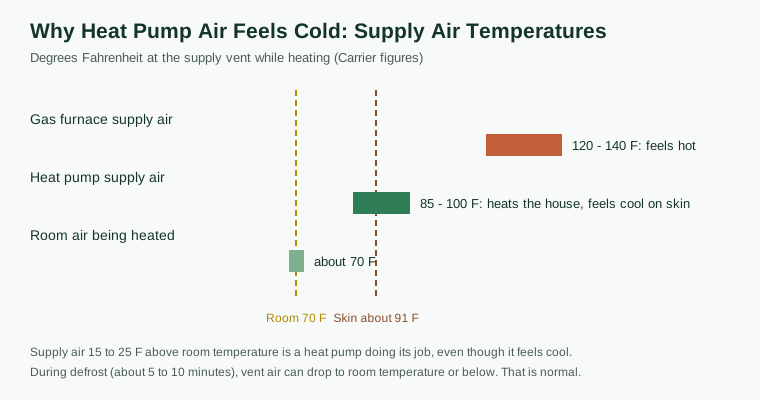
A heat pump blowing air that feels cold is usually not broken. Heat pump supply air runs about 85 to 100 degrees F, well below the 120 to 140 degrees of a gas furnace and right around skin temperature, so it feels cool on your hand while heating the house correctly. The second normal cause is the defrost cycle: Carrier's manual describes the system briefly reversing to melt frost off the outdoor coil, a cycle of about 5 to 10 minutes (up to 10 by design) during which vents can blow cool air and steam rises off the outdoor unit. This guide runs the diagnosis in order: time the episode, measure the vent air against room temperature, check the thermostat traps (fan ON, a multidegree setback recovery, emergency heat), check the filter and the outdoor unit, and only then decide it is a fault. The real faults (low refrigerant, a stuck reversing valve, a failed defrost control, a dead outdoor fan) are named with the symptom that separates each from the normal causes, plus Carrier's rule of thumb: if the house sits consistently more than 2 to 3 degrees below the thermostat setting, have the system checked.
Quick Checks
- 1Give it 15 minutes first. A defrost cycle makes vents blow cool air for about 5 to 10 minutes (Carrier), with steam at the outdoor unit and AUX showing on the thermostat. Heat that returns on its own was never a fault.
- 2Measure, do not feel. Heat pump supply air is about 85 to 100 degrees F (Carrier), close to skin temperature, so it feels cool while heating correctly. A thermometer at the vent, compared with room temperature, settles the question: warmer than the room by 15 degrees or more is a working heat pump.
- 3Check the three thermostat traps: mode actually on HEAT, fan on AUTO rather than ON, and no big manual temperature jump, which calls auxiliary heat by design (Carrier). Emergency heat is for a failed heat pump only.
- 4Then the free checks: a clogged filter, closed or blocked registers, snow or leaves around the outdoor unit, and a tripped breaker or outdoor disconnect.
- 5Call a technician when the coil stays iced over between cycles, the outdoor fan does not spin, the air stays at room temperature for an hour of runtime, or the house sits consistently more than 2 to 3 degrees below the setting (Carrier's rule).
Heat Pump Blowing Cold Air? A Diagnostic Guide: What Is Normal, What You Can Fix, and When to Call a Technician
By EnergyBS Editorial Team | October 21, 2026
The Short Answer
Short Answer: Most heat pumps blowing "cold" air are working correctly. Two normal behaviors explain most episodes. First, a heat pump's supply air is only about 85 to 100 degrees F (Carrier), versus 120 to 140 degrees F from a gas furnace. Air at 90 degrees is heating your 70-degree house, but it is below skin temperature, so it feels cold on your hand. Second, the defrost cycle: in cold, damp weather the system briefly reverses itself to melt frost off the outdoor coil, and for about 5 to 10 minutes the vents can blow cool air, the outdoor unit may steam, and the thermostat may show AUX while backup heat covers the gap (Carrier). Both behaviors end on their own. The diagnosis below separates them from the real faults in about fifteen minutes, with a thermometer and a walk outside, before any money changes hands.
The diagnosis in six steps:
- Time it. Note when the cool air started and whether the thermostat shows AUX or DEFROST.
- Look outside during the episode: steam, a stopped outdoor fan, and frost melting are defrost, and they are normal.
- Measure the vent air temperature and compare it with the room temperature.
- Check the thermostat: HEAT mode, fan on AUTO, setpoint, and whether someone just raised it several degrees.
- Check airflow and power: filter, registers open, outdoor unit clear, breakers and disconnect on.
- Decide: episode over and heat back means normal; persistent room-temperature air, a permanently iced coil, or a silent outdoor unit means a technician.
This guide sits in our HVAC library. For the cold-weather capacity side of the same question, see the cold-climate heat pump performance guide; this page is about the day something feels wrong.
1. Normal Cause One: the Defrost Cycle
A heat pump heating your home is running its refrigeration cycle in reverse: the outdoor coil is the cold side, and it runs 10 to 20 degrees F colder than the outdoor air (Trane, compiled in the diagnosis literature). Below about 45 degrees F outside, moisture in the air freezes onto that coil (Carrier owner's manual). Frost is insulation the system cannot afford: left alone, it chokes airflow and the heat output falls. So the heat pump defrosts itself.
Here is what a defrost looks and sounds like from inside the house:
- The system reverses into cooling mode briefly to warm the outdoor coil and melt the frost. That is the whole reason for the cool air at the vents: for a few minutes, the machine is literally air-conditioning the house to de-ice itself.
- The cycle is short. Carrier puts a typical defrost at about 5 to 10 minutes, with a hard maximum of 10 minutes in the manual's design; Lennox and Bryant figures run 5 to 15 minutes; Trane's demand-defrost systems often finish in 3 to 5.
- The outdoor fan stops during defrost (it would blow the heat away), and you may hear a whoosh as the reversing valve switches, and a sound like running water.
- Steam or fog rises from the outdoor unit as the frost melts into cold air. Carrier's manual is blunt: do not be alarmed, and do not try to chip ice off the unit's grille.
- Most systems switch on auxiliary heat (electric strips in the air handler, or the furnace in a dual-fuel setup) during defrost to cover the gap, which is why the thermostat shows AUX. Carrier lists defrost as one of the three designed triggers for auxiliary heat. Some dual-fuel systems cannot run both heat sources at once and simply blow cool air through the cycle; that is also normal for those systems.
- Defrost runs on a control schedule, at preset intervals such as 30, 50, or 90 minutes, and only when the coil sensor says ice is actually interfering (Carrier manual). In damp weather just below freezing, defrosts can come often; in dry cold, rarely.
The verdict rule: if the cool episode lasts under about 15 minutes and normal heating resumes, it was defrost. Write down the time; a pattern of short episodes in frosty weather confirms it. If the steam is what actually brought you here, our defrost cycle explainer is devoted to that one alarming sight.
2. Normal Cause Two: Heat Pump Air Just Feels Cold
Furnaces spoiled everyone's hands. A gas furnace delivers air at roughly 120 to 140 degrees F, which feels hot because it is far above skin temperature (about 91 degrees F at the surface of your hand). A heat pump delivers a larger volume of air at a lower temperature: about 85 to 100 degrees F (Carrier). Put your hand over the vent and 92-degree air feels like a cool breeze, even though it is 20 degrees warmer than the room it is heating.
Replace the feel test with a measurement:
- Put a thermometer (a kitchen probe or an inexpensive infrared thermometer) at a supply vent while the system runs in heating, not during a defrost.
- Measure the room temperature at the thermostat.
- Supply air 15 to 25 degrees F above room temperature is a heat pump doing its job. Supply air at or below room temperature, sustained over 20 to 30 minutes of runtime, is not.
- Cross-check with the house: is the indoor temperature holding or climbing toward the setpoint? Carrier's service threshold is a house that sits consistently more than 2 to 3 degrees below the thermostat setting. Within that band on the coldest nights, the system may simply be at capacity with auxiliary heat assisting, which is design behavior, not failure.
3. The Thermostat Traps
Three settings manufacture this exact symptom in healthy systems:
Mode and fan. Mode on COOL, or a schedule that has not switched over, is the embarrassing classic; check it anyway. Fan set to ON instead of AUTO runs the blower between heating cycles, pushing unheated room air through the vents continuously. The air is room temperature, but moving air on skin feels cold. AUTO is the correct setting for heating season.
The big temperature jump. Raising the setpoint several degrees at once (coming home to a setback house is the usual case) tells the controls to recover fast, and Carrier lists exactly this as a designed trigger for auxiliary heat. What you feel during recovery can be a blend of heat pump and strip heat, and if the strips are undersized or a stage has failed, the blend can feel lukewarm. The fix is behavioral: recover in steps of 2 degrees, or use a thermostat with adaptive recovery that starts early without aux heat.
Emergency heat left on. EM or EHEAT mode shuts the heat pump off entirely and runs the backup alone (Carrier manual: it "is not normally used" and exists for when the heat pump itself has failed). If a previous scare left the thermostat on EM, the vents blow strip-heat air, which is warmer than heat pump air, so this risk usually presents as a shocking electricity bill rather than cold air. It is worth checking because the bill version of this mistake is expensive: strip heat converts electricity to heat at 100 percent efficiency while a heat pump delivers up to three times the heat per unit of electricity (Carrier; ENERGY STAR). A week on emergency heat in cold weather can cost roughly triple the electricity for the same warmth. EM is a bridge to a repair visit, never a setting to live on.
4. The Free Checks: Airflow and Power
Restricted airflow makes a healthy heat pump blow cooler air and work harder doing it, because the coil cannot move heat into air that is not flowing:
- Filter. A clogged filter is the most common cause of weak, cool-feeling heat. Hold it to the light; if you cannot see light through it, replace it. Our HVAC filter MERV guide covers choosing the rating your blower can actually handle.
- Registers and returns. Closed supply registers in unused rooms and a blocked return grille (furniture, a rug, a storage pile) starve the system the same way.
- Outdoor unit clearance and condition. Clear snow, leaves, and debris off the top and away from the sides, with about two feet of breathing room. Check that the outdoor fan spins during a heating call; a fan that hums but does not turn, or sits still and silent, is a fault, not a setting.
- Breakers and disconnect. The outdoor unit has a breaker in the panel and usually a disconnect box on the wall beside it. A tripped breaker reset once is a data point; a breaker that trips again is a technician call, not a ritual.
- A coil that stays iced. Frost between defrosts is normal; a coil that builds a solid shell of ice and never clears points to a failed defrost control, sensor, or reversing valve. Switch to emergency heat so the house stays warm, and call. Chipping the ice yourself can puncture the coil, which turns a control repair into a coil replacement.
5. The Faults That Need a Technician
When the normal causes and free checks are cleared, the remaining causes live inside a sealed refrigerant system and a control board, and they belong to a technician:
| Symptom pattern | Likely fault | Why it blows cold |
|---|---|---|
| Air at room temperature for an hour or more; outdoor unit runs | Low refrigerant charge from a leak | The cycle cannot pick up and move enough heat; the leak must be found and fixed, not just topped up |
| Works in cooling, will not heat (or the reverse) | Stuck reversing valve or its solenoid | The valve that switches the cycle direction is not switching |
| Coil encased in ice that defrost never clears | Defrost control board, coil sensor, or reversing valve fault | The de-icing step in Section 1 never runs or never finishes |
| Outdoor fan not spinning; unit hums or clicks | Fan motor or capacitor failure | No air across the outdoor coil means no heat absorbed |
| AUX on constantly, house still lagging, huge bills | Auxiliary heat staging fault or heat pump running at a fraction of capacity | The expensive backup is carrying a load the heat pump is failing to carry |
| Breaker trips repeatedly | Electrical fault in the unit or wiring | A protective trip is information; keep resetting it and it becomes damage |
A technician's visit for these starts with gauges and the refrigerant circuit, the reversing valve test, and the defrost controls. Go in with your notes: when the episodes happen, how long they last, what the thermostat displayed, and what the vent thermometer read. That history is often half the diagnosis.
6. Why a Degraded Heat Pump Costs Real Money While You Wait
Cold-feeling air is a comfort complaint; the reason to diagnose it promptly is arithmetic. A healthy heat pump moves heat rather than making it, delivering up to three times more heat energy than the electricity it consumes (ENERGY STAR's figure, cited by Carrier). Electric resistance backup delivers exactly the heat its electricity converts to, at 100 percent efficiency. Every hour a fault pushes your system onto auxiliary or emergency heat, you buy the same warmth at up to three times the electricity.
A labeled example, with the assumptions stated: suppose a home needs 40 kWh of heat across a cold day. On the heat pump alone, at 300 percent delivered efficiency, that warmth takes about 40 divided by 3 = 13.3 kWh of electricity. On backup strips alone, it takes the full 40 kWh. The difference is 26.7 kWh per day. If a failed defrost board or a tripped outdoor unit goes unnoticed for two weeks of cold weather because the house still feels "warm enough" on strips, the excess is about 26.7 x 14 = 374 kWh, which at any residential electricity price is a visible line on the bill, and it buys nothing except delay. This is also why the thermostat's AUX indicator deserves a glance during cold snaps: occasional AUX is design, constant AUX with a lagging house is a meter spinning at strip-heat rates. Diagnose early, and if the fault needs a part that takes days to arrive, you at least spend the wait knowing what it costs per day, and can weigh a space heater in one room against heating the whole house on strips.
7. The Decision Summary
| What you observe | Verdict | Action |
|---|---|---|
| Cool air for 5 to 15 minutes, steam outside, then heat returns | Defrost cycle | Nothing; it is the system maintaining itself |
| Vent air 85 to 100 degrees F, house holding temperature | Normal heat pump air | Nothing; measure instead of feeling |
| Cool air with fan running between cycles | Fan set to ON | Switch fan to AUTO |
| Lukewarm air after a big setpoint jump | Auxiliary recovery by design | Recover in 2-degree steps; check strips if it persists |
| Cool air, dirty filter or blocked vents | Airflow restriction | Replace filter, open vents, re-test |
| Outdoor unit silent or iced solid; air at room temperature for an hour | Fault | Emergency heat for warmth, then a technician |
| House consistently 2 to 3+ degrees below setpoint (Carrier) | Underperforming system | Book service with your episode notes |
Frequently Asked Questions
Why does my heat pump blow cold air when it is in heat mode?
Most often, one of two normal behaviors: a defrost cycle (5 to 10 minutes of reversed operation to melt frost off the outdoor coil, per Carrier) or simply heat pump air, which at 85 to 100 degrees F feels cool against skin while heating the house correctly. Persistent room-temperature air beyond an hour of runtime is a fault.
How long should a defrost cycle last?
About 5 to 10 minutes on Carrier systems, with a 10-minute design maximum in the manual; 5 to 15 minutes on Lennox and Bryant equipment; and 3 to 5 minutes on Trane demand-defrost systems. Cool air, a stopped outdoor fan, a whoosh, and steam at the outdoor unit during those minutes are all normal.
Is steam coming from my outdoor unit a problem?
No. Steam or fog during defrost is melting frost meeting cold air, and Carrier's manual says not to be alarmed and not to chip ice off the grille. Smoke, a burning smell, or steam that never stops are different observations and justify a service call.
What does AUX mean on my thermostat, and should I worry?
AUX means auxiliary (backup) heat is assisting. Carrier designs it to engage in three situations: very cold weather below the system's balance point, a rapid manual temperature increase, and defrost. Occasional AUX is normal and expected. AUX that runs constantly while the house still lags is a symptom worth a service visit.
When should I use emergency heat?
Only when the heat pump itself has failed, to keep the house warm until the repair (Carrier). Emergency heat runs the backup strips or furnace alone; on strips it uses roughly three times the electricity per unit of heat compared with the heat pump, so it is a bridge, not a setting.
My heat pump blows cold air at night but works in the day. Why?
That pattern points at defrost frequency and capacity, both of which worsen as outdoor temperature and humidity drop overnight. More frost forms, defrosts come more often, and the heat pump's output falls exactly when the house's heat loss peaks, so auxiliary heat carries more of the load. If the house still holds its setpoint, this is the system working as designed; if it falls consistently more than 2 to 3 degrees behind, have it checked (Carrier).
Can a dirty filter really cause cold air?
It causes weak, cooler-feeling air and longer runtimes by starving the indoor coil of airflow, and it is the most common fixable cause. Replace the filter and re-measure the vent temperature before booking a service call.
The outdoor unit is covered in ice. What do I do?
A frost layer that comes and goes is defrost doing its job. A solid shell that never clears means the defrost system has failed: switch the thermostat to emergency heat so the backup warms the house, and call a technician. Do not chip or pour hot water on the coil; a punctured coil turns a control repair into a major one.
How cold is too cold for a heat pump to work alone?
There is no universal number. Carrier is explicit that the balance point, where auxiliary heat must help, is specific to the heat pump, the home, and the system design rather than a set temperature like 30 or 35 degrees F. Single-stage systems tend to need help nearer the low 30s; modern variable-speed cold-climate units keep heating well below that. Your system's design paperwork, not a rule of thumb, has your number.
The Bottom Line
Time it, measure it, then judge it. A heat pump that blows cool air for ten minutes while steam rises outside is maintaining itself; a heat pump whose vent air reads 15 degrees above room temperature is heating, whatever your hand says; and a heat pump that delivers room-temperature air for an hour, wears a shell of ice, or leaves the house 3 degrees behind its setting has a fault with a name and a fix. Work the free checks first (thermostat mode and fan, filter, registers, the outdoor unit, the breakers), use emergency heat only as a bridge, and hand the technician your notes. For the related decisions, our heat pump installation cost breakdown prices the replacement end of this road, and the duct cleaning cost guide covers the other service most often sold to homeowners chasing an airflow problem that turns out to be a filter.
What to Read Next
Cold Climate Heat Pump Performance Data 2026 ToolUse this next to compare the cost, incentive, installation, or operating-risk angle before you make a home energy decision.Sources and Verification
- Carrier What Is Auxiliary Heat? (carrier.com: auxiliary heat activates in three scenarios: extreme cold below the system's thermal balance point, which is specific to the heat pump, home, and system design rather than a universal temperature such as 30 or 35 degrees F; rapid temperature changes, when you manually raise the thermostat by several degrees; and defrost mode, where supplemental heat assists during the defrost cycle to prevent cold air from blowing out of the vents while the outdoor unit deices; variablespeed highend heat pumps can operate effectively at much lower outdoor temperatures without auxiliary heat than singlestage lowerefficiency systems, which may need aux heat closer to 32 degrees)
- Carrier Heat pump owner's manual, heating, defrost, and emergency heat modes (ManualsLib mirror of the manufacturer manual: when the heat pump is providing heat and the outdoor temperature drops below 45 degrees F, moisture may freeze on the outdoor coil; the automatic defrost mode runs at a preset interval (90 minutes, resettable to 30 or 50) only if ice is sufficient to interfere with operation; after the ice melts, or after a maximum of 10 minutes in defrost, the unit returns to normal heating; do not be alarmed if steam or fog appears at the outdoor unit during defrost; do not attempt to remove ice from the outdoor unit grille, the condition will clear on its own; the emergency heat (EHEAT) setting turns off the heat pump and uses only the supplemental heat source, and is not normally used)
- Homeowner Basics Heat Pump Blowing Cold Air? Causes and Fixes (manufacturer figures compiled: Carrier puts heat pump supply air at roughly 85 to 100 degrees F while heating, against roughly 120 to 140 degrees F from a gas furnace; the outdoor coil runs 10 to 20 degrees F colder than the outdoor air per Trane, so frost can form even in the low 40s; a defrost cycle typically lasts about 5 to 15 minutes (Lennox, Bryant) or 5 to 10 minutes (Carrier), with Trane demanddefrost systems usually finishing in 3 to 5 minutes; some dualfuel systems blow cool air during defrost, which is also normal; emergency heat should be used only when the heat pump has failed; Carrier calls electric strip heat 100 percent efficient against as much as 300 percent for a heat pump, and ENERGY STAR says a heat pump can deliver up to three times more heat energy than the electricity it uses; Carrier suggests having the system checked if indoor temperature is consistently more than 2 to 3 degrees away from the thermostat setting)
Editorial Review
EnergyBS Editorial Team
EnergyBS publishes practical homeowner guides. Important program, product, and cost claims should be checked against the linked source and local project documents before you commit to work.
Related Guides
View All ArticlesCold Climate Heat Pump Performance Data 2026 Tool
Can heat pumps handle subzero winters? We audit realworld performance data, Coefficient of Performance (COP) curves in extreme cold, and actual utility bill impacts.
Heat Pump Smoking? The Defrost Cycle Explained (2026)
It's 20°F outside, your heat pump is making demon noises, and there is steam rising from it. Relax. It's not on fire; it's just defrosting. Here is the physics.
Best MERV Rating for a Home 2026 Guide & Data
Choose an HVAC filter by particleremoval goal, clean and loaded pressure drop, filter area, and measured system airflow. Includes a MERV decision table and commissioning worksheet.