Dehumidifier Not Collecting Water, Icing Up, Leaking, or Running Constantly: A Safe Diagnostic Guide
Diagnose a portable dehumidifier that runs without collecting water, freezes, leaks, cycles incorrectly, or never reaches its setpoint using temperature, humidity, airflow, drainage, recall, and measuredperformance evidence.
Direct Answer
Diagnose a portable dehumidifier that runs without collecting water, freezes, leaks, cycles incorrectly, or never reaches its setpoint using temperature, humidity, airflow, drainage, recall, and measuredperformance evidence.
Diagnose the Room, Air Path, and Water Path Before Blaming the Refrigerant Circuit
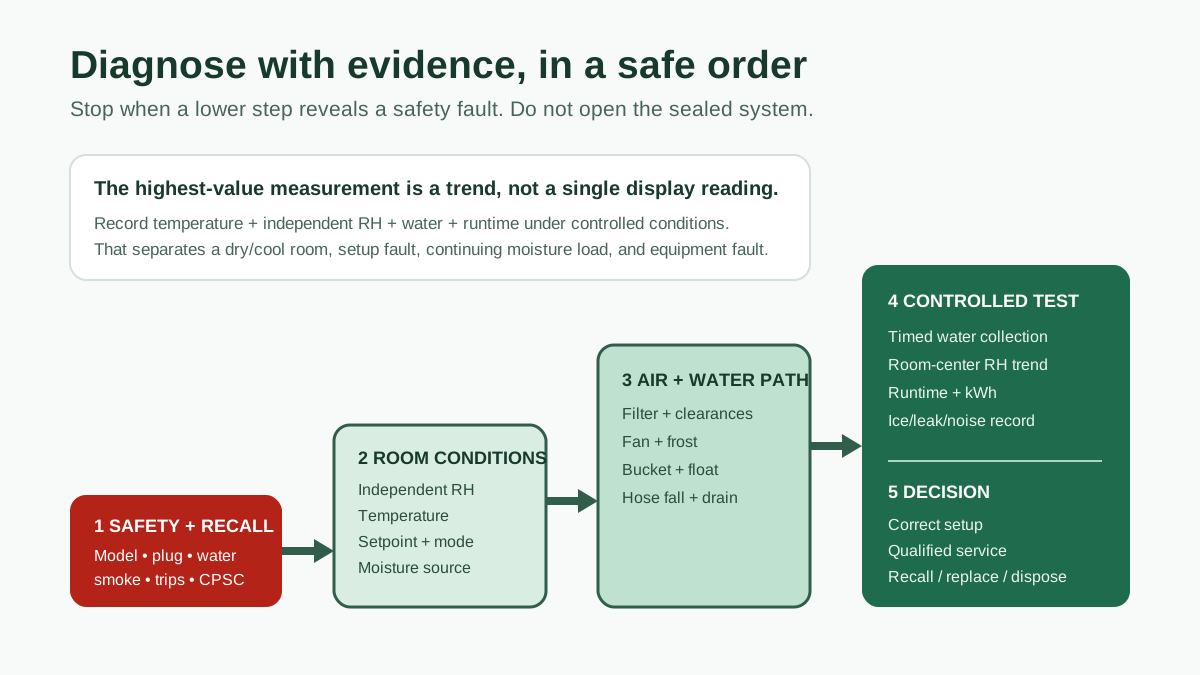
Short answer: Unplug the unit immediately for smoke, a burning smell, melted plastic, a hot or damaged plug, water near energized parts, repeated breaker trips, or a recalled model. Otherwise, record the exact model, room temperature, independent relative humidity, setpoint, fan/compressor behavior, filter and coil condition, bucket or hose arrangement, measured water collected, and electricity use. A dehumidifier may collect little water because the room is already dry, the air is cool, airflow is blocked, the humidistat is inaccurate, the bucket switch is open, the drain is misrouted, or the refrigeration system has failed. Those cases require different actions.
Do not start by opening a sealed cabinet. A portable dehumidifier combines line-voltage electricity, water, moving parts, capacitors, and a sealed refrigerant circuit. The useful owner-level work is evidence gathering, cleaning explicitly allowed by the manual, correcting placement and drainage, and deciding when the evidence justifies qualified service or replacement.
First: Stop for Fire, Electrical, Water, or Recall Risk
Turn the unit off, unplug it without touching wet surfaces, and stop troubleshooting if you observe:
- smoke, arcing, a burning or fishy electrical odor;
- softened, browned, cracked, or melted plug/receptacle material;
- a cord that is cut, crushed, repaired, unusually hot, or missing its grounding pin;
- repeated breaker or ground-fault trips;
- water reaching the receptacle, plug, controls, or internal electrical compartment;
- abnormal metal grinding or a fan that cannot turn freely after power is removed;
- cabinet deformation, scorching, or evidence of overheating;
- a model included in a stop-use recall.
The recall check is not optional for an older, used, inherited, or storage-returned unit. Search its full model and serial/date code on the CPSC dehumidifier recall page. Brand alone is insufficient because a recall normally applies to specified models and production identifiers. CPSC has documented recalls involving overheating and fire hazards, including a 2021 action covering about two million New Widetech-made units in the United States (CPSC recall notice). Follow the remedy in the exact notice rather than testing a recalled unit again.
Do not use an extension cord, power strip, smart plug, or timer unless the manufacturer explicitly permits that exact arrangement. Use the rating label and manual to confirm supply requirements. A receptacle or circuit concern belongs with a qualified electrician.
Build a Ten-Minute Evidence Record
Before changing settings, photograph the display, installation, filter, rear label, bucket, hose, drain termination, and any water trail. Then create this record:
| Evidence | Record | Why it separates causes |
|---|---|---|
| Exact model and serial/date code | Enables manual, parts, warranty, and recall match | |
| Room temperature at inlet height | Cool air changes coil behavior and water-removal rate | |
| Independent RH near room center | Tests whether the room actually needs drying | |
| Display RH and setpoint | Reveals sensor offset or a satisfied control | |
| Fan operation and sound | Confirms some airflow, not full refrigeration performance | |
| Compressor sound/vibration | Distinguishes fan-only operation from an attempted cooling cycle | |
| Filter and grille condition | Blockage reduces airflow and can promote icing | |
| Coil appearance | Dust, frost pattern, or damage changes diagnosis | |
| Bucket seating and float movement | A mis-seated bucket can hold the safety switch open | |
| Drain route and slope | Explains backup, leakage, or a bucket filling despite a hose | |
| Water collected over a timed test | Converts “not working” into measurable output | |
| Plug-in meter kWh, if safely permitted | Helps distinguish standby/fan-only from compressor operation |
Use a separate hygrometer; do not assume the unit’s display is laboratory-accurate. Place the independent sensor away from discharge air, wet walls, exterior masonry, a dryer, a floor drain, and the floor itself. Compare readings after the instruments have stabilized together, then move the reference sensor to the room center.
Symptom Map: Choose the Branch That Matches the Evidence
| Primary symptom | First evidence to check | Common non-invasive explanation | Escalate when |
|---|---|---|---|
| Runs, no water | Independent RH, temperature, compressor behavior | Room dry/cool, setpoint satisfied, fan-only mode | Humid/warm room, clear airflow, compressor attempts, still no output |
| Ice on coil | Temperature, filter, clearances, fan airflow | Cool room, dirty filter/coil, restricted air | Ice returns in allowed conditions after cleaning and full thaw |
| Water on floor | Bucket, hose, slope, drain, level | Mis-seated bucket, loose hose, blocked drain, tilted unit | Cabinet or internal path leaks with correct setup |
| Runs constantly | RH trend, setpoint, source load, room connection | Undersized unit, open zone, bulk moisture, sensor offset | Load is controlled but RH/output never improves |
| Starts and stops | Display code, bucket switch, frost cycle, voltage symptoms | Normal defrost, satisfied control, bucket interlock | Rapid abnormal cycling, overheating, trips, or no recovery |
| Bucket fills with hose attached | Hose fall and fitting | Uphill run, sag, cap/adapter error, blockage | Correct manual-approved gravity path still will not drain |
The table is a triage tool, not a diagnosis by itself. Follow the branch below and compare behavior with the exact manual.
Branch 1: It Runs but Collects Little or No Water
Confirm there is a moisture load
If independent RH is already at or below the setpoint, little collection can be normal. Relative humidity also falls when air warms even if no water leaves the air. Record both temperature and RH for several hours rather than interpreting one display value.
EPA’s general moisture guidance recommends keeping indoor RH below 60 percent and ideally 30–50 percent where possible, while recognizing that building and climate conditions matter (EPA mold guide). Do not force an arbitrarily low setting just to make the bucket fill.
Confirm the operating temperature
ENERGY STAR advises considering a model specified for lower temperatures when the space often falls below 65°F; frost can form on coils below that temperature and impair performance (ENERGY STAR buying guidance). The exact permitted range and defrost behavior come from the model manual. A basement at 58°F is not equivalent to a test room at 75°F.
Move the appliance only if the manual permits the new location and the electrical/drainage setup remains safe. Do not use a space heater as a makeshift cure without assessing fire risk and total energy use. If the problem is a persistently cold, damp assembly, address insulation, drainage, air leakage, and moisture sources.
Verify the setpoint and mode
Check whether the control is in fan, laundry, continuous, comfort, auto, pump, or timed mode. Labels vary. Reset only according to the manual; photograph settings first. Make the test setpoint meaningfully below the independent room RH without choosing an extreme target.
Some units delay compressor restart to protect the refrigeration system. Repeatedly unplugging and replugging can restart that delay and obscure the test. Allow the manual-specified stabilization period.
Restore approved airflow
With power disconnected, remove and clean the filter only as the manual directs. Vacuum or wipe accessible grilles without bending fins or wetting controls. Keep the required inlet and discharge clearances. Furniture, stored boxes, curtains, dust, lint, and wall placement can reduce circulation even though the fan remains audible.
After reassembly, verify that discharge air is moving freely. Weak airflow after an approved filter cleaning, or a fan that surges, scrapes, or stalls, warrants service. Do not reach through a grille.
Run a controlled collection test
Close exterior windows and doors to the defined zone, but do not compromise combustion safety or required ventilation. Empty and dry the bucket, seat it correctly, note room conditions, and run the unit for a fixed interval allowed by the manual. Weighing collected water is often more accurate than reading molded bucket marks: one kilogram of water is approximately one litre, but use a kitchen scale only on a removed, dry-outside bucket and never near energized equipment.
Do not expect the nameplate pints-per-day value in every basement. DOE capacity is measured under specified test conditions; ENERGY STAR explains that current portable ratings use a cooler test condition than older ratings and therefore old and new pint labels are not directly comparable (testing and capacity). Field output changes with inlet temperature, RH, airflow, cycling, and defrost.
If the room is demonstrably humid and within the allowed temperature range, airflow is clear, the bucket switch is satisfied, the compressor appears to run, and repeated controlled tests show no meaningful collection or RH decline, the sealed system, sensor, or controls may require qualified diagnosis.
Branch 2: The Coil Ices Up
First unplug the unit and let it thaw naturally in the upright position with water contained. Do not chip ice with a tool, bend fins, apply a heat gun, or pour hot water through the cabinet. Those actions can damage tubing, insulation, wiring, coatings, and the drain path.
After thawing, inspect only accessible areas permitted by the manual:
- Record room temperature and RH.
- Clean or replace the filter as specified.
- Clear the inlet and outlet.
- Confirm the fan moves air normally.
- Confirm the unit is level and the coil/drain area is not packed with dust.
- Restart at a permitted temperature and observe the frost pattern without removing guards.
A light temporary frost followed by an automatic defrost cycle may be normal for a model designed that way. A solid recurring ice block, ice that returns rapidly in an allowed room temperature, or ice paired with weak airflow is not something to normalize. Capture the time from restart to frost, temperature, RH, and a photograph for service.
Do not infer “low refrigerant” from ice alone. Restricted airflow, cold inlet air, control/sensor problems, fan faults, or refrigeration faults can produce overlapping symptoms. The refrigerant circuit should remain sealed and belongs with appropriately qualified service.
Branch 3: Water Leaks onto the Floor
Water location and timing matter more than the size of the puddle. Unplug safely, dry the area, and map the first wet point—not where water finally travels.
Bucket-mode checks
- Inspect the bucket for a hairline crack over a dry sink.
- Seat it squarely and confirm the float moves as the manual describes.
- Check for debris at the internal drain outlet accessible without disassembly.
- Confirm the unit is upright and level on a rigid surface.
- Do not defeat the full-bucket switch or tape a float down.
If the bucket overfills rather than shutting the appliance off, stop using it. The safety interlock, float, switch, or seating geometry needs correction before unattended operation.
Gravity-hose checks
A gravity drain needs continuous fall. A sag becomes a water risk; an uphill section cannot drain by gravity; a hose pushed too far into a standpipe can create an unintended seal; and a loose fitting can leak under intermittent flow. Use only the diameter, adapter, maximum route, and termination arrangement the manual allows.
Trace the hose from unit to receptor. Look for kinks, crushed sections, biofilm, sediment, a frozen exterior segment, or a drain that backs up. Secure the termination so it cannot jump out. Do not create a trip hazard or route water beside electrical connections.
Pump-mode checks
For an integral or external condensate pump, identify the reservoir, lift limit, tube size, check valve, alarm, and overflow response from the manuals. A pump can hum without moving water. Test only by the documented procedure. If there is no safe overflow shutoff or alarm, do not rely on it unattended above a finished space.
If water emerges from the cabinet seam despite a level unit, correctly seated intact bucket, and manual-compliant drain setup, stop and arrange service. Internal drain-pan cracks, displaced tubing, coil contamination, or assembly faults require access beyond safe owner work.
Branch 4: It Runs Constantly but RH Stays High
Constant operation can mean the appliance is responding correctly to a continuing load. Investigate the building before condemning the machine:
- rain or foundation seepage;
- plumbing or appliance leaks;
- damp concrete or drying construction materials;
- open sump or crawlspace connection;
- dryer venting indoors or a disconnected exhaust;
- showers, cooking, aquariums, or indoor clothes drying;
- open windows/doors and humid outdoor-air entry;
- oversized connected volume or poor mixing;
- filter/coil restriction;
- a setpoint lower than the building can reasonably sustain.
Log outdoor weather, indoor temperature/RH at multiple points, bucket water, and kWh daily for one week. If water collection is substantial but RH remains high, the load may exceed capacity or the defined zone may be too open. If energy use suggests compressor operation but both collection and RH response are negligible under suitable conditions, equipment diagnosis moves higher on the list.
Do not use water collection alone as proof of success. A unit can collect many pints while a leak continuously replaces them. EPA’s central principle is moisture-source control: dry wet materials and fix the water problem, rather than treating dehumidification as the repair (EPA).
Branch 5: It Cycles, Shows an Error, or Will Not Start
Read the exact code in the model manual. Common categories include full bucket, bucket missing, sensor fault, defrost, pump fault, filter reminder, power-loss recovery, or a protection delay, but code meanings are not standardized across brands.
Owner-level checks are limited:
- verify the receptacle works using an appropriate safe method;
- inspect the plug and cord;
- seat the bucket and float correctly;
- clean the filter and clear grilles as allowed;
- restore normal room temperature;
- cancel a timer or mode using the manual;
- perform only the documented reset;
- wait through any documented compressor delay.
Stop if the breaker trips again, the plug heats, the fan cannot start, a relay chatters, or the appliance repeatedly attempts to start and stops. Do not bypass switches, substitute a larger fuse/breaker, open capacitor covers, or energize the unit with guards removed.
Separate Sensor Error from Moisture Load
Place two independent hygrometers beside the unplugged unit for several hours. Record their spread. Then run the unit and keep the reference instruments away from its warm, dry discharge. Compare the control display to the room-center reference, not the discharge plume.
Evidence of a likely sensor/control issue includes:
- display stays fixed while independent RH changes materially;
- displayed RH differs consistently from multiple references after stabilization;
- unit stops far above setpoint or runs far below it;
- touching or moving the cabinet changes the reading abruptly;
- an error code identifies a sensor under the manual.
Small disagreement is not proof of failure. Consumer sensors have tolerances and location effects. Use the consistent trend and the manufacturer’s diagnostic criteria.
Decide Between Correction, Service, and Replacement
Correct the setup when
- independent RH is already satisfied;
- the room is below the model’s operating range;
- the filter or clearance is restricted;
- the bucket is mis-seated;
- the gravity hose lacks continuous fall;
- a known moisture source is overwhelming the appliance;
- the setpoint or mode was misunderstood.
Seek qualified service when
- the fan, sensor, bucket switch, control, or pump fault persists;
- ice returns under permitted conditions with clean airflow;
- a warm, humid controlled test produces no collection;
- internal leakage is evident;
- the unit has an unresolved electrical symptom;
- sealed-system work is contemplated.
Replace or follow a recall remedy when
- CPSC lists the exact model/identifier and directs consumers to stop using it;
- required parts or safe service are unavailable;
- repair cost, remaining life, capacity, efficiency, and flood/fire consequence favor replacement;
- the cabinet, cord, plug, or water-management system cannot be restored safely.
Do not vent, cut, or puncture the refrigeration circuit. EPA explains that household refrigerant appliances must be handled so refrigerant is recovered before disposal; local programs and retailers may have additional rules (EPA homeowner FAQ). Ask the disposal provider how it handles refrigerant-containing appliances.
A 24-Hour Acceptance Test After Correction
Do not declare success because the fan starts. Record:
| Time | Room °F/°C | Reference RH | Display RH | Setpoint/mode | Water removed | Meter kWh | Ice/leak/noise |
|---|---|---|---|---|---|---|---|
| Start | |||||||
| 1 hour | |||||||
| 4 hours | |||||||
| 8 hours | |||||||
| 24 hours |
An acceptable result is not a universal number. It is a safe, repeatable trend toward the chosen building-appropriate RH; stable drainage; no abnormal heat, ice, odor, trips, or leakage; reasonable cycling; and output consistent with the actual conditions. Preserve the record with the receipt, manual, recall lookup, and maintenance date.
Frequently Asked Questions
Why is my dehumidifier running but collecting no water?
The room may already be at setpoint, the air may be too cool, airflow may be restricted, the bucket interlock may be open, the control may be in fan/defrost/delay, or the refrigeration/control system may have failed. Measure independent temperature and RH, then run the controlled test above. ENERGY STAR notes that capacity and frost behavior depend on operating conditions (guidance).
Is ice on a dehumidifier coil always a refrigerant problem?
No. Cool inlet air and restricted airflow can also cause icing. ENERGY STAR specifically warns that frost can form below 65°F and impair performance; the model’s own operating range controls (ENERGY STAR). Recurring ice under allowed conditions needs qualified diagnosis.
Why does the bucket fill when a drain hose is attached?
Gravity hoses need a manual-compliant connection and uninterrupted downhill fall to an approved receptor. A kink, sag, blockage, loose adapter, uphill run, or drain backup can return water to the bucket. Never defeat the full-bucket safety.
Can I keep using a dehumidifier that trips the breaker?
No. Unplug it and have the appliance and circuit evaluated. Do not reset repeatedly, change breaker size, use another adapter, or bypass protection. Also check the exact model against CPSC recalls.
Does a low bucket output mean the pint rating is false?
Not necessarily. The label is a standardized test result, not a promise for every room. DOE test conditions and rating methods changed; ENERGY STAR explains why newer capacities can appear lower than older labels (testing and capacity).
Should I set the humidistat as low as possible to test it?
Use a setting below measured room RH for a controlled test, but do not treat an extreme setting as normal operation. EPA’s general target is below 60 percent and ideally 30–50 percent where possible, subject to the building and season (EPA).
Can I recharge a portable dehumidifier myself?
Do not open or puncture the sealed system. Confirm conditions and airflow first, then use qualified service where repair is appropriate. Refrigerant must also be properly recovered before disposal (EPA appliance FAQ).
What should I give a repair technician?
Provide model/serial, manual, recall result, room temperature/RH, settings, error code, photographs, frost timing, water collected, kWh if safely measured, drainage configuration, and every correction already tested. That record reduces guesswork.
What to Read Next
Choose capacity, placement, and drainage with the portable dehumidifier sizing guide. Compare permanent moisture control with the whole-house dehumidifier versus AC guide. If below-grade materials are wet, use the basement insulation and mold guide. If runtime is showing up on the bill, analyze interval data with the summer electricity troubleshooting guide.
Sources and Verification
Operating-temperature, placement, capacity, humidistat, and water-removal claims use ENERGY STAR dehumidifier guidance and its explanation of testing and capacity. Indoor-humidity and moisture-source guidance comes from the U.S. EPA mold guide. Fire-safety screening and stop-use actions come from the CPSC dehumidifier recall hub and the cited New Widetech recall notice. Refrigerant-aware end-of-life guidance comes from the EPA homeowner appliance FAQ. The exact model manual, recall identifiers, site electrical/drainage conditions, and qualified diagnosis govern a specific appliance.
Sources and Verification
Editorial Review
EnergyBS Editorial Team
EnergyBS publishes practical homeowner guides. Important program, product, and cost claims should be checked against the linked source and local project documents before you commit to work.
Related Guides
View All ArticlesPortable Dehumidifier Sizing and Placement: Capacity, Drainage, Temperature, and Operating Cost
Size and place a portable dehumidifier using space area, uncontrolled moisture condition, temperature, air connection, drainage, electrical supply, sound, filtration, energy, heat release, commissioning, and sourcecontrol evidence.
WholeHouse Dehumidifier vs. AC: Diagnose, Size, Duct, and Commission It
A measurementfirst wholehouse dehumidification guide covering moisturesource control, portableversusducted selection, pintload sizing, HVAC and ventilation coordination, drainage, energy, and commissioning.
Basement Insulation and Mold Prevention: A MoistureFirst Retrofit Guide
Diagnose bulk water, capillary moisture, humidity, condensation, soil gas, and hidden damage before choosing a basement wall, rimjoist, or floor insulation assembly.