Portable Dehumidifier Sizing and Placement: Capacity, Drainage, Temperature, and Operating Cost
Size and place a portable dehumidifier using space area, uncontrolled moisture condition, temperature, air connection, drainage, electrical supply, sound, filtration, energy, heat release, commissioning, and sourcecontrol evidence.
Direct Answer
Size and place a portable dehumidifier using space area, uncontrolled moisture condition, temperature, air connection, drainage, electrical supply, sound, filtration, energy, heat release, commissioning, and sourcecontrol evidence.
A Dehumidifier Manages Moisture Load; It Does Not Repair the Source
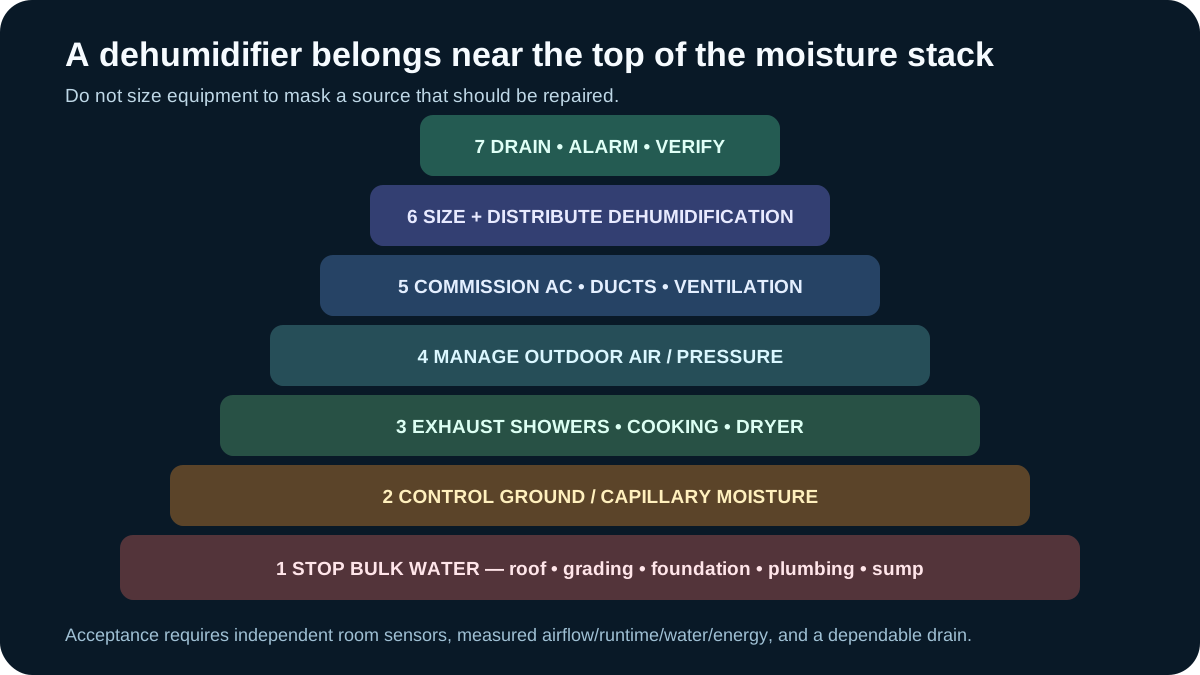
Short answer: First stop bulk water, plumbing leaks, rain entry, ground moisture, and unsafe mold conditions. Then measure temperature and relative humidity in the actual zone. Use ENERGY STAR's current capacity chart as a minimum starting point based on square footage and how damp the space is without dehumidification, then adjust for low temperature, connected rooms, doors, air leakage, laundry/showers, drying materials, and required recovery time. Place the unit with manual-specified clearances, on a level supported surface, directly connected to an approved receptacle, and with a bucket, gravity drain, or listed pump route that cannot flood. Commission it with a seven-day temperature/RH, runtime, kWh, and water log.
The right question is not “How many pints for my basement?” It is “How much moisture enters this connected air volume, under what temperature, and where will every collected pint go?”
Stop for Water and Safety Problems First
Do not energize portable equipment in standing water or near wet electrical parts. Address:
- active plumbing or appliance leak;
- sewage or contaminated water;
- flooding or rain entry;
- wet foundation materials and hidden cavities;
- deteriorated receptacle or extension-cord dependency;
- smoke, burning odor, overheating, or repeated trips;
- a recalled dehumidifier;
- visible growth or health conditions outside safe owner cleanup.
CPSC has repeatedly warned about fire hazards in recalled dehumidifiers. Search the complete model and serial on the CPSC dehumidifier page before placing an older, inherited, used, or stored unit back into service. Follow stop-use instructions exactly.
EPA emphasizes controlling moisture as the key to mold control. A dehumidifier can help manage airborne moisture after the source is corrected, but it does not dry a concealed wall assembly by itself or make contaminated materials safe (EPA mold and moisture guide).
Measure the Space as a Moisture Zone
Record:
- floor area and ceiling height;
- open doors, stairways, ducts, and connected rooms;
- temperature at floor and occupied height;
- relative humidity at several locations/times;
- visible condensation, dampness, odor, or water staining;
- foundation/wall/floor type;
- sump, floor drain, laundry, shower, drying clothes, aquarium, or stored firewood;
- outdoor weather and season;
- HVAC operation and supply/return location;
- desired RH and recovery time;
- whether the zone is occupied or used for storage.
A closed 500-square-foot basement room and an open 500-square-foot basement connected to stairs, crawlspace, and laundry are not the same load. Cubic volume and air exchange matter even when product charts use square feet.
Use more than one hygrometer
Low-cost sensors can disagree. Compare two or three in the same location for a day, then distribute them away from the dehumidifier supply/exhaust, exterior wall, floor, laundry, or HVAC register. Record temperature with RH because relative humidity changes with temperature even when moisture content does not.
Do not chase a single minute-by-minute reading. Look at daily peaks, sustained periods, and spatial differences. If one corner remains humid while the unit satisfies nearby, air mixing or local moisture may be the problem.
Interpret Humidity Targets Carefully
EPA training material says indoor RH should be below 60% and ideally 30–50% where possible (EPA mold course). This is general moisture-control guidance, not a requirement to force every cold basement to 30%.
Too-low settings can increase runtime, energy, heat, noise, and drying of materials without solving a source. In winter, indoor RH targets may need to avoid window condensation based on outdoor temperature and window performance. In summer, a basement can read high RH partly because its air is cool; warming the same air lowers RH without removing water, while actual moisture remains.
Choose a starting setpoint within manufacturer and building guidance, then verify:
- no condensation or damp materials;
- comfort and stored-item needs;
- reasonable runtime;
- stable drainage;
- no overly dry wood, instruments, or sensitive contents;
- adjacent zones do not remain wet.
Use the Current Capacity Chart, Not an Old Pint Label
ENERGY STAR explains that portable dehumidifier capacity is rated in pints removed per 24 hours and that needed capacity depends on space size and the condition without dehumidification (ENERGY STAR dehumidifiers). Capacity ratings changed with test conditions, so a newer “35-pint” unit may not be directly comparable to an older unit with a larger legacy pint label.
Record:
- rated capacity and test basis/year;
- integrated energy factor (IEF) or current efficiency metric;
- square-foot recommendation and dampness condition;
- minimum operating temperature;
- airflow and clearances;
- bucket capacity (not the same as daily moisture capacity);
- auto-defrost;
- humidistat/setpoint range;
- continuous-drain and pump provisions;
- input watts/amps and voltage;
- noise data;
- refrigerant and recall status.
Minimum versus recovery capacity
A unit can maintain a dry stable basement yet take days to recover after a flood, wet renovation, or humid-air event. Do not permanently oversize solely for one construction-drying event; rental restoration equipment and professional drying may be safer and faster. Conversely, a tiny unit that runs continuously without approaching target may be under-capacity or facing an unresolved source.
Adjust for Temperature
Most portable refrigerant dehumidifiers pass room air over a cold evaporator. At lower room temperature, moisture removal can fall and frost may form; defrost controls may interrupt collection. The exact minimum operating temperature and performance curve matter.
In a cold basement or garage:
- measure temperature over the coldest periods;
- compare the product's operating range;
- do not use heaters or enclosed placement to trick the sensor;
- inspect for frost/error under the manual;
- consider whether the space needs air sealing/insulation/heat or a technology designed for lower temperature;
- keep pipes and drains protected from freezing.
Do not infer failure from a smaller bucket volume on a cooler day. Compare RH, temperature, runtime, and water together.
Place for Airflow, Not Convenience Alone
Follow exact clearances. Avoid:
- curtains, boxes, walls, and furniture blocking intake/outlet;
- a closed closet unless the unit is listed and sized for it;
- dusty renovation zones without approved filtration/protection;
- direct spray, sink, shower, or floor-water exposure;
- soft carpet that blocks grilles or destabilizes casters;
- combustible storage near heat rejection;
- a spot where children/pets can tip the unit or access the bucket;
- stairs and egress paths;
- an unconditioned location outside operating limits.
The discharge air is warmer because the unit rejects compressor energy plus the latent heat associated with condensing moisture. That heat can be welcome in a cool basement and burdensome in a hot room. Do not describe a dehumidifier as “free cooling.”
One unit for several rooms
Open doors do not guarantee adequate air exchange. Use small safe circulation fans only where cords and airflow are allowed. If remote rooms remain humid, move the unit and log response or use separate/ducted equipment. Do not place a portable in a corridor that blocks egress.
Electrical Requirements
Connect directly to the compatible grounded receptacle specified by the manual. Do not use an extension cord, power strip, adapter, damaged receptacle, or shared overloaded circuit. Stop for a hot plug, discoloration, buzzing, arcing, odor, or protective-device trip.
Measure energy only with a listed monitor rated for the exact voltage, current, plug, compressor startup, and environment. Do not defeat LCDI/GFCI or other protection. If the only available outlet requires a long cord across a damp floor, fix the electrical layout instead of normalizing the hazard.
Choose the Drainage Method Before Buying
Bucket
The bucket must seat and operate its float correctly. Confirm full-bucket shutoff, carry weight, handle, spill path, and emptying accessibility. A rated 50-pint/day machine may have a much smaller bucket and need multiple empties during high load.
Gravity drain
Water only runs downhill. Confirm:
- approved hose diameter/material and connection;
- continuous downward slope without loops/kinks;
- receptor below outlet;
- no trip or pinch path;
- termination secured with air gap/backflow provisions under local rules;
- hose cannot freeze;
- floor drain/risk is maintained;
- leaks are visible or detected.
Do not drain into a sealed container or uphill. Do not route through a window where water damages facade, sidewalk, or neighbors.
Built-in or external pump
Verify listed compatibility, lift, run, check-valve, hose, power, alarm, shutoff behavior, and failure response. A pump lets water climb but creates another failure point. Test it with the unit and route, not just at the sink.
Sump or condensate system
Confirm capacity, power/outage behavior, check valve, discharge destination, and local code. A dehumidifier can keep producing water until its own controls stop; the downstream system must accept it.
Commission With a Seven-Day Log
Start only after source control and safe installation:
| Date/time | Zone temp/RH | Setpoint | Runtime | Bucket/drain volume | kWh | Weather/source event |
|---|---|---|---|---|---|---|
| Baseline | ||||||
| Day 1 | ||||||
| Day 3 | ||||||
| Day 7 |
Interpret:
- RH falls and runtime moderates: capacity/placement likely adequate;
- RH falls near unit but not remotely: distribution or local source;
- continuous runtime with little RH change: unresolved load, undersizing, air bypass, low temperature, frost, or fault;
- little water but RH at target: normal low load can be plausible;
- little water with high RH: temperature, sensor, airflow, frost, compressor, or drainage evidence needed;
- drain path wets floor: stop and correct immediately;
- room becomes too warm: account for sensible heat and consider other strategies.
Do not extrapolate one rainy day to annual performance. Repeat seasonally.
Estimate Operating Cost
Annual kWh = average operating kW × equivalent runtime hours
Annual cost = annual kWh × local marginal electricity price
Example only:
- measured average while operating: 0.45 kW;
- 2,000 equivalent operating hours/year;
- $0.18/kWh;
- 0.45 × 2,000 × $0.18 = $162/year.
Compare comfort and moisture outcome, not watts alone. A smaller inefficient unit running continuously can use more than a larger efficient unit that reaches target and cycles/modulates. ENERGY STAR certification uses current IEF criteria; use exact Product Finder data and label.
Include filter, pump, hose, maintenance, service, replacement, and water-damage risk. Do not promise a payback from a generic savings percentage.
Source Control Checklist
- Grade and drainage move water away from foundation.
- Gutters/downspouts are intact and discharge appropriately.
- Plumbing/appliance leaks are repaired.
- Sump and perimeter drainage work.
- Crawlspace/foundation moisture strategy matches climate/assembly.
- Bathroom/kitchen/dryer exhaust reaches outdoors as designed.
- Laundry is not dried indoors without moisture control.
- Air-conditioning short cycling or oversized cooling is assessed.
- Cold surfaces and insulation/air leakage are addressed.
- Wet materials are dried or removed appropriately.
Use the basement insulation and mold guide for an assembly-first plan. A dehumidifier that fills daily may be valuable evidence of moisture load, not permission to ignore it.
Diagnose Moisture by Location
Basement wall or floor edge
Map whether dampness follows rain, snowmelt, irrigation, plumbing use, or summer humidity. Efflorescence, staining, peeling coatings, and wet slab edges can indicate liquid-water movement; surface condensation can occur where humid air meets a cold wall/floor. The repair differs. Do not cover the evidence with impermeable finish before diagnosis.
Rim joist and cold pipes
Condensation on cold-water pipes or cold framing points to surface temperature plus air moisture. Insulate pipes with a complete appropriate vapor-control approach and address air leakage/thermal bridging under building guidance; do not rely solely on lowering whole-space RH until materials overdry.
Laundry zone
Confirm the dryer exhausts outdoors where required, the vent is intact, the washer does not leak, and clothing is not air-dried into a closed basement without moisture planning. One wet load can release substantial moisture. A dehumidifier can manage planned drying only when capacity and energy are accounted for.
Bathroom or shower
Use an effective outdoor-vented fan and manage door/air transfer. A portable in the hallway is not a substitute for capturing moisture at the source. See the bathroom exhaust fan guide.
Crawlspace connection
Open vents, soil moisture, drainage, duct leakage, and an unsealed basement-crawl opening can dominate load. Do not set a dehumidifier in a crawlspace unless it is listed/installed for the environment, service access, drainage, and electrical conditions. Use the crawlspace encapsulation decision guide.
Storage closet
Closed doors and packed contents restrict air. Keep belongings away from foundation walls and floor moisture, use shelving that permits inspection, and monitor inside the closet. Valuable paper, leather, instruments, food, medication, or chemicals may have their own storage range; follow product guidance.
Portable Versus Whole-House Equipment
Choose portable when one connected zone dominates, a direct drain and receptacle are available, doors can remain arranged for airflow, and noise/heat/service access are acceptable. It is also useful for measurement: a week of collected-water/runtime data can clarify load before a larger project.
Consider whole-house/ducted dehumidification when:
- several rooms/zones require simultaneous control;
- doors must remain closed;
- portable noise/heat is unacceptable in occupied rooms;
- drainage and maintenance are better centralized;
- HVAC ventilation and pressure need coordination;
- capacity/runtime of multiple portables becomes inefficient;
- controls must prevent competing AC/dehumidifier operation.
Ducted equipment is not simply a larger portable. Return/supply location, outdoor-air ventilation, sensible heat, duct static pressure, condensate, controls, service access, and HVAC interactions require design. Read the whole-house dehumidifier versus AC guide and request an equipment/load/duct plan.
Two portable units versus one large unit
Two units can solve disconnected rooms and provide partial redundancy, but double filters, buckets/drains, electrical loads, sound, heat, and maintenance. One larger unit cannot control a closed remote room without air exchange. Compare measured zone response, not just total pints.
Maintenance That Preserves the Measurement
Follow the manual for:
- filter cleaning/replacement;
- intake/outlet and coil access;
- bucket wash and float inspection;
- gravity hose cleaning/inspection;
- pump reservoir, check valve, and alarm test;
- caster/foot stability;
- cord and plug inspection;
- sensor calibration/check if supported;
- seasonal drying/storage;
- frost/error response.
Do not spray cleaner into energized coils, bend fins, open a sealed refrigerant circuit, or use an unapproved disinfectant. A dirty filter can reduce airflow and water collection; a biofilm in a hose or bucket can create odor; a stuck float can cause nuisance shutoff or overflow risk.
Monthly drain-path test
For continuous drainage, introduce water only through the model's official test/operation procedure—never directly into electrical or coil areas. Confirm flow reaches the receptor, the hose stays sloped and secured, the pump starts/stops where applicable, and no connection wets. Test leak sensors/shutoff notifications under their own instructions.
Seasonal Commissioning Checklist
Before humid season:
- verify recall status by model/serial;
- inspect cord, bucket, float, hose, pump, and filter;
- clean/dry/reassemble per manual;
- inspect source-control repairs and floor drain/sump;
- place with required clearances;
- verify receptacle and no extension cord;
- test bucket-full or drain path;
- compare hygrometers;
- start with a documented setpoint;
- complete the seven-day log.
At season end, drain, clean, and dry fully; store in the specified orientation and temperature. Preserve caps, hose adapters, remote, pump tubing, and manual. Do not put a damp sealed unit into a closet.
Special Operating Cases
After a flood or construction
Wet building materials can require professional moisture mapping, air movement, heat, dehumidification, and removal. A consumer pint rating does not establish drying capacity for walls, subfloors, insulation, or contamination. Do not hide wetness with a low room-RH reading.
Garage
Temperature extremes, combustion products, dust, vehicles, pesticides, flammables, and lack of drainage can make a consumer dehumidifier inappropriate. Confirm listing/ambient range and never use where the manual prohibits flammable vapors.
Pool, spa, grow room, or commercial laundry
These have high continuous latent loads, corrosion, chemicals, and ventilation needs. Use purpose-designed equipment and professional calculation rather than a residential square-foot chart.
Vacation home
Remote monitoring does not replace a reliable drain and power plan. Consider outage behavior, frozen drains, pump failure, internet loss, full-bucket shutoff, leak detection, and a local responder. Test alerts and recovery before leaving.
Quote Worksheet for a Larger Moisture Project
| Scope item | Provider A | Provider B |
|---|---|---|
| Moisture source diagnosis | ||
| Design indoor/outdoor conditions | ||
| Latent capacity and rating basis | ||
| Air distribution/duct plan | ||
| Sensible heat interaction | ||
| Drain/pump/overflow protection | ||
| Electrical and controls | ||
| Filter/service access | ||
| Commissioning RH/water/kWh test | ||
| Warranty and maintenance |
Reject a proposal based only on square footage when the moisture source, temperature, connected volume, and drainage are undocumented.
Frequently Asked Questions
What size dehumidifier do I need?
Use the current ENERGY STAR chart based on square footage and how damp the space is without dehumidification, then adjust for connected volume, temperature, sources, and recovery time (ENERGY STAR).
Why does a new 35-pint unit replace an old 50-pint unit?
Capacity test conditions changed, so old and new pint labels may not be directly comparable. Compare the stated test basis, current capacity, and efficiency; ENERGY STAR explains the rating change on its dehumidifier page.
What humidity should I set?
EPA general guidance says below 60% and ideally 30–50% where possible. Choose within building/product needs and verify condensation, materials, comfort, and runtime (EPA mold course).
Can I drain a dehumidifier into a floor drain?
Only with a continuously downhill approved hose, secure termination, and plumbing arrangement that meets the manual and local rules. Maintain the risk and prevent backflow/freezing.
Why does the dehumidifier warm the room?
Its condenser returns compressor energy and transferred heat to the room while moisture condenses. Warmer discharge is expected within model limits; overheating, burning odor, or trips are not.
Should I buy a used dehumidifier?
Check model/serial against CPSC recalls, inspect cord/bucket/drain, verify operation and refrigerant-aware disposal plan, and avoid units with unknown overheating history.
Does a dehumidifier kill mold?
It manages humidity; it does not remove contaminated materials or fix water entry. EPA emphasizes moisture control and appropriate cleanup in its mold guide.
What to Read Next
Compare portable equipment with the whole-house dehumidifier versus AC guide. If the unit runs but does not collect water, follow the dehumidifier diagnostic. Plan a basement assembly with the basement insulation and mold guide, and trace cold-season glass moisture with the window condensation guide.
Sources and Verification
Capacity, rating-change, and efficiency claims use ENERGY STAR dehumidifier guidance and key efficiency criteria. Humidity and source-control claims use the EPA mold course and home moisture guide. Fire-recall and disposal claims use CPSC and the EPA homeowner appliance FAQ. Exact ratings, manual, drainage, electrical conditions, and building diagnosis control the project.
Sources and Verification
Editorial Review
EnergyBS Editorial Team
EnergyBS publishes practical homeowner guides. Important program, product, and cost claims should be checked against the linked source and local project documents before you commit to work.
Related Guides
View All ArticlesWholeHouse Dehumidifier vs. AC: Diagnose, Size, Duct, and Commission It
A measurementfirst wholehouse dehumidification guide covering moisturesource control, portableversusducted selection, pintload sizing, HVAC and ventilation coordination, drainage, energy, and commissioning.
Dehumidifier Not Collecting Water, Icing Up, Leaking, or Running Constantly: A Safe Diagnostic Guide
Diagnose a portable dehumidifier that runs without collecting water, freezes, leaks, cycles incorrectly, or never reaches its setpoint using temperature, humidity, airflow, drainage, recall, and measuredperformance evidence.
Basement Insulation and Mold Prevention: A MoistureFirst Retrofit Guide
Diagnose bulk water, capillary moisture, humidity, condensation, soil gas, and hidden damage before choosing a basement wall, rimjoist, or floor insulation assembly.