Induction Range Installation Guide: Circuit, Panel, Fit, Ventilation, and Quote Scope
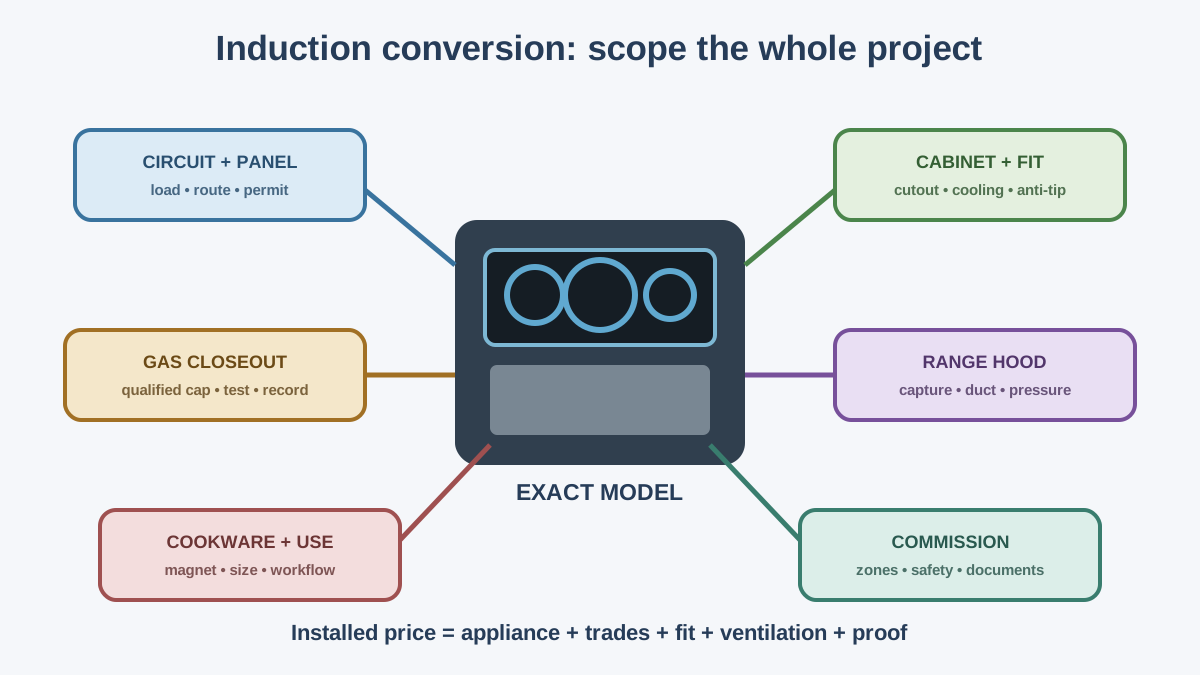
Plan an induction range or cooktop conversion by exact model load and wiring, service capacity, circuit route, receptacle or hardwire connection, gas decommissioning, cabinet/countertop fit, ventilation, antitip protection, cookware, permits, commissioning, and total installed quote.
Direct Answer
Plan an induction range or cooktop conversion by exact model load and wiring, service capacity, circuit route, receptacle or hardwire connection, gas decommissioning, cabinet/countertop fit, ventilation, antitip protection, cookware, permits, commissioning, and total installed...
Select the Exact Model Before Pricing the Circuit
Short answer: An induction conversion begins with the exact range or cooktop installation instructions—not a generic 40- or 50-amp rule. A qualified electrician should verify voltage, nameplate/load data, branch-circuit and conductor requirements, connection method, panel and service capacity, route, permits, and final testing. The project must also solve cabinet/countertop dimensions, appliance ventilation, anti-tip protection, range hood capture, gas-line decommissioning, cookware, delivery access, and finish work.
Many replacements from a conventional electric range can reuse a suitable existing circuit after inspection. A gas-to-induction project often needs a new high-voltage branch circuit, but it does not automatically require a 200-amp service. A portable induction hob may provide a lower-power interim option on an appropriate existing receptacle. Compare actual models and the whole-home load calculation.
Three Different Products
Full induction range
Combines induction cooking zones and an electric oven in one freestanding or slide-in appliance. It usually replaces a full range opening and needs the exact product's high-voltage supply and anti-tip provisions.
Built-in induction cooktop
Fits a countertop cutout above a cabinet or oven arrangement. It is often hardwired and requires precise cutout, support, ventilation, clearances, junction-box access, and compatible equipment below.
Portable countertop hob
Uses one or two zones and a standard receptacle when the exact unit and circuit allow. It has lower total power and no built-in oven but can test the cooking experience or avoid immediate major wiring. It still needs a safe stable counter, clearances, circuit capacity, and compatible cookware.
DOE Better Buildings' Induction Cooking 101 distinguishes ranges, cooktops, and portable hobs and highlights electrical and cookware planning. Use it as consumer context; product manuals control installation.
The Electrical Work Is Model-Specific
ENERGY STAR's electric cooking criteria report model voltage and amperage among product data. Record:
- exact model and installation-manual revision;
- nameplate voltage, frequency, and load;
- required branch-circuit rating;
- conductor material/size and temperature assumptions under code/design;
- dedicated-circuit requirement;
- receptacle/cord or hardwired junction method;
- three-wire/four-wire and grounding/neutral provisions under exact instructions and local rules;
- breaker type and panel compatibility;
- disconnect accessibility;
- route length, penetrations, and damage protection;
- permit and inspection;
- load calculation for service/feeder.
Do not buy a cord from a generic online checklist. The electrician and manual must match cord/connection, conductor, strain relief, terminals, grounding, and local code.
Existing electric range
An existing receptacle and breaker are evidence, not approval. Inspect circuit condition, conductor, grounding/neutral configuration, receptacle, box, terminations, breaker, panel listing, route, and exact new load. An older range that operated does not prove a larger new model is compatible.
Existing gas range
Survey the electrical panel and route before appliance delivery. A nearby 120-volt receptacle for ignition is not the required range circuit. Price cable/conduit, breaker, receptacle or junction, wall/floor access, patching, permit, and service/load work.
Do Not Assume a Service Upgrade
A whole-home load calculation should consider existing and planned loads under the method accepted by the authority. The panel capacity guide explains why panel spaces, bus rating, service rating, calculated load, and condition are different questions.
Possible project outcomes include:
- existing service and panel have capacity;
- panel has capacity but lacks physical breaker space;
- new circuit needs a subpanel or panel replacement for condition/space;
- service load requires upgrade;
- approved load management or a lower-load appliance may solve the constraint;
- another planned load changes the sequence.
Only use load controls that are listed/approved for the exact application and accepted locally. A device that manages an EV charger does not automatically manage a range.
Circuit Route Survey
Draw from panel to appliance:
- basement/crawlspace/attic access;
- finished walls and ceilings;
- joists, beams, masonry, and fire blocks;
- existing chases and conduits;
- wet locations and heat sources;
- cabinet toe-kick and rear clearance;
- receptacle or junction location permitted by appliance diagram;
- cable protection and penetrations;
- rated assemblies and fire stopping;
- hazardous-material risk in older finishes;
- length and voltage-drop/design considerations;
- future service access.
The cheapest straight line may require cutting tile or structural framing. Price alternate routes before demolition.
Gas-Line Decommissioning
If replacing gas, assign qualified gas work:
- shutoff and verify supply;
- disconnect appliance under local requirements;
- cap or remove branch at the accepted location/method;
- leak/pressure testing as required;
- address flexible connector and valve;
- update labels or permits;
- preserve or remove future gas capacity intentionally;
- coordinate gas service if other appliances remain;
- protect finishes and dispose/reuse old appliance safely.
Do not hide an uncapped or casually capped line behind the new range. Do not assume the appliance delivery crew performs licensed gas work.
Physical Fit Is More Than Width
Measure:
- opening width at front, middle, and back;
- counter height and level;
- depth to wall and backsplash;
- countertop overhang;
- door/drawer/handle conflicts;
- rear cord, receptacle, junction, and gas-valve space;
- oven-door swing and aisle;
- adjacent cabinet heat clearances;
- upper cabinet and hood clearance;
- floor height under old range;
- anti-tip bracket location and substrate;
- delivery doors, stairs, elevator, and turns.
Whirlpool's example induction range manual shows detailed cutout, cabinet, electrical, and anti-tip instructions for one model. It illustrates why “30-inch range” is not a complete dimension.
Slide-in trim and countertop gaps
Some slide-in products overlap the counter; others sit between edges. Old counters may be notched for a different flange. Specify filler, trim, scribe, backsplash, and heat-resistant finish work.
Built-In Cooktop Cutout
A cooktop conversion requires:
- exact cutout width/depth and corner radius;
- countertop material and remaining strength;
- support clips/brackets;
- clearance below and to drawers;
- cooling/ventilation openings;
- junction box and flexible conduit access;
- compatibility with wall oven below;
- separation from combustible materials;
- protection from stored objects contacting hot/electrical parts;
- stone cutting, dust control, and crack risk;
- seal/gasket method under the manual.
Do not enlarge stone or composite countertops without a qualified fabricator and dust controls. Confirm model before cutting; returns rarely cover a custom opening.
Appliance Cooling and Cabinet Ventilation
Induction electronics and coils need product-specified airflow. Do not block intake/exhaust slots with drawer contents, insulation, a shelf, or a flush custom panel. Record required openings and service path.
If an oven is installed below, use an approved combination and both installation manuals. Heat and junction-box placement can change clearances.
Keep the Range Hood
Induction removes gas combustion at the cooktop but not cooking particles, grease, moisture, or odors. EPA's cooking IAQ guidance recommends an outdoor-vented hood, back burners when possible, and operation during and after cooking.
Use the range hood venting guide to plan capture, duct, noise, and pressure. A gas-to-induction project may change combustion risk at the range, but other natural-draft appliances or fireplaces can still matter for high exhaust.
Cookware Audit Before Delivery
ENERGY STAR's buying guidance says a refrigerator magnet can screen for ferromagnetic cookware compatibility. Test the flat cooking surface, not only a handle or decorative layer.
Inventory:
- pot/pan base diameter and flatness;
- magnetic response across base;
- cracked, warped, or rough bottoms;
- bridge/griddle requirements;
- pressure canner dimensions and manufacturer rules;
- wok shape and zone fit;
- favorite nonmagnetic aluminum/copper/glass pieces;
- weight and glass-top handling;
- noise behavior with layered cookware.
Magnet attraction is a useful screen, not a guarantee of even heating or quiet operation. Check the appliance and cookware manufacturers.
The induction wok guide compares flat, concave, and dedicated solutions without assuming one zone fits every technique.
Energy Claims Need Model and Use Context
ENERGY STAR's current criteria define certification and report annual/test information. Actual energy depends on meals, cookware, oven use, standby, household behavior, and utility rates.
Do not forecast a major whole-home bill reduction from a generic transfer-efficiency percentage. Compare exact model annual/test data, current gas fixed charges, ventilation/space-conditioning interactions, and cooking frequency. Eliminating gas service can change fixed costs only if no other gas appliance remains and the utility account can actually close.
Quote Comparison Worksheet
| Scope field | Bid A | Bid B | Bid C |
|---|---|---|---|
| Exact appliance/model | |||
| Nameplate/manual electrical | |||
| Load calculation | |||
| Panel/service work | |||
| Circuit route and finish repair | |||
| Receptacle/cord or hardwire | |||
| Permit/inspection | |||
| Gas disconnect/cap/test | |||
| Cabinet/countertop modification | |||
| Anti-tip/support | |||
| Hood/ventilation work | |||
| Delivery/stairs/haul-away | |||
| Cookware allowance | |||
| Commissioning/training | |||
| Gross cash price |
Separate appliance sale price from installed project price. A rebate or promotional financing does not erase required trade work.
Worked Gas-to-Induction Example
A home has a 100-amp service, gas range, unfinished basement below the kitchen, and two panel spaces. Contractor A assumes a 200-amp upgrade and quotes appliance plus service. Contractor B performs the accepted load calculation, selects the exact range, confirms available capacity, routes a dedicated circuit through the basement, closes the gas branch under permit, installs the anti-tip bracket, and includes inspection and wall patching.
B is not automatically correct because it is cheaper; its evidence makes the scope reviewable. If the load calculation or panel condition fails, an upgrade or alternate appliance may still be justified. Compare calculation, model load, future EV/HVAC plans, panel condition, and authority approval.
Compare Four Capacity Scenarios
Scenario 1: suitable existing electric circuit
The home already has an electric range. A qualified inspection confirms the breaker, conductor, receptacle or junction, grounding, condition, and rating suit the exact induction model. The project may need only a new approved cord/connection, anti-tip work, fit adjustments, and inspection.
Scenario 2: service capacity, but no route
The load calculation passes, yet the gas range location has no suitable high-voltage branch. Price panel breaker, cable/conduit, route, penetrations, receptacle/junction, finish repair, and permit. Compare basement, attic, exterior conduit, and interior wall routes before cutting.
Scenario 3: panel space or condition problem
Calculated service capacity may exist while the panel lacks listed breaker space, contains damage, or cannot accept the required equipment. A panel replacement or approved subpanel can be distinct from a utility service upgrade. Ask the electrician to state which condition drives the scope.
Scenario 4: calculated service constraint
If the accepted calculation shows inadequate capacity, compare service/feeder upgrade, a lower-demand appliance, project sequencing, or an approved load-management strategy. Include future heat pump, water heater, dryer, EV, spa, or accessory loads only when they are actual plans—not as vague fear or an excuse to ignore them.
Each scenario produces a different installed price. The service label alone cannot choose among them.
Accessibility and Household Use
Induction's control style varies. Before purchase, test or review:
- tactile knobs versus touch controls;
- readability in bright/low light;
- control contrast and font size;
- wet-finger or spill behavior;
- lock functions and reset sequence;
- audible signal volume and adjustment;
- zone markings and pan detection;
- reach over hot cookware;
- oven height, rack handling, and door force;
- app dependence versus full local control;
- behavior after brief power interruption.
Do not assume a smart interface is easier for every user. A household with low vision, limited dexterity, hearing needs, cognitive load, or children may prefer physical controls and clear status indicators. Download the manual and, if possible, try the control panel before committing to a cutout.
Power Outages and Cooking Resilience
An induction appliance does not operate during a power outage unless supplied by a properly designed backup system. A typical portable power station or home battery may not support a full range's voltage, peak, circuit, grounding, and energy needs.
Plan outage cooking separately:
- shelf-stable meals and no-cook food;
- a compatible portable induction hob on an appropriately designed backup circuit, if verified;
- outdoor-only fuel appliances used safely away from doors, windows, and air intakes;
- battery/generator transfer equipment installed by qualified trades;
- never using charcoal, grills, camp stoves, or generators indoors or in garages.
Do not retain an unsafe gas appliance solely as informal backup. If resilience is a requirement, write the loads, runtime, transfer, ventilation, fuel, and safe-use plan explicitly.
Delivery-Day Hidden Conditions
Preprice:
| Finding | Evidence | Planned response |
|---|---|---|
| Existing receptacle is in prohibited/conflicting location | Manual diagram + field measure | Relocate circuit box |
| Circuit conductor/rating is unsuitable | Qualified inspection | Replace branch circuit |
| Gas valve projects into appliance space | Field measure | Qualified relocation/closure |
| Floor under old range is unfinished/uneven | Removal inspection | Patch/level floor |
| Counter opening is undersized | Template/measure | Fabricator modification |
| Old range hides damaged wall or pest path | Photo/inspection | Repair allowance |
| Panel has no accepted breaker/space | Panel documentation | Approved panel/subpanel scope |
| Hazardous material is suspected | Qualified assessment | Stop work/abatement |
Require written authorization before extras. Appliance delivery should not become the moment a household learns that the kitchen will be unusable for weeks.
First-Month Verification Log
Track several meals:
- cookware and zone used;
- power setting and cooking result;
- unexpected cycling, noise, or pan-detection behavior;
- cooling-fan operation and whether vents remain clear;
- breaker trips, error codes, odor, heat, or loose control behavior;
- hood speed and capture;
- oven/broiler/convection performance;
- control accessibility issues;
- countertop/cabinet heat or finish concerns;
- glass scratches or cookware instability.
Stop and seek service for repeated breaker trips, electrical odor, arcing, damaged cord/receptacle, smoke unrelated to food, loose appliance, failed anti-tip protection, or persistent fault codes. Do not open electrical covers.
Keep the log with the installation manual, load calculation, permit, circuit record, gas closure, anti-tip verification, invoice, warranty, and model/serial. This distinguishes a product issue from installation, cookware, ventilation, or user-setting problems.
Photograph the final panel directory, anti-tip bracket evidence, appliance ventilation openings, gas closure location, and accessible connection area without removing energized covers. These records help future service and prevent a later remodel from blocking cooling or electrical access.
Portable Induction as a Trial or Constraint Tool
A listed portable hob can:
- test cookware and cooking behavior;
- provide one efficient zone while remodel plans develop;
- serve renters where permitted;
- reduce simultaneous range use;
- avoid premature panel work for a household that needs only one zone.
Check its required circuit, plug, counter clearances, ventilation, cord safety, and whether other appliances share the branch. Do not use an extension cord unless the product explicitly allows it. A portable unit does not replace required hood/source control.
Installation-Day Sequence
- Verify delivered model against contract.
- Protect floors, counters, and path.
- Qualified trades isolate electrical and gas.
- Remove old appliance without damaging connections.
- Inspect opening, floor, wall, circuit, gas branch, and hidden condition.
- Complete permitted electrical/gas/cabinet work.
- Install cord/hardwire, strain relief, grounding, and cover under exact instructions.
- Level and install anti-tip device/support.
- Slide into place without crushing cord, conduit, junction, or gas cap.
- Inspect clearances and ventilation.
- Energize, test, and close permits.
Electrical shock, arc, gas, heavy lifting, stone cutting, and tip hazards make this qualified-trade work. Homeowners can verify documents and operation.
Commissioning and Handoff
Record:
- model and serial;
- breaker/circuit and panel directory;
- permit/inspection;
- load calculation and any management logic;
- receptacle/connection and cord model where applicable;
- anti-tip verification;
- level/stability and door operation;
- every zone detection and heat test with compatible cookware;
- oven/broiler/convection functions as applicable;
- cooling-fan operation and clear openings;
- controls, lock, hot-surface indicator, timer, and power management;
- hood capture and user training;
- gas closure record;
- warranty registration and manuals.
Some induction units pulse or share power at lower settings, and cooling fans can run after cooking. Explain normal product behavior from the manual so it is not confused with a fault.
Common Project Failures
- appliance ordered before electrical and cutout survey;
- generic 50-amp assumption replaces exact manual;
- existing electric circuit accepted without inspection;
- 200-amp upgrade quoted from service label alone;
- receptacle behind range prevents full insertion;
- cord/conduit crushed during slide-in;
- gas line left in the way or inadequately closed;
- stone cut before product arrives;
- cooling opening blocked by drawer contents;
- anti-tip device omitted;
- range hood removed because cooking is electric;
- cookware replacement discovered after delivery;
- delivery crew expected to do permit trade work;
- app/smart features tested but basic zones and safety indicators are not.
Sources and Verification
- ENERGY STAR's product criteria support model voltage/amperage and certified energy/test-data comparison.
- ENERGY STAR's buying guide supports induction technology, product forms, cookware magnet screening, and model selection.
- DOE Better Buildings' Induction Cooking 101 provides range/cooktop/portable and electrical-planning context.
- Whirlpool's example induction-range manual demonstrates model-specific cabinet, connection, clearance, and anti-tip instructions.
- Whirlpool's range installation article reinforces consulting exact instructions and qualified electrical work.
- EPA's cooking IAQ guidance supports keeping effective source capture after electrification.
Verify exact model instructions, current adopted electrical/mechanical/building code, and local permits. Do not use cited example wiring as instructions for another model.
Frequently Asked Questions
Does every induction range need a 50-amp circuit?
No. Requirements vary. ENERGY STAR reports model voltage and amperage; use the exact manual and qualified electrical design.
Does a gas-to-induction conversion require 200 amps?
Not automatically. Perform the accepted load calculation and panel/service assessment. The panel guide separates service rating from calculated capacity.
Can I reuse my electric-range outlet?
Only after verifying the exact new range, breaker, conductor, receptacle, grounding/neutral, condition, and local requirements. Existing operation is not proof.
Does induction need special cookware?
It needs compatible magnetic cookware and appropriate size/condition. ENERGY STAR's buying guide recommends a magnet as a screening test.
Can I remove the range hood?
No. Cooking still creates particles, moisture, grease, and odors. EPA recommends outdoor-vented capture where possible.
Is induction always cheaper to operate than gas?
Not everywhere. Compare exact model use, cooking pattern, electric/gas rates, fixed charges, ventilation, and remaining gas appliances. Efficiency alone does not set the bill.
Can a delivery crew connect the range?
Only for work they are authorized and qualified to perform under local requirements and the exact product. Confirm electrical, gas, permits, anti-tip, and finish scope before delivery.
Is the glass surface cold while cooking?
Induction heats cookware directly, but the glass can become hot from the pan and retain heat. Follow hot-surface indicators and the appliance manual.
What to Read Next
Compare the cooking experience with the induction versus gas guide, plan source capture with the range hood guide, and verify electrical capacity with the panel guide.
Sources and Verification
- ENERGY STAR: Residential Electric Cooking Products Key Criteria
- ENERGY STAR: Electric Cooking Products Buying Guidance
- DOE Better Buildings: Induction Cooking 101
- Whirlpool: SlideIn Induction Range Owner and Installation Manual
- Whirlpool: Installing a Gas or Electric Range
- U.S. EPA: Strategies for Improving Indoor Air Quality While Cooking
Editorial Review
EnergyBS Editorial Team
EnergyBS publishes practical homeowner guides. Important program, product, and cost claims should be checked against the linked source and local project documents before you commit to work.
Related Guides
View All ArticlesInduction vs Gas Cooking Guide: Speed, Safety, and Efficiency (2026)
Compare induction and gas cooking by heat delivery, indoorair implications, control, cookware, ventilation, installation scope, and local operating cost.
Range Hood Venting Guide: Capture, Duct Route, Noise, and Makeup Air
Plan a kitchen range hood by capture geometry, verified airflow, smooth metal duct size and developed length, termination, noise, cleaning access, pressure and combustion safety, makeup air, commissioning, and a comparable installation quote.
Electrical Panel Capacity for Home Electrification: Upgrade, Manage, or Sequence Loads?
A decision guide for homeowners adding heat pumps, EV charging, induction, water heating, solar, or batteries: service ratings, load calculations, demand data, panel space, load management, project sequencing, and quote review.