Roof Replacement Cost 2026: What Installation Really Costs
Replacing a roof in 2026 costs $9,609 on average in the US (Angi 2026 data), with asphalt shingles at $3 to $5 per square foot installed and standingseam metal at $9 to $16. This guide prices every common material by the square, separates tearoff and decking lines from the headline number, works through the asphaltvsmetal lifetime math, and covers the energy side: coolroof reflectance, attic ventilation, and Canada pricing.
Quick Checks
- 1Budget $9,609 as the US national average for a full roof replacement in 2026. Angi puts the working range at $5,903 to $46,000, and the material you pick moves you inside that band more than anything else.
- 2Asphalt shingles cost $3 to $5 per square foot installed ($5,700 to $12,000 typical). Architectural shingles run $4 to $6 per square foot ($7,500 to $16,000). Standing-seam metal costs $9 to $16 per square foot ($13,500 to $40,000).
- 3Measure the roof, not the house. Roofers price by the square: 100 square feet of roof surface. A 20-square roof at $300 to $500 per square for 3-tab shingles is $6,000 to $10,000 before extras.
- 4Tear-off, decking, underlayment, flashing and permits are the lines that move quotes apart. Permits alone run $100 to $500, and metal labor runs $400 to $800 per square against $200 to $350 for shingles.
- 5In Canada, HomeStars puts an asphalt roof at $5,000 to $15,000 installed with the average near $9,000, metal at $10,000 to $30,000, and labor at 40 to 60 percent of the project. Winter work can carry a 15 to 25 percent premium.
- 6On the energy side, an ENERGY STAR steep-slope roof needs initial solar reflectance of at least 0.25, and a DOE-funded Oak Ridge study measured 45 percent less heat flow through a vented metal shake roof than through direct-nailed shingles of similar reflectance.
Roof Replacement Cost 2026: What Installation Really Costs
By EnergyBS Editorial Team | October 11, 2026
The Short Answer
Short Answer: A full roof replacement costs $9,609 on average in the US in 2026, with a working range of $5,903 to $46,000 depending on size, material and pitch. That average comes from Angi's 2026 cost guide, updated March 5, 2026. HomeGuide's installer-side data lands in the same place from a different angle: an asphalt shingle roof costs $3 to $5 per square foot installed, or $5,700 to $12,000 on a typical house, while a metal roof costs $5 to $16 per square foot installed, or $7,500 to $40,000. The material choice is the single biggest lever on the invoice, and it also decides how many times you pay that invoice over the life of the house.
A roof is the one home project where the price and the energy story are the same conversation. The same metal roof that costs two to three times what shingles cost can also cut cooling costs by up to 25 percent a year, according to a DOE-funded Oak Ridge National Laboratory study. The same tear-off that exposes rotted decking is the cheapest moment you will ever get to fix attic ventilation. This guide prices the job the way a careful roofer quotes it: by the square, line by line, with the energy decisions priced alongside the shingles.
1. Repair, Recover, or Replace: The Order That Saves Money
A roof fails in stages, and a full replacement is the last stage, not the first. Three cheaper exits exist, and each one is legitimate in the right spot.
Targeted repair is the first exit. HomeStars' Canadian pricing puts a section repair of standard asphalt shingles at $300 to $700 per square (100 square feet), and architectural or dimensional shingles at $400 to $900 per square. A handful of missing shingles after a wind event often runs $200 to $500 as a flat repair, and most leak repairs land between $400 and $1,200 depending on whether water has reached the decking. Repair is the right call when the damage is local: a wind-scoured slope, a failed pipe boot, lifted flashing around a chimney. It is the wrong call when the whole field of shingles is curling, cupping or shedding granules by the handful, because that roof is telling you its age all at once.
A second layer, or recover, is the second exit. Most building codes allow a second layer of shingles over one existing layer. The savings are real: no tear-off labor, no disposal fees, one day less of crew time. The trade-offs are real too. The new layer hides whatever the old layer is doing to the decking underneath, it adds roughly 200 to 350 pounds per square of dead load to the roof structure, and it shortens the new roof's life because the old shingles underneath run hotter. Many shingle manufacturers also trim their warranties on recover jobs. A recover makes sense on a sound, single-layer roof with flat decking that you plan to sell in the next five to ten years. It makes no sense on a roof with two layers already, visible sag, or any decking you would not stand on.
Replacement is the third exit, and it is the right one when the roof is at the end of its material life. The published lifespan table is blunt: asphalt 3-tab lasts 15 to 20 years, architectural shingles 20 to 30, metal 30 to 80 plus, tile 30 to 100 plus, slate 50 to 200 plus. A 22-year-old 3-tab roof that leaks in two places is not a repair candidate twice over. It is a replacement that should have been budgeted for two years ago.
One more door that is not yours to open: insurance. HomeGuide's 2026 guidance is explicit that homeowners insurance covers roof replacement for damage from an accident or a natural disaster, and does not cover wear and tear from age. Be suspicious of any roofer who leads with an insurance promise. That pitch is common enough that HomeGuide flags it as a known scam pattern.
2. What the Installed Price Covers
A professional replacement quote, priced by the square, should describe the same job in the same order: tear-off, deck work, dry-in, surface, and finish. Here is what each line means and what moves it.
Tear-off and disposal. Stripping the old roof to the deck is the first labor block. Disposal is usually bundled into the per-square rate, but on quotes that itemize, expect a dumpster or trailer line. The tear-off is also the inspection: soft or delaminated decking found here becomes a priced line before the new roof goes on.
Decking repair or replacement. Rotten or damaged plywood or OSB gets cut out and replaced. This is the line most likely to appear as an allowance rather than a fixed number, because nobody can count bad sheets until the old roof is off. A fixed allowance with a per-sheet unit price is the correct way to write it. Ask for the unit price in writing before work starts.
Underlayment and ice-and-water shield. The membrane layer between decking and shingles. In cold climates the valleys, eaves and penetrations get an ice-and-water shield membrane; the field gets synthetic or felt underlayment. This is cheap insurance relative to the project total and not the place to save a few hundred dollars.
The surface. Shingles, panels, tiles or slate, plus starter courses, ridge caps and the hip and valley material. This is the material number the whole guide prices in section 4.
Flashing, drip edge and penetrations. Step flashing at walls, counter-flashing at chimneys, drip edge at eaves and rakes, and new boots at every pipe penetration. Reusing old flashing to save a few hundred dollars is a false economy: flashing fails on its own schedule, and replacing it later means disturbing the new roof.
Ventilation. Ridge vents, soffit vents, or powered and passive exhaust where the attic design calls for it. Section 7 works through why this line matters for energy bills.
Permits and inspection. Roof replacement permits cost $100 to $500 in HomeGuide's 2026 data, and most municipalities require one for a full replacement. The permit is the roofer's problem to pull, not yours, but its absence on a quote is a red flag.
Labor. HomeGuide's 2026 labor data, priced per square, runs $200 to $300 for asphalt shingles, $300 to $350 for architectural shingles, $400 to $800 for metal, $500 to $1,700 for tile, $400 to $1,400 for slate and $200 to $450 for flat roofing. Labor is priced per square, not per hour, on most residential quotes, and it is the reason a complex roof costs more than a simple one in the same material.
What the headline price does not always include: gutters and downspouts (usually a separate trade and a separate quote), skylight replacement (re-flashing is included, replacing the skylight itself is extra), chimney masonry repair, and interior drywall repair from old leaks. Get each of those answered in writing.
3. Cost by Material: The Table That Sets Your Budget
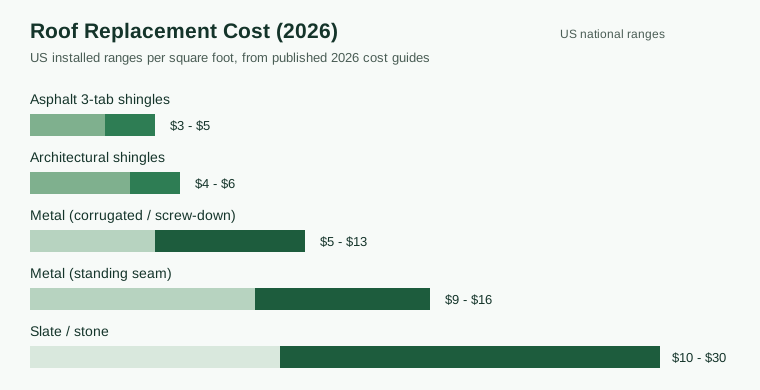
Material is the first and largest multiplier. HomeGuide's 2026 installed pricing, per square foot and as project totals, runs as follows:
| Material | Installed, per sq ft | Typical project total | Published lifespan |
|---|---|---|---|
| Asphalt 3-tab shingles | $3 - $5 | $5,700 - $12,000 | 15 - 20 years |
| Architectural / dimensional shingles | $4 - $6 | $7,500 - $16,000 | 20 - 30 years |
| Metal (all types) | $5 - $16 | $7,500 - $40,000 | 30 - 80+ years |
| Tile | $7 - $25 | $10,500 - $62,500 | 30 - 100+ years |
| Slate / stone | $10 - $30 | $22,000 - $70,000 | 50 - 200+ years |
| Flat / rolled / built-up | $3 - $11 | $4,000 - $16,800 | 5 - 60 years |
A few notes that the table alone does not tell you.
3-tab versus architectural is the most common decision in the market. Architectural shingles cost roughly a third more installed and last roughly half again as long. They are thicker, heavier and more wind-resistant, which is why the material-only price runs $100 to $250 per square against $80 to $130 for 3-tab. On a roof you plan to own for 20 years, the architectural upgrade is usually the better buy. On a roof you plan to sell from in five, 3-tab is the rational economy pick.
Metal is three different products. Corrugated screw-down panels sit at the bottom of the metal band at roughly $500 to $1,000 per square installed. Galvalume standing seam runs $800 to $1,300 per square. Full standing-seam systems land at $9 to $16 per square foot, or $13,500 to $40,000 for the project. Metal shingles, which look like shingles and install like a metal system, run $6 to $14 per square foot. The material price alone for steel runs $100 to $1,300 per square depending on whether it is galvanized, galvalume, stainless or copper, so "metal roof" quotes that differ by a factor of three are usually quoting different metals, not the same job at different margins.
Tile and slate are structural decisions first. Both are heavy. Tile runs $200 to $1,200 per square in materials alone with $500 to $1,700 per square in labor; slate runs $600 to $1,600 in materials with $400 to $1,400 in labor. Many houses need structural reinforcement before either goes on, which is a separate engineering and framing line. Their lifespans are measured in generations, which is the entire point of the price.
4. Cost by Size: Squares, Pitch and Complexity
Roofers do not price your floor plan. They price roof surface, measured in squares. One square is 100 square feet of roof surface. A 2,000-square-foot house does not have a 2,000-square-foot roof: pitch, overhangs and multiple sections add surface. Your home's square footage is the starting point, not the answer.
The arithmetic is simple once you have the measurement. Take the roof area in square feet, divide by 100, and multiply by the per-square installed rate for your material:
| Roof surface | 3-tab at $300 - $500/sq | Architectural at $400 - $600/sq | Standing seam at $900 - $1,600/sq |
|---|---|---|---|
| 15 squares (1,500 sq ft) | $4,500 - $7,500 | $6,000 - $9,000 | $13,500 - $24,000 |
| 20 squares (2,000 sq ft) | $6,000 - $10,000 | $8,000 - $12,000 | $18,000 - $32,000 |
| 25 squares (2,500 sq ft) | $7,500 - $12,500 | $10,000 - $15,000 | $22,500 - $40,000 |
| 30 squares (3,000 sq ft) | $9,000 - $15,000 | $12,000 - $18,000 | $27,000 - $48,000 |
Read the 20-square row against the national numbers and it lines up: HomeGuide's asphalt shingle range centers on $5,700 to $12,000, and its standing-seam band centers on $13,500 to $40,000. The table is the same data, solved for your roof.
Three things move a quote off the table. Pitch is the first: a walkable 4/12 roof is fast work, a 10/12 roof needs staging, harnesses and slower crew movement, and labor follows the slope upward. Complexity is the second: every valley, dormer, skylight and chimney is flashing and cutting time, and a cut-up roof can run 20 to 30 percent more in labor than a clean gable of the same square count. Layers are the third: tearing off two old layers instead of one adds labor and disposal, and it is the most common surprise on houses that had a recover done twenty years ago.
5. Asphalt vs Metal: The 50-Year Ownership Math
The sticker comparison misleads because the two materials do not live the same life. Price them over the same 50 years of ownership and the gap narrows, sometimes reverses. The example below is hypothetical, built from the published ranges above, and meant as a framework you fill in with your own quotes.
Take a 20-square roof. Architectural shingles installed at $12,000, with a 25-year service life. Standing-seam metal installed at $27,000, with a 50-year service life.
| Architectural shingles | Standing-seam metal | |
|---|---|---|
| Installed today | $12,000 | $27,000 |
| Replacement at year 25 | $12,000 (plus inflation) | none |
| 50-year install total | $24,000 before inflation | $27,000 |
| Tear-offs paid | 2 | 1 |
| Cooling-energy effect | baseline | up to 25 percent less annual cooling cost (ORNL/ASHRAE finding) |
On install cost alone the two converge at $24,000 versus $27,000 across 50 years, before inflation makes the second shingle roof more expensive in real terms. Add the cooling savings from the vented metal assembly, which section 7 documents, and the lifetime ledger tips further toward metal in cooling-dominated climates. In heating-dominated climates the energy argument weakens and the durability argument carries the case: one roof, installed once, with one tear-off and one round of disruption.
None of this says metal is the right answer for every house. It says the right comparison is lifetime cost per year of service, not the first quote. A $12,000 shingle roof that lasts 25 years costs $480 a year before maintenance. A $27,000 metal roof that lasts 50 years costs $540 a year. That is the actual price difference once both options are measured over the same 50 years.
6. What a Replacement Disrupts: Timing and Process
A roof replacement is loud, fast and weather-dependent. Angi's 2026 guidance puts the job at 1 to 9 days depending on material, size, pitch and complexity: asphalt shingle work typically takes 1 to 3 days, metal 1 to 5 days, and tile 7 to 9 days. Rain, snow or high wind stops work mid-job, so a forecast check the week before matters more than the contract's start date.
Plan for a full tear-off day of noise and vibration inside the house, a dumpster or trailer in the driveway, and landscaping protection around the eaves where debris lands. Move cars, cover attic-stored items against dust that falls through gaps in the decking, and warn neighbors about the early start. The crew's magnet sweep for nails at the end of the job is worth confirming explicitly: it is standard practice on good quotes and the most common post-job complaint when it is skipped.
Season matters for scheduling and sometimes for price. Spring and fall are peak roofing season in most of Canada and the northern US. Summer heat slows crews and can affect shingle adhesion on some products. Winter work is possible but slower, and HomeStars notes that winter roofing in Canada often carries a 15 to 25 percent premium over standard rates. Booking in the shoulder season is the closest thing this trade has to a discount.
7. The Energy Side: Cool Roofs, Ventilation and Solar Readiness
This is the section most roofing quotes skip, and it is the one that decides what your roof costs you every summer for the next 25 years.
Cool-roof reflectance has a real standard behind it. ENERGY STAR's steep-slope roof criteria require an initial solar reflectance of at least 0.25, maintained at at least 0.15 three years after installation. That is a modest bar: it rules out the darkest roofs and rewards the light-colored and coated ones. For context, a standard dark shingle reflects roughly 5 to 15 percent of sunlight and can reach 150 degrees Fahrenheit on a summer afternoon, while a cool-rated surface stays tens of degrees cooler. New York City's CoolRoofs program notes that reflective coatings reflect 70 to 90 percent of the sun's energy when newly installed, and that the small winter heating penalty is usually minimal compared with the summer cooling savings.
Ventilation does as much work as reflectance. A DOE-funded study by Oak Ridge National Laboratory, field-testing a stone-coated metal shake roof against a direct-nailed asphalt shingle roof with comparable reflectance, measured a 45 percent reduction in heat flow through the metal assembly. About 15 points of that came from reflectance and about 30 points from the air space under the metal, created by the batten and counter-batten mounting. The same research, corroborated by the Florida Solar Energy Center and accepted by an ASHRAE subcommittee, supports up to 25 percent annual cooling cost savings for vented metal roofs over dark shingles. A separate Florida Power and Light study found a white galvanized metal roof saved about $128 a year, or 23 percent, in cooling costs on a 1,770-square-foot home versus dark gray shingles.
What to specify at replacement time. Ask for balanced intake and exhaust ventilation: soffit intake plus ridge exhaust is the standard assembly, and it costs far less to install correctly during a tear-off than to retrofit later. Our roof venting guide walks through the ridge-and-soffit layout. If you are in a cooling-dominated climate, ask which shingle colors in the line you are considering carry cool-roof ratings, and price the upgrade. It is typically a small premium per square.
Solar readiness is a one-time option. If solar panels are anywhere in your five-year plan, the replacement is the moment to prepare: confirm the roof will outlast the panel warranty, ask the roofer to document rafter locations, and consider standing-seam metal, whose seams accept clamp-on solar mounts with no roof penetrations at all. Our replace-the-roof-before-solar guide works through the timing math, and the solar shingle cost comparison prices the integrated-roof alternative.
8. Canada Pricing
Canadian numbers run on the same logic with different bands. HomeStars' national guidance puts a standard asphalt roof at $5,000 to $15,000 installed, with the average near $9,000. A metal roof runs $10,000 to $30,000, and slate tile $20,000 to $60,000. Per square foot, HomeStars lists asphalt at $4 to $7, wood shake at $7 to $15, metal shingles at $10 to $20, and slate at $20 to $40.
Labor is the larger share of the bill in Canada than in the US: HomeStars puts roofing labor at $2.50 to $5.00 per square foot, accounting for 40 to 60 percent of the total project. Urban premiums are real. Tight lots in Toronto or Vancouver, where crews cannot stage equipment or waste easily, can add $100 to $400 to the project. Vancouver's market specifically averages around $18,000 for asphalt shingles.
Two Canadian specifics belong on every quote. First, ice-and-water shield at eaves and valleys is not optional in freeze-thaw climates; ice dams are the failure mode the membrane exists to contain. Second, schedule around winter: emergency winter roofing carries the 15 to 25 percent premium noted above, while spring and fall are the competitive seasons.
On rebates, keep expectations flat: there is no standing federal roofing rebate in 2026, and provincial programs change year to year. Price the roof on its own merits and treat any rebate as a bonus, not a budget line.
9. The Quote Checklist
Get three written quotes. Then run each one through this list before you compare the bottom lines.
- Tear-off depth. One layer or two coming off, and the per-sheet price for decking replacement found during tear-off.
- Underlayment spec. Synthetic or felt in the field, ice-and-water shield at eaves, valleys and penetrations, named by product.
- Flashing. New step flashing, counter-flashing and drip edge, not reused. Pipe boots replaced at every penetration.
- Ventilation. Balanced intake and exhaust specified, not just "vents as needed."
- Material, named. Manufacturer, product line, color, and warranty tier, not just "architectural shingles."
- Start and completion dates with a weather-delay clause, plus daily cleanup and a final magnet sweep in writing.
- Permit. Who pulls it, and the permit number before work starts.
- Payment schedule. Deposit, progress and final payment tied to milestones, with the final payment after your walkthrough.
- Warranties, two of them. The manufacturer's material warranty and the installer's workmanship warranty, each with its term and what voids it.
- Disposal. Old roofing and packaging removed from the property, dumpster placement agreed in advance.
- Gutters. Explicitly in or out of scope. If out, who protects and rehangs them.
- Change orders. Anything not on the quote gets a written price before the work happens, not after.
The cheapest quote is rarely the cheapest roof. A quote that is 15 percent lower because it reuses flashing, skips the permit and prices decking as "TBD" is not 15 percent cheaper. It is a different, worse job.
FAQ
How much does it cost to replace a roof in 2026?
Angi's 2026 data puts the US national average at $9,609, with a range of $5,903 to $46,000. The useful way to think about it is per material: asphalt shingles run $3 to $5 per square foot installed ($5,700 to $12,000 typical), architectural shingles $4 to $6 per square foot ($7,500 to $16,000), and metal $5 to $16 per square foot ($7,500 to $40,000).
How do roofers measure a roof?
By the square: 100 square feet of roof surface. A 2,000-square-foot roof is 20 squares. At $300 to $500 per square installed for 3-tab shingles, that is $6,000 to $10,000 before extras like decking repair, permits and disposal.
Is it cheaper to put a new roof over the old one?
Yes, up front: a recover skips tear-off labor and disposal. But most codes allow only two layers total, the new layer hides decking problems, adds roughly 200 to 350 pounds per square of dead load, and usually carries a reduced manufacturer warranty. It suits a sound single-layer roof you plan to sell from within a decade, not a roof with structural or decking issues.
How long does a roof replacement take?
One to nine days in Angi's 2026 guidance: typically 1 to 3 days for asphalt shingles, 1 to 5 days for metal, and 7 to 9 days for tile. Pitch, size, complexity and weather move the schedule.
Metal roof vs shingles: which costs less over time?
The sticker favors shingles; the lifetime ledger is close. A $12,000 architectural shingle roof with a 25-year life costs about $480 a year over 50 years with one mid-life replacement, before inflation. A $27,000 standing-seam metal roof with a 50-year life costs about $540 a year, with one tear-off instead of two and up to 25 percent lower annual cooling costs in hot climates per the Oak Ridge findings.
Does a metal roof really save energy?
Yes, through two mechanisms. Reflective coatings bounce solar heat away, and the air space under a batten-mounted metal roof lets heat escape before it reaches the attic. The DOE-funded Oak Ridge study measured 45 percent less heat flow than direct-nailed shingles of similar reflectance, with about two-thirds of the benefit coming from the ventilation gap.
What does a new roof cost in Canada?
HomeStars puts a standard asphalt roof at $5,000 to $15,000 installed with the average near $9,000, metal at $10,000 to $30,000, and slate at $20,000 to $60,000. Labor runs $2.50 to $5.00 per square foot, or 40 to 60 percent of the project, and winter work can cost 15 to 25 percent more.
Does homeowners insurance pay for a new roof?
Only for damage from an accident or a natural disaster, not for age and wear. Treat any roofer who leads with an insurance promise as a warning sign, and get the adjuster's determination in writing before signing a contract that depends on it.
What to Read Next
Should You Replace the Roof Before Solar? A 2026 AnalysisUse this next to compare the cost, incentive, installation, or operating-risk angle before you make a home energy decision.Sources and Verification
- Angi How Much Does Roof Replacement Cost? [2026] (national average $9,609, range $5,903 to $46,000; updated March 5, 2026)
- HomeGuide How Much Does a Roof Replacement Cost? (2026) (installed persquarefoot and average totals by material: asphalt $3 to $6, metal $5 to $16, tile $7 to $25, slate $10 to $30; material lifespan table)
- HomeGuide Asphalt Shingle Roof Cost (2026) (3tab $3 to $5 per sq ft installed, $5,700 to $12,000 average; architectural $4 to $6; national average $8,800)
- HomeGuide Metal Roof Cost (2026) (standing seam $9 to $16 per sq ft installed, $13,500 to $40,000; aluminum $7 to $18; steel material bands)
- HomeGuide Roofing Labor Cost Per Square (2026) (labor per square: asphalt shingles $200 to $300, architectural $300 to $350, metal $400 to $800; permit fees $100 to $500)
- HomeStars Roof Replacement Costs (Canada) (asphalt $5,000 to $15,000, average near $9,000; metal $10,000 to $30,000; slate $20,000 to $60,000; labour $2.50 to $5.00 per sq ft, 40 to 60 percent of project)
- ENERGY STAR Roof Products Program Requirements (steepslope: initial solar reflectance at least 0.25, maintained at least 0.15 after three years)
- Building Design + Construction / ORNL DOEfunded metal roof energy study (45 percent heatflow reduction for vented metal shake vs directnailed asphalt shingles; up to 25 percent annual cooling cost savings accepted by ASHRAE)
Editorial Review
EnergyBS Editorial Team
EnergyBS publishes practical homeowner guides. Important program, product, and cost claims should be checked against the linked source and local project documents before you commit to work.
Related Guides
View All ArticlesShould You Replace the Roof Before Solar? A 2026 Analysis
A roofandsolar sequencing guide covering condition evidence, remaining life, removeandreinstall scope, warranties, structural and electrical coordination, and sidebyside lifecycle scenarios.
Attic Ventilation Guide
Choose and diagnose attic vents by first defining whether the roof is vented or unvented, then measuring netfree area, intake and exhaust paths, baffles, air leakage, moisture, weather exposure, and field performance.
Attic Insulation Removal Cost 2026: What Removal and Replacement Really Cost
Removing old attic insulation in 2026 typically costs $1$2 per square foot, or $1,600$3,600 total on average, and removing plus replacing runs $2$6 per square foot. This guide breaks down cost by attic size and material, contamination and asbestos surcharges, why the empty attic is the cheapest airsealing window you will ever get, and how to compare quotes.