Should You Replace the Roof Before Solar? A RemovalandReinstallation Decision Guide
A roofandsolar sequencing guide covering condition evidence, remaining life, removeandreinstall scope, warranties, structural and electrical coordination, and sidebyside lifecycle scenarios.
The Short Answer
Short Answer: Replace or repair the roof before solar when a qualified roof assessment shows the covering, deck, flashing, drainage, or penetrations are unlikely to remain serviceable for the planned solar term. Do not decide from roof age alone. Compare the incremental cost of coordinated reroofing now with the future cost and risk of solar removal, storage, roof work, reinstallation, testing, permits, lost production, and warranty coordination. Put responsibility between roofer and solar contractor in writing.
A solar array can remain in service for decades. A roof beneath it may not. The expensive mistake is not always installing on an old roof; it is installing without documenting condition, access, warranties, and the future removal path.
This guide works for asphalt shingles, tiles, metal, low-slope membranes, and other assemblies, but the technical answer is roof-specific. Use qualified roofing, structural, electrical, and solar professionals under local rules.
Age Is a Clue, Not the Decision
A “12-year-old roof” does not tell you:
- material and product;
- installation quality;
- climate exposure;
- ventilation and attic moisture;
- slope and drainage;
- number of layers;
- hail, wind, snow, tree, or foot-traffic history;
- deck condition;
- flashing and penetration details;
- repair history;
- remaining manufacturer and workmanship coverage.
One roof can have years of service left while another of the same age needs replacement. Ask for observed condition and limitations rather than a salesperson's age threshold.
DOE rooftop-potential guidance identifies roof shape, pitch, orientation, area, and shading as solar inputs. Add roof condition and serviceability before treating available area as installable area.
The Three-Party Problem
Rooftop solar involves at least:
- the owner;
- the roofing contractor or warranty provider;
- the solar installer or system owner.
It may also involve the utility, lender, lessor/PPA provider, insurer, building authority, structural professional, manufacturer, and future buyer.
A roofer can blame a solar penetration. A solar contractor can blame pre-existing roof failure. The owner can discover that neither contract includes removal for warranty work. Prevent this by defining interfaces before installation.
Commission an Independent Roof Assessment
The solar seller's roof check protects its installation process. It may not replace a roof inspection focused on remaining service life and water management.
Ask the roof professional to document:
- covering type, manufacturer if known, approximate age, and layers;
- slope, roof planes, valleys, drainage, and low-slope transitions;
- shingle, tile, panel, seam, or membrane condition;
- flashing at walls, chimneys, skylights, valleys, eaves, and penetrations;
- deck condition where visible or testable;
- signs of leaks, rot, condensation, staining, or prior patching;
- attic ventilation and moisture observations;
- wind, hail, snow, ice, tree, or animal damage;
- areas that cannot be assessed;
- repairs needed before solar;
- a reasoned remaining-service range, not a guarantee;
- whether solar attachments affect an existing warranty.
Photographs and moisture evidence are more useful than a checkbox saying “roof good.”
If wind, hail, lightning, fire, flood, or tree impact may have caused the roof problem, preserve the event condition and use the solar storm-damage claim workflow before ordinary removal or repair changes the evidence.
For a Canadian purchase or pre-installation inspection, BubbleWatch's roof due-diligence guide provides a fuller evidence record.
Inspect the Attic and Interior Too
Exterior covering condition is only one side. Where accessible, inspect:
- underside of deck;
- stains and active moisture;
- frost, condensation, or mold-like conditions;
- blocked soffit paths;
- bath or kitchen exhaust ending in attic;
- roof or plumbing leaks;
- sagging, damaged, or altered framing;
- insulation blocking drainage or ventilation details;
- electrical and solar conductor pathways;
- prior structural changes.
Solar does not cause every later roof problem, and a dry ceiling does not prove a sound deck. Concealed conditions remain uncertainty. State them in the decision.
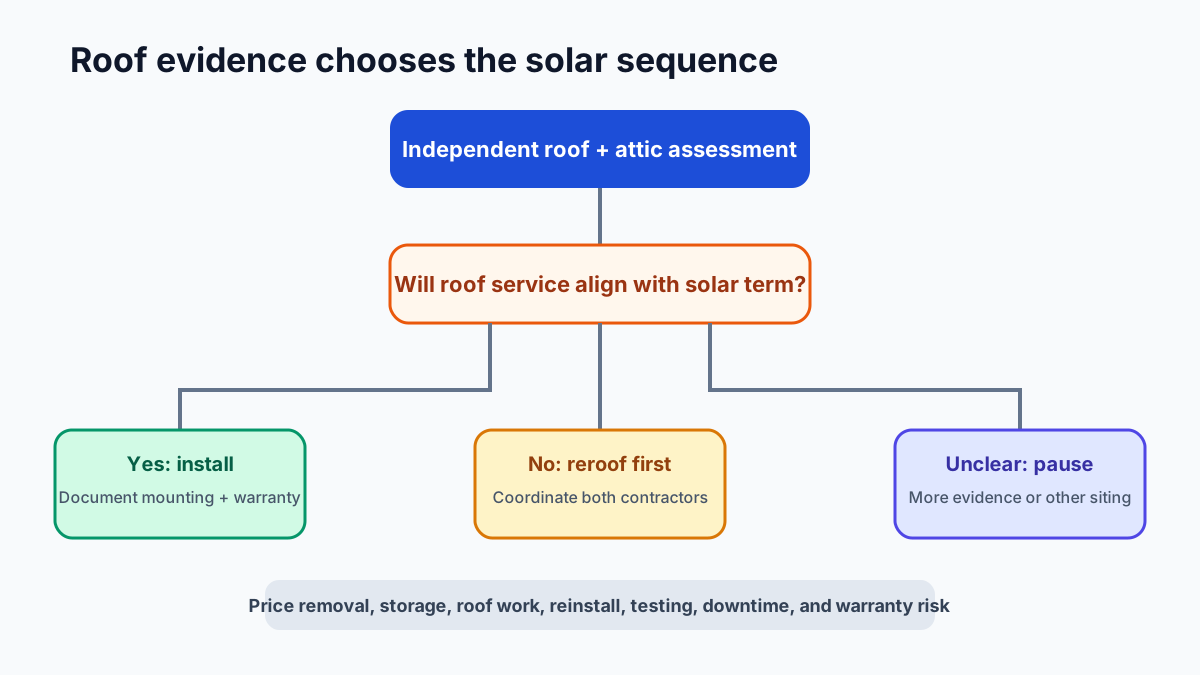
The Sequencing Decision Tree
Path A: Roof is sound with compatible remaining life
Proceed with solar if mounting, warranty, structure, drainage, fire access, and future service are resolved. Keep the assessment and pre-installation photographs.
Path B: Localized repair can restore a durable assembly
Complete repair first, allow required curing or inspection, then document it. Confirm whether solar layout will block future access to known weak areas.
Path C: Roof life is materially shorter than solar term
Price coordinated reroofing now. Compare the incremental cost with a future remove-and-reinstall scenario.
Path D: Roof condition is uncertain
Do not let a solar deadline force the decision. Obtain more evidence, open limited areas where justified, or defer rooftop solar. Ground mount, carport, community solar, or efficiency work may be alternatives.
Path E: Roof is part of a shared or regulated building
Condo, strata, co-op, HOA, leased-roof, heritage, and multifamily approvals can change ownership and access. Confirm authority before contracting.
Calculate the Cost of Waiting
Future roof work under solar can include:
- site survey and system documentation;
- utility or authority notification;
- safe shutdown and electrical isolation;
- module removal;
- racking or attachment removal;
- temporary weatherproofing;
- transport or secure storage;
- roof demolition and replacement;
- new attachment layout or flashing;
- module and racking reinstallation;
- replacement of damaged or incompatible parts;
- electrical testing and recommissioning;
- permit or inspection work;
- lost generation;
- warranty administration;
- schedule coordination between trades.
Do not multiply a national per-panel figure and call it a quote. Labor market, stories, pitch, access, array layout, equipment, storage, electrical configuration, permits, warranty, and roof material create wide differences.
Request a current local removal-and-reinstallation proposal or contract method, then apply a range for future uncertainty.
Worked Lifecycle Comparison
Hypothetical inputs:
- roof assessment: likely 4–8 years of service remaining;
- solar design term: 25 years;
- reroof now: $18,000;
- reroof without solar in year 6: uncertain future cost;
- solar removal/reinstallation in year 6: current local quote $5,000, modeled as a range;
- lost production and coordination: additional allowance;
- solar project: same under both paths.
Scenario 1: Reroof now
The owner pays the roof cost now, coordinates flashing and attachment zones, and avoids a planned mid-term removal. The relevant premium is not always the full roof cost: if reroofing would be required soon anyway, compare timing and financing costs.
Scenario 2: Install now, reroof later
The owner receives solar production earlier but accepts removal/reinstallation, contractor availability, equipment compatibility, roof inflation, and downtime risk.
Scenario 3: Defer both
The owner preserves cash but loses solar production and remains exposed to roof failure. This may still be rational when roof condition is uncertain, utility compensation is weak, or ownership duration is short.
Build a present-value model only if you can explain its discount, energy-price, degradation, and cost-escalation assumptions. A simple range may be more honest.
Use Incremental Cost Correctly
If the roof must be replaced regardless of solar, do not assign the entire roofing cost to solar payback. Solar-related incremental items may include:
- earlier timing than otherwise planned;
- upgraded material chosen for compatibility;
- structural work;
- solar-ready pathways;
- attachment coordination;
- warranty modifications;
- financing cost of accelerating the project.
Conversely, do not claim the roof qualifies for a solar incentive merely because panels will be installed. Tax and program rules are jurisdiction- and fact-specific. Obtain current professional advice.
Roof Material Questions
Asphalt shingles
Record layers, granule loss, cracking, curling, adhesion, flashing, deck, and ventilation. Attachment layout should avoid damaged zones and manage water at every penetration.
Tile
Identify tile type, underlayment age, breakage risk, spare-tile availability, attachment method, and walking/access plan. The visible tile and concealed waterproofing can have different service lives.
Standing-seam metal
Some systems attach with seam clamps and no field penetrations, but seam profile, metal thickness, coating, clip design, load, compatibility, and manufacturer approval matter. Confirm roof warranty.
Exposed-fastener metal
Fastener and washer maintenance may occur during the solar term. Plan access and do not assume all “metal roofs” have identical longevity.
Low-slope membrane
Ballasted or attached designs affect load, drainage, membrane protection, wind, fire, access, and warranty. Use roof-manufacturer-approved details and preserve drains and service paths.
Wood, slate, and specialty roofs
Fragility, fire rules, fastening, replacement materials, heritage restrictions, and specialist availability can make rooftop solar costly. A non-roof mounting option may be better.
Solar Layout Can Improve or Harm Roof Serviceability
Review the plan for:
- access to valleys, drains, gutters, skylights, chimneys, vents, rooftop equipment, and fire paths;
- module edges relative to drainage and snow shedding;
- safe service clearances;
- attachment concentration;
- wire and conduit support;
- animal guards where suitable;
- leaf and debris accumulation;
- future section repair;
- roof expansion and movement;
- array removal sequence.
Maximum panel count is not the only goal. A slightly smaller array can preserve access, reduce shade, avoid weak planes, or improve utility value.
Structural and Weather Loads
The roof must support existing dead load plus the solar system and applicable snow, wind, seismic, rain, ponding, and maintenance loads. Conditions vary by jurisdiction and building.
Potential structural flags include:
- altered or cut trusses;
- long spans or sagging;
- damaged or wet framing;
- multiple roof layers;
- heavy tile or ballast;
- concentrated snow drift;
- high wind exposure;
- older additions with uncertain design;
- array changes after permit.
Use the structural review required locally. A sales roof sketch is not structural approval.
Coordinate Warranties in Writing
Ask the roofer:
- Does solar installation affect material or workmanship coverage?
- Which attachment and flashing systems are permitted?
- Must an approved contractor perform penetrations?
- Who inspects after solar?
- Who responds to a leak beneath the array?
Ask the solar provider:
- What roof workmanship is covered, for how long, and by whom?
- Does coverage include removal needed to diagnose a leak?
- Are pre-existing conditions excluded broadly?
- What if the original installer closes?
- What does removal/reinstallation cost or how is it priced?
- Can another qualified contractor work without voiding coverage?
Attach answers to the contract. A verbal “we cover roof leaks” is not enough.
Existing Solar: Remove, Reinstall, Resize, or Retire?
When reroofing under an existing array, audit the system before removal:
- age and remaining module performance;
- inverter condition and warranty;
- actual annual production versus weather-adjusted expectation;
- ownership, loan, lease, or PPA restrictions;
- utility tariff or grandfathered interconnection;
- spare parts and racking compatibility;
- code requirements triggered by reinstallation;
- roof layout changes;
- storage and transport risk;
- cost of reinstalling old equipment versus a new system.
Do not assume replacing the array preserves the same utility treatment. Confirm interconnection consequences before changing size or equipment.
Document production immediately before shutdown and after recommissioning. Photograph serial numbers, wiring, racking, roof, and stored modules. Allocate responsibility for damage.
Buying or Selling a Solar Home
For a sale, collect:
- roof and solar contracts;
- ownership and payoff documents;
- permits and permission to operate;
- equipment list and serial numbers;
- production history;
- roof age and repair records;
- warranties and transfer requirements;
- removal/reinstallation history;
- leak claims;
- utility tariff;
- insurance disclosure;
- monitoring-account transfer.
A buyer should not accept “new roof” without scope and date, or “owned solar” without lien and contract evidence. Roof and solar may have different owners or warranty parties.
The buying-a-house-with-solar audit turns that issue into four closing files: ownership/finance, roof/equipment, production/utility, and transfer.
Contractor Scope Matrix
| Task | Roofer | Solar contractor | Owner/other |
|---|---|---|---|
| Condition assessment | |||
| Structural review | |||
| Array shutdown | |||
| Removal and storage | |||
| Deck repair | |||
| Roofing and flashing | |||
| Attachment layout | |||
| Reinstallation | |||
| Electrical testing | |||
| Permit/utility notice | |||
| Leak response | |||
| Damage during storage | |||
| Final roof and production documentation |
Fill every row with a named party and contract reference.
Red Flags
- roof approved from satellite imagery alone despite visible age or damage;
- no attic or interior limitation noted;
- solar contract broadly disclaims every roof issue;
- roofing warranty has not been checked;
- “free roof with solar” without separated cash and financing prices;
- incentive assumed to cover unrelated roofing;
- removal/reinstallation described as easy but not priced or assigned;
- different contractors each say the other handles flashing;
- array blocks drains, valleys, service equipment, or required access;
- structural review omitted despite visible alteration or local requirement;
- salesperson uses an expiring offer to prevent independent inspection.
FTC guidance warns consumers against pressure and misleading “free solar” claims. Slow the project down when the roof interface is unclear.
Build One Coordinated Scope of Work
When reroofing and solar occur together, the most valuable document is a single coordination schedule that names the responsible party at every handoff. It can be an exhibit to one contract or a matching attachment to both contracts. The format matters less than eliminating gaps.
Start with preconstruction. Record who verifies measurements, deck condition, attachment locations, structural assumptions, electrical routing, required setbacks, attic access, and the location of vents, drains, skylights, chimneys, and future service paths. Identify which observations can be made before tear-off and which require an open roof.
At tear-off, specify who documents hidden conditions and who has authority to approve repairs. Rotten decking, damaged framing, wet insulation, obsolete flashing, and abandoned penetrations should trigger photographs, a written price, and approval before concealment. Use unit prices for predictable unknowns such as deck-sheet replacement where practical. An allowance without a measurement rule invites conflict.
Before the new roof is covered, require confirmation that the solar attachment plan still matches actual rafters, trusses, purlins, or deck conditions. A drawing prepared from aerial imagery should not override conditions revealed on site. If attachment locations change, update the plan and preserve the revision in the closeout file.
The schedule should define these hold points:
| Hold point | Evidence before work continues |
|---|---|
| Deck exposed | Photos and approved repair scope |
| Underlayment/flashing stage | Required inspection or contractor sign-off |
| Solar attachment layout | Confirmed structure and waterproofing detail |
| Array installed | Attachment records where applicable and roof review |
| Electrical complete | Inspection and labeling status |
| Closeout | Warranty, permit, interconnection, and monitoring documents |
Do not treat the table as a universal inspection code. Local requirements and roof systems differ. It is a homeowner coordination record that should be adapted by the qualified contractors and authority having jurisdiction.
Plan for Water Management Around the Array
Solar design should follow the roof's drainage strategy. Water, snow, leaves, needles, and wind-blown debris need a path to move without concentrating at attachments or array edges. On low-slope roofs, avoid placing equipment where it obstructs drains, scuppers, crickets, or maintenance routes. On pitched roofs, keep valleys and known runoff concentrations serviceable.
Ask the roofer to review the final array layout, not only a generic attachment detail. The roofer should flag locations where flashing geometry, membrane seams, tile courses, metal ribs, or drainage make the proposed attachment difficult. The solar contractor should then document the compatible mounting method.
Also decide how future leak diagnosis will work. A stain inside the house may originate upslope from where it appears. The contract should not assume that proximity to a panel proves solar caused the leak, or that solar can never be responsible. A fair procedure defines notification, access, joint inspection when needed, documentation, temporary protection, and responsibility based on the identified cause.
Preserve photographs before panels cover the roof. Capture the finished roofing, flashing, underlayment details that remain visible during construction, attachment locations, sealants where used, conduits, junction boxes, and attic conditions. Label photographs by roof plane and date. This modest record can shorten a future investigation substantially.
Budget the Full Lifecycle, Not Only Today's Contract
Create a roof-and-solar reserve alongside the purchase decision. It should include known reroof work, solar installation, structural corrections, electrical changes, possible utility requirements, and a future allowance for array removal and reinstallation. The allowance is not a quoted promise; obtain local pricing and document what it includes.
Removal and reinstallation can involve more than labor to lift panels. Potential scope includes permits, mobilization, scaffolding or fall protection, storage, replacement mounting hardware, roof attachments, damaged wiring, new code requirements, inspection, recommissioning, and monitoring verification. Older equipment may be difficult to match or may not justify reinstalling in its original configuration.
Test at least three timelines:
- reroof and install solar now;
- repair the roof, install solar, and reroof at the expected repair horizon;
- defer solar until the planned reroof.
For each timeline, include forgone solar savings during deferral, borrowing costs, incentives you have independently verified, remove-and-reinstall costs, and the risk of emergency work. Use ranges for uncertain future amounts. A decision that changes only when one uncertain input is set to an extreme value is usually less fragile than one balanced on several optimistic assumptions.
If cash is constrained, ask contractors to price essential roof work separately from elective upgrades. This makes the financing decision legible. It also prevents a solar proposal from obscuring what the roof would have cost without solar.
Closeout Records to Keep for the Next Owner
Maintain one digital and one durable local copy of the approved roof and solar plan, contracts and change orders, invoices, permits, inspection records, product names, color and batch information where useful, attachment and flashing details, photographs, warranty certificates, warranty-transfer instructions, interconnection approval, array map, serial numbers, shutdown instructions, and monitoring access.
Record the legal names and contact details of the roofer, solar contractor, electrician, designer or engineer, and finance provider. Note which warranty covers roofing outside the array, roofing under the array, penetrations, mounting equipment, electrical equipment, labor, and removal/reinstallation. Calendar maintenance or registration requirements that could affect coverage.
When selling, give the buyer the factual package rather than a verbal summary. A buyer can then verify ownership, loan or lease obligations, roof history, utility arrangement, warranty transfer, and system operation. This reduces surprises during inspection and prevents valuable records from disappearing with an old email account.
Final Checklist
- Independent roof assessment documents condition and limits.
- Attic/interior evidence reviewed where accessible.
- Repair, reroof-now, reroof-later, and defer scenarios compared.
- Removal/reinstallation scope and local cost range obtained.
- Incremental roofing cost separated from required base roof work.
- Mounting, flashing, drainage, access, and warranty details approved.
- Structural and code requirements addressed.
- Roof and solar contractor responsibilities assigned.
- Utility/interconnection effects of future system changes checked.
- Existing solar production documented before and after work.
- Financing and incentives independently verified.
- Sale, transfer, insurance, and monitoring records planned.
Frequently Asked Questions
How old is too old for a roof under solar?
There is no universal age. Material, condition, climate, installation, deck, flashing, and remaining-life evidence matter. Compare likely roof life with the solar term and future removal burden.
Can solar panels damage a roof?
Poor attachment, flashing, layout, foot traffic, drainage, or workmanship can cause damage. A correctly designed and installed system on a suitable roof can perform well. Contracts and inspections should address the interface.
Who removes panels for roof work?
The contract and ownership arrangement decide. Solar electrical work may require qualified or authorized personnel. Confirm warranty, utility, permit, storage, and recommissioning requirements before hiring.
Does a new roof become part of the solar tax credit?
Do not assume so. Tax rules are jurisdiction- and fact-specific and can change. Separate costs and obtain current tax advice rather than relying on a sales proposal.
Should I install solar shingles while reroofing?
Compare integrated products with conventional roofing plus rack-mounted solar on total price, production, roof coverage, repairability, contractor availability, warranties, and future replacement. Use the solar shingles comparison.
Can I reinstall an old solar system after reroofing?
Often, but verify equipment condition, racking compatibility, code, utility tariff, warranties, labor cost, and expected remaining production. Reinstallation is not automatically the economic choice.
Will panels protect the roof underneath?
They can shade parts of the covering, but attachments, water paths, debris, access, and uncovered areas still age. Do not extend roof-life estimates without evidence.
What to Read Next
Use the solar quote comparison worksheet to assign roof and removal scope before signing. Then compare integrated roofing with solar shingles versus panels, test roof planes with the orientation guide, and verify output through the solar production estimate guide.
Sources and Method
This guide combines DOE rooftop-potential and roof-coordination guidance, FTC contract questions, and NREL production modeling context. It avoids a national roof-age or removal-price rule because material, access, labor, system, warranty, and local requirements vary. Obtain current site-specific assessments and contracts.
Sources and Verification
Editorial Review
EnergyBS Editorial Team
EnergyBS publishes practical homeowner guides. Important program, product, and cost claims should be checked against the linked source and local project documents before you commit to work.
Related Guides
View All ArticlesTesla Solar Roof vs Solar Panels: Cost Comparison 2026
Compare Tesla Solar Roof, GAF solar shingles, and traditional solar panels by installed cost, roof timing, efficiency, maintenance, and 2026 taxcredit assumptions.
Solar Quote Comparison Worksheet: Price, Production, Financing, and Contract Checks
A sidebyside homeowner worksheet for normalizing solar cash prices, financed cost, equipment, production assumptions, roof scope, utility rules, warranties, and contract obligations.
Best Solar Panel Direction: Azimuth and Tilt Guide (2026)
The old rule was 'South Facing Only'. But with TimeofUse rates and cheap panels, facing panels East and West might actually save you more money.