Heat Pump Water Heater Installation Cost 2026: Installed Prices, the Ended Tax Credit, and Payback Math
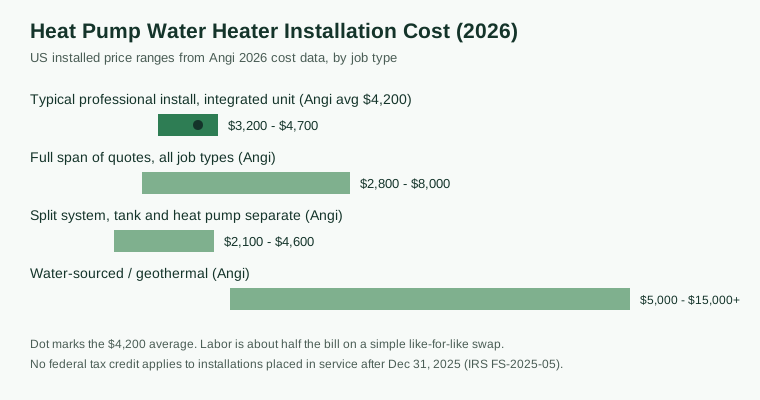
Installing a heat pump water heater costs $4,200 on average in the US in 2026, with most professional installations between $3,200 and $4,700 and a full span of $2,800 to $8,000 in Angi's 2026 data. Labor is about half the bill on a simple likeforlike swap. The federal 25C tax credit that used to return 30 percent, up to $2,000, no longer applies: the IRS confirms no credit is allowed for property placed in service after December 31, 2025, so a 2026 installation has to pay back on energy savings alone. ENERGY STAR puts those savings at about $550 a year for a household of four compared with a standard electric tank, and more than $5,600 over the unit's life. This guide breaks the price down by type and tank size, prices the three jobs that change the quote, works the payback arithmetic in the open, and ends with a quote checklist.
Quick Checks
- 1Budget $4,200 as the US average installed price for a heat pump water heater in 2026 (Angi). Most professional installations land between $3,200 and $4,700; the full span of quotes runs $2,800 to $8,000.
- 2On a simple like-for-like swap, labor is about half the bill (Angi). The jobs that push past $5,000 are conversions: a new 240-volt circuit, a condensate route that needs a pump, or a gas-to-electric switch.
- 3There is no federal tax credit for a 2026 installation. The IRS confirms the 25C credit is not allowed for property placed in service after December 31, 2025. Units installed in 2025 can still be claimed on a 2025 return.
- 4ENERGY STAR puts the saving at about $550 a year for a household of four against a standard electric tank, and more than $5,600 over the unit's life. Smaller households save less, so run the payback math on your own household size before you buy.
- 5Check the room before you check prices: the unit needs a large volume of air around it (plan on roughly 1,000 cubic feet, or a louvered door or duct kit), a route for condensate, and a spot where fan and compressor noise will not bother a bedroom.
Heat Pump Water Heater Installation Cost 2026: Installed Prices, the Ended Tax Credit, and Payback Math
By EnergyBS Editorial Team | October 21, 2026
The Short Answer
Short Answer: A heat pump water heater installed by a professional costs $4,200 on average in the US in 2026, with most homeowners paying between $3,200 and $4,700 and a full span of $2,800 to $8,000 across all job types (Angi, updated July 2026). On a simple swap, where the new unit goes in the same spot as an old electric tank, labor is about half the total. The number that changed for 2026 is the incentive: the federal Section 25C tax credit, which returned 30 percent of the cost up to $2,000, no longer exists for new installations. The IRS states the credit is not allowed for any property placed in service after December 31, 2025. What still carries the economics is the running cost. ENERGY STAR calculates that a certified heat pump water heater saves a household of four about $550 a year compared with a standard electric water heater, and more than $5,600 over the unit's lifetime.
The job in six steps:
- Confirm the room fits the unit: enough air volume, a condensate route, and power.
- Pick the tank size from your household's hot water use, not from the old tank's label alone.
- Get itemized quotes that separate the unit, labor, electrical work, and permit.
- Pull the permit and schedule the swap, including removal of the old tank.
- Set the unit, connect water, power, and the condensate drain, and fill and purge the tank before energizing.
- Set the operating mode to heat pump or hybrid, register the warranty, and keep the invoice for any state or utility rebate claim.
This guide sits in our water heating library next to the tankless water heater installation cost guide and the standard tank replacement cost guide. It prices the heat pump option on the same basis, then does the payback arithmetic in the open, because in 2026 the arithmetic is the whole decision.
1. What the Installed Price Is Made Of
An installed quote for a heat pump water heater has four parts, and quotes that bundle them into one number are the ones that are hard to compare.
The unit. The heat pump water heater itself. Angi's size table (Section 3 below) puts a 50-gallon unit at $1,100 to $1,300 and an 80-gallon unit at $2,000 to $2,500, before installation. Bigger tanks and higher efficiency ratings cost more, and the tank is the part of the quote you can verify against retail prices in minutes.
Labor. About half the total project cost on a simple replacement, according to Angi, with installer rates of $50 to $130 per hour. A straightforward swap of one electric tank for another, in the same location, with the same circuit, is the cheap end of labor. Anything that adds a trade (an electrician for a new circuit, a second visit for a condensate pump) adds hours.
Parts and permits. Shut-off valves, an expansion tank where code requires one, a drain pan, condensate tubing or a condensate pump, and the permit. Angi puts permits at $25 to $300 or more depending on the municipality. These lines are small individually and are where low quotes quietly leave things out.
Disposal and extras. Hauling the old tank away, and any electrical panel work. Panel work is the swing item: a home whose panel has no room for the circuit can add a four-figure line that has nothing to do with the water heater itself. Our electrical panel upgrade cost guide prices that job separately if a quote sends you there.
2. Price by Type
Not every heat pump water heater is the familiar integrated tank with a compressor on top. Angi's 2026 type table separates four designs, and the design sets the price band before size does.
| Type (Angi 2026) | Average cost range | What it is |
|---|---|---|
| Conventional (integrated) | $1,100 to $3,000 | One tank with the heat pump built in; the standard residential choice |
| Split system | $2,100 to $4,600 | Tank indoors, heat pump unit separate; used where space or noise rules out integrated |
| Solar-supported | $2,900 to $7,000 | Heat pump paired with solar thermal input |
| Water-sourced / geothermal | $5,000 to $15,000+ | Pulls heat from a ground or water loop; a different project class entirely |
Read the table with the installed average in mind: the $4,200 average and the $3,200 to $4,700 typical band describe a professionally installed integrated unit, which is what nearly every home buys. The type table's lower figures for integrated units track the unit-side cost more than the finished job. If a quote for a full installation lands near the bottom of the integrated range, ask what the quote leaves out, because labor alone is about half of a typical finished price.
3. Price by Tank Size
Hot water demand is a household-size question. Angi's 2026 size table prices the unit by capacity:
| Tank size | Unit price (Angi 2026) | Fits |
|---|---|---|
| 30 gallon | $700 to $900 | 1 to 2 people, low use |
| 40 gallon | $900 to $1,100 | 2 people |
| 50 gallon | $1,100 to $1,300 | 3 to 4 people, the most common size |
| 65 gallon | $1,500 to $2,000 | 4 to 5 people |
| 80 gallon | $2,000 to $2,500 | 5+ people or a soaking tub |
| 100 gallon | $2,600 to $3,100 | Large households, high simultaneous use |
Two sizing notes that protect the payback. First, a heat pump water heater recovers more slowly than a standard electric tank heating on its elements alone, so a household that regularly empties the tank at the morning peak should size up one step rather than rely on the backup elements, which erase the efficiency advantage every time they run. Second, oversizing has a real cost too: the price steps above show roughly $400 to $700 per size step at the unit level, and a bigger tank loses more heat standing idle. Match the tank to the household, not to the biggest number that fits the closet.
4. The Three Jobs That Change the Price
The $2,800 to $8,000 span in Angi's data is not random. It maps to three different jobs.
Job 1: the like-for-like electric swap. The old tank is electric, the circuit exists, the new unit fits the space, and the condensate can reach a floor drain or sink by gravity. This is the $3,200 to $4,700 typical band, labor about half, done in a day.
Job 2: the gas conversion. The old tank burns gas. The new unit needs a 240-volt circuit that does not exist yet, the gas line has to be capped by a licensed fitter, and the vent through the roof or wall becomes redundant. Circuit runs and any panel work push these jobs toward and past $5,000, and they are most of the top half of Angi's span. A newer class of 120-volt heat pump models, designed to share an existing outlet circuit, exists specifically to cut this job's electrical cost; ask about it if your quotes all carry a four-figure electrical line.
Job 3: the tight-space install. The tank lives in a small closet or a finished room. The unit needs air (Section 6), the condensate needs a pump because no drain is nearby, and the installer may recommend a split system or ducting. Parts are cheap; the labor and the return visits are not. Get the air and drain plan in writing before you sign.
5. The 2026 Incentive Picture: the Federal Credit Is Gone
Many pages still describe a 30 percent federal tax credit for heat pump water heaters. That was Section 25C, the Energy Efficient Home Improvement Credit, which covered 30 percent of the project cost up to a $2,000 annual limit for heat pumps and heat pump water heaters. It ended early. Under Public Law 119-21, and confirmed in IRS Fact Sheet FS-2025-05 (August 2025), no 25C credit is allowed for property placed in service after December 31, 2025.
What that means in practice:
- Installed in 2026 or later: no federal credit. Do not let a quote sheet subtract $2,000 that is not there.
- Installed on or before December 31, 2025: the credit can still be claimed on the 2025 tax return with Form 5695. If your unit went in during 2025 and nobody claimed it, that is worth a conversation with your tax preparer.
- State and utility rebates still exist, and they are now the whole incentive story. Amounts, eligible models, and claim windows are set program by program and change during the year, so this guide does not print figures that could be stale by the time you read them. Check your utility's rebate page and your state energy office before you buy, not after: some programs require the model to be on an approved list, and some require the claim within a set number of days of installation. DOE-funded Home Energy Rebate programs also run through state energy offices, with rules set by each state.
Budget the project as if the rebate were zero, then treat anything you actually qualify for as a shorter payback.
6. Fit Checks Before You Buy
A heat pump water heater moves heat from the room air into the water. That one fact creates four checks that a standard tank never asks for.
Air volume. The unit needs a large volume of air to draw heat from. Manufacturer installation instructions commonly call for roughly 1,000 cubic feet of surrounding air space, or a louvered door, a duct kit, or an open path to a larger room. Do the arithmetic on your space: a 10 ft by 10 ft room with an 8 ft ceiling holds 800 cubic feet (10 x 10 x 8), which is under the common threshold, and a water heater closet holds a fraction of that. Garages, basements, and utility rooms pass easily in most homes; interior closets are the problem case.
Room temperature. Heat pump mode works best in air that stays roughly between 40 and 90 degrees F. In a cold garage in a northern winter, the unit leans on its backup electric elements, and the savings shrink for those months. This is a sizing and expectations issue, not a deal-breaker, but a quote for a cold-climate garage install should say so plainly.
Condensate. Pulling heat from air condenses moisture out of it, the same way a dehumidifier fills its bucket. The unit produces a steady trickle of condensate that needs a drain, a sink, or a condensate pump. No drain route, no install; confirm the route in the quote.
Noise and cold exhaust. The unit has a compressor and a fan, and it exhausts air that is cooler and drier than the room. In a basement or garage that is a side benefit in summer. Next to a bedroom wall, check the manufacturer's sound rating before you buy, because the unit runs for hours a day, often in the evening.
7. Running Cost and Payback, With the Math Shown
ENERGY STAR's figures are the anchor: a certified heat pump water heater uses about 70 percent less energy than a standard electric water heater, saving a household of four approximately $550 a year, and more than $5,600 over the unit's lifetime. Angi's broader ballpark, $100 to $500 a year, covers smaller households and homes switching from cheaper fuels; the honest range depends on what you have now and how many people shower.
Worked example 1: household of four, like-for-like electric swap.
- Installed cost: $4,200 (Angi average).
- Annual saving vs the standard electric tank it replaced: $550 (ENERGY STAR, household of four).
- Simple payback on the full installed cost: $4,200 divided by $550 per year = 7.6 years of bill savings to repay the entire job.
- Over a 10-year horizon: 10 x $550 = $5,500 saved, against $4,200 spent, before any rebate.
ENERGY STAR's own framing is shorter, about three years, because it measures payback on the price difference between a heat pump model and a standard tank, not on the whole job. Both numbers are true; they answer different questions. If your old tank has already failed, the premium framing is the right one, because you were buying a water heater anyway. If your old tank works fine and you are replacing early, the full-cost framing is the honest one.
Worked example 2: household of two.
- ENERGY STAR's $550 figure is for a household of four. Hot water use roughly follows people, so a two-person household should plan on materially less, in line with Angi's $100 to $500 ballpark.
- At $300 a year of savings, the same $4,200 job takes $4,200 divided by $300 = 14 years to repay in full.
- The premium framing still works in this household's favor if the alternative was a new standard tank, but an early replacement of a working tank is hard to justify on savings alone at this size. Replacing at failure, with the right size, is the disciplined move.
Switching from gas? ENERGY STAR is explicit that savings against natural gas depend on local utility rates, and no national figure is honest. Use this worksheet instead: find your gas bill's water heating share (in summer, when the furnace is off, nearly all household gas use is water heating for most homes), price a year of it, and compare with the electric cost of the heat pump unit at your electricity rate using the unit's published annual kWh estimate from its ENERGY STAR listing. Your installer should do this arithmetic with your actual bills before recommending a conversion.
8. Quote Checklist
Before you sign, confirm each of these is answered in writing:
- Unit make, model, tank size, and its efficiency rating (UEF), with the model on the quote, not a placeholder.
- Unit price and labor shown as separate lines.
- Electrical scope stated: existing circuit reused, new circuit run, or panel work, each priced.
- Condensate route stated: gravity drain, sink, or pump, and who supplies the pump.
- Air volume solution for the space: open room, louvered door, or duct kit.
- Old tank removal and disposal included.
- Permit included, and who pulls it.
- Gas line capping by a licensed fitter, on a conversion.
- Warranty terms: tank and parts years, labor warranty from the installer, and who you call for each.
- Rebate paperwork: which state or utility programs the installer will file, and which are on you, with claim deadlines.
- Operating mode set at commissioning (heat pump or hybrid), and the manual left with you.
- Total price fixed, with the conditions that could change it named in writing.
Frequently Asked Questions
How much does it cost to install a heat pump water heater in 2026?
The US average is $4,200 professionally installed, with most jobs between $3,200 and $4,700 and a full span of $2,800 to $8,000 (Angi, 2026). Like-for-like electric swaps sit in the typical band; gas conversions and panel work push toward the top.
Is there still a federal tax credit for a heat pump water heater?
No, not for a new installation. The Section 25C credit (30 percent, up to $2,000) is not allowed for property placed in service after December 31, 2025, per IRS Fact Sheet FS-2025-05. Units installed in 2025 can still be claimed on a 2025 return. State and utility rebates remain, set program by program.
How much will a heat pump water heater save me each year?
ENERGY STAR calculates about $550 a year for a household of four switching from a standard electric water heater, and more than $5,600 over the unit's life. Smaller households save less; Angi's broader ballpark is $100 to $500 a year. Savings against a gas tank depend on your local gas and electricity rates.
How long is the payback period?
About three years on the price premium over a standard tank for a household of four (ENERGY STAR's framing), or about 7.6 years to repay the full $4,200 average installed cost at $550 a year of savings. Households of two should plan on a longer payback and are usually best served by replacing at failure rather than early.
What size heat pump water heater do I need?
Match the tank to the household: 50 gallons covers most 3 to 4 person homes (Angi's size table prices the unit at $1,100 to $1,300). Size up one step if your household regularly empties the tank at peak times, because heat pump recovery is slower than element-only heating.
Can a heat pump water heater replace a gas water heater?
Yes, and it removes a combustion appliance from the house. Budget for the electrical side: most models need a 240-volt circuit, the gas line must be capped by a licensed fitter, and the old vent becomes redundant. Conversions are the jobs that land in the upper half of the $2,800 to $8,000 span.
Does a heat pump water heater need a drain?
Yes. It condenses moisture from the air as it works and produces a steady trickle of water that must reach a floor drain, a sink, or a condensate pump. Confirm the condensate route in the quote; it is a small line that causes real damage if it is improvised.
Will it make the room cold?
It exhausts air cooler than it took in, so the room it sits in runs cooler while it works, and drier. In a basement or garage that is usually neutral or welcome in summer. It is one reason interior closets and rooms next to bedrooms need the air-volume and noise checks in Section 6 before purchase.
Can I install a heat pump water heater myself?
The plumbing mirrors a standard tank swap, but the unit weighs 150 to 300 pounds (Angi), needs two people to set safely, and adds a condensate line and, on many jobs, electrical work that requires a permit and a licensed electrician. A DIY install can also complicate warranty claims. Most homeowners hire this one out; if you DIY the plumbing, still have the electrical inspected.
The Bottom Line
A heat pump water heater is a $4,200 average job in 2026 whose case rests entirely on running cost now that the federal credit has ended: about $550 a year back for a household of four coming from electric resistance heating, less for smaller households, and rate-dependent against gas. Price the job by its scope (swap, conversion, or tight-space), verify the room passes the air, drain, and noise checks, and make every quote show its electrical and condensate lines in writing. For the technology itself, start with our heat pump water heater mastery guide; for the running-cost comparison across fuels, see the water heater fuel type cost comparison; and for keeping whichever tank you own alive longer, the anode rod maintenance guide is the cheapest page on this site to act on.
What to Read Next
Tankless Water Heater Installation Cost 2026: Prices, AddOns and PaybackUse this next to compare the cost, incentive, installation, or operating-risk angle before you make a home energy decision.Sources and Verification
- Angi How Much Does It Cost to Install a Heat Pump Water Heater? [2026 Data], updated July 8, 2026 (professional installation averages $4,200, most homeowners pay $3,200 to $4,700, full span $2,800 to $8,000; labor accounts for around half the total project cost on a simple replacement; installer rates $50 to $130 per hour; permits $25 to $300 or more; cost by type: split system $2,100 to $4,600, solarsupported $2,900 to $7,000, conventional integrated $1,100 to $3,000, watersourced or geothermal $5,000 to $15,000 or more; prices by tank size: 30 gallon $700 to $900, 40 gallon $900 to $1,100, 50 gallon $1,100 to $1,300, 65 gallon $1,500 to $2,000, 80 gallon $2,000 to $2,500, 100 gallon $2,600 to $3,100; a heat pump water heater weighs 150 to 300 pounds and needs two people to set; savings ballpark $100 to $500 a year against a broader set of homes)
- ENERGY STAR (US EPA and US DOE) SuperEfficient Water Heater, Energy Star Home Upgrade (an ENERGY STAR certified heat pump water heater can save a household of four approximately $600 per year on electric bills compared with a standard electric water heater in the page summary, with the certified savings detailed in the program guide below; while a heat pump water heater costs more upfront, the savings pay back the difference in about three years for a household of four; certified models carry a minimum 6year manufacturer warranty)
- ENERGY STAR (US EPA) Heat Pump Water Heater Guide, partner resources (ENERGY STAR certified heat pump water heaters use about 70 percent less energy than a standard electric water heater, which could save a household of four approximately $550 per year on its electric bills and more than $5,600 over the unit's lifetime; operating cost savings relative to natural gas depend on local utility rate structures)
- Internal Revenue Service FAQs for Modification of Sections 25C, 25D, 25E, 30C, 30D, 45L, 45W, and 179D under Public Law 11921 (Fact Sheet FS202505, August 21, 2025): the Energy Efficient Home Improvement Credit (Section 25C), which covered heat pump water heaters at 30 percent of cost up to a $2,000 annual limit, will not be allowed for any property placed in service after December 31, 2025
Editorial Review
EnergyBS Editorial Team
EnergyBS publishes practical homeowner guides. Important program, product, and cost claims should be checked against the linked source and local project documents before you commit to work.
Related Guides
View All ArticlesTankless Water Heater Installation Cost 2026: Prices, AddOns and Payback
A tankless water heater costs $1,400$5,600 installed in the US in 2026, and C$2,800$6,500 for a typical Canadian gas install. This guide breaks down unit, labor, venting, gasline and panel addons, sizes the unit, and runs 20year payback math with stated assumptions against a new tank.
Tank Water Heater Replacement Cost 2026: What Installation Really Costs
Replacing a standard tank water heater in 2026 typically costs $600$3,100 installed in the US for a 40 to 50gallon unit, and $1,100$3,000+ in Canada. This guide breaks down size, fuel, labor, code upgrades, repairvsreplace math, and running costs.
Heat Pump Water Heater Guide 2026 Tool (Guide & Data)
Size and specify a heat pump water heater using firsthour rating, installation air, electrical capacity, condensate routing, operating modes, noise, and local energy prices.