Tank Water Heater Replacement Cost 2026: What Installation Really Costs
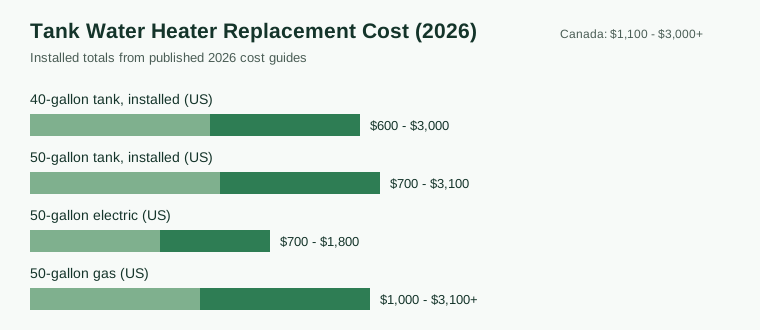
Replacing a standard tank water heater in 2026 typically costs $600$3,100 installed in the US for a 40 to 50gallon unit, and $1,100$3,000+ in Canada. This guide breaks down size, fuel, labor, code upgrades, repairvsreplace math, and running costs.
Quick Checks
- 1Budget $600-$3,100 installed in the US for a standard 40- to 50-gallon tank replacement in 2026; Canada pricing for a standard hot water tank runs $1,100-$3,000+ installed.
- 2Labor for a standard tank swap runs $200-$1,000, and a same-size replacement usually takes a professional plumber 2 to 6 hours. Emergency timing adds extra service charges.
- 3Size by first-hour rating, not by gallons alone. A 50-gallon tank commonly serves a home of 3 to 4 people, but recovery rate decides whether back-to-back showers run cold.
- 4Expect the quote to move for code work: an expansion tank adds $100-$400, new venting $100-$600 to replace or $500-$1,500 to install for the first time, and relocation $500-$2,500.
- 5A tank that is past 10 years old, leaking from the tank itself, or facing a repair above half the replacement cost is usually a replacement, not a repair.
Tank Water Heater Replacement Cost 2026: What Installation Really Costs
By EnergyBS Editorial Team | October 3, 2026
The Short Answer: What a Tank Replacement Costs
Short Answer: In 2026, replacing a standard storage-tank water heater typically costs $600 to $3,100 installed in the United States for the common 40- to 50-gallon sizes, according to HomeGuide's 2026 cost guide, with the tank itself at $400-$2,100 before labor. A 50-gallon electric replacement runs $700 to $1,800 installed, while a 50-gallon gas replacement runs $1,000 to $3,100 or more, because gas adds venting and fuel-line work. In Canada, HomeStars puts a standard hot water tank at $1,100 to $3,000+ installed, with basic installation labour at $700-$1,200 before permits, upgrades, and disposal.
This guide covers one specific job: taking out an old tank and putting a new tank in its place. That is still the most common water heater purchase in North America, and it is priced differently from a conversion. If you are weighing a switch to tankless or to a heat pump unit instead, the honest installed bands are higher (tankless at $1,400-$5,600 and hybrid heat pump at $2,000-$4,600 in the same HomeGuide dataset), and sections 9 and 10 explain when that extra spend earns its keep. Here, the focus stays on what a tank-for-tank replacement should cost, what moves the quote, and how to tell a complete quote from a cheap one.
One framing note before the tables. A water heater is usually bought in a hurry, with water on the floor and no hot showers. That urgency is exactly why the pricing bands below matter. A planned replacement, quoted from two or three plumbers with the tank size and fuel already decided, is a different purchase from a same-day emergency swap, even when the hardware is identical.
1. What the Installed Price Actually Covers
Homeowners often anchor on the tank price they can find at a retailer. The installed invoice is the tank plus the work around it. Published 2026 line items break down as follows:
| Cost component | Typical US range (2026) | What drives the variation |
|---|---|---|
| Tank unit only (40-50 gal) | $400-$2,100 | Size, fuel, efficiency tier, warranty length, brand |
| Installation labor (standard tank) | $200-$1,000 | Region, access, whether gas or electric, code work included |
| Permits and inspections | $50-$200 | Municipality, gas or electrical scope |
| Old tank removal and disposal | $75-$500 | Whether the tank is pre-drained and disconnected |
| Expansion tank (if required) | $100-$400 | Tank size and local code |
| Venting (gas models) | $100-$600 to replace, $500-$1,500 first-time | Vent material, route, power-vent vs. atmospheric |
A complete replacement quote usually bundles the new tank, shutoff valves and connectors, the temperature and pressure relief valve and its discharge pipe, fill and drain-down, removal of the old unit, startup, and a check for leaks and proper operation. When one quote is several hundred dollars below the others, the gap is rarely the tank. It is usually missing disposal, missing permit, missing expansion tank, or a shorter warranty tank substituted without saying so. Section 12 turns this into a line-by-line checklist.
Two scope items deserve early attention. First, confirm whether the quote includes bringing the installation up to current local code. Older installations often lack an expansion tank, a drain pan, or seismic strapping where that applies, and the installer may be required to add them. HomeGuide puts general code-compliance work at $75-$500 or more. Second, confirm the exact model and warranty in writing. Two 50-gallon gas tanks can differ by $500 on warranty length alone, and the warranty on paper is not the same as labor coverage if the tank fails early.
2. Cost by Tank Size
Size is the cleanest price ladder in the job. HomeGuide's 2026 published ranges by tank size are:
| Tank size | Unit price only | Total installed cost (US) | Typical household fit |
|---|---|---|---|
| 30 gallon | $300-$900 | $500-$1,900 | 1-2 people, low use |
| 40 gallon | $400-$2,000 | $600-$3,000 | 1-2 people |
| 50 gallon | $500-$2,100 | $700-$3,100 | 3-4 people |
| 65 gallon | $700-$2,400 | $900-$3,400 | Larger families |
| 75 gallon | $900-$2,600 | $1,100-$3,600 | High demand |
| 80 gallon | $1,000-$3,000 | $1,200-$4,000 | High demand, large homes |
The 40- and 50-gallon sizes dominate replacements because they match the housing stock already installed. Moving up one size is not just a tank-price difference. A larger tank can need a larger footprint, a bigger drain pan, and, on gas models, a check that the vent and gas supply still suit the higher input rating. Section 4 covers the sizing question properly, because gallons alone are a weak way to choose.
Note the width of each band. The low end of a band is a like-for-like swap in an accessible spot with reusable connections. The high end is the same tank with code upgrades, difficult access, or a premium warranty model. A quote near the top of a band is not automatically a bad quote, but it should itemize what puts it there.
3. Gas vs. Electric: The 50-Gallon Comparison
Fuel is the second price fork, and the 50-gallon size shows it clearly. HomeGuide's 50-gallon breakdown is:
| Cost item (50-gallon) | Electric | Gas |
|---|---|---|
| Unit only | $500-$1,200 | $600-$2,100 |
| Installation labor | $200-$600 | $400-$1,000+ |
| Total installed | $700-$1,800 | $1,000-$3,100+ |
Electric tanks cost less to buy and less to install. There is no venting, no gas line, and no combustion check. Gas tanks cost more up front and more to install, because the installer handles the gas connection, the vent, and combustion safety.
The running-cost side runs the other way in most markets. HomeGuide's operating ranges put a gas tank at $250-$420 per year and an electric resistance tank at $530-$600 per year, with local fuel prices deciding the real gap at your address. That is why a fuel switch should be priced as its own project, not slipped into a replacement quote. Converting from electric to gas costs $400-$2,000 or more depending on whether a gas supply line already exists, and converting from gas to electric costs $250-$1,000 or more for a new dedicated circuit and wiring. A dedicated electrical circuit on its own runs $250-$900, and a larger gas supply line runs $350-$2,000.
If hot water runs out now, fuel is also a recovery question. Electric tanks recover more slowly than gas tanks of the same size, so an electric replacement for a busy household often needs the next size up. The fuel comparison for all water heating types, with the same discipline applied to propane and heat pump options, is in our water heater fuel type cost comparison.
4. Sizing: First-Hour Rating Beats Gallons
A tank is not chosen by gallons alone. The useful number is the first-hour rating: how many gallons of hot water the unit can deliver in one hour starting from a full, heated tank. That rating combines tank size with recovery rate, which is how fast the burner or elements reheat water as it is used.
HomeGuide's sizing estimate by household is a reasonable starting band:
| People in house | Tank size | Tankless flow rate for comparison |
|---|---|---|
| 1-2 | 23-30 gallon | 4-8 GPM |
| 2-3 | 36-40 gallon | 6-9 GPM |
| 3-4 | 40-60 gallon | 7-10 GPM |
| 5 or more | 50-80 gallon | 9-11+ GPM |
Three practical checks keep this honest. First, count simultaneous demand, not just people. Two showers, a dishwasher, and a washing machine in the same hour is a different load from the same people spread across a morning. Second, read the first-hour rating on the specific model, not the category average. Two 50-gallon tanks can carry different ratings. Third, if the current tank runs cold, decide whether the problem is size, recovery, or a failing unit before paying for a bigger tank. A sediment-heavy old tank can underperform its rating for years before it leaks. Our diagnostic guide to hot water running out fast separates those causes.
Oversizing has a cost beyond the purchase price. A larger resistance tank keeps more water hot around the clock, which adds standby loss every hour of every day. Right-size from the first-hour rating and your peak hour, then stop.
5. The Code and Access Items That Move a Quote
Tank quotes diverge in the utility room details. These are the items that separate a complete job from a cheap one.
Expansion tank. In many areas, a thermal expansion tank is required so heated water has somewhere to go in a closed plumbing system. HomeGuide puts installation at $100-$400. If the old installation has none and local code now requires one, that line belongs in the budget.
Venting on gas models. Replacing existing venting runs $100-$600. Installing venting for the first time runs $500-$1,500. Power-vent models cost $350-$500 more than direct-vent models because they add a blower and electrical wiring. A quote that changes vent type without a venting line is incomplete.
Drain pan and discharge piping. A pan under the new tank, piped to a drain, is cheap protection in finished spaces and required by code in many locations. Confirm it is included where the tank sits above living space or near finished flooring.
Relocation. Moving a tank to a new location adds $500-$2,500 depending on size and access, before any new plumbing runs at roughly $12-$15 per linear foot. Relocation is a renovation decision, not a replacement decision, and should be quoted separately.
Access and timing. Difficult installations in cramped closets can add $125-$300 per labor hour. Emergency or after-hours service adds extra charges on top of the standard labor band. The same tank, in the same house, costs more on a Saturday night with water on the floor than on a scheduled Tuesday. That is the core argument for replacing a failing tank before it fails.
None of this argues for the cheapest quote. It argues for itemized quotes, which section 12 enforces.
6. Repair vs. Replace: The Tank Math
A tank decision turns on age, leak location, and repair size. HomeGuide's guidance is direct: consider replacing a water heater over 10 years old, or when the repair costs more than 50% of the replacement cost. Tank water heaters last 8 to 12 years on average, and published repair ranges for tank units run $150-$700 depending on the part.
A practical framework:
- A leaking tank is a replacement. Leaks from the tank body itself mean the steel has corroded through. Fittings, valves, and the relief valve can be repaired. The tank cannot.
- The 50% rule. On a unit past 8 years, a repair above roughly half the installed replacement cost usually buys little remaining life. The same repair on a 4-year-old tank is often sound.
- Parts tell the story. Heating elements, thermostats, igniters, and anode rods are maintenance items. Repeated element failure in hard water, rusty hot water, or rumbling from sediment point to a tank near the end.
- Maintenance extends, it does not resurrect. Flushing the tank every 6 to 12 months and replacing the anode rod every 3 to 6 years can extend life toward 15 years. Our water heater anode rod maintenance guide covers the inspection that decides whether a mid-life tank is worth keeping.
If the tank is leaking and you are not sure where the water is coming from, our guide to finding the source of a water heater leak walks the fitting-by-fitting check before you commit to either path.
7. Running Costs: What the Tank Costs After the Install
Installed price is half the decision. The other half is the annual cost of keeping 40 to 50 gallons of water hot. HomeGuide's published operating ranges are:
| Water heater type | Monthly cost to run | Annual cost to run |
|---|---|---|
| Gas tank | $21-$35 | $250-$420 |
| Electric tank | $44-$50 | $530-$600 |
| Gas tankless | $18-$40 | $220-$480 |
| Electric tankless | $28-$45 | $340-$540 |
| Hybrid heat pump tank | $13-$16 | $160-$190 |
Two honest readings of that table. First, the electric resistance tank is the expensive tank to run in most years, even though it is the cheapest to install. That does not make it the wrong choice for a small household, a mild climate, or a home with low hot water use, where the annual gap is spent on a much lower installed price. Second, standby loss is built into every tank number. A tank loses heat through its walls around the clock, then reheats water nobody used. Newer tanks insulate better, but no storage tank eliminates the pattern.
Hypothetical example (labeled as such): take the midpoints of the published ranges. An electric tank at about $565 per year and a hybrid heat pump tank at about $175 per year differ by roughly $390 per year. Against a hybrid installed premium of about $2,050 over an electric tank (midpoints of $3,300 vs. $1,250 from the installed ranges in sections 1 and 9), simple payback on energy alone is roughly 5 to 6 years in this example, inside a typical tank lifespan. In a home that uses little hot water, the real annual gap shrinks and the payback stretches past the point where the tank premium makes sense. Run the same arithmetic with your own utility rates before letting the table decide. The full heat pump case, with space, noise, and condensate conditions, is priced in our heat pump water heater installed cost and ROI guide.
One setting matters more than most replacement decisions: temperature. Every degree of unnecessary storage temperature is paid for in standby loss, all day. Set the new tank to the temperature your household and local guidance call for, confirm it at the tap, and leave it there.
8. Canada Pricing: What Differs North of the Border
Canadian tank pricing follows the same structure as US pricing, with labour, permits, and disposal itemized the same way. HomeStars, which tracks Canadian contractor pricing, puts a standard hot water tank at $1,100 to $3,000+ installed, against $3,000-$6,500+ for a tankless conversion. Its labour and setup breakdown is:
| Task (Canada) | Published cost |
|---|---|
| Basic installation | $700-$1,200 |
| Electrical system upgrade | $500-$2,500+ |
| Gas line rerouting | $750-$3,000+ |
| Permits and inspections | $150-$500 |
| Removal and disposal | $75-$300 |
HomeStars also notes that most hot water tanks last around 10 to 15 years depending on maintenance and usage, and lists the same failure signs seen in the US market: rust, persistent leaks, inconsistent heating, and rumbling or banging from sediment buildup.
Two Canada-specific cautions apply. First, a large share of Canadian tanks are rented rather than owned. If the failing tank is a rental, the replacement decision starts with the rental agreement and buyout terms, not with a purchase quote. A purchase you can compare line by line is the stronger negotiating position, but only after the rental obligation is priced. Second, provincial and utility programs change by year and often favor higher-efficiency equipment. Verify the current program rules for your province before assuming any amount in a quote, and keep the model number and invoice for the claim file.
9. Tank, Tankless, or Heat Pump at the Replacement Moment
A failed tank forces the technology question under time pressure. The disciplined way to handle it is to price the like-for-like tank first, then price any conversion as a separate decision with its own install scope.
| Option | Installed cost (US, 2026) | Expected life | Best fit |
|---|---|---|---|
| Standard tank | $600-$3,100 | 8-12 years | Lowest upfront cost, same-day replacement, modest hot water use |
| Tankless | $1,400-$5,600 | 15-20 years | Endless hot water, high simultaneous demand, long tenure in the home |
| Hybrid heat pump tank | $2,000-$4,600 | Check model warranty | Electric homes with space for the unit and high hot water use |
A new tank is usually the disciplined choice when the old tank served the household well, the home may be sold in the next few years, budget timing matters, or the failure is an emergency and hot water needs to return today. The install is the simplest, the quote set is the most comparable, and there is no venting, gas-line, or panel project attached.
Tankless deserves a full quote when the household regularly runs out of hot water, space is at a premium, or the household expects to stay long enough for a 15- to 20-year appliance life to matter. The install scope is the price: our tankless water heater installation cost guide breaks down the venting, gas-line, and electrical add-ons that move those quotes, and our tankless vs. tank comparison works the efficiency and flow-rate tradeoff without the sales framing.
A hybrid heat pump tank deserves a full quote when the home heats water with electricity today, hot water use is high enough for the running-cost gap in section 7 to matter, and the location suits the unit. Heat pump water heaters need room air volume or ducting, make some noise, produce condensate that needs a drain, and cool the space around them. In a warm garage or a large basement mechanical room, those traits are minor. In a small interior closet, they can rule the option out.
Do not let a failure choose for you by default. If the emergency forces a same-day tank, that is a legitimate outcome. Record it as one, and revisit the technology question at the next replacement with time to quote it properly.
10. Emergency vs. Planned Replacement
The same installation costs more under emergency conditions, and the quote quality drops at the same time. HomeGuide notes that emergency or after-hours installations carry extra service charges, and that a standard tank installation takes 2 to 6 hours depending on access. Under pressure, homeowners accept the first available tank, the first available model, and the first price.
A planned replacement keeps three advantages. You can choose the size from the first-hour rating instead of accepting what is on the truck. You can collect two or three itemized quotes for the same model and scope. And you can schedule the code work, permit, and disposal as part of one visit instead of paying to reopen the job.
The practical trigger for planning is age plus symptoms. A tank past 10 years with rusty water, rumbling, or a relief valve that weeps is announcing its timeline. Getting one written quote while the unit still heats costs nothing and removes the emergency premium from the next failure. If water is already on the floor, shut off the supply and the fuel or power first, then quote the replacement. Safety work outranks price work in every version of this job.
11. Incentives in 2026: Budget Without Assuming a Credit
Budget as if no federal cheque is coming, then treat verified incentives as a bonus. Federal home energy credit rules changed for equipment placed in service after December 31, 2025, so a standard tank installed in 2026 should not carry a federal credit in the quote math. Confirm any exception with a tax professional for your specific situation.
What can still apply, depending on address and program year:
- Utility rebates for higher-efficiency or heat pump water heaters, usually requiring approved models and often pre-approval before installation.
- State and provincial programs, which in 2026 frequently favor heat pump water heaters over standard tank replacements.
- Manufacturer and retailer promotions, typically seasonal and model-specific.
Most programs require documentation: model and serial numbers, invoices, photos, and permit sign-offs. If a rebate matters to the decision, confirm eligibility before the old tank leaves the house, because some programs require the existing equipment details as part of the claim.
12. Quote Checklist: How to Compare Three Quotes Fairly
Get three written, itemized quotes for the same job. Tank replacements reward scope discipline more than brand shopping. Each quote should state:
- Exact make and model, tank size, first-hour rating, fuel type, and warranty terms for tank and parts stated separately
- Labor, permit, and inspection fees itemized, with who pulls the permit
- Expansion tank, drain pan, venting, valves, and connectors: included or explicitly excluded, line by line
- Removal and disposal of the old tank, included or priced
- Any code-compliance work the installer expects, priced before work starts, not discovered during it
- Fuel conversion work, if any, quoted separately from the like-for-like replacement price
- Startup, leak check, temperature setting, and cleanup included
- Total price with taxes and payment schedule; never pay the full amount before the new tank is installed and producing hot water
Red flags: a quote with no model number, no warranty terms, no disposal line, a same-day signature deadline, or a fuel switch folded into the price without its own scope. Shoulder seasons are usually the easiest time to get careful quotes. Mid-emergency pricing is the most expensive way to buy an 8- to 12-year appliance.
Frequently Asked Questions
How much does it cost to replace a tank water heater in 2026?
Most US homeowners pay $600-$3,100 installed for a standard 40- to 50-gallon tank replacement, according to HomeGuide's 2026 cost guide. A 50-gallon electric replacement runs $700-$1,800 installed, and a 50-gallon gas replacement runs $1,000-$3,100 or more. In Canada, a standard hot water tank runs $1,100-$3,000+ installed.
How long does a tank water heater last?
Tank water heaters last 8 to 12 years on average. Flushing the tank every 6 to 12 months and replacing the anode rod every 3 to 6 years can extend life toward 15 years. Tankless units last 15 to 20 years with routine flushing and descaling where hard water requires it.
Should I repair or replace my water heater?
Consider replacement when the unit is over 10 years old, the tank itself is leaking, or the repair costs more than about half the replacement cost. Repairs for tank units run $150-$700, so a small repair on a young tank is often sound, while the same bill on a 12-year-old tank usually buys little remaining life.
What size tank water heater do I need?
Start from the first-hour rating, not gallons alone. As a guide, a 40-gallon tank commonly suits 1 to 2 people and a 50-gallon tank suits 3 to 4 people with moderate use. Homes with simultaneous showers, laundry, and dishwashing in the same hour should check the first-hour rating against that peak hour before choosing a size.
How long does it take to replace a tank water heater?
Installing a tank water heater takes 2 to 6 hours depending on access and scope. A same-size replacement with reusable connections is at the fast end. Code upgrades, venting work, relocation, or a fuel conversion add time and should be scheduled and priced separately.
Is a tankless water heater worth the extra cost at replacement time?
It depends on demand and tenure. Tankless costs $1,400-$5,600 installed against $600-$3,100 for a tank, and lasts 15 to 20 years against 8 to 12. Households that regularly run out of hot water or plan to stay in the home long-term have the strongest case. For average use, price the conversion as its own project rather than deciding during an emergency.
Can I install a tank water heater myself?
Water heater work involves plumbing under pressure and, on gas models, fuel and venting that can create carbon monoxide risk. Electric models involve high-voltage circuits. Most jurisdictions require permits and inspections, and manufacturers can void warranties for unlicensed installation. This is licensed professional work.
What to Read Next
- Tankless Water Heater Installation Cost 2026 - the full conversion price, including venting, gas-line, and panel add-ons
- Heat Pump Water Heater Installed Cost and ROI 2026 - equipment, space, and payback conditions for the hybrid option
- Tankless vs. Tank Water Heater Debate - flow rate, efficiency, and lifespan compared without the sales framing
- Water Heater Anode Rod Maintenance Guide - the inspection that extends a mid-life tank and delays this purchase
- Water Heater Fuel Type Cost Comparison - gas, electric, propane, and heat pump running costs side by side
Sources and Verification
- HomeGuide Water Heater Installation or Replacement Cost (2026 installed ranges by type and size)
- HomeGuide 50Gallon Water Heater Cost (2026 electric vs. gas unit, labor and installed totals)
- HomeStars Hot Water Tank Replacement Cost Guide (Canada installed ranges, labour and setup fees)
- HomeStars Water Heater Replacement Cost Breakdown (Canada storage tank and hybrid ranges)
Editorial Review
EnergyBS Editorial Team
EnergyBS publishes practical homeowner guides. Important program, product, and cost claims should be checked against the linked source and local project documents before you commit to work.
Related Guides
View All ArticlesTankless Water Heater Installation Cost 2026: Prices, AddOns and Payback
A tankless water heater costs $1,400$5,600 installed in the US in 2026, and C$2,800$6,500 for a typical Canadian gas install. This guide breaks down unit, labor, venting, gasline and panel addons, sizes the unit, and runs honest 20year payback math against a new tank.
Tankless vs. Tank Water Heaters 2026 Tool (Guide & Data)
Compare tankless and storage water heaters using peak flow, inletwater temperature, firsthour rating, fuel and electrical capacity, venting, distribution delay, maintenance, and installed cost.
Water Heater Anode Rod and Maintenance 2026 Tool
A modelspecific waterheater maintenance plan covering anode type and depletion, water chemistry, access, flushing, relief and leak checks, heatpump filters/condensate, tankless scale service, records, and replacement contingencies.