Pool Heater Installation Cost 2026: Gas vs Heat Pump vs Solar Prices
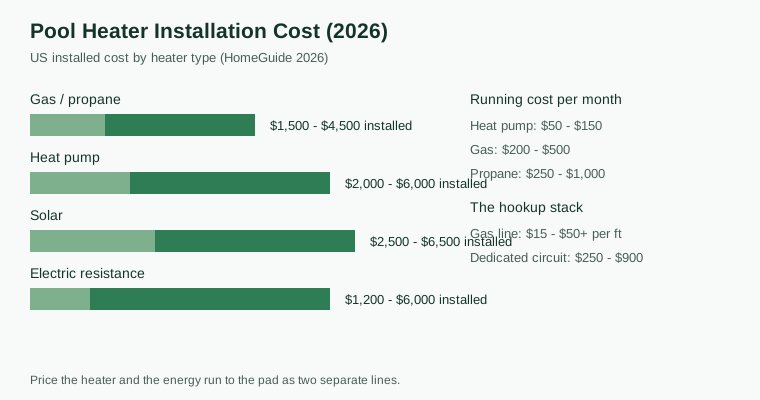
A pool heater costs $1,600 to $5,200 installed on average in 2026 (HomeGuide, national average $3,300), and Angi puts the typical project at $1,864 to $4,351 with an average near $3,100 across 1,019 projects. Type sets both halves of the bill: gas installs for $1,500 to $4,500 but runs $200 to $500 a month, a heat pump installs for $2,000 to $6,000 and runs $50 to $150 a month, and solar installs for $2,500 to $6,500 and runs $10 to $25 a month. This guide prices each type, the gasline and electrical hookups that decide real quotes, BTU sizing by pool size, a worked 10degree heating example with the math shown, 10year ownership totals, and a quote checklist.
Quick Checks
- 1Budget $1,864 to $4,351 for a typical installed project (Angi, 1,019 projects) or $1,600 to $5,200 on HomeGuide's wider band. The heater type and the utility run to the equipment pad explain most of the spread.
- 2Price the hookup separately from the heater. A new gas line runs $15 to $50+ per linear foot (HomeGuide) or $500 to $2,000 as a project line (Angi), and a dedicated heat pump circuit runs $250 to $900 (HomeGuide) up to $2,100 (Angi). At many houses the hookup, not the heater, decides which type wins.
- 3Match the heater to the use pattern, not the brochure. Gas heats fast and suits weekend or spa use. A heat pump holds temperature for $50 to $150 a month (HomeGuide) and suits daily season-long swimming. Solar runs $10 to $25 a month and suits long sunny seasons.
- 4Size by surface area and volume before shopping: HomeGuide's floor is 50,000 BTU for every 5,000 to 10,000 gallons in a mild climate, doubled in a cold one. An undersized heater runs constantly and still loses ground on cold nights.
- 5Buy the cover with the heater. Angi puts a pool cover at $650 to $2,200 installed and credits covers with cutting heating energy 50% to 90%, because most pool heat leaves through the surface overnight.
Pool Heater Installation Cost 2026: Gas vs Heat Pump vs Solar Prices
By EnergyBS Editorial Team | October 16, 2026
The Short Answer
Short Answer: A pool heater costs $1,600 to $5,200 installed on average in 2026, with a national average of $3,300 (HomeGuide). Angi, working from 1,019 verified projects, puts the typical project at $1,864 to $4,351 with an average near $3,100. By type, installed: gas or propane $1,500 to $4,500, heat pump $2,000 to $6,000, solar $2,500 to $6,500, and electric resistance $1,200 to $6,000 (HomeGuide). Angi's bands run higher at the top end for heat pumps ($2,500 to $7,500) and solar ($2,500 to $9,500), because its projects include more large pools and full utility runs.
The installed price is only half the decision. The same sources put monthly running costs at $200 to $500 for gas, $250 to $1,000 for propane, $175 to $600 for electric resistance, $50 to $150 for a heat pump, and $10 to $25 for solar (HomeGuide, for an 8-month season). A heater that saves $1,000 at installation and costs $150 more every month gives the saving back in its first season. This guide prices both halves, then the hookups, sizing, and ownership math that connect them.
1. Installed Cost by Heater Type
| Heater type | Unit price | Labor | Total installed (HomeGuide) | Total installed (Angi) |
|---|---|---|---|---|
| Gas / propane | $1,000 to $3,000 | $500 to $1,500 | $1,500 to $4,500 | $1,500 to $6,000 |
| Heat pump | $1,500 to $5,000 | $500 to $1,000 | $2,000 to $6,000 | $2,500 to $7,500 |
| Solar | $2,000 to $5,000 | $500 to $1,500 | $2,500 to $6,500 | $2,500 to $9,500 |
| Electric resistance | $700 to $5,000 | $500 to $1,000 | $1,200 to $6,000 | $1,000 to $6,000 |
Gas and propane. The cheapest full-size heater to buy and the fastest to heat. A gas unit burns fuel and passes pool water through a heat exchanger, so it heats on demand in any air temperature and suits a pool or attached spa that sits cold between uses. The costs arrive later: the highest monthly fuel bill of the four types and the shortest service life in this guide, 7 to 8 years (HomeGuide). Propane adds a tank and the highest running band of any type, which is why propane pool heating is mostly a rural default where no gas main exists, not a first choice.
Heat pump. An electric unit that moves heat from the outdoor air into the water instead of making heat from fuel or a resistance element. Department of Energy guidance puts most pool heat pumps at a coefficient of performance (COP) of 3 to 7, meaning each unit of electricity delivers 3 to 7 units of heat. That ratio is the whole economic case: higher unit price, much lower monthly cost. The limits are speed and air temperature. A heat pump raises water temperature slowly, so it works by holding a set temperature day after day, and its output drops as the air cools, which shortens its useful season in northern climates.
Solar. Roof or rack-mounted collectors that pool water circulates through. Fuel cost is near zero because there is no fuel; the running line is the pump electricity to move the water, $10 to $25 a month (HomeGuide). Angi's dedicated solar guide prices the installed system at $2,500 to $6,500, averaging $4,500, with collectors at $20 to $40 per square foot. Solar heats only while the sun is on the collectors, it cannot hold a set temperature through a cold week, and it needs collector area in the same order as the pool's surface area. In a long, sunny season it is the cheapest heat there is. In a short northern season it is a season extender, often paired with a gas or heat pump unit for the cold ends of the year.
Electric resistance. A resistance element in the water path: simple, compact, and near 100% efficient at the element, which still makes it the most expensive way to heat a full pool, because every BTU is bought at the full electricity price with no COP multiplier. HomeGuide puts it at $175 to $600 a month and describes it as suited to spas and small therapy pools. That is the right scope. For a spa that needs fast, occasional heat in a small volume, resistance is reasonable. For 20,000 gallons, the worked example in section 5 shows what the physics does to the bill.
Two smaller lines belong in every budget: removing the old heater runs $25 to $50 (both sources, often folded into the install quote), and above-ground pools price lower as a class, $1,300 to $2,400 installed (HomeGuide), because the pools and heaters are smaller and everything sits at surface level.
2. The Hookup Decides the Quote
Two houses buying the same heater can get quotes $2,000 apart, and the difference is usually the run between the house systems and the equipment pad. A pool heater is often the largest gas appliance at the house, and a heat pump needs a dedicated high-amp circuit. Price these lines separately, in writing, before comparing heater prices.
| Hookup line | Published range | Source |
|---|---|---|
| New gas line, per linear foot | $15 to $50+ | HomeGuide |
| Gas line, as a project line | $500 to $2,000 | Angi |
| Dedicated electrical circuit | $250 to $900 | HomeGuide |
| Electrical circuit, as a project line | $250 to $2,100 | Angi |
| Plumbing connection to existing lines | $300 to $600 | HomeGuide |
| Water lines, as a project line | $350 to $1,900 | Angi |
| Permit (new gas line, roof-mounted solar) | $100 to $500 | Angi |
| Old heater removal and disposal | $25 to $50 | HomeGuide and Angi |
Gas jobs. The line has to be sized for the heater's full BTU input, not just extended from the nearest pipe. A long run from a meter on the far side of the house, a run under a driveway or deck, or a line that needs upsizing back to the meter is how a $1,500 heater becomes a $4,500 project. Propane replaces the line problem with a tank: tank, pad, regulator, and line all price into the job, and no source above publishes a single national band for that stack, so get it as its own written line.
Heat pump jobs. The unit needs a dedicated 240-volt circuit and breaker space in the panel. If the panel is near the pad and has room, the circuit sits at the low end of the bands above. If the panel is full, the job grows a panel project; our panel upgrade cost guide prices that work on its own. Distance matters the same way it does for gas: wire, conduit, and trenching scale with feet.
Solar jobs. The hookup is roof work and plumbing: collectors mounted and flashed, pipe runs between roof and pad, and a controller and valve that send water up only when the roof is hotter than the pool. Angi notes permits are mandatory for roof-mounted solar in its data, $100 to $500.
Labor itself runs $500 to $1,500 across the types (HomeGuide), with electricians at $50 to $100 an hour and plumbers at $45 to $200 an hour in Angi's figures, and a straightforward swap takes 1 to 2 days (HomeGuide). A quote that bundles heater, hookup, and labor into one number cannot be checked against any table in this section. Ask for the split.
3. Sizing: BTU by Pool Size
A heater has one job: replace heat faster than the pool loses it, with enough reserve to raise the temperature on a cold start. Surface area drives the loss, because heat leaves through the surface. Volume drives the heat-up time. Both tables below are published sizing guidance, and they agree in shape if not in exact steps.
HomeGuide, by surface area:
| Pool surface area | Volume | Heater size | Average unit price |
|---|---|---|---|
| Up to 300 sq ft | 1,000 to 10,000 gal | 50,000 to 106,000 BTU | $1,300 to $2,200 |
| 301 to 500 sq ft | 10,000 to 20,000 gal | 106,001 to 250,000 BTU | $1,800 to $3,200 |
| 501 to 800 sq ft | 20,000 to 40,000 gal | 250,001 to 400,000 BTU | $2,300 to $3,600 |
| 801 to 1,200 sq ft | 40,000 to 80,000 gal | 400,000+ BTU | $3,000 to $5,000 |
Angi, gas heater sizing by volume: 10,000 gallons needs 40,000 to 60,000 BTU ($1,000 to $2,500 installed), 15,000 gallons needs 60,000 to 90,000 BTU ($1,500 to $3,500), 20,000 gallons needs 80,000 to 120,000 BTU ($2,000 to $3,500), 25,000 gallons needs 100,000 to 150,000 BTU ($2,500 to $4,000), and 30,000 gallons needs 120,000 to 180,000 BTU ($4,000 and up).
HomeGuide's rule of thumb ties the two together: a minimum of 50,000 BTU for every 5,000 to 10,000 gallons in a mild climate, and double that in a cold climate. The doubling is not upselling. A heater sized for a mild-climate afternoon cannot hold temperature through a cold, windy night, because the loss side of the ledger grows while the heater side stays fixed.
Undersizing is the expensive error in this category. An undersized unit runs near-continuously, wears faster, and still loses ground in cold weather, so the owner pays full running costs for a pool that never reaches the set temperature. Oversizing a gas heater mainly buys faster heat-up. Oversizing a heat pump buys reserve for cold nights at a higher unit price. Neither error is symmetric: too small fails every day, too large costs once.
One sizing note for attached spas: a spa is small volume that wants a large, fast temperature rise, which is gas-heater work even at a house that heats the pool itself with a heat pump. Combination installs, heat pump for the pool and gas for the spa, are a standard answer to that split, and the quote should price the two units and the shared plumbing separately.
4. Running Costs: The Monthly Ledger
| Heater type | Cost per month (HomeGuide) | Cost per year, 8-month season (HomeGuide) | Cost per month (Angi) |
|---|---|---|---|
| Natural gas | $200 to $500 | $1,600 to $4,000 | $200 to $400 |
| Propane | $250 to $1,000 | $2,000 to $8,000 | $200 to $850 |
| Electric resistance | $175 to $600 | $1,400 to $4,800 | $175 to $600 |
| Heat pump | $50 to $150 | $400 to $1,200 | $120 to $200 |
| Solar | $10 to $25 | $80 to $200 | $0 to $10 |
The two sources differ most on heat pumps, $50 to $150 a month against $120 to $200. Both can be right for different houses: monthly cost scales with pool size, target temperature, season length, local electricity price, and how many hours a day the heater runs to hold temperature against the weather. Read the pair as a planning band of roughly $50 to $200 a month for a heat pump against $200 to $500 for gas, and use your own rates in the section 5 method to place your pool inside it.
Usage pattern changes which row matters. Gas is at its best heating for short periods: a cold pool brought up for a weekend, then left alone. Its monthly band assumes regular use; an occasional-use pool burns far less. A heat pump has to run to hold temperature, so its advantage grows the more days per season the pool is kept warm. Solar's band barely moves with use, because the energy is sunlight; the constraint is availability, not price. This is the same fuel-comparison discipline we apply indoors in the water heater fuel cost comparison: convert every fuel to cost per unit of delivered heat, then multiply by how much heat your pattern actually uses.
5. Worked Example: What a 10-Degree Rise Costs
The monthly bands above are other people's pools. This example prices one defined job of heating so you can rerun it with your own rates. It is a hypothetical example with every assumption stated, and it covers the heat-up only, not the ongoing loss replacement that dominates real monthly bills.
The pool and the job. 20,000 gallons, raised 10 degrees F, starting cold.
The physics. One gallon of water weighs about 8.34 pounds, and raising one pound of water one degree F takes one BTU. So:
- Water weight: 20,000 gal x 8.34 lb/gal = 166,800 lb
- Heat per degree: 166,800 BTU per degree F
- Heat delivered for 10 degrees: 166,800 x 10 = 1,668,000 BTU (1.668 MMBTU) into the water
The assumed rates and efficiencies, stated so you can swap in your own: natural gas at $1.50 per therm (1 therm = 100,000 BTU), propane at $2.60 per gallon (about 91,500 BTU per gallon), electricity at $0.17 per kWh (1 kWh = 3,412 BTU), a gas or propane heater at 85% efficiency, and a heat pump at COP 5.0, inside the 3 to 7 range in the DOE guidance cited for this guide.
| Heater | Input energy needed | Fuel or electricity used | Cost of the 10-degree rise |
|---|---|---|---|
| Gas | 1.668 / 0.85 = 1.962 MMBTU | 19.6 therms | 19.6 x $1.50 = $29.44 |
| Propane | 1.962 MMBTU | 21.4 gal | 21.4 x $2.60 = $55.76 |
| Heat pump, COP 5.0 | 1.668 / 5 = 0.334 MMBTU | 97.8 kWh | 97.8 x $0.17 = $16.62 |
| Electric resistance | 1.668 MMBTU | 488.9 kWh | 488.9 x $0.17 = $83.11 |
Read the table in ratios, because the ratios survive a change of rates better than the dollars do. Per unit of delivered heat, the heat pump in this example costs about 56% of gas, gas costs about 35% of electric resistance, and propane costs about 1.9 times gas. Change the electricity price to $0.25 per kWh and the heat pump rise becomes $24.45, still under gas at the stated gas price. Change gas to $1.00 per therm and gas becomes $19.62, close to the heat pump at $0.17 electricity. The crossover is exactly those two prices and the COP, which is why local rates, not national articles, settle this choice at any given house.
Holding temperature is the larger bill, and no single example can price it, because nightly loss depends on air temperature, wind, humidity, and cover use. That is what the published monthly bands in section 4 are for.
6. Ten-Year Ownership, From the Same Published Bands
Installed price plus running cost plus service life, using the midpoint of each published band. Hypothetical illustration built only from the HomeGuide figures above: midpoints are arithmetic means of the cited ranges, the season is HomeGuide's 8-month basis, and no repairs, rate changes, or financing are included.
| Heater | Installed (midpoint) | Running cost per year (midpoint) | 10-year total | Published lifespan |
|---|---|---|---|---|
| Gas | $3,000 | $2,800 | $31,000 | 7 to 8 years |
| Heat pump | $4,000 | $800 | $12,000 | Up to 15 years |
| Solar | $4,500 | $140 | $5,900 | Up to 15 years |
| Electric resistance | $3,600 | $3,100 | $34,600 | 10 to 12 years average, all types |
Two adjustments make the gas row worse than it looks and the solar row narrower than it looks. First, a gas heater with a 7 to 8 year life is replaced inside a 10-year window, and the table charges it once; add a second unit and its install, and the gas total moves past $34,000. Second, solar's $5,900 assumes solar alone meets the heating need. A house that pairs solar with a backup heater for cold weeks owns two systems, and its real total is the solar row plus the backup's row at lower use. Even with both adjustments, the ordering is stable across the published bands: for a pool kept warm all season, running cost decides ownership cost, and the heat pump's higher purchase price is recovered out of the gas-to-heat-pump running gap. At the low-saving end of the bands (gas $1,600 a year, heat pump $1,200 a year, a $400 yearly gap) recovering a $1,000 installed-price gap takes about 2.5 years. At the high-saving end (gas $4,000, heat pump $400, a $3,600 gap) it takes a few months. Occasional-use pools sit outside this math entirely: a pool heated six weekends a year never burns enough gas for the gap to matter, which is the case section 7 handles.
7. Choosing by Use Pattern: A Decision Sequence
Work these in order. The first clear answer usually settles the type.
- How many days a season will the pool be kept warm? Kept warm daily for a long season points to a heat pump or solar, because running cost dominates (sections 4 and 6). Heated for scattered weekends and events points to gas, because heat-up speed dominates and total fuel stays small.
- Is there an attached spa? A spa that must go from cool to hot on a Friday evening is gas work, whatever heats the pool. Price a gas unit for the spa circuit even inside a heat pump or solar design.
- What does the air do during your season? Heat pump output falls as air cools. In a season that regularly swims in air under about 50 degrees F, a heat pump alone will struggle at the ends of the season; gas does not have that limit, and solar has it worst of all.
- What utilities already reach the pad? An existing gas line at the pad removes gas's biggest install risk. A panel with spare capacity and a short wire run does the same for a heat pump. Section 2's hookup lines can reverse the type ranking at a specific house, so get both hookups quoted if both types are still live options.
- Is there unshaded roof or rack area near the pool? Solar needs collector area in the same order as the pool's surface. No area, no solar option, whatever the running cost says.
- How long will you own the house? Solar and heat pumps return their higher purchase price through running savings over years. A sale inside two years argues for the lower installed price, or for no heater and a good cover.
The indoor version of this equipment choice, a heat pump moving heat instead of burning fuel, is priced for domestic hot water in our heat pump water heater cost guide, and solar hot water in the solar thermal guide. The physics is the same; the pool is simply a much larger tank that loses heat to the sky.
8. The Cover: The Cheapest Heating Decision
Most heat a pool loses leaves through the surface, mostly overnight, by evaporation and radiation to a cold sky. A heater replaces that heat at fuel prices. A cover prevents the loss at a one-time price, which is why it belongs in a heater budget rather than an accessories list.
Angi prices a pool cover at $650 to $2,200 installed and credits covers with reducing heating energy costs by 50% to 90%. HomeGuide prices covers from $75 for basic types up to $3,000 and up for mechanized systems, with solar blankets (bubble covers) at $50 to $400 by size. A solar blanket also adds some daytime solar gain, but its main value is the night shift: heat the water by day, keep it from leaving at night.
Run the pairing arithmetic with your own numbers: on a gas-heated pool burning the midpoint $2,800 a season from section 6, even the low end of Angi's reduction range (50%) is worth about $1,400 a season, against a cover that costs less than that installed. No heater upgrade in this guide pays back that fast. If a quote includes a heater and no cover conversation, the quote is solving the expensive half of the problem.
9. Canada: Shorter Season, Same Math
HomeStars lists pool heater installation for Canadian inground pools in the same numeric bands as the US HomeGuide figures, labeled in Canadian dollars: natural gas $1,500 to $4,500, electric resistance $1,200 to $6,000, heat pump $2,000 to $6,000, and solar $2,500 to $6,500. Treat those as the Canadian planning bands they are published as, and expect the hookup lines (gas fitting, electrical) to be quoted locally on top, under provincial licensing and permit rules. Gas pool heaters are certified-gas-fitter work in Canada, and heat pumps are licensed electrical work, as in the US.
The Canadian difference is season shape, not price structure. The swim season is shorter and the shoulder months are colder, which pushes the section 7 sequence in two directions at once. Gas gains ground, because it heats at full output in cold April and October air where a heat pump's output has fallen. Solar loses ground as a sole source, because spring and fall sun angles are lower and cold snaps are longer, and works best as a mid-season extender under a cover. A heat pump still wins the mid-season months on running cost in southern Canada, which is why combination systems (heat pump for May to September, gas for the spa and the season's cold ends) are common in Canadian quotes. Winterization is a real line in Canada and the northern US: drain the heater and lines, close the gas valve on a gas unit, cut power, and protect the heat exchanger from freeze damage (Angi's winterization list). Price the annual open and close into ownership if a pool service does them.
10. The Quote Checklist
Compare pool heater quotes line by line. A complete quote names:
- The heater make, model, BTU output, and, for a heat pump, its rated COP, checked against the section 3 sizing tables for your surface area and volume.
- The unit price and the labor price as separate lines, against the section 1 bands for the type.
- The gas line, for gas and propane: feet, pipe size, whether upsizing runs back to the meter, and the per-foot or project price from section 2. For propane, the tank, pad, and regulator as their own line.
- The electrical work, for a heat pump: breaker size, circuit length, and the stated price, plus the agreed rate if the panel needs work before the circuit can land.
- The plumbing tie-in: cutting into the existing loop, valves, and any bypass for a solar or combination system, priced ($300 to $600, HomeGuide).
- Permits: which permits the job needs (new gas line, roof-mounted solar), the fee ($100 to $500, Angi), and who pulls them.
- Removal and disposal of the old heater ($25 to $50), stated, not assumed.
- The pad and placement: a level equipment pad, clearances for a gas unit's venting and a heat pump's airflow, and freeze protection where the climate needs it.
- The cover: type, price, and how it stores, quoted with the heater, not after it.
- Warranty split and startup: equipment warranty, labor warranty, and a startup visit that sets the target temperature, shows the bypass and winterization valves, and confirms the heater holds temperature overnight.
A quote missing lines 3, 4, and 6 is not a cheaper version of a complete quote. It is a heater price with the deciding work left unpriced.
Frequently Asked Questions (FAQ)
How much does it cost to install a pool heater in 2026?
HomeGuide puts the installed average at $1,600 to $5,200, with a national average of $3,300. Angi, from 1,019 verified projects, puts most projects at $1,864 to $4,351, averaging about $3,100. By type (HomeGuide, installed): gas $1,500 to $4,500, heat pump $2,000 to $6,000, solar $2,500 to $6,500, electric resistance $1,200 to $6,000. A new gas line, a new electrical circuit, or roof work for solar can add $250 to $2,100 on top.
What is the cheapest pool heater to run?
Solar, at $10 to $25 a month in pump electricity (HomeGuide), or $0 to $10 in Angi's table. Among heaters that can hold a set temperature in any weather, a heat pump is cheapest to run at $50 to $150 a month (HomeGuide) to $120 to $200 (Angi), against $200 to $500 for natural gas, $250 to $1,000 for propane, and $175 to $600 for electric resistance.
Is a heat pump or a gas heater better for a pool?
It depends on the use pattern. A heat pump costs more to install ($2,000 to $6,000 vs $1,500 to $4,500, HomeGuide) and far less to run, and it heats slowly by holding temperature, with output that falls as air cools toward 50 degrees F. A gas heater installs for less, heats fast in any weather, and suits weekend use and spas. Daily season-long swimming favors the heat pump; occasional fast heat-ups favor gas. Section 7 works the choice in order.
What size pool heater do I need?
Start with surface area and volume. HomeGuide's table runs from 50,000 to 106,000 BTU for pools up to 300 sq ft and 10,000 gallons, up to 400,000 BTU and beyond for 801 to 1,200 sq ft and 40,000 to 80,000 gallons, with a floor of 50,000 BTU per 5,000 to 10,000 gallons in a mild climate, doubled in a cold one. Angi's volume table for gas heaters puts a 20,000-gallon pool at 80,000 to 120,000 BTU. An attached spa needs its own fast-heat capacity on top.
How long does a pool heater last?
Ten to 12 years on average across types (HomeGuide). Gas heaters sit at the short end at 7 to 8 years. Heat pumps and solar systems can last up to 15 years. Water chemistry, winterization in cold climates, and run hours decide where a given unit lands; an undersized heater that runs constantly wears toward the short end of its band.
Can I install a pool heater myself?
The plumbing tie-in is within reach of an experienced home plumber, but the energy connections are the licensed parts of the job: gas work needs a licensed gas installer in most jurisdictions, a heat pump needs a dedicated circuit and electrical permit work, and HomeGuide notes most states require a licensed contractor for gas appliances. The $500 to $1,500 labor band also buys sizing judgment and the permit record. Solar is the common partial exception for installation labor, and even there, DIY installs can lose rebate eligibility.
Does a pool heater need a cover to be worth it?
Not to function, but the economics change without one. Most heat loss leaves through the surface overnight, and Angi credits a cover ($650 to $2,200 installed) with cutting heating energy 50% to 90%. On a mid-band gas pool that is roughly $1,400 a season. Solar blankets run $50 to $400 (HomeGuide). Any heater type runs less and lasts longer heating a covered pool.
What should I read next before deciding?
Price the hookup your type needs: the panel upgrade cost guide if a heat pump circuit may force panel work. Compare fuel math method in the water heater fuel cost comparison, which converts gas, propane, electric, and heat pump water heating to cost per unit of delivered heat. For the solar route, the solar thermal guide covers collector sizing and when solar heat beats PV plus a heat pump. If the project grows into a full equipment-pad rebuild, the tankless water heater cost guide prices the indoor side of the same fuel choices.
Prices in this guide are planning ranges from the published 2026 sources cited above, not quotes for your pool. Pool size, target temperature, season length, local fuel and electricity prices, and the distance between your utilities and the equipment pad decide the final figures. Get the heater, the hookup, and the permit priced as separate lines, and rerun the section 5 example with the rates on your own bills before you sign.
What to Read Next
Gas vs Electric Water Heater Operating Cost ComparisonUse this next to compare the cost, incentive, installation, or operating-risk angle before you make a home energy decision.Sources and Verification
- HomeGuide How Much Does a Pool Heater Cost? (2026), updated January 2, 2026 (installed average range $1,600 to $5,200, national average $3,300, minimum $1,000, maximum $11,000; by type, unit plus labor: gas/propane $1,000 to $3,000 plus $500 to $1,500 labor for $1,500 to $4,500 installed, electric resistance $700 to $5,000 plus $500 to $1,000 for $1,200 to $6,000, heat pump $1,500 to $5,000 plus $500 to $1,000 for $2,000 to $6,000, solar $2,000 to $5,000 plus $500 to $1,500 for $2,500 to $6,500; monthly running costs and 8month season yearly figures; size table by surface area, gallons and BTU; gas line $15 to $50+ per linear foot; plumbing connection $300 to $600; dedicated circuit $250 to $900; old heater removal $25 to $50; lifespans: gas 7 to 8 years, heat pump and solar up to 15 years, 10 to 12 years average; aboveground installed $1,300 to $2,400; install time 1 to 2 days)
- Angi How Much Does a Pool Heater Cost? [2026 Data], updated September 15, 2026, based on 1,019 verified projects (national average about $3,100, most projects $1,864 to $4,351; installed ranges by type: gas or propane $1,500 to $6,000, electric resistance $1,000 to $6,000, solar $2,500 to $9,500, heat pump $2,500 to $7,500; hookups: gas lines $500 to $2,000, electrical circuits $250 to $2,100, water lines $350 to $1,900; permits $100 to $500 for new gas lines and roofmounted solar; removal $25 to $50; BTU sizing by pool volume; monthly energy: gas $200 to $400, propane $200 to $850, electric resistance $175 to $600, heat pump $120 to $200, solar $0 to $10; pool cover $650 to $2,200 installed reducing energy costs 50% to 90%; electrician $50 to $100 per hour, plumber $45 to $200 per hour)
- Angi How Much Does Solar Pool Heater Installation Cost? [2026 Data], updated March 5, 2026 (solar pool heating installs for $2,500 to $6,500, average $4,500; materials $1,500 to $4,000 and labor $1,000 to $4,000; collector cost $20 to $40 per square foot)
- HomeStars Inground Pool Cost guide, Canada (pool heater installation bands listed in Canadian dollars for inground pools: natural gas $1,500 to $4,500, electric resistance $1,200 to $6,000, heat pump $2,000 to $6,000, solar $2,500 to $6,500)
- U.S. Department of Energy heat pump pool heater guidance, as summarized in Aiper's heat pump vs gas pool heater comparison, read October 16, 2026 (a pool heat pump moves heat from the air into the water instead of making heat, and most models deliver a coefficient of performance, COP, of 3 to 7, meaning 3 to 7 units of heat per unit of electricity; output and efficiency fall as outdoor air gets colder, which is why heat pumps suit seasonlong heating in milder weather and gas suits fast heatup in any weather)
Editorial Review
EnergyBS Editorial Team
EnergyBS publishes practical homeowner guides. Important program, product, and cost claims should be checked against the linked source and local project documents before you commit to work.
Related Guides
View All ArticlesGas vs Electric Water Heater Operating Cost Comparison
Compare gas, electric resistance, propane, tankless, and heat pump water heater operating costs with a worked example priced from EIA residential energy data, plus the installation tradeoffs that change the result.
Solar Thermal vs. Solar PV 2026 Guide & Data
Solar Panels (PV) are sexy, but Solar Thermal is significantly more efficient at harvesting raw BTU. Why heating water with the sun remains the practical thermodynamic cheat code.
Tankless Water Heater Installation Cost 2026: Prices, AddOns and Payback
A tankless water heater costs $1,400$5,600 installed in the US in 2026, and C$2,800$6,500 for a typical Canadian gas install. This guide breaks down unit, labor, venting, gasline and panel addons, sizes the unit, and runs 20year payback math with stated assumptions against a new tank.