Skylight Installation Cost 2026: What Installation Really Costs
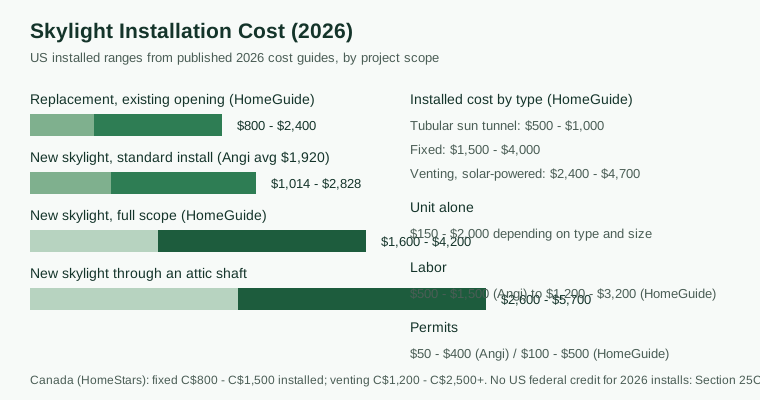
Installing a skylight costs $1,014 to $2,828 in the US in 2026, averaging $1,920 per skylight (Angi, updated September 2026, 1,577 verified projects). HomeGuide prices a new skylight wider at $1,600 to $4,200, a likeforlike replacement at $800 to $2,400, and a new skylight that needs a framed shaft through the attic at $2,600 to $5,700. This guide prices fixed, venting, and tubular units, the size ladder, labor from both sources, the addon stack (flashing, framing, drywall, permits), repairvsreplace math, Canada pricing, and the 2026 credit picture: the federal Section 25C credit that covered skylights through 2025 ended on December 31, 2025, so a 2026 installation gets no federal credit.
Quick Checks
- 1Budget $1,920 as the US average for one professionally installed skylight in 2026 (Angi, 1,577 verified projects). Most standard jobs land between $1,014 and $2,828; a new opening with an attic shaft runs $2,600 to $5,700 in HomeGuide's data.
- 2Replacement and new installation are different projects at different prices. Swapping a unit into a sound existing opening costs $800 to $2,400 (HomeGuide) and takes 3 to 5 hours. Cutting a new opening takes 1 to 3 days and adds framing, flashing, and interior finishing.
- 3The tubular sun tunnel is the budget daylighting option: $500 to $1,000 installed (HomeGuide) against $1,500 to $4,000 for a fixed skylight. For a windowless bathroom or hallway, the tube delivers the light at a third of the price.
- 4Flashing is the job. Most skylight leaks trace to installation and flashing failures, not the unit. The quote should name the manufacturer's flashing kit for your roof type as a separate line, not bury it in a lump sum.
- 5Do not let a quote subtract a federal tax credit. The Section 25C credit that covered windows and skylights (capped at $600) ended for property placed in service after December 31, 2025. A 2026 skylight gets no federal credit; older cost guides still showing a 26 to 30 percent credit are out of date.
Skylight Installation Cost 2026: What Installation Really Costs
By EnergyBS Editorial Team | October 13, 2026
The Short Answer
Short Answer: A professionally installed skylight costs $1,014 to $2,828 in the US in 2026, averaging about $1,920 per skylight (Angi, updated September 8, 2026, based on 1,577 verified projects). HomeGuide prices the same project wider: $1,600 to $4,200 for a new skylight, with a national average of $2,900. The two sources are measuring slightly different jobs. Angi's band centers on standard installations; HomeGuide's range reaches up into custom sizes, attic shafts, and harder roofs. Both agree on the shape of the market: a tubular sun tunnel installs for $500 to $1,000, a fixed skylight for $1,500 to $4,000, and a motorized venting unit can push past $4,700 before interior finishing.
The single biggest pricing question is whether a hole already exists. Replacing a skylight in a sound opening costs $800 to $2,400 (HomeGuide) and takes 3 to 5 hours. Cutting a new opening takes 1 to 3 days, because the project is now roofing, framing, flashing, and drywall at the same time. This guide prices both scopes, then the type and size ladders, the labor split, the add-on stack, repair-vs-replace math, Canada pricing, and the 2026 credit picture, which changed this year: the federal credit that used to cover skylights is gone for 2026 installations.
1. New Installation vs Replacement: Two Different Projects
Quotes confuse people because installers use the word "skylight" for two scopes with a 2x price gap between them.
Replacement. The old unit comes out of its existing opening and a same-size unit goes in, with new flashing. HomeGuide prices a full replacement at $800 to $2,400, depending on size, type, and access. The work takes 3 to 5 hours when the opening and curb are sound. If the surrounding roof or the shaft framing has water damage, the job stops being a swap and the price moves toward new-install territory. That discovery usually happens after the old unit is off, which is why replacement quotes should carry a written allowance for deck or framing repair.
New installation. No opening exists. The crew cuts the roof deck between rafters (or reframes around a truss), sets the unit, flashes it into the roofing, and finishes the ceiling side: a shaft or light well through the attic if there is one, drywall, and paint. HomeGuide's $1,600 to $4,200 band and $2,900 average live here, and Angi's per-square-foot figure of $150 to $300 is a useful cross-check on any quote that seems light. A new install takes 1 to 3 days.
If you are collecting quotes, force every bidder onto the same scope in writing: replacement in the existing opening, or new opening, and if new, whether the shaft and interior finish are included. A $1,400 replacement quote and a $3,800 new-opening quote are not comparable bids; they are different projects that happen to end with glass in the roof.
2. Cost by Type: Fixed, Venting, and Tubular
HomeGuide's 2026 table separates the unit price from the installed price, which is the right way to read a quote:
| Skylight type | Unit price (HomeGuide 2026) | Installed cost (HomeGuide 2026) | Installed cost (Angi 2026) |
|---|---|---|---|
| Tubular sun tunnel | $150 to $500 | $500 to $1,000 | $900 to $2,100 |
| Fixed | $150 to $800 | $1,500 to $4,000 | $1,200 to $2,400 |
| Venting, manual | $300 to $1,200 | $1,600 to $3,900 | part of vented band below |
| Venting, electric | $1,100 to $1,600 | $2,500 to $4,600 | part of vented band below |
| Venting, solar-powered | $1,100 to $2,000 | $2,400 to $4,700 | vented overall $1,500 to $3,500 |
| Custom size or shape | varies | varies | $2,500 to $5,500+ |
Fixed units do not open. They are the cheapest full-size option and, having no moving seals or operators, the least leak-prone design. Buy fixed when the room needs light and already has ventilation from a window or a fan.
Venting units open. A venting skylight at the top of a stairwell or over a kitchen does real work: hot air collects at the ceiling, and an opening there lets it out instead of pushing it into the air conditioner's load. Manual units open with a crank or a rod, which suits skylights you can reach. Electric and solar-powered units add a motor, remote, and usually a rain sensor; solar models avoid new wiring because a small panel and battery run the operator. The price steps in the table are mostly the operator and its controls, not the glass.
Tubular units (sun tunnels) are a reflective tube, 10 to 22 inches in diameter per HomeGuide, running from a small roof dome down to a ceiling diffuser. They fit between rafters without reframing, which is why the installed price is a fraction of a full skylight's. They suit windowless bathrooms, hallways, closets, and laundry rooms: spaces that need daylight, not a view or ventilation.
Brand is a smaller lever than type. HomeGuide lists unit prices of $150 to $2,000 for Velux, the largest supplier, and $220 to $3,500 for Fakro, with tubular specialists such as Solatube at $140 to $500 for the unit. Paying for a major brand buys the matched flashing kit and the warranty network; the glass itself is comparable across the top brands at the same spec.
3. The Size Ladder
Angi's 2026 size table prices installed cost by the unit's largest dimension:
| Size | Typical use | Installed cost (Angi 2026) |
|---|---|---|
| 10 to 14 in | Tubular or compact fixed; hallways, closets | $900 to $1,600 |
| 22 to 46 in | Standard fixed or vented; bedrooms, kitchens | $1,500 to $2,700 |
| 48 to 72 in | Custom or oversized; living rooms, great rooms | $2,500 to $5,000+ |
HomeGuide's unit-only prices for standard fixed and venting sizes run from $200 to $1,200 for a 21 x 38 in unit up to $500 to $1,600 for a 46 x 46 in unit. Two sizing rules matter more than the price steps:
First, standard sizes are priced off the shelf; custom sizes are made to order and carry the premium in Angi's custom band. If your opening or your design calls for a non-standard dimension, get the custom premium as its own quote line so you can decide whether the design is worth it.
Second, width is constrained by structure. On a truss roof, the unit has to fit between trusses or the trusses have to be modified, and modifying a truss is an engineered change, not a carpenter's judgment call. Angi prices a structural engineer at $300 to $800 when framing changes are needed. A quote that proposes cutting a truss without an engineer's detail is a quote to discard.
4. Labor and the Add-On Stack
The two sources split labor differently, and the gap is instructive. Angi puts installation labor at $500 to $1,500, with a carpenter adding $300 to $800 if the opening needs framing changes. HomeGuide puts labor at $1,200 to $3,200, describing a scope that includes cutting the opening, mounting, framing, flashing, and ceiling finishing. Read together: the core roof work is the Angi figure; the full project labor, including the interior side, is the HomeGuide figure. When a quote lands well under $500 of labor for a new opening, the interior finish or the flashing is probably missing from the scope.
The add-on lines that appear on real quotes:
- Flashing kit: matched to the skylight model and the roof covering. Tile and metal roofs need more labor and different flashing than asphalt shingles (Angi). This line should never be a generic allowance; it is a specific kit.
- Demolition and prep: $200 to $700 for removing roofing and ceiling material, cutting the opening, and disposal (Angi). Replacement jobs with a sound opening sit at the low end or skip this line.
- Electrical: $50 to $120 per hour for an electrician (Angi); HomeGuide prices connecting an electrically vented unit at $100 to $350. Solar-powered venting units skip this line entirely.
- Drywall and paint: drywall ceiling repair runs $300 to $1,500+ (HomeGuide); painters and drywall finishers run $200 to $600 (Angi). Vaulted ceilings that follow the roofline skip most of this; flat ceilings under an attic do not.
- Permits and inspections: $50 to $400 for permits (Angi) or $100 to $500 including inspection (HomeGuide), plus $100 to $250 where separate inspections are billed (Angi). Cutting a new roof opening is structural work in most jurisdictions; the contractor should pull the permit.
- Blinds and shading: $100 to $500 per window for materials (HomeGuide), manual at the low end and motorized at the high end. On a south or west slope, budget this from the start rather than after the first overheated summer.
- Glass upgrades: laminated, impact, or triple-pane upgrades add $100 to $250 per window (HomeGuide). Section 6 covers when this earns its price.
5. The Attic Shaft and the Roof You Have
Two house variables move a new installation more than the unit choice does.
The shaft. If the ceiling is flat and there is an attic between the ceiling and the roof, the daylight has to travel: the installer frames a shaft (also called a chase or light well) from the roof opening down to the ceiling, then drywalls and paints it. HomeGuide prices a skylight installed through an attic at $2,600 to $5,700, against $1,600 to $4,200 for a pitched-roof install overall. A cathedral or vaulted ceiling that follows the roofline has no shaft to build, which is why two neighbors can pay prices $1,500 apart for the same unit. Splaying the shaft walls (wider at the ceiling than at the roof) spreads the light and is worth asking for while the framing is open; it costs carpentry time, not materials.
The roof. HomeGuide prices flat-roof skylights at $2,100 to $4,800 installed, above the pitched-roof band, because a flat roof needs a curb, domed glass to shed water, and more sealing work to keep water from pooling at the penetration. Steep pitches raise labor through access and safety. Tile and metal coverings raise it through cutting and flashing complexity (Angi). If a reroof is anywhere in your next few years, read section 8 before scheduling a skylight on its own.
6. What a Skylight Does to Your Energy Bills
A skylight is a hole in the best-insulated part of the house, filled with glass. Its energy case has two sides, and both are real.
The credit side is daylight. The U.S. Department of Energy's daylighting guidance is plain about the mechanism: planned use of windows and skylights cuts the need for electric lighting, and placement decides whether it also helps or hurts heating and cooling. North-facing glass brings in light with minimal glare and summer heat; east and west glass brings excess heat and glare (DOE). A skylight faces up, not north, so it collects more sun than a vertical window of the same size, in summer as well as winter. That is the case for the blind in section 4 and for a low solar heat gain coefficient (SHGC) on hot-climate and west-slope installs.
Put numbers on it with a labeled hypothetical. Hypothetical example: a windowless hallway bathroom where the lights would otherwise run 6 hours a day on 30 watts of LED lighting. That is 0.18 kWh a day, about 66 kWh a year, worth roughly $13 a year at a hypothetical $0.20 per kWh. A $750 tubular skylight (inside HomeGuide's $500 to $1,000 installed band) does not pay for itself out of that math in any reasonable horizon. Daylighting is a comfort and usability purchase. Anyone selling you a skylight on lighting payback alone is working from a spreadsheet that assumes the lights were on all day.
The debit side is heat transfer. DOE notes that windows are about 10 percent of a typical home's surface area yet roughly 35 to 45 percent of winter heat loss passes through them. A skylight sits in the roof, where the warmest air in the room pools against it all winter. This is where the spec sheet matters: look for the NFRC rating label and compare U-factor (lower loses less heat) and SHGC (lower admits less solar heat) for your climate zone, and prefer units meeting the current ENERGY STAR Version 7.0 specification for windows, doors, and skylights, which DOE analysis supports. Replacing a 20-year-old single-pane or acrylic-dome unit with a modern low-E double-pane unit is the one skylight project with a genuine energy argument, because the old unit's losses are large and the opening already exists.
Venting is the middle case. A venting skylight that purges hot air on summer evenings can cut some air-conditioning runtime in a two-story house with a hot upstairs. The size of that effect depends on the house and the habit of actually opening it, so treat it as a comfort feature with an energy side benefit, not a modeled saving.
Our position: buy a skylight for light and, where it fits, for venting. Spend the energy money inside the project on the glazing spec and the blind, not on the expectation of a payback.
7. Repair or Replace an Existing Skylight
Angi's rule is simple: when a repair quote passes 50 percent of the cost of a new installation, replace instead. The repair bands (Angi: $250 to $800 for common repairs) against the replacement band ($800 to $2,400, HomeGuide) make the rule usable. A reseal or flashing repair at $300 on a 10-year-old unit is a repair. A $700 glass-and-seal job on a 20-year-old unit is money into a unit at the end of its life: Angi puts skylight lifespan at 15 to 25 years, HomeGuide at 15 to 40 years with most warranties running 10 to 20 years.
Component pricing from HomeGuide's repair guide: glass replacement $150 to $600 in its summary table ($300 to $650 in the body text), dome replacement $350 to $900, motor replacement $350 to $700, and blinds replacement $100 to $500 for materials. Leak diagnosis comes first, because the leak is often not the skylight: failed flashing, cracked shingles above the unit, and condensation from indoor humidity all present as a dripping skylight. Condensation in particular is a house problem (warm moist air reaching cold glass) that a new unit alone will not fix; venting the bathroom properly will.
Replace outright when the unit is past 15 years with cracked or yellowed glazing, when seals have failed and condensation sits between the panes, or when you are reroofing anyway (section 8). Repair when the unit is young, the glazing is clear, and the failure is a named, priced component.
8. Time It With the Roof
A skylight's flashing is woven into the roof covering. Replacing a roof around an old skylight means the roofer flashes new shingles to a unit that may only have a few years left, and replacing that unit later means disturbing the new roof around it. The standard sequence, and the one in our roof replacement cost guide, is to replace skylights during the reroof if they are anywhere near end of life, and to decide the question before the roofing quote is signed, not on the day. The same logic applies if solar is in the plan: our replace-the-roof-before-solar guide covers the sequencing for panels, and a new skylight belongs in the same conversation, since both projects open the roof.
Bundling also changes the skylight price itself: the crew, the access, and the flashing work are already on site, and Angi lists bundling with other roofing work among its cost-reduction routes, alongside choosing standard sizes and fixed units where venting is not needed.
9. Canada Pricing
HomeStars' 2026 Canadian window cost guide prices a fixed skylight at C$800 to C$1,500 installed and venting skylights at C$1,200 to C$2,500 or more, noting that flat or low-pitched roofs complicate waterproofing and push costs toward the higher end. Those bands sit below the US new-installation figures above, and the likely reason is scope: the Canadian guide's numbers read as replacement-weighted, with light-shaft construction and interior finishing priced by the job rather than inside the band. Two Canada-specific points hold regardless of scope. Snow load and freeze-thaw cycling punish weak flashing details harder than in most US markets, so the flashing kit and the installer's local track record matter more, not less, at the lower price. And a venting unit over a Canadian bathroom earns its keep in winter by exhausting moist air at the ceiling, provided it actually gets opened.
As in the US, verify any rebate claim against the program's own current rules for your province before counting it; program amounts and eligibility change, and a contractor's brochure is not a program document.
10. The 2026 Credit Picture: The Federal Credit Is Gone
Older skylight cost guides, including one of the sources cited here, still carry a line claiming energy-efficient or solar-powered skylights qualify for a 26 to 30 percent federal tax credit. That was true of earlier years. It is not true for a 2026 installation.
Through 2025, the Section 25C Energy Efficient Home Improvement Credit covered qualifying windows and skylights at 30 percent of cost, capped at $600 for the windows-and-skylights category. Section 25C terminated for property placed in service after December 31, 2025, and the Section 25D Residential Clean Energy Credit, the one behind the 30 percent solar claims, ended for expenditures after the same date. A skylight installed in 2026, fixed, venting, or solar-powered, gets no federal tax credit. If a quote shows a credit line, ask the contractor to name the program and show you its current published terms; for a federal claim, there are none to show.
What can still exist is state, provincial, and utility money, which varies by address and changes often. Price the project as if the incentive were zero, then treat anything you verify from the program itself as a discount you found, not one the quote assumed.
11. The 12-Point Quote Checklist
Compare quotes line by line. A complete skylight quote names:
- Scope: replacement in the existing opening or new opening, stated in words, with the unit's exact model, size, and glazing spec (U-factor and SHGC from the NFRC label).
- Mounting: deck-mounted or curb-mounted, and who builds or repairs the curb.
- Flashing: the manufacturer's kit matched to your roof covering, as its own line.
- Framing: rafter or truss work included, and the engineer's detail if any truss is modified.
- Shaft: for attic installs, shaft framing, drywall, and paint included or excluded, in writing.
- Roofing tie-in: shingles or covering around the unit replaced to match, and underlayment and ice-and-water shield at the penetration.
- Electrical: wiring for electric venting units included, or the solar-powered alternative priced beside it.
- Shading: blind or shade priced, manual or motorized, especially on south and west slopes.
- Permits and inspection: who pulls the permit, and final inspection before final payment.
- Deck and framing repair allowance: the rate or cap that applies if water damage is found under the old unit.
- Warranty split: the manufacturer's unit warranty (term and what it covers, including glass breakage and leaks) and the installer's workmanship warranty, stated separately.
- Cleanup and disposal: old unit and roofing debris removed, included or excluded.
A quote missing lines 1, 3, 5, and 9 is not a cheaper version of a complete quote. It is a smaller project wearing the same name.
Frequently Asked Questions (FAQ)
How much does it cost to install a skylight in 2026?
Angi's 2026 data (updated September 8, 2026) puts professional installation at $1,014 to $2,828, averaging $1,920 per skylight across 1,577 verified projects. HomeGuide prices a new skylight at $1,600 to $4,200 with a $2,900 average, a range that reaches further into custom sizes and attic-shaft work. By type, tubular units install for $500 to $1,000, fixed units for $1,500 to $4,000, and solar-powered venting units for $2,400 to $4,700 (HomeGuide).
How much does it cost to replace an existing skylight?
A full replacement in a sound existing opening costs $800 to $2,400 (HomeGuide) and takes 3 to 5 hours. The price assumes the opening, curb, and surrounding roof are reusable. Rot in the deck or shaft framing found during removal moves the job toward new-installation pricing, which is why a written repair allowance belongs in the quote.
Are tubular skylights worth it compared with a full skylight?
For pure daylight in a small windowless room, yes: $500 to $1,000 installed (HomeGuide) against $1,500 to $4,000 for a fixed skylight, with no reframing because the 10 to 22 inch tube fits between rafters. What you give up is the view, the ventilation, and the light output on overcast days. For a bathroom, hallway, or closet, there is usually nothing to give up.
Do skylights always leak?
No. HomeGuide's position is that a professionally installed skylight with the manufacturer-recommended flashing does not leak, and the common causes are improper installation, neglected maintenance, aging materials, and poor roof drainage. Leaks blamed on skylights also turn out to be flashing failures, damaged shingles above the unit, or indoor condensation. Diagnose the source before replacing the unit.
How long do skylights last?
Angi puts lifespan at 15 to 25 years; HomeGuide at 15 to 40 years depending on type, brand, climate, and installation quality, with most warranties at 10 to 20 years and acrylic or polycarbonate domes carrying much shorter warranties of 1 to 5 years. Past 15 years, weigh every repair against replacement using the 50 percent rule in section 7.
Will a skylight lower my energy bills?
It can lower lighting use in a room that would otherwise run electric lights all day, and a venting unit can purge hot air in summer. It also adds heat loss in winter and heat gain in summer through glass set in the roof. The worked example in section 6 shows the lighting saving on a typical hallway bathroom is on the order of $13 a year. Buy the skylight for light and comfort, choose a low U-factor and an appropriate SHGC, and add a blind on sunny slopes.
Is there a tax credit for skylights in 2026?
No federal one. The Section 25C credit that covered qualifying windows and skylights (30 percent, capped at $600 for the category) ended for property placed in service after December 31, 2025, and Section 25D ended for expenditures after the same date. Some older cost guides still show a 26 to 30 percent credit; that math expired with 2025. State, provincial, and utility programs may still apply locally.
What should I read next before deciding?
Price the surrounding envelope work in the same pass: our window replacement cost guide for the vertical glass, the triple pane window cost breakdown for the glazing-spec logic that also applies to skylights, the entry door replacement cost guide for the other big envelope opening, and the roof replacement cost guide if the roof itself is due, because the two projects should be sequenced together.
Prices in this guide are planning ranges from the published 2026 sources cited above, not quotes for your house. Scope (replacement vs new opening), shaft construction, roof covering and pitch, unit type and size, permits, and local labor decide the final figure. Fit the unit between the structure or engineer the change, insist on the matched flashing kit, spec the glazing from its NFRC label, and make sure the cheapest quote is also a complete one.
What to Read Next
Window Replacement Cost 2026: What Installation Really CostsUse this next to compare the cost, incentive, installation, or operating-risk angle before you make a home energy decision.Sources and Verification
- Angi How Much Does Skylight Installation Cost? [2026 Data], updated September 8, 2026 (installation $1,014 to $2,828, national average $1,920, based on 1,577 verified projects; $150 to $300 per square foot; by type fixed $1,200 to $2,400, vented $1,500 to $3,500, tubular $900 to $2,100, custom $2,500 to $5,500+; by size 1014 in $900 to $1,600, 2246 in $1,500 to $2,700, 4872 in $2,500 to $5,000+; labor $500 to $1,500; carpenter $300 to $800; electrician $50 to $120 per hour; structural engineer $300 to $800; demolition and prep $200 to $700; permits $50 to $400, inspections $100 to $250; repairs $250 to $800; skylight lifespan 15 to 25 years; replace when repair exceeds 50 percent of new installation cost)
- HomeGuide How Much Does a Skylight Cost to Install? (2026) (new skylight $1,600 to $4,200, national average $2,900, minimum $500, maximum $5,700; unit $150 to $2,000; fixed installed $1,500 to $4,000, ventilating $1,600 to $4,700 with manual $1,600 to $3,900, electric $2,500 to $4,600, solar $2,400 to $4,700; tubular installed $500 to $1,000, unit $150 to $500; labor $1,200 to $3,200; attic shaft installation $2,600 to $5,700; flat roof $2,100 to $4,800 vs pitched roof $1,600 to $4,200; permits $100 to $500; blinds $100 to $500 materials; glass upgrades $100 to $250; new install takes 1 to 3 days)
- HomeGuide How Much Does It Cost to Repair or Replace a Skylight? (2026) (full replacement $800 to $2,400; glass replacement $150 to $600 in the summary table and $300 to $650 in the body; dome replacement $350 to $900; motor replacement $350 to $700; blinds replacement $100 to $500 materials; replacement takes 3 to 5 hours; skylights last 15 to 40 years, most warranties 10 to 20 years)
- HomeStars Window Installation Costs in Canada in 2026 (fixed skylight C$800 to C$1,500 installed; venting skylights C$1,200 to C$2,500 or more; flat or lowpitched roofs complicate waterproofing and push costs toward the higher end)
- U.S. DOE Energy 101: Daylighting (daylighting uses windows and skylights for natural lighting and temperature regulation, reducing lighting, heating, and cooling costs when placement is planned; northfacing glass gives light with minimal glare and summer heat, east and west glass brings excess heat and glare)
- U.S. DOE EPA's New ENERGY STAR Specifications for Windows, Doors, and Skylights (Version 7.0 performance specifications for residential windows, doors, and skylights, built on DOE and Lawrence Berkeley National Laboratory analysis; windows account for roughly 10 percent of a home's surface area but about 35 to 45 percent of winter heat loss passes through them)
Editorial Review
EnergyBS Editorial Team
EnergyBS publishes practical homeowner guides. Important program, product, and cost claims should be checked against the linked source and local project documents before you commit to work.
Related Guides
View All ArticlesWindow Replacement Cost 2026: What Installation Really Costs
Replacing house windows in 2026 averages $517$800 per installed window in the US (C$600C$2,000 in Canada). This guide breaks down frame materials, insert vs. fullframe pricing, glass packages, overlooked costs, and a payback check with stated assumptions.
Roof Replacement Cost 2026: What Installation Really Costs
Replacing a roof in 2026 costs $9,609 on average in the US (Angi 2026 data), with asphalt shingles at $3 to $5 per square foot installed and standingseam metal at $9 to $16. This guide prices every common material by the square, separates tearoff and decking lines from the headline number, works through the asphaltvsmetal lifetime math, and covers the energy side: coolroof reflectance, attic ventilation, and Canada pricing.
Entry Door Replacement Cost 2026: What It Really Costs
Replacing a single entry door in 2026 typically costs $500 to $2,500 installed in the US, with most projects landing near $1,218. This guide prices doors by material, separates slab work from a full prehung system, explains where frame damage changes the job, and works through the energy side: Ufactor, glass share, and the point where weatherstripping beats replacement.